


What Is LAN and WAN Network Explained for UK Businesses
- Craig Marston
- Oct 19, 2025
- 15 min read

Updated: Nov 5, 2025
Let's get one thing straight from the start: a Local Area Network (LAN) connects devices within a single, contained space like your office, while a Wide Area Network (WAN) links separate LANs across different geographical locations.
Think of it this way. Your LAN is like the internal phone system within one building, letting everyone talk to each other instantly. The WAN is the national telephone network that connects your London office to your Manchester office.
A Quick Look at LAN and WAN Networks
To really get your head around what a LAN and WAN network is, just picture your day-to-day business operations. Every single device in your main office—from computers and printers to servers—is communicating over a LAN. This private, high-speed network is the engine of daily productivity, allowing teams to share files and resources without a second thought. It's the digital equivalent of everyone being in the same room.
A WAN, on the other hand, steps in when your business grows beyond a single location. It’s the connective tissue that links your company’s various LANs together, creating one unified network across towns, cities, or even countries. This is what lets your Edinburgh branch access the central server in your London headquarters as if it were sitting right next to them.
LAN vs WAN Quick Comparison
To make the differences even clearer, here's a simple table breaking down the core characteristics of each network type. It's a handy reference for understanding where each one shines.
Characteristic | Local Area Network (LAN) | Wide Area Network (WAN) |
|---|---|---|
Geographical Scope | Confined to a single building or campus. | Spans across cities, countries, or continents. |
Speed | Extremely high speeds, often 1 Gbps or more. | Slower than a LAN, speed varies by connection. |
Ownership | Privately owned and managed by the business. | Typically leased from third-party telecoms providers. |
Cost | Lower initial setup and minimal ongoing costs. | Higher setup costs and recurring monthly fees. |
Primary Use | Sharing local resources like files and printers. | Connecting multiple remote office locations. |
As you can see, they are built for entirely different jobs but often work together to create a complete business network.
The Core Differences Visualised
The idea of Local Area Networks and Wide Area Networks has come a long way, especially here in the UK. LANs are the workhorses inside our offices, delivering blazing-fast local data transfer for seamless file sharing and application access.
This infographic breaks down the main distinctions at a glance.
As the visual shows, a LAN is all about high speed and low cost within a single site. A WAN sacrifices some of that raw speed to gain the incredible ability to connect multiple locations, which naturally comes with a bigger investment in infrastructure.
Key Characteristics of LANs and WANs
The real separation between these two network types boils down to ownership and scale. A business almost always owns and manages its own LAN hardware, giving it total control over security and performance. This self-contained setup is precisely why LANs are so fast and reliable.
A common mistake is seeing LAN and WAN as competing technologies. They’re not. They are two sides of the same coin. A powerful WAN is useless without well-designed LANs at each end, and isolated LANs can't support a multi-site business without a WAN to connect them.
A WAN, conversely, relies on infrastructure you don't own—think fibre optic lines leased from telecommunications providers that run under public streets. This reliance on third-party carriers is what makes global connectivity possible, but it also brings in things like monthly costs and a dependency on external service levels.
Ultimately, understanding your complete network infrastructure is the first step toward building a system that actually helps your business grow. These distinct models are designed for different, yet deeply interconnected, needs.
How a Local Area Network Powers Your Office
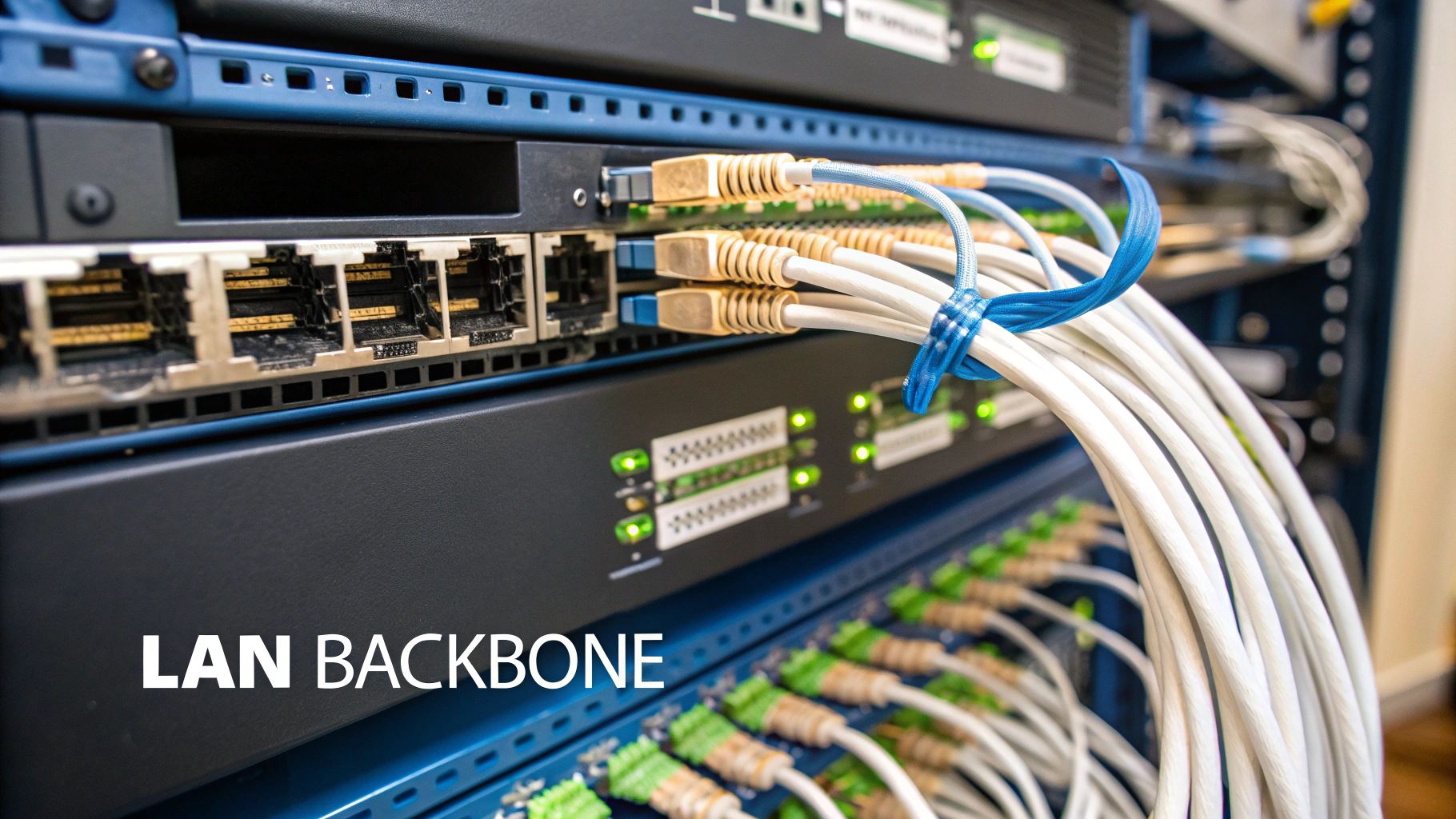
Think of your office as a single, self-contained building. A Local Area Network (LAN) is like the internal nervous system of that building, connecting everything and everyone inside it. It’s the physical, tangible network that allows all your devices—computers, printers, servers—to talk to each other at lightning speed.
This isn't just an abstract concept; it's built from real hardware. Switches act like the building's switchboard operator, directing data traffic to the right desk. Routers are the gatekeepers, deciding what information stays within the office and what needs to go out to the wider world. The whole system is connected by a web of high-speed cabling, the private motorways that data packets race along.
Without this infrastructure, work would grind to a halt. The LAN is what lets your team access shared files, send a document to the office printer, and join a video call without that dreaded lag. It’s the very foundation of modern productivity.
Common LAN Setups for Different Workflows
Just as offices have different floor plans, LANs can be structured in various ways to suit specific needs. These structures, known as topologies, dictate how devices are connected and how data moves between them. For most businesses, it comes down to two main designs: Star and Mesh.
Star Topology: This is the classic setup. Every device, be it a PC or a printer, connects directly to a central hub or switch. Picture a bicycle wheel, where the switch is the hub and each device is a spoke. It's popular because it's simple and reliable—if one cable fails, only that one device goes offline, not the entire network.
Mesh Topology: A mesh network takes reliability to the next level by creating multiple paths for data. Devices can connect to several other devices, forming a resilient, self-healing web. If one connection drops, data simply finds another route. This is brilliant for ensuring solid wireless coverage across large or awkwardly shaped office spaces.
Picking the right topology is a crucial part of network design. A small, single-floor office will do just fine with a simple Star setup. A large, multi-level headquarters, however, would really benefit from the non-stop connectivity a Mesh configuration provides.
Why a High-Performance LAN is Non-Negotiable
In today's business world, a slow or flaky LAN isn't a minor annoyance—it's a direct bottleneck to getting things done. Modern applications, from cloud software to HD video conferencing, are incredibly data-hungry. A poorly built network just can't keep up, leading to dropped calls, glacial file transfers, and hours of wasted staff time.
A fast, professionally installed LAN is an investment in your team's efficiency. When the network runs smoothly, so does your business. It removes technical friction and allows your employees to focus on what they do best.
This is where the quality of the physical hardware and installation truly matters. For example, a professional fibre cable installation can provide the raw speed and bandwidth needed to handle heavy data loads without breaking a sweat. Working with an Excel network accredited partner guarantees that every component is installed to the highest possible standard, resulting in certified, tested network delivery. This often includes a 25 year equipment warranty, giving you complete peace of mind.
Ultimately, understanding what a LAN and WAN network is starts with respecting the LAN's role as the bedrock. Before you can connect effectively to the outside world, your internal network needs to be a fortress of speed and reliability. If you're planning an upgrade or a new build-out, learning about the importance of data network installation will give you the essential insights needed to create a network that drives your business forward.
Connecting Your Business with a Wide Area Network
If your Local Area Network (LAN) is the private, internal nervous system of a single office, then the Wide Area Network (WAN) is the national motorway system that connects all your separate offices. It’s what allows your London headquarters to collaborate seamlessly with branches in Manchester and Edinburgh, creating one unified business network across vast geographical distances.
A WAN is fundamentally different from a LAN because it operates over an infrastructure you don't own. It relies on circuits leased from third-party telecommunications providers to create private, secure links between your different locations. This digital motorway is essential for any multi-site business that needs to share data, access centralised applications, or maintain constant communication between teams.

Key Technologies That Power a Modern WAN
To really get what a LAN and WAN network is, you need to look at the technologies that make long-distance connectivity possible. While the internet is the ultimate public WAN, businesses rely on more secure and reliable private WAN technologies to keep their sensitive data safe.
Here are some of the core technologies you'll come across:
MPLS (Multiprotocol Label Switching): Think of MPLS as a private, priority lane on the data motorway. It’s a highly reliable and secure way to connect multiple sites and is known for providing consistent performance for critical applications like voice and video calls. It directs traffic using a clever labelling system, making sure data packets take the most efficient route.
VPLS (Virtual Private LAN Service): VPLS takes things a step further. It makes multiple, geographically separate LANs appear as if they are all part of the same single, local network. This is incredibly useful for organisations that need seamless Layer 2 connectivity between sites, as it really simplifies network management.
SD-WAN (Software-Defined WAN): This is the modern, flexible evolution. SD-WAN uses software to intelligently manage network traffic, often over several types of connections at once (like MPLS, broadband, and 4G/5G). This approach gives you greater agility, can reduce costs, and improves performance by automatically routing traffic based on real-time conditions.
The growth of these technologies in the UK is tied directly to the business need for secure and efficient multi-site data communication. In fact, statistics from UK business broadband reports show that around 70% of medium to large enterprises operate multi-site WANs that depend on technologies like MPLS and VPLS to maintain low-latency, secure links. You can learn more about the strategic importance of WAN for UK businesses at fluidone.com.
Private WAN vs The Public Internet
It’s crucial to understand the difference between a private WAN and the internet. While both are types of Wide Area Networks, their purpose and security posture are worlds apart. The internet is a public network, accessible to everyone, which makes it inherently less secure for sensitive corporate data.
A private WAN is like having your own exclusive courier service that only handles your company's packages. The internet, by contrast, is the general postal system—it gets the job done, but your packages travel alongside everyone else's.
For this reason, businesses use private WANs for their internal, inter-office traffic and the public internet for everything else, like accessing websites or public cloud services. A professionally designed WAN architecture ensures this separation is managed securely, often using firewalls and other security measures at the network edge.
This infrastructure is the backbone for modern business operations. It’s what enables a distributed workforce to access central servers, ensures reliable access to cloud-based applications like Office 365 or Salesforce, and provides the foundation for a robust business continuity plan. If one site goes down, a well-designed WAN can reroute traffic to keep the rest of the business operational.
Comparing LAN vs WAN for Business Decisions
Choosing between a Local Area Network (LAN) and a Wide Area Network (WAN) isn't really about picking one over the other. It's about understanding their completely different jobs to make smart decisions for your business. Think of it this way: a LAN is the super-fast nervous system inside your office, while a WAN is the vital link connecting your business to the outside world. They work together, but knowing their trade-offs is key for budgeting and planning.
When you get down to what a LAN and WAN network actually is, you quickly realise it’s a story of two very different investment models. A LAN is built with equipment you own and control, all housed within your building. A WAN, on the other hand, almost always means leasing services from a third-party telecoms provider, which creates a totally different cost structure and set of performance expectations.
Geographical Scope and Speed Trade-Offs
The most obvious difference comes down to geography and speed. A LAN is confined to a single location, like an office or a campus, and this limitation is actually its greatest strength. Because the distances are so short and you own all the hardware, data flies around at incredible speeds—often 1 Gbps or even 10 Gbps over a well-designed fibre optic backbone. This is what makes massive file transfers, real-time collaboration, and HD video calls feel instant.
A WAN, by contrast, has to sacrifice some of that raw speed to achieve its main goal: connecting distant locations. While you can get gigabit speeds over dedicated leased lines, they come at a much higher price tag than a LAN. Most WAN connections run at lower speeds, which is simply the trade-off you make for spanning cities or even countries. Getting LAN-like performance across a WAN requires a serious investment in third-party infrastructure.
Cost Structures and Management Overheads
The way you pay for and manage a LAN versus a WAN are worlds apart. Building a high-performance LAN involves a one-time capital spend on hardware like switches, routers, and cabling. While it's a significant initial outlay, you get total ownership of that asset. For instance, a professional fibre cable installation is a capital cost that provides a long-term benefit.
When you work with an Excel network accredited partner, you not only get a certified, tested network delivery but often a 25-year equipment warranty. This model gives you predictable costs and rock-solid reliability for your internal network.
A WAN, however, is almost entirely an operational expense. You pay a recurring monthly or annual fee to a service provider for that connection. The cost can swing wildly depending on the speed, reliability, and distance you need to cover. Management is different too; while you look after your own LAN devices, you’re relying on the provider’s support team to troubleshoot and maintain the WAN links.
The core decision isn't just about the technology; it's about balancing your performance needs with your budget. A gigabit LAN is a standard expectation in a modern office, but a gigabit WAN is a strategic investment reserved for mission-critical connections between sites.
Detailed Feature Comparison LAN vs WAN
To give you a clear, head-to-head view, this table breaks down the key differences across several important features. Use this as a quick guide to figure out which network characteristics matter most for different parts of your business.
Feature | Local Area Network (LAN) | Wide Area Network (WAN) |
|---|---|---|
Primary Function | Connects local devices within one site. | Connects multiple LANs across different locations. |
Data Transfer Speed | Very high (typically 1-10 Gbps+). | Lower than LAN (varies hugely by service). |
Ownership | Privately owned and managed by you. | Leased from third-party carriers. |
Cost Model | Primarily a one-time capital expenditure. | Recurring operational expenditure (monthly fee). |
Geographical Reach | Limited to a single building or campus. | Spans cities, countries, or the entire globe. |
Reliability | High, as it's under your direct control. | Dependent on the service provider's uptime. |
Security Control | You have full control over all security policies. | Security is a shared responsibility with the provider. |
Ultimately, understanding these distinctions helps you put your money where it matters most. Your investment in a robust, warrantied LAN keeps day-to-day productivity high, while your spending on a WAN is a strategic choice to bring your entire business footprint together.
Building a High-Performance Business Network
Knowing the difference between a LAN and a WAN is one thing; turning that knowledge into a genuine business asset is another game entirely. Designing a network isn’t just about plugging in computers. It’s about building a digital foundation that fuels growth, supports your teams, and keeps your data safe. This blueprint covers both sides of the coin: fortifying your internal LAN for lightning-fast speeds and strategically picking the right WAN for seamless multi-site connectivity.
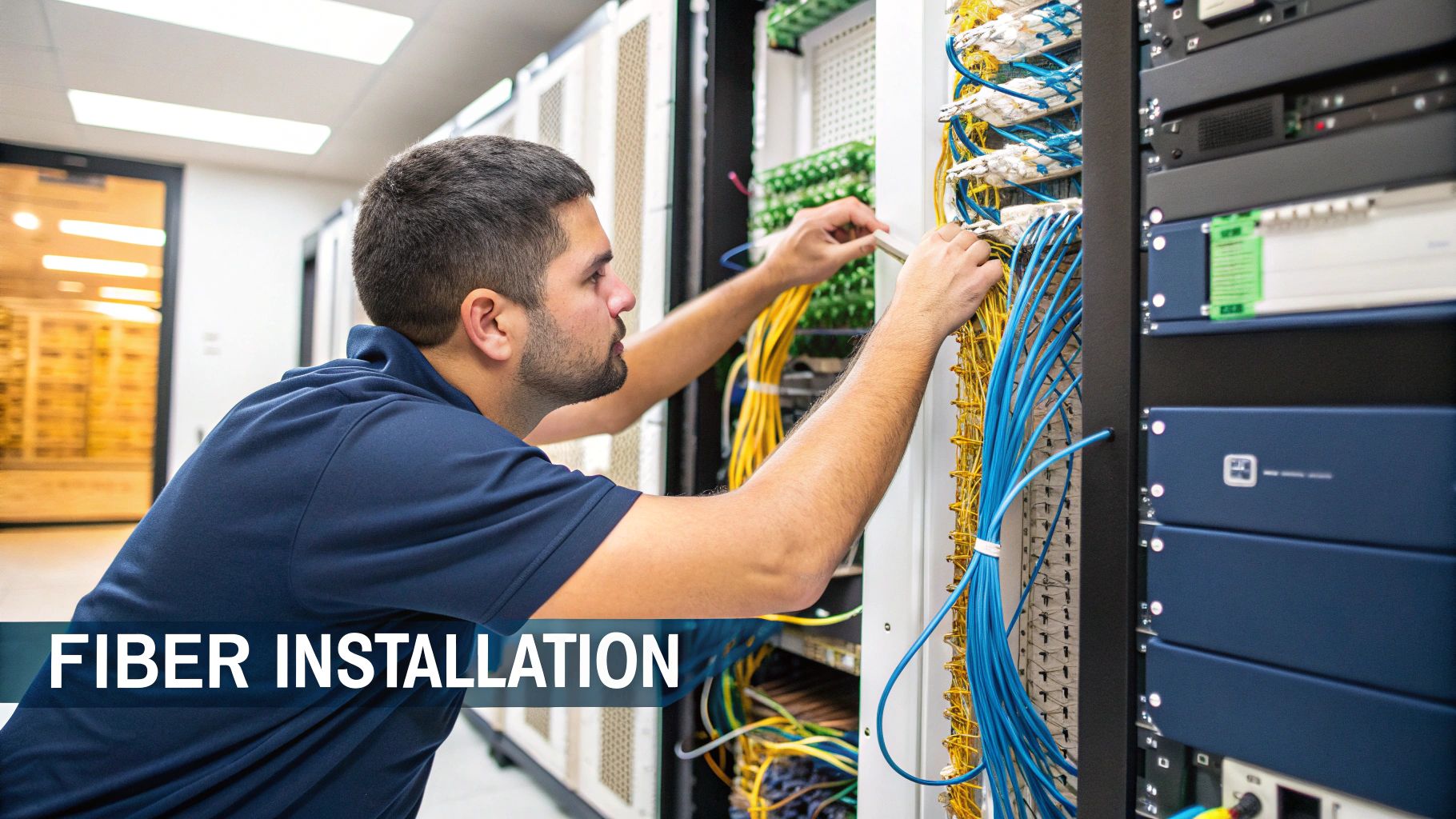
A common mistake I see is businesses treating the physical layer of a network as an afterthought. For your LAN, the quality of your structured cabling is everything. Think of it as the motorway your data travels on – if it's poorly built, you’ll have traffic jams, no matter how powerful your servers are.
Forging a Rock-Solid LAN Foundation
The backbone of any modern office LAN is increasingly built on fibre optic technology. A professional fibre cable installation gives you the immense bandwidth needed to handle today's data-hungry applications, from HD video conferencing to chunky file transfers between departments. Honestly, it's the best way to future-proof your office against ever-growing data demands.
But great components are only half the story. The expertise of the installer is just as vital, which is why partnering with an Excel network accredited partner is such a smart move. Accreditation is a mark of quality, ensuring your installation is done to exacting industry standards.
This level of professionalism results in a certified, tested network delivery. Every single cable and connection is rigorously tested to guarantee performance, taking the guesswork out of the equation and preventing those frustrating bottlenecks down the line.
The real prize of a professionally certified installation is long-term peace of mind. When your network is installed by an accredited partner using high-quality components, it’s often backed by a comprehensive 25 year equipment warranty, securing your investment for decades.
This approach elevates your LAN from a simple utility into a reliable, high-performance asset. You get a network that not only meets your needs today but is also ready to scale for whatever comes next. If you're planning a new setup, getting to grips with the various categories of computer network cables is an excellent place to start.
Choosing the Right WAN Technology for Growth
Once your internal LANs are solid, the focus shifts to connecting them all together. Selecting the right WAN technology is a strategic choice that hinges on your specific needs – the number of sites you have, your security requirements, and your plans for expansion.
Dedicated Fibre Leased Lines: For businesses needing uncompromising performance and security between two key locations, like a head office and a data centre, a dedicated fibre leased line is the gold standard. It provides a private, uncontended connection with guaranteed bandwidth.
MPLS Networks: If you have multiple offices spread across the UK, an MPLS network offers a private and highly reliable way to connect them all. It's brilliant for prioritising critical traffic, ensuring that applications like VoIP and video conferencing always get the performance they need.
SD-WAN Solutions: For the ultimate flexibility and cost-efficiency, SD-WAN is the modern choice. It intelligently routes traffic over multiple connections (including broadband and 4G/5G), optimising performance in real-time and making life much simpler for IT teams.
The scale and ambition of modern WANs can be truly immense. Take the UK's academic network, JANET, as a prime example. It supports over 20 million users across universities and colleges by interconnecting sites with multiple 10 and 100 Gbps links. It even uses dedicated 200 Gbps paths for research data, which just goes to show the incredible bandwidth required for large-scale collaboration.
Building a high-performance network is your blueprint for creating a scalable, secure, and resilient foundation. By investing in a professional LAN installation and making an informed WAN choice, you empower your business to operate efficiently today while being perfectly positioned for tomorrow's challenges.
So, Which Network is Right for Your Business?
Choosing between a LAN and a WAN isn't really a choice at all. Think of it less like an either/or decision and more like understanding two essential parts of the same machine. A fast, reliable LAN is the engine room that powers your team's day-to-day work, while a robust WAN is the motorway connecting all your sites into a single, cohesive business.
The real shift in thinking is to see your network not just as another utility bill, but as a core business asset that fuels growth. A strategic investment in a professionally designed and installed network is the only way to build a digital foundation that’s genuinely ready for the future.
Building a Foundation That Lasts
When you invest in your network, you're buying performance, reliability, and most importantly, peace of mind. Partnering with a specialist ensures your infrastructure is built to the highest standards, and that has tangible, long-term benefits.
A professional fibre cable installation gives you the raw speed and capacity to handle ever-increasing data demands without hitting a bottleneck. And when that work is done by an Excel network accredited partner, you get a certified, tested network delivery that guarantees performance right out of the gate.
The biggest benefit of a professional installation is the security it provides for the long haul. High-quality components paired with expert engineering often come with a 25-year equipment warranty. This protects your investment for decades and eliminates future headaches over performance.
This commitment to quality ensures the central nervous system of your business is strong, scalable, and ready to support your ambitions. Once you understand what a LAN and WAN can truly do for you, you can make the right choices to build an infrastructure that doesn’t just support your company—it actively drives its success.
A Few Common Questions
Once you get your head around the basics of LANs and WANs, a few more specific questions usually pop up. Let's tackle some of the most common ones to really cement your understanding.
Can a Business Get by with Just a LAN?
For sure. A small business running out of a single office is the perfect example. All they really need is a solid LAN to link up their local kit – computers, printers, maybe a server or two for sharing files internally.
Of course, they'll still need an internet connection to talk to the outside world, but they won't necessarily need their own private WAN. Those are really for businesses that need to securely connect multiple, geographically separate sites.
Is the Internet a Type of WAN?
Absolutely. In fact, the internet is the biggest WAN on the planet. It's a gigantic, public network made up of countless interconnected networks that anyone can access.
Businesses use their private WANs for secure, dedicated links between their own offices, but they rely on the internet (the public WAN) for just about everything else, like browsing websites or using cloud services.
Think of it like this: a private WAN is your own secure, exclusive motorway for company data travelling between your different office locations. The internet is the public road network—it’s vast and gets you anywhere, but you're sharing it with everyone else.
This distinction is fundamental to how we think about network design and security.
How Do Fibre Optic Cables Make Networks Better?
Fibre optic cables are a game-changer for network performance, boosting both LANs and WANs in a big way. A professional fibre cable installation is pretty much standard for any serious modern network.
On a LAN, fibre is brilliant as a high-speed backbone, maybe connecting all the network switches in a large office building or across a campus. For a WAN, fibre optics are the bedrock for linking cities together, forming the core infrastructure for services like leased lines and MPLS circuits. They offer massively better speed, reliability, and security than old-school copper wires.
What's the Real Benefit of a Certified Installation?
Getting a certified, tested network delivery from an Excel network accredited partner takes all the guesswork out of the equation. It’s your guarantee that every single component, from the cable to the connector, meets strict performance standards.
This isn't just about making sure things work; it's about preventing those frustrating slowdowns and intermittent connection problems down the line. Plus, a professional install is often backed by a 25 year equipment warranty, protecting your investment and giving you total peace of mind. Your network isn't just up and running—its performance is validated and guaranteed for the long haul.
A reliable, high-performance network is the foundation of any modern business. At Constructive-IT, we specialise in designing and delivering certified network infrastructure, from structured cabling with a 25-year warranty to complete LAN and WAN solutions that drive your business forward. Plan your network upgrade with us today.
Article created using [Outrank](https://outrank.so)
Comments