

When it comes to your building's network, the conversation often gets stuck on a simple question: Ethernet or Wi-Fi? The truth is, it’s not an either/or debate. The real difference is simple: Ethernet is your rock-solid, high-speed physical connection, while wireless offers incredible, cable-free convenience. In modern building automation, success isn’t about picking a winner; it’s about strategically using both for what they do best.
What is Unmanned Building Management?
In practice, unmanned building management means creating a facility that operates securely and efficiently without requiring day-to-day staff on site. It's about using integrated technology to handle everything from access control and security surveillance to environmental monitoring and user support remotely. This allows a single operator to manage multiple sites from a central location, reducing operational costs while improving security and responsiveness. A truly autonomous building doesn't just have automated parts; it has a fully integrated nervous system where power, access, and data work together as a single, cohesive unit.
Why Most Unmanned Building Projects Fail
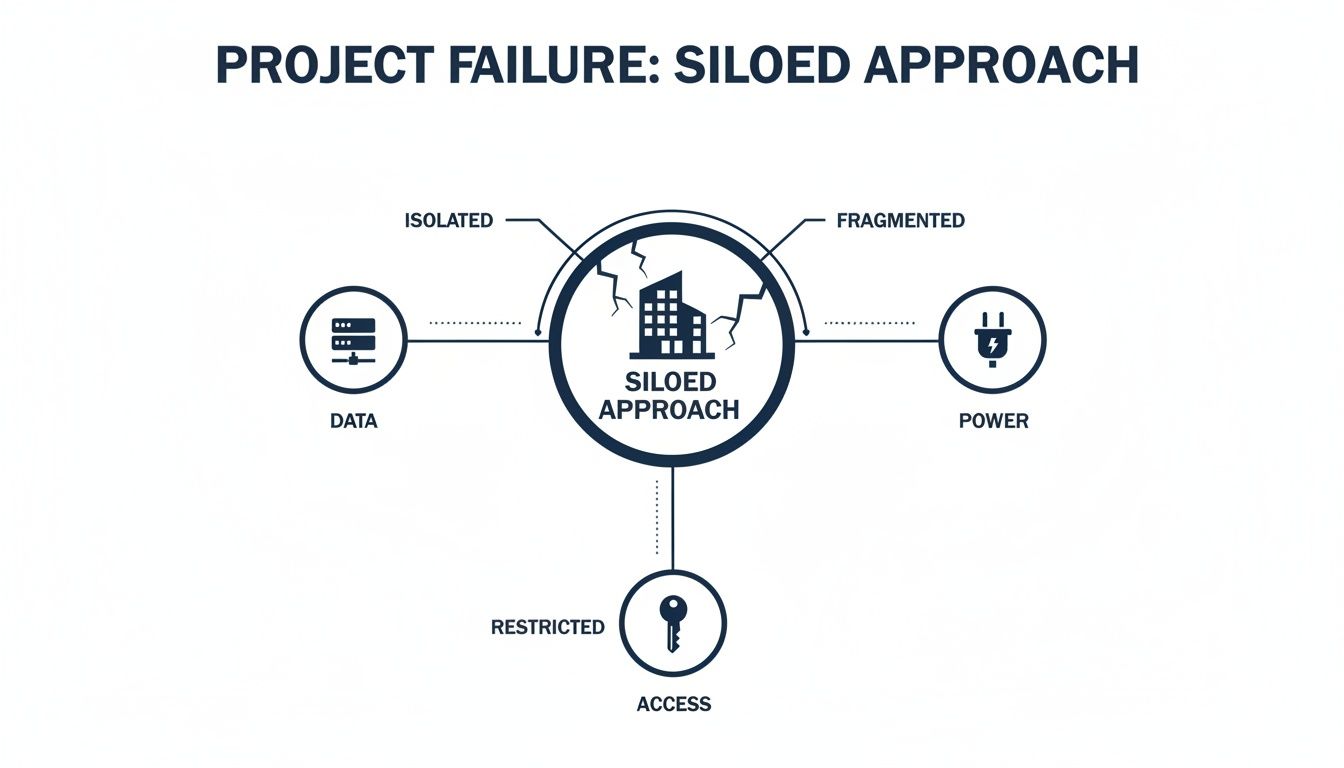
The idea of a fully autonomous building is brilliant on paper, but in reality, a surprising number of these projects end up failing. It’s rarely one big, spectacular mistake. Instead, failure is usually baked in from the very beginning, stemming from a single design flaw: treating a building’s core systems as completely separate jobs. This siloed approach, where the commercial electrical installation, data network, and security systems are planned in isolation, is the number one reason projects fall short.
Think of it this way. Imagine you tasked one team with building a skeleton, another with the circulatory system, and a third with the nervous system, all working from different plans. You wouldn't get a functional human being; you’d get a jumble of incompatible parts. That's exactly what happens when data, power, and physical access are planned in their own silos.
The Consequences of a Siloed Approach
When these three critical systems aren't designed to work together, they actively work against each other. The result is a building that’s the opposite of autonomous. It's fragile, unreliable, and a constant source of operational headaches.
We see the same failure points time and time again:
Power Outages Taking Down Security: An access control panel suddenly goes dark during a momentary power dip because it wasn't plugged into a resilient Power over Ethernet (PoE) switch with a proper battery backup.
Data Bottlenecks Crippling CCTV: High-definition security cameras are connected to a network that was never specified to handle their massive, constant data streams, leading to dropped frames and useless footage just when you need it most.
Wireless Dead Zones Compromising Access: NFC-powered locks or mobile management tools fail to connect in stairwells or store rooms because the Wi-Fi survey didn't account for the final placement of access points and the building materials used.
A truly resilient autonomous building requires a unified design where every component—from the electrical installation to the network switch and the door lock—is part of a single, cohesive strategy from day one.
Designing a Unified Infrastructure for Autonomous Buildings
The solution isn't just to do things better; it's to do them differently. You have to start thinking of your building's infrastructure as a single, integrated nervous system, where every part is planned together to work as one cohesive whole. This means creating one unified blueprint where your commercial electrical installation and certification, your structured cabling, and your access and security systems are all designed from day one to work in perfect harmony. It’s a core principle behind modern smart building technology.
Mapping Your Core Infrastructure
First things first, get out the floor plans. We need to map out every single fixed asset that is absolutely essential for the building to run on its own. These are the devices that demand a permanent, high-reliability connection, no questions asked.
This is where you plan the wired backbone using both ethernet and wireless strategically. Key devices include:
CCTV Cameras: These need stable, high-bandwidth ethernet connections for uninterrupted recording and reliable surveillance.
Access Control Readers: For main entrances and critical internal doors, you need the reliability that only a wired reader can provide.
Building Management System (BMS) Sensors: Fixed sensors for critical alerts like fire, flood, or environmental monitoring simply have to be online 24/7.
How Access, Power and Data Must Be Designed Together
Now, here's where the design gets really smart. Instead of running a separate power cable alongside the data cable to each of these devices, we use Power over Ethernet (PoE). With PoE, a single Ethernet cable delivers both high-speed data and the low-voltage electrical power needed to run the device.
This approach dramatically simplifies the entire installation. It cuts down on cabling complexity, lowers labour costs, and lets you centralise your power management. With PoE, all your critical devices are powered from a network switch, which can be backed up by a single, robust uninterruptible power supply (UPS). This means your entire security and sensor network stays online, even during a power cut.
This integrated approach is the only way to build out fully autonomous unmanned building units that are truly resilient.
Integrated System Deployment Blueprint
Device / System | Primary Network Choice | Power Strategy |
|---|---|---|
Fixed CCTV Cameras | Wired Ethernet | Power over Ethernet (PoE) |
Main Access Control Readers | Wired Ethernet | Power over Ethernet (PoE) |
Critical Building Sensors | Wired Ethernet | Power over Ethernet (PoE) |
Battery-less NFC Locks | Wireless (NFC) | Powered by user credential |
Guest Wi-Fi & Mobile Devices | Wi-Fi | Local mains / battery |
Non-Critical IoT Sensors | Wi-Fi / LoRaWAN communication protocol | Battery or local mains |
This blueprint shows how a hybrid network provides the best of both worlds: rock-solid reliability for core systems and convenient flexibility where it makes sense.
Real-World Reasons for Choosing Battery-less, NFC Proximity Locks
In automated access systems, traditional electronic locks are a notorious weak link. Why? Batteries. They die, usually at the worst possible moment, forcing someone to manually intervene and creating a security headache. It’s a maintenance nightmare that completely defeats the purpose of an unmanned building.
The answer is to use battery-less, NFC-powered proximity locks. These innovative locks have no internal battery at all. Instead, they draw a tiny bit of power directly from the user's credential—whether that's a smartphone or an NFC key card—at the very moment of use.
This design offers huge real-world advantages:
Zero Battery Maintenance: You completely eliminate the cost, labour, and scheduling hassle of replacing batteries across potentially hundreds of locks.
Increased Reliability: By removing the single most common point of failure (a dead battery), you create a far more dependable access control system.
Enhanced Security: There's no risk of a door becoming unsecured or inaccessible because of a power failure at the lock itself.
Once this wired backbone and your critical access points are all mapped out, we can then overlay a professional Wi-Fi design. This wireless network provides flexible connectivity for things like mobile device management, guest access, and non-critical IoT sensors, perfectly complementing the rock-solid wired infrastructure. You can learn more about how mesh networking topology can benefit modern UK buildings in our detailed guide.
By designing these systems together from the start, you create a genuinely autonomous building that is robust, efficient, and truly low-maintenance.
Getting The Installation Right: From Blueprint to Reality
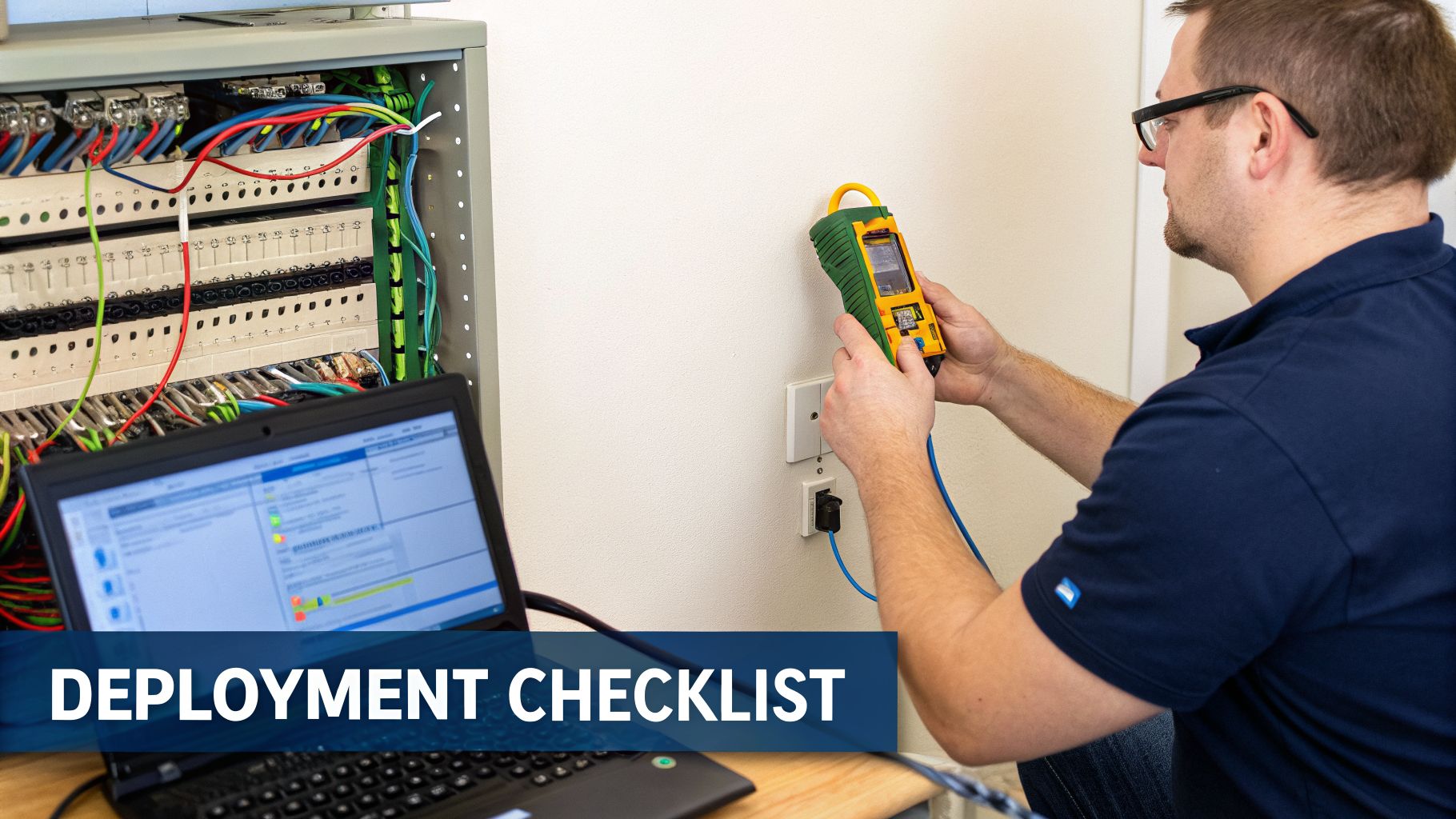
Turning a detailed network design into a fully working, reliable system is where the real work begins. A great plan is only half the battle; the quality of the installation itself is what determines whether your network will be a solid asset or a source of constant frustration. Cutting corners during deployment is a false economy that almost always leads to nagging performance issues that are far more expensive to fix later.
The Bedrock: Certified Structured Cabling
Think of your building’s Ethernet cabling as its central nervous system. It has to be perfect. This is why a professional, certified installation isn't just a good idea—it's an absolute must for any serious project. During this process, every single cable is individually tested using specialised equipment to verify it can consistently handle its rated speed, whether that's 1Gbps or 10Gbps.
The installer then provides a detailed certification report for every link. This document is your concrete proof that the physical network is free from faults and performs exactly as specified. It's also the key that unlocks the 25-year manufacturer warranty, giving you the confidence that your network’s core is built to last. Our guide on what is structured cabling breaks this process down even further.
Commercial Electrical Installation and Certification
A commercial electrical installation needs to happen in lockstep with the data cabling. The power infrastructure, from the main distribution boards to the UPS and the PoE switches, must be specified and installed by certified professionals to ensure it can reliably support the entire technology stack. Proper certification confirms that the installation is not only safe and compliant with UK standards but also clean and stable enough for sensitive IT equipment.
Validating the Wireless Layer
A Wi-Fi design based on floor plans is a fantastic starting point, but it's still a simulation. An engineer must physically walk the entire site with diagnostic tools, mapping out the actual Wi-Fi coverage, measuring signal strength, and identifying interference. This on-site validation is the only way to confirm the network performs under live conditions, catching things the plans couldn't predict, like dead zones created by unforeseen building materials. With this real-world data, we can make targeted adjustments to guarantee rock-solid coverage everywhere you need it.
This unified approach, overseen by a single project manager, delivers a fully functioning, autonomous unit that not only works flawlessly today but is also ready to scale for the future.
Operational Success and Long-Term Maintenance
Getting an unmanned building up and running is one thing. Keeping it that way without constant call-outs is a whole different ball game. The go-live date isn't the finish line; it's the starting pistol. Real success is measured by how smoothly the site runs day-in, day-out, with minimal intervention. This is where maintenance and operational considerations become critical.
All too often, these practical 'day two' problems are an afterthought. Your focus has to pivot to keeping the system healthy using tools that allow you to remotely monitor the entire network—from the core switches in the comms room to the very last wireless camera on both ethernet and wireless connections. This allows you to spot a CCTV camera that’s dropping packets or a switch reporting a power issue long before it becomes a critical failure.
Real-World Examples of Unmanned Systems
The true value of a well-designed, integrated system really shows in places where reliability is everything and operational costs need to be kept to a minimum. These aren't just ideas on paper; they’re working brilliantly in the field every single day in sectors like:
Self-Storage Facilities: Customers get 24/7 access without needing a manager on site. A single operator can remotely oversee multiple locations, control access for hundreds of units, and monitor CCTV, all powered by one solid network.
Co-Working Spaces: These dynamic environments use NFC-powered locks to eliminate the hassle of changing batteries, while a hybrid network delivers rock-solid Ethernet for building infrastructure and dependable Wi-Fi for members.
Remote Data Centres & Server Rooms: In these mission-critical sites, security and uptime are completely non-negotiable. An integrated power, data, and access system ensures only authorised personnel can enter specific areas, with every action logged and monitored over a secure, dedicated network backbone. The UK data centre market is set to grow to USD 2.07 billion by 2031, a boom that demands these tough, integrated solutions. You can read the full research on data centre market growth.
The Importance of a Maintenance and Troubleshooting Playbook
Even the most bulletproof system will hit a snag eventually. The trick is to have a plan ready to deal with it quickly and, wherever possible, remotely. This means creating a straightforward troubleshooting guide. For instance, if a door access reader suddenly drops offline, the first step is to remotely check its port on the network switch. Can you ping it? Is it still drawing PoE power? This remote check can often find the root cause in minutes, saving a site visit.
By designing maintenance considerations like battery-less locks and remote diagnostics into the system from the beginning, you create a truly autonomous building, not just an automated one.
Your Questions, Answered
Taking the plunge on a new network design for an unmanned building always brings up a few practical questions. Getting straight answers is key to making the right call for your facility's infrastructure. Here, we tackle the most common queries we hear from IT and Facilities Managers, so you can move forward with confidence.
Can We Run an Unmanned Building on Wi-Fi Alone?
While it’s tempting to think about the simplicity of a purely wireless setup, relying only on Wi-Fi is a high-risk strategy for an unmanned building. The reality is that Wi-Fi is a shared medium, making it unpredictable and vulnerable to interference from other devices or even neighbouring networks.
Your critical systems—the primary access control, CCTV cameras, and building management sensors—demand the rock-solid stability and dedicated bandwidth that only a wired ethernet connection can deliver. The industry best practice is a hybrid model: use ethernet for the essential backbone and then layer on wireless for convenience where it makes sense.
What Is Structured Cabling, and Why Does Certification Matter So Much?
Structured cabling is a standardised, organised approach to your building’s entire data cabling infrastructure. Instead of a messy, point-to-point "spaghetti junction" of wires, it creates a clean, manageable, and scalable system running from a central comms room out to every device outlet.
Certification is the final, crucial step where a specialist engineer tests every single cable with specialised equipment. This proves it meets the required performance standards, whether that's 1Gbps or 10Gbps. The certification report is your guarantee of reliability and is absolutely required to activate the long-term manufacturer warranties. It’s the only way to ensure your building's network will perform flawlessly for decades.
Think of certification as the MOT for your network cabling. It's the independent proof that the infrastructure is installed correctly and is capable of delivering the performance you've paid for—something that’s non-negotiable for a fully autonomous building.
Are Battery-Less Locks Reliable Enough for Main Entrances?
Absolutely. Modern battery-less locks, especially those using NFC (Near Field Communication), are incredibly reliable because they draw power directly from the user's credential—like a smartphone or key card—at the exact moment of use.
This clever design eliminates the single biggest point of failure in traditional electronic locks: the dead battery. It slashes maintenance costs and completely removes the operational headache of scheduling battery replacements, making these locks an ideal choice for low-touch, high-reliability unmanned facilities.
Planning and deploying a unified network for an unmanned building requires a partner with deep expertise in commercial electrical installation, certified cabling, and security system integration. Constructive-IT brings over 20 years of hands-on experience to ensure your project succeeds, from the initial design right through to go-live support and beyond. If you're looking to build out fully autonomous unmanned building units, let's discuss how our integrated approach can deliver the reliability and efficiency you need.