

A lot of UK teams are trying to do the same thing right now. They're taking a storage unit, satellite office, plant room, yard building, welfare block, gatehouse, or remote operational site and turning it into something that can run safely without permanent staff on site.
On paper, that sounds straightforward. Fit smart locks, add CCTV, connect alarms, install resilient power, give operations a dashboard, and hand over to facilities. In practice, that's where projects drift. One contractor treats access as a security purchase. Another treats power as an electrical package. IT gets asked to “just provide connectivity” after the main decisions are already fixed.
That's why IT governance frameworks matter. Not as policy theatre, but as the control system that keeps building access, data, electrical installation, monitoring, and operations working as one design.
The Hidden Risk in Unmanned Building Projects
An unmanned building project usually starts with a sensible goal. Reduce staffing overhead, improve access control, centralise monitoring, and keep the site available outside normal hours. The trouble starts when those goals are split across separate workstreams.
The access control installer picks a platform that doesn't integrate cleanly with the alarm path. CCTV is specified late, after the switching and storage decisions are already locked. Electrical works provide power to the room, but not a proper resilience strategy for locks, controllers, routers, cameras, and fail-safe release devices. The site becomes “automated” in pieces, but not operationally coherent.
Where risk shows up first
The first warning signs are rarely dramatic. They're usually small gaps that become expensive under live conditions.
- Access events don't tell the full story because door logs, CCTV footage, and network records sit in separate systems.
- Remote recovery is weak because nobody defined what happens after a controller fault, broadband outage, or local power loss.
- Supplier boundaries become failure boundaries because each contractor signs off their own package, while no one owns the integrated service outcome.
- Cyber exposure increases when internet-connected building devices are installed without proper governance for change control, supplier access, and incident response.
That last point isn't theoretical. The UK Government's Cyber Security Breaches Survey 2025 reports that 43% of businesses and 30% of charities experienced a cyber breach or attack in the previous 12 months, reinforcing the need for governance that covers change control, supplier oversight, and incident readiness, as noted in this UK breach survey reference.
Practical rule: If the building can't stay safe and understandable during a communications fault, power event, or failed software update, it isn't autonomous. It's just unattended.
Governance is the missing design layer
Most project teams don't fail because they bought poor hardware. They fail because they never created a decision model for how systems should interact, who approves risk, what gets monitored, and what evidence proves the design works.
That's what IT governance frameworks bring to an unmanned building. They force clear ownership. They make teams define measurable controls. They tie technical decisions back to the business outcome, whether that's secure access, lower maintenance burden, auditability, or continuity during building works and cutovers.
What IT Governance Means for Your Infrastructure
In infrastructure terms, governance is the rulebook for technology decisions. It decides who has authority, what risks need formal approval, how performance gets measured, and what evidence must exist before a system is accepted into service.
That approach has deep roots in UK practice. Historically, UK IT governance was strongly influenced by the Turnbull Guidance in 1999, which embedded IT risk within enterprise control. Current governance thinking still centres on five domains: strategic alignment, value delivery, risk management, resource management, and performance management, as outlined in this Turnbull and IT governance overview.
The five domains in a live building project
These domains sound abstract until you apply them to a real site.
| Domain | What it means on a building project |
|---|---|
| Strategic alignment | Does the chosen access, CCTV, cabling, and remote management model support the organisation's operating model? |
| Value delivery | Are you buying systems that reduce friction and support actual operational use, not just passing a specification review? |
| Risk management | What happens during power loss, device failure, failed entry attempts, forced-door events, or contractor changes? |
| Resource management | Are ports, switch power budgets, cabinet space, maintenance access, and support responsibilities properly planned? |
| Performance management | What KPIs prove the building is functioning as intended once live? |
What unmanned building management means in practice
An unmanned building is not merely a locked building with remote viewing. In practice, it means the site can control entry, monitor occupancy-relevant events, support safe operation, report faults, and recover from common incidents without relying on a permanent on-site team.
That usually involves a mix of:
- Controlled access using proximity credentials, mobile credentials, intercoms, or approved remote release paths
- CCTV and event verification so operators can see what happened, not just react to an alarm
- Commercial electrical installation and certification that supports safe, maintainable operation
- Structured network design for controllers, cameras, wireless links, and management interfaces
- Remote monitoring and escalation for incidents, faults, and maintenance triggers
Governance doesn't replace engineering. It makes engineering decisions traceable, accountable, and testable.
The useful question to ask
Forget “do we have governance?” Ask this instead: can the board, project lead, facilities team, and IT team all see how access, risk, cost, and service continuity connect?
If the answer is no, then the framework isn't working yet.
Why Unmanned Building Projects Silently Fail
Most failures in unmanned building management don't announce themselves on day one. The site goes live, doors open, cameras record, and dashboards look clean enough. The trouble appears later, when a contractor needs temporary access, a switch fails, a power dip corrupts a controller state, or a remote operator can't tell whether an alert is a security event or just a wiring fault.
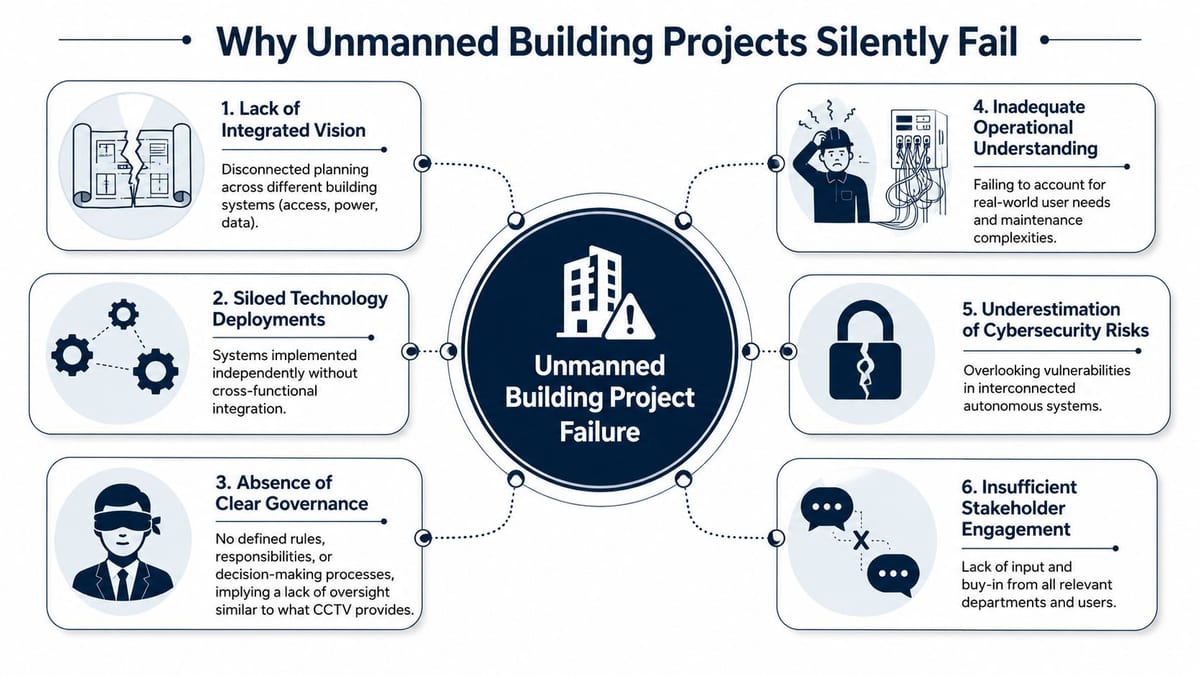
The building is automated, not managed
A proper unmanned building has to do more than basic access control. It needs a coherent operational model. That includes who grants access, how temporary permissions expire, what happens when a delivery arrives, how alarms are verified, which systems stay online during an outage, and how someone diagnoses a fault without standing in front of the cabinet.
Projects fail when nobody defines that operating model. Teams install components, but they don't design the building as a service.
Common symptoms look like this:
- Doors work but workflows don't because visitor entry, contractor access, and emergency attendance were never mapped.
- CCTV exists without context because camera footage isn't linked to access events, intercom calls, or alarm states.
- Remote management is partial because critical reset points still require a physical visit.
- Maintenance becomes reactive because no one planned routine checks, spares, firmware control, or device lifecycle ownership.
Silos create technical conflict
The security team often starts with the doors. Electrical starts with containment and supply. IT gets drawn in around switching, connectivity, Wi-Fi, and remote access. Facilities focus on occupancy, compliance, handover, and support.
That structure looks normal, but it creates silent conflict.
A camera estate can consume switching capacity the network design never reserved. An access controller may need stable power and enclosure conditions that weren't considered in the electrical package. A lock choice may force a door-set change late in the programme. CCTV retention and remote review can create data demands that the WAN path or local storage design can't comfortably support.
If access, power, and data are procured separately, the project usually pays for integration twice. Once during installation, and again during live operation.
Failure points that repeat
The recurring problem areas are usually operational, not theoretical:
Undefined authority
No one knows who can accept downtime risk, approve a temporary bypass, or sign off a non-standard integration.Weak change control
Contractors make local changes during fit-out or relocation works, but nobody checks the service impact across connected systems.No joined-up testing
Individual devices pass vendor commissioning, yet the building fails integrated scenarios such as out-of-hours access during a communications issue.Poor handover quality
The organisation receives manuals and drawings, but not an actual runbook for daily operation, fault triage, and escalation.Overlooked maintenance reality
Devices mounted high, controllers buried in crowded risers, and undocumented patching all create support friction.
An autonomous building unit only works when governance forces these disciplines before handover, not after the first incident.
The Integrated Design of Access Power and Data
A reliable unmanned site starts with one rule. Access, power, and data must be designed together. If one is left behind, the building inherits a weakness that shows up in operation.
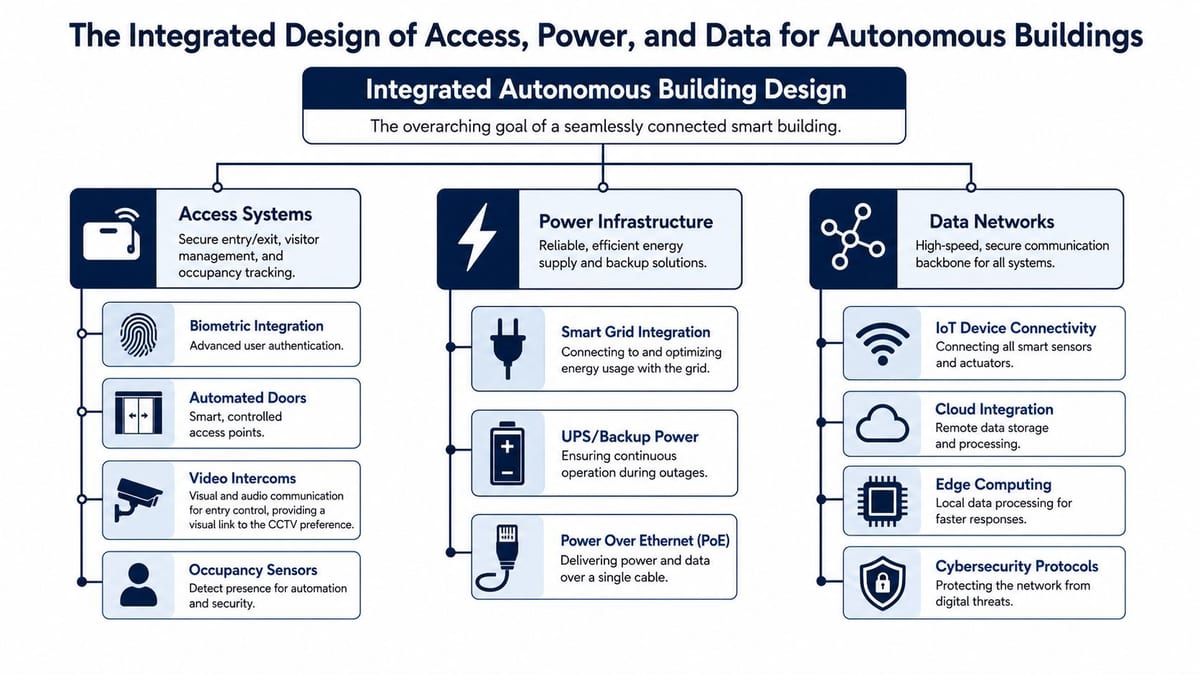
Access design starts with operating reality
For unmanned use, access control has to support more than authorised entry. It needs to reflect the site's real traffic patterns, remote approval model, contractor use, and failure behaviour.
Battery-less, NFC proximity locks are often a strong fit where teams want lower maintenance overhead and fewer field visits. Beyond merely avoiding battery change schedules, their key benefit is that they remove a common failure and maintenance burden from doors that may not be checked every day. They also suit estates where simple credential use, predictable operation, and cleaner support routines matter more than feature-heavy door hardware.
That choice still needs discipline. You need to know:
- Which doors need online control versus standalone behaviour
- Which openings must fail safe or fail secure
- Where door state monitoring is mandatory
- How intercom, remote release, and audit logging fit together
For temporary or dispersed estates, some teams also assess options such as cellular-based property access when fixed-line connectivity isn't the best fit for the access layer.
Power design must match the building's control priorities
Power is where many unmanned projects become fragile. Teams assume that if the room has mains power, the systems are covered. They aren't.
You need a power model that maps building functions to resilience requirements. Access controllers, electric locks, intercoms, core switching, WAN edge, CCTV recording, and monitoring devices don't all need the same backup strategy, but they do need an intentional one.
A practical design review usually checks:
- Primary supply path for all cabinets, controllers, and field devices
- PoE and PoE++ planning where cameras, intercoms, wireless links, or edge devices share switch budgets
- UPS coverage for life-safety-adjacent control functions, core access infrastructure, and network paths
- Generator or extended backup integration where the site has continuity requirements beyond short outages
- Safe shutdown behaviour for anything that records, authenticates, or controls entry
Commercial electrical installation and certification matter here because bad segregation, poor labelling, weak earthing practice, or inaccessible isolators don't just create compliance problems. They make diagnosis and recovery harder.
On site reality: the best autonomous design is the one an engineer can understand at 2am, under pressure, from the cabinet schedule and runbook alone.
Data design is the backbone, not an add-on
The data network is what turns separate subsystems into one operating environment. If it's underspecified, everything above it becomes harder to trust.
That's why structured cabling, cabinet layout, switching, segmentation, and uplink design must be agreed early. If you need a refresher on why the physical layer matters so much, this guide to structured cabling design is worth reviewing before final layouts are fixed.
The key principles are simple:
- Separate critical traffic paths where access control, CCTV, and business traffic shouldn't compete blindly.
- Design for maintenance with labelled patching, sensible cabinet reserves, and documented uplinks.
- Protect remote access paths so support doesn't rely on improvised workarounds.
- Plan CCTV storage and viewing properly because video can stress links and switching if it's treated as an afterthought.
When access, power, and data are governed as one design, the building behaves like a system. When they aren't, every future change becomes a live risk.
Selecting an IT Governance Framework for Your Project
Framework selection shouldn't be ideological. It should reflect the size of the project, the number of parties involved, the regulatory pressure, and how much operational detail you need.
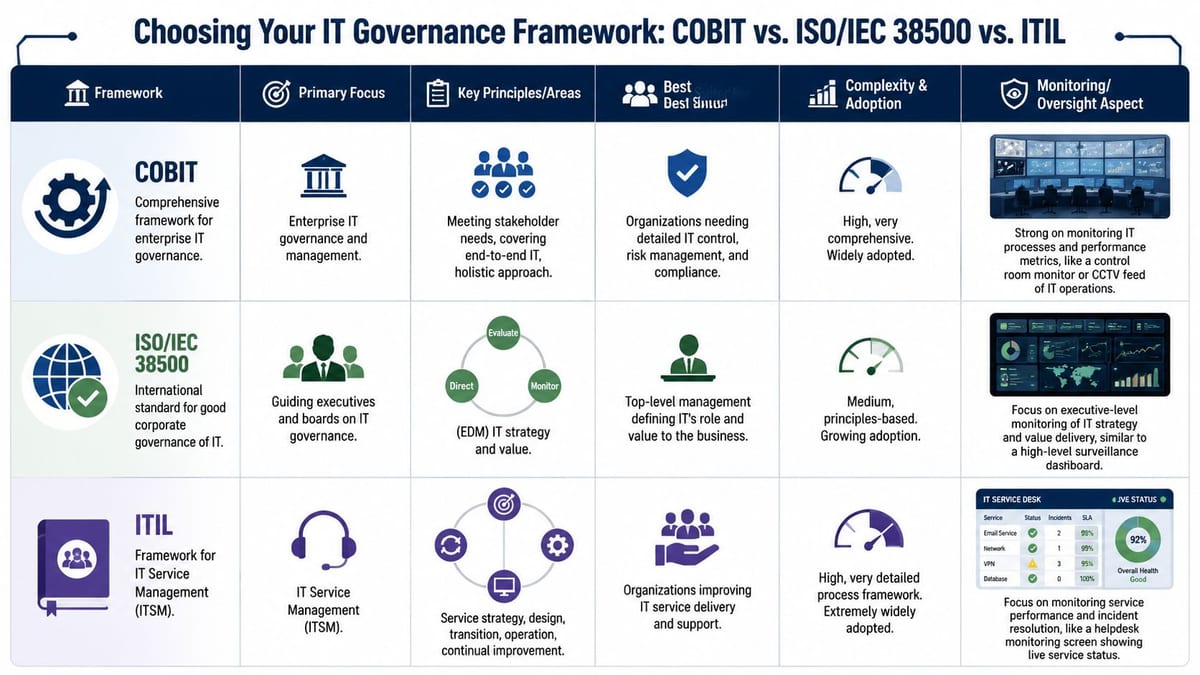
For UK organisations, the main trade-off is usually speed versus depth. COBIT is one of the most widely used and more detailed frameworks, with full implementation often taking 6 to 24 months, while ISO/IEC 38500 can often be established in 2 to 6 months, which makes it useful for faster-moving infrastructure work, as summarised in this framework timing comparison.
When COBIT is the right answer
COBIT suits larger, more regulated, or more integration-heavy environments. It's especially useful when the project includes multiple sites, formal audit expectations, difficult supplier boundaries, or high dependence on measurable controls.
Its practical strength is the Evaluate, Direct, Monitor model. That's valuable on an unmanned building project because it creates a working loop between governance decisions, technical implementation, and measurable oversight. If the board or programme team says resilience and auditability matter, COBIT gives you a way to push that down into change control, role definition, monitoring, and evidence capture.
Use COBIT when you need:
- Formal control objectives
- Visible accountability across teams
- Traceable KPIs and decision logs
- A stronger governance model for complex delivery
When ISO IEC 38500 fits better
ISO/IEC 38500 is a good fit when the organisation needs governance principles quickly, without building a heavy control estate from day one. It works well for office fit-outs, relocations, smaller autonomous building units, and estates where the board wants clarity on accountability but the delivery team still needs speed.
It won't replace operational processes. It gives senior decision-makers a cleaner way to evaluate, direct, and monitor how technology is used.
This is often the right starting point when:
- The project timeline is tight
- The estate isn't highly complex
- You need governance discipline before adding deeper controls later
For projects with a broad stakeholder set, a formal stakeholder communication plan helps turn that board-level direction into actual working decisions.
Where ITIL belongs
ITIL is often the practical companion rather than the headline governance framework. It's strong after deployment, when the question becomes how the building is supported as a service. Incident handling, service transition, change control, and continual improvement all matter once the site is live.
This short overview gives a useful visual comparison before you commit to an operating model.
A common pattern is simple:
| Project need | Best fit |
|---|---|
| Complex control environment | COBIT |
| Faster governance baseline | ISO/IEC 38500 |
| Operational service management | ITIL alongside the main framework |
The wrong choice is usually the one that looks good in policy but never reaches the site team.
Your Implementation Checklist for an Autonomous Building
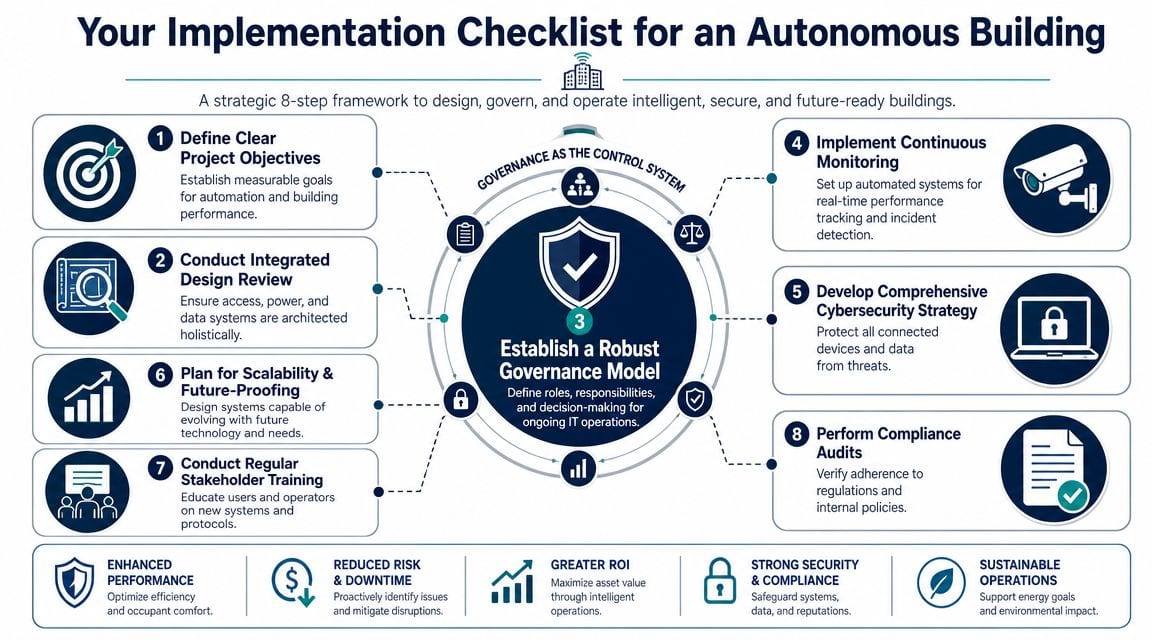
In regulated environments, governance works as a control system, not as a document set. That means policies, roles, and KPIs have to be embedded into delivery and operations, with measurable controls such as change approval times and incident rates used to verify that the framework is working, as reflected in this governance control system guidance.
Planning and design controls
Before any installer starts pulling cable or fixing hardware, the project should have a joined-up control baseline.
Define the operating model
Decide what “unmanned” means for your site. Is it fully unattended, remotely supervised, or only unstaffed outside core hours? That answer drives every design choice after it.Map critical journeys
Test the reality of deliveries, contractors, cleaners, emergency attendance, and out-of-hours support. If a workflow needs a human override, document who owns it.Set governance roles early
Name the person who approves access risk, the person who signs off live changes, and the team that owns day-two support.Freeze interface points
Access control, CCTV, alarms, electrical containment, data cabinets, WAN, and building controls all need agreed handoff points. Undefined interfaces are where delays and disputes hide.
Installation and integration controls
Project teams often rush. They shouldn't.
Verify commercial electrical installation and certification
Electrical works must support both compliance and maintainability. Cabinet supplies, lock power, local isolation, UPS feeds, and labelled circuits need to be testable and understandable.Validate access hardware against door reality
Door material, closer force, escape requirements, strike compatibility, and external exposure all matter. A lock that looks right on paper can become unreliable on the actual opening.Commission CCTV as part of the service
Don't only confirm image presence. Check camera placement, lighting conditions, retention settings, event review workflow, and network impact under normal and busy conditions.Test integrated failure scenarios
Simulate link loss, local power issues, controller restart, failed credentials, forced entry, and temporary contractor access. Vendor commissioning alone isn't enough.
Good governance shows up in test scripts, sign-off records, and escalation rules. If it only appears in policy documents, it won't protect the building.
Operational and maintenance controls
A fully autonomous unmanned building unit only stays reliable if maintenance was designed in from the start.
Use this handover checklist:
- Create an operational runbook with door schedules, contact paths, reset procedures, exception handling, and approved remote actions.
- Assign maintenance ownership for locks, controllers, UPS equipment, CCTV devices, intercoms, network hardware, and structured cabling.
- Control firmware and changes so updates don't happen informally or without rollback planning.
- Track measurable KPIs such as service-impact windows, repeat incidents, access exception patterns, and unresolved faults.
- Store clean as-built records including cabinet elevations, patch schedules, circuit details, device inventories, and support contacts.
Where these systems are commonly used
The same governance-led approach applies across a wide spread of sites:
- Remote offices and satellite spaces
- Yard offices and logistics units
- Storage compounds and plant buildings
- Gatehouses and entry-controlled service buildings
- Healthcare and education estates with distributed buildings
- Fit-out projects where parts of a building must operate before full occupation
These environments don't all need the same technology stack. They do need the same discipline. The building has to be operable, supportable, and understandable once the installers have left.
From Blueprint to a Resilient Autonomous Site
A successful unmanned building isn't the result of buying smart products. It comes from governing the whole environment as one operational system. That means access control, CCTV, electrical installation, network design, maintenance, and remote support all sit inside a framework that defines ownership, acceptable risk, monitoring, and change control.
That's also why lessons learned matter. Teams that capture failure points and handover issues in a proper lessons learned process build stronger sites the next time round.
If you're planning a new autonomous unit, an office fit-out, or a remote facility upgrade, the hard part usually isn't choosing a lock or a camera. It's making sure every dependency has been designed, tested, certified, and handed over in a way your organisation can run.
If you need help turning governance requirements into a working physical environment, Constructive-IT supports UK organisations with the planning, cabling, electrical works, CCTV integration, certification, and project delivery needed to build resilient unmanned sites with fewer surprises at go-live.