
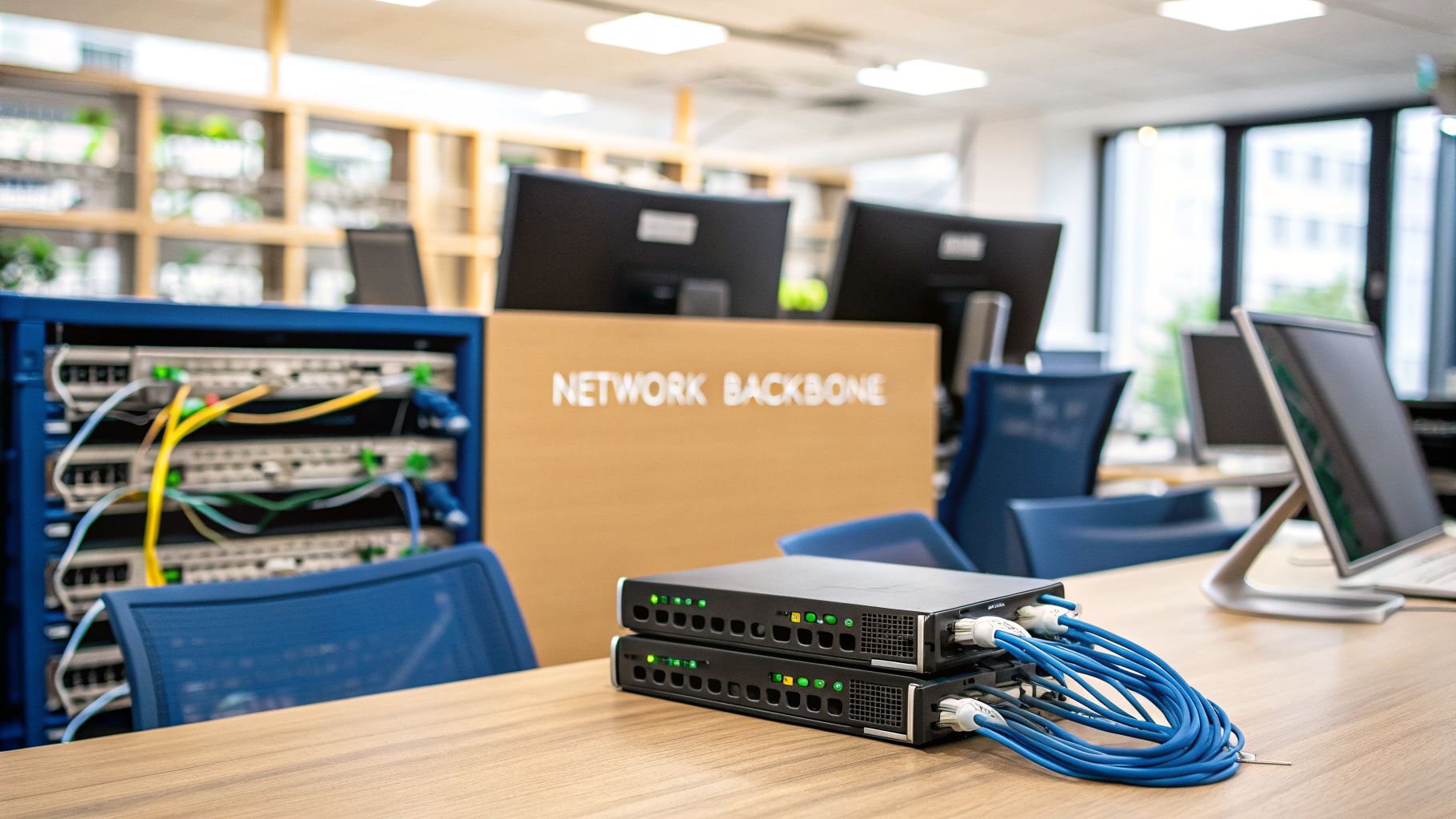
An Ethernet cable is the unsung hero of the modern office. It creates a private, secure physical connection for your business's data, linking essential devices like computers, printers, and CCTV cameras directly to your network. Unlike Wi-Fi, which broadcasts data through the air, this dedicated wire guarantees faster speeds, rock-solid stability, and better security for your most important operations.
The Superhighway for Your Business Data
Think of your office network as a city's transport system. Wi-Fi is like the public roads – open to everyone but often congested with traffic, prone to detours, and easily blocked by physical barriers like concrete walls. An Ethernet cable, on the other hand, is your own private superhighway, built to get data from A to B with zero interruptions.
This direct, wired link is what an Ethernet cable does best: it provides a completely predictable and consistent flow of information. It's the reason why your large file transfers finish without errors, your VoIP calls sound crystal clear, and your high-definition CCTV footage doesn't stutter or drop frames. A physical cable simply removes the variables that plague wireless networks, like interference from other devices or your building's construction.
Core Functions in a Business Network
In a commercial environment, Ethernet cabling isn't just for getting online; it's the non-negotiable backbone of your entire IT infrastructure. Its role goes far beyond connecting a single computer to the internet.
To understand its role better, here's a quick summary of what Ethernet cabling really does for a business.
Ethernet Cable Core Functions at a Glance
Function | Description | Business Benefit |
|---|---|---|
Reliable Data Transfer | Ensures data-heavy tasks, like server backups or transferring large design files, are completed quickly and without corruption. | Minimises downtime and data loss, keeping productivity high. |
Power over Ethernet (PoE) | Modern cables transmit both data and electrical power, simplifying the installation of devices like VoIP phones and security cameras. | Reduces installation costs and clutter by removing the need for separate power supplies. |
Foundation for Critical Systems | Provides the stable connectivity needed for essential systems, including access control, meeting room AV, and data centre links. | Guarantees that the systems your business relies on for security and operations are always online and performing correctly. |
As you can see, these cables do much more than just provide an internet connection; they form the central nervous system of a modern, efficient workplace.
By creating a dedicated physical path for data, an Ethernet cable eliminates the uncertainty of a wireless connection. This stability isn't just a nice-to-have; it's a business necessity for any operation that demands 100% uptime and performance you can count on. It is the bedrock of a professionally organised network.
From Copper Wires to the Speed of Light
Not all Ethernet cables are created equal. While they all provide that stable, wired connection we rely on, the type of cable you run through your walls is what dictates the true performance of your network. Think of it like the roads in a city; you have local streets for everyday traffic and massive motorways for high-speed, long-distance travel.
Getting this choice right is fundamental to building an IT infrastructure that works for you today and won't hold you back tomorrow. For most offices, the workhorses are traditional copper cables, known by their "Category" or "Cat" rating.
This is what a solid, wired connection brings to the table: pure speed, unwavering reliability, and robust security.
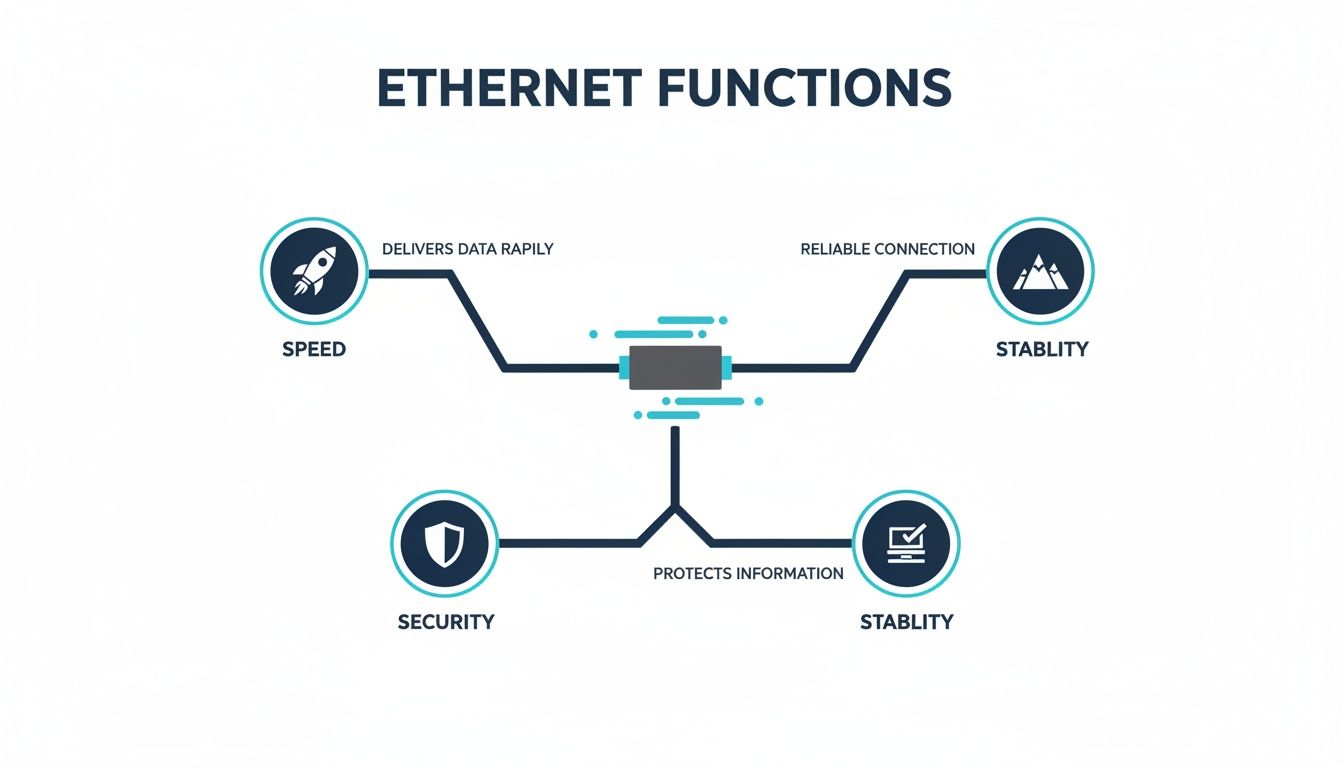
As you can see, a physical cable gives your data a dedicated, private lane to travel down, free from the interference and congestion that can plague a wireless signal.
Understanding Copper Cable Categories
For the vast majority of UK businesses, the choice boils down to a few standard copper cables. Each newer category brings better performance and stronger protection against electrical interference.
Cat5e (Category 5e): This is the old guard of network cabling. It can handle speeds up to 1 Gigabit per second (Gbps), which is fine for very light use. However, we wouldn’t recommend it for any new installation today—it leaves you with no room to grow.
Cat6 (Category 6): This is the undisputed champion for modern office fit-outs. It also supports 1 Gbps with ease but is built to a higher standard. It can even push 10 Gbps speeds over shorter runs (up to 55 metres). Its tighter construction drastically reduces "crosstalk" (interference between the wires), making it the perfect sweet spot between cost and performance.
Cat6a (Augmented Category 6): Think of this as Cat6 on steroids. It’s specifically engineered to deliver a rock-solid 10 Gbps signal over the full 100-metre cable length. Cat6a is the go-to for data-heavy environments or for businesses that want to build a network that will last a decade or more.
The industry has clearly voted with its feet. The global LAN cable market was valued at a massive USD 13,851.35 million in 2023, with Cat6 cables claiming the largest slice of the pie. It’s cemented its place as the standard for offices and data centres where performance is non-negotiable.
The Leap to Fibre Optic Cables
But what happens when you need to go further than copper can stretch, or when you need speed that copper simply can't deliver? That's when you turn to fibre optics.
Instead of pushing electrical signals down metal wires, fibre optic cables send data as literal pulses of light through impossibly thin strands of glass.
A fibre optic cable is like having your own private motorway with no speed limit and no exits for 20 kilometres or more. It’s engineered for one job: moving huge amounts of data over vast distances at the speed of light, with zero signal loss.
This incredible technology is essential for a few very specific, high-stakes jobs:
Connecting separate buildings on a business park or university campus.
Linking your main server racks together within a large data centre.
Building a future-proof network backbone that won’t need to be replaced for decades.
While copper like Cat6 is perfect for the day-to-day connections to your desks and printers, fibre is reserved for the critical, high-capacity arteries that hold your entire network together. If you want to get into the nitty-gritty, you can explore our complete business guide to optical fibre to learn more. It’s never a case of one being "better," but always about using the right tool for the job.
While Wi-Fi gives you freedom, there are times in business when that convenience just can't compete with a solid, physical connection. For your most critical operations, a wired Ethernet connection is simply non-negotiable.
Think of it like this: Wi-Fi is a bit like a radio broadcast. The signal travels through the air, where it gets weakened by walls, disrupted by everything from microwaves to your team's smartphones, and can even be intercepted. An Ethernet cable, on the other hand, is a private, shielded tunnel connecting your device directly to the network. No interference, no eavesdropping.
That physical connection is what gives Ethernet its knockout advantage in four key areas: speed, reliability, security, and latency. A wired link delivers a consistent, full-throttle data flow that even the best wireless networks struggle to match, especially in a busy office. For the parts of your business that absolutely cannot fail, that stability is everything.
Where Ethernet Is the Only Choice
In some business scenarios, the wired vs. wireless debate is a non-starter. The performance demands are so high that only a dedicated Ethernet cable will do the job.
High-Definition CCTV: Modern security cameras need a constant, high-bandwidth connection to stream and record crystal-clear footage. An Ethernet connection guarantees your surveillance system won't drop frames or lose signal at a critical moment. Plus, Power over Ethernet (PoE) can send electricity down the same cable, making installation far simpler.
VoIP Phone Systems: Lag, or latency, is the enemy of a clear phone call. Ethernet gives you an ultra-low latency connection, getting rid of the frustrating delays and garbled audio that often plague calls made over a congested Wi-Fi network. For professional, client-facing communication, a wired link is essential.
Servers and Data Centres: Your servers are the heart of your business, and they demand unwavering, stable connectivity. Relying on Wi-Fi for this is unthinkable. Ethernet provides the dependable, high-speed link needed for server-to-server communication and reliable data access for your entire team.
Smart Access Control in Unmanned Buildings: In a building without staff on-site, access control systems have to be completely foolproof. A wired Ethernet connection ensures door locks, entry keypads, and other security gear are always online and responsive, delivering a secure and reliable experience for anyone with authorised access.
The Clear Winner for Business
So, how do the two technologies really stack up in a professional environment? The table below gives you a straightforward comparison.
Ethernet vs Wi-Fi for Business Use
Feature | Ethernet (Wired) | Wi-Fi (Wireless) |
|---|---|---|
Speed & Consistency | Consistently high speeds, unaffected by external factors. | Variable speeds, susceptible to interference and congestion. |
Reliability | Rock-solid stability with virtually zero signal drops. | Prone to dropouts due to distance, physical barriers, and interference. |
Security | Highly secure, as access requires a physical connection. | More vulnerable; requires robust encryption and passwords. |
Latency | Extremely low, ideal for real-time applications like VoIP. | Higher latency, which can cause lag in calls and video streams. |
For a deeper dive into why a wired backbone is crucial for business growth, learn more about the advantages of wired networking in our dedicated guide.
Ultimately, while Wi-Fi is great for casual browsing on a laptop, Ethernet remains the undisputed champion for your business-critical infrastructure.
Powering Modern Offices and Unmanned Buildings
It's easy to take Ethernet for granted, but those humble cables are the lifeblood of any modern office. A properly planned network is what keeps everything ticking, from the PCs at every desk to the AV gear in your meeting rooms. It’s the essential plumbing that supports critical tools like essential VoIP phone systems, which are non-negotiable for business communication today.
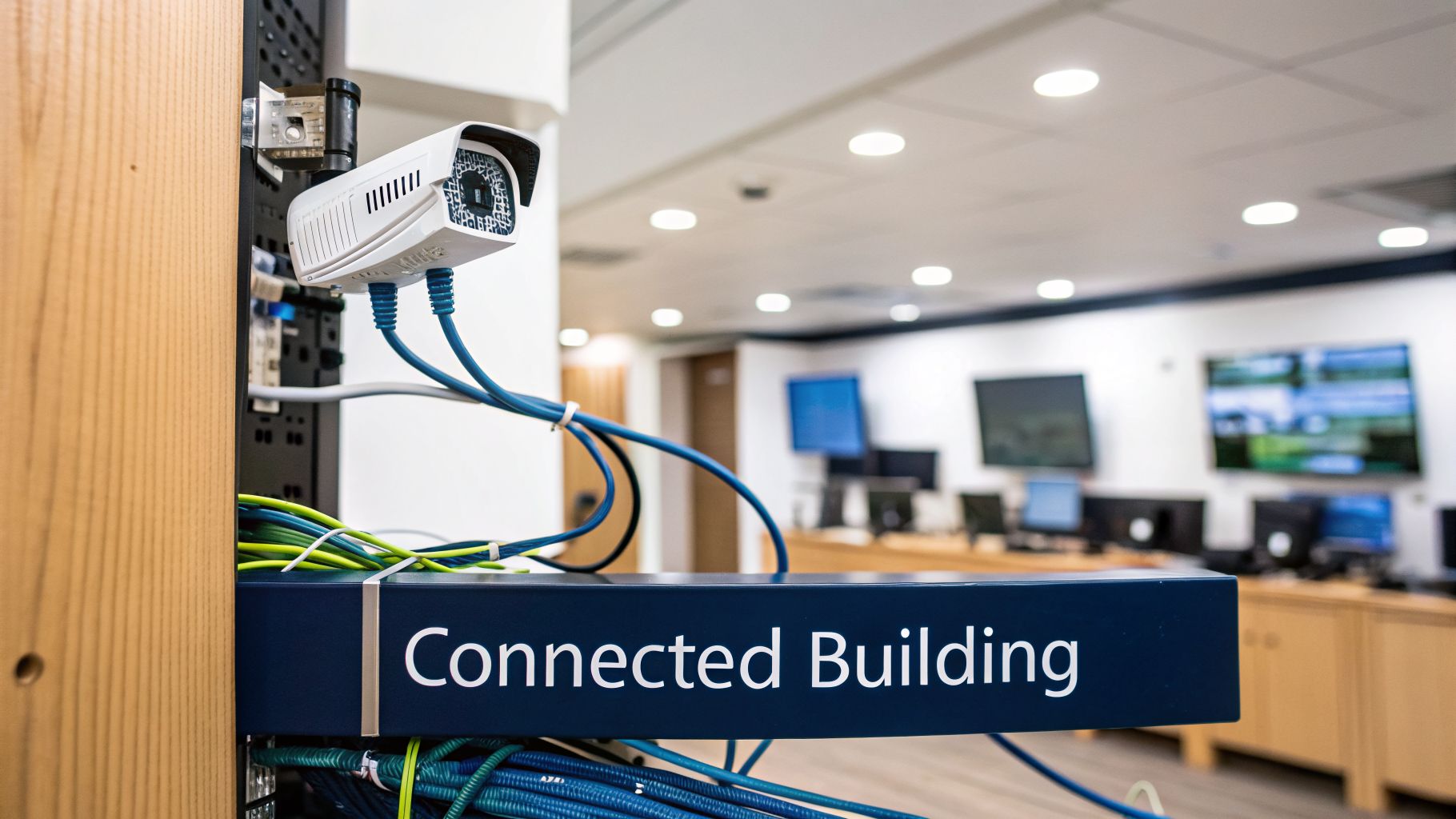
But Ethernet’s role is evolving far beyond the traditional office floor. It's now the backbone of one of the most exciting trends in property management: building out a fully autonomous unmanned building. These are commercial or residential spaces engineered to run securely and smoothly with zero on-site staff, and it all hinges on a perfectly integrated network of connected devices.
The Rise of the Autonomous Building
So, what does unmanned building management actually mean in practice? It means every crucial function—from granting access to monitoring security and controlling the climate—is handled remotely through a single, unified network. And this is exactly where Ethernet becomes indispensable. Examples of where these systems are commonly used include self-storage facilities, co-working spaces, private gyms, and short-term rental properties.
A successful unmanned project depends on designing three core elements together from the very start: access, power, and data.
Access Control: This involves devices like battery-less, NFC proximity locks. These are chosen for a crucial real-world reason: reliability. They draw power directly via Power over Ethernet (PoE), which eliminates the maintenance and operational nightmare of dead batteries—a huge point of failure in unattended sites.
CCTV Surveillance: High-definition cameras demand a stable, high-bandwidth connection that only a dedicated Ethernet cable can guarantee. This ensures footage is captured without a single dropped frame, which is an absolute must-have for security.
Power and Data Integration: With PoE, a single Ethernet cable delivers both data and electricity to devices like locks, cameras, and sensors. This dramatically simplifies the commercial electrical installation and certification, cutting down on complexity and potential failure points.
Many unmanned building projects fail because these three pillars—access, power, and data—are treated as separate projects. A lock is installed without thinking about its data needs, or a camera is placed where it’s a nightmare to run a reliable cable. A unified design, built on a foundation of structured Ethernet cabling, is the only way to achieve true autonomy.
Ethernet as the Unifying Force
By integrating all these systems over a single, professionally installed Ethernet network, you create a cohesive and incredibly resilient infrastructure. For example, when a user taps their NFC card, the lock instantly communicates over the network to verify credentials and unlock the door. At the same time, the CCTV system can log the entry, with all the data transmitted securely to a central management platform.
This level of integration is fuelling huge demand for high-performance cabling. Data centres, the brains behind these connected systems, are a massive driver of this growth. By 2026, they are projected to account for 8% of total metallic cable demand and a staggering 16% of global optical cable demand, a trend powered by their unprecedented need for connectivity.
If you're interested in building a robust, automated property, our ultimate guide to unmanned building management systems takes a much deeper look into the strategy behind it all.
Why Professional Installation Is Your Best Defence
A high-performance network is only ever as good as its weakest link. You can spend a fortune on the best Cat6a cables and top-of-the-line hardware, but if the installation itself is sloppy, you'll never see the performance you paid for. It’s a hard lesson many learn when a project fails not because of faulty kit, but because the cabling strategy was flawed from the start.
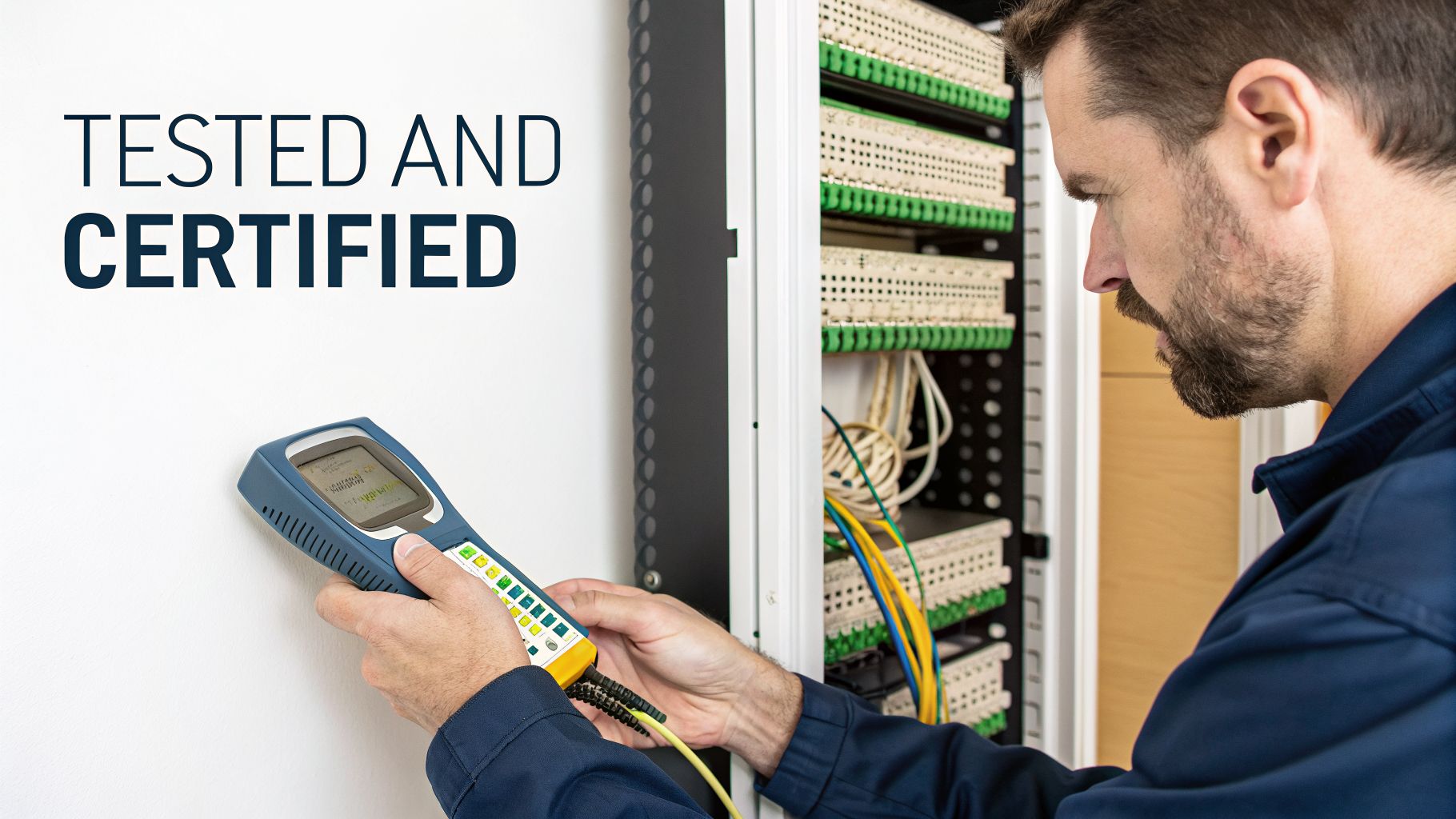
Understanding what an Ethernet cable does is the first step, but making sure it can actually do its job properly is what really counts. A professional installation isn't just about making things look tidy; it's about sticking to strict industry standards that protect the integrity of your data.
The Devil Is in the Details
An amateur installation can undermine your network in ways that aren't immediately obvious. A professional, on the other hand, obsesses over the critical details that guarantee long-term performance and rock-solid reliability.
Respecting Bend Radius: Every cable has a maximum bend radius. If you bend an Ethernet cable too sharply, you can damage the delicate internal wiring, leading to data loss and cripplingly slow speeds. Professionals ensure every curve is gentle and kept well within the manufacturer's specifications.
Avoiding Electrical Interference: Running data cables parallel to high-voltage electrical lines is a recipe for disaster. This creates electromagnetic interference (EMI), which corrupts data signals and causes chaos. A proper installation involves meticulously planning cable routes to maintain a safe distance from power sources.
Clear and Logical Labelling: In a complex network, an unlabelled cable is just a future headache waiting to happen. Professionals implement a clear, logical labelling system at both the wall outlet and the patch panel. This simple step makes maintenance, troubleshooting, and future upgrades exponentially faster and easier.
A professional installation isn't an expense; it's an investment in future stability. The meticulous process of testing and certifying every single connection ensures your network performs at its peak from day one and protects you against costly, business-halting downtime years down the line.
The Power of Certification
The final—and arguably most crucial—step of any professional installation is testing and certification. Using specialised tools like a Fluke network tester, every single cable run is individually checked to confirm it meets the performance standards for its category (e.g., Cat6).
This process does more than just verify speed and reliability. A full certification report is your concrete proof that the installation was done correctly, which is often a requirement to secure the 25-year manufacturer's warranty on the cabling system. Without it, you are left completely unprotected if a problem arises. It’s your ultimate defence, ensuring your network is not just functional but certifiably excellent.
Building a Network That Works for You
Getting your head around what an Ethernet cable does is a great first step. But the real challenge is designing a network infrastructure that actually helps your business, instead of holding it back. Going the DIY route almost always leads to hidden costs, poor performance, and a lot of future headaches.
This is especially true for more complex projects like building out a fully autonomous unmanned building, where a slapdash approach just won’t cut it.
A strategic approach is all about avoiding those pitfalls. It starts by realising that in any modern commercial installation, you can’t treat data, power, and access control as separate projects. They have to be designed together, right from day one.
Aligning Strategy with Business Goals
We’ve seen plenty of unmanned building projects stumble precisely because this integrated planning was missed. Someone picks an access control system without thinking about its power supply, or CCTV cameras get installed where a reliable data connection is a complete afterthought.
The professional solution is to use Power over Ethernet (PoE) to deliver both data and electricity down a single cable. This is perfect for devices like battery-less, NFC proximity locks, ensuring they never fail just because a battery has died. These maintenance and operational considerations are paramount; eliminating battery replacements removes a major recurring cost and a primary point of failure.
This unified thinking streamlines the entire build-out and certification process. But the work doesn't stop once the initial setup is done. To get the most out of your wired infrastructure for years to come, consistent care is essential. Robust preventive IT maintenance programmes are your best defence against downtime and ensure everything keeps running smoothly.
A network is more than just wires; it's a strategic business asset. By planning for access, power, and data simultaneously, you create a cohesive system that is reliable, easy to manage, and ready for future demands.
This kind of forward-thinking is more important now than ever. The UK is in the middle of a massive infrastructure shift, with Openreach's copper switch-off programme pushing everyone towards fibre broadband. This means any business planning new cabling must prioritise Ethernet that’s ready for next-generation fibre connections just to stay in the game. You can read more about these UK broadband statistics and changes.
By partnering with a specialist who gets these complexities, you’re not just buying cables; you’re building a future-proof asset, not a recurring problem. At Constructive-IT, we help you align your network design with your business goals, making sure your infrastructure works for you, not against you.
Your Ethernet Questions, Answered
Even when you’ve got a good grasp of the basics, a few practical questions always pop up. Here, we tackle the most common queries we hear from businesses, giving you straight answers to help you make the right call.
Can I Use a Cat7 or Cat8 Cable for My Office?
While you technically can, it's almost always a case of over-engineering and over-spending. For a typical office environment, Cat6 or Cat6a cabling provides more than enough speed and bandwidth for everything your team does.
Cat7 and Cat8 cables are built for the extreme density and interference found in data centres. Their heavy-duty shielding offers no real-world advantage for connecting a user’s PC to the network and just adds unnecessary cost to the project.
Does the Colour of an Ethernet Cable Matter?
Functionally, no. A blue cable and a red cable will perform exactly the same. However, in any professionally installed network, colour-coding is a non-negotiable part of the design. It's how we keep things organised and make troubleshooting a breeze.
For example, we might use blue for all user workstations, red for the CCTV system, white for Wi-Fi access points, and yellow for VoIP phones. This simple system instantly tells an engineer what a cable is for, saving a huge amount of time during maintenance or future upgrades.
What Is the Maximum Length for an Ethernet Cable?
For any copper Ethernet cable, including Cat6 and Cat6a, the maximum reliable length is 100 metres (328 feet). Once you go past that point, the data signal starts to break down, which leads to slow speeds, packet loss, and frustrating connection drops.
For any run longer than 100 metres—like linking two buildings on a campus or connecting a remote cabin to the main office—fibre optic cable is the only professional, industry-standard solution.
A well-designed network should be a powerful asset for your business, not a constant source of problems. For expert help with planning, installing, and certifying your network infrastructure, trust Constructive-IT to deliver a solution that’s built for rock-solid performance and reliability. Learn how we can support your next project.