


A Guide to Flawless Fibre Optic Cable Installation
- Craig Marston
- Jan 10
- 15 min read

A successful fibre optic cable installation isn't just about technical skill during the pull; it’s built on a foundation of meticulous planning. For complex places like commercial buildings and hospitals, this initial planning stage dictates everything—performance, reliability, and whether your network can scale for the future.
Getting this right is the single most important factor in avoiding costly data network mistakes down the line. A network that isn't properly tested and certified from day one is a liability waiting to happen.
Planning Your Network for Performance and Growth
Before a single tool comes out of the box, a thorough site survey and requirements gathering session has to happen. This isn't just about measuring distances. It's a strategic deep dive into how your organisation works now and where you see it in five, ten, or even twenty years. Skipping this step is like building a house without a blueprint—you’re just asking for trouble.
A classic mistake is designing a network that only meets today's needs. Sure, an office might only need 1Gbps to the desk right now, but what happens when video conferencing, cloud apps, and IoT devices start demanding more? A well-planned installation anticipates this growth, preventing expensive and disruptive retrofits later on.
Conducting a Comprehensive Site Survey
The site survey is where it all begins. For a commercial building or a hospital, this involves way more than just locating server rooms. A professional installer will walk the entire site to map out the most efficient and resilient pathways for the cable.
Key things we look for during this phase include:
Existing Infrastructure: Are there usable ducts, risers, or cable trays we can leverage? Finding these can save a huge amount of time and money.
Building Materials: Drilling through reinforced concrete requires a totally different approach (and set of tools) than running cables through a suspended ceiling.
Environmental Factors: We need to identify and mitigate any areas with high moisture, risk of physical damage, or electromagnetic interference.
Access and Disruption: In a busy hospital or office, work has to be scheduled to cause minimal disruption. This often means working out-of-hours to keep things running smoothly.
A successful fibre optic installation is 90% planning and 10% execution. The questions you ask before pulling any cable are far more critical than the physical work itself. This is where you prevent future bottlenecks and ensure the network delivers long-term value.
Aligning Network Design with Business Goals
Once we understand the physical landscape, the next job is to align the technical design with your business objectives. This means having detailed conversations with everyone from the IT team to facilities managers and even company leadership. The goal is to build a network that doesn't just work, but actively helps the organisation achieve its mission.
An office relocation, for example, is the perfect chance to rethink the network from the ground up. Will the new space have more collaborative zones that need bulletproof Wi-Fi backhaul? Is the business shifting to a hybrid work model that demands flawless connectivity for staff both in and out of the office? It’s crucial to remember that your entire network infrastructure is a guide to your business backbone, and this planning phase ensures it's strong enough to support whatever comes next.
This is where choosing a certified and experienced partner becomes so important. As an Excel network accredited partner, we make sure every installation isn't just functional but is delivered to a standard that qualifies for a full 25 year equipment warranty. That warranty is only possible when a network is correctly designed, installed by certified engineers, and meticulously tested to meet strict performance criteria. This process guarantees that from the tidy desk to the data centre, your network is a reliable, long-term asset.
Mastering the Technical Side of Installation
With the network blueprint signed off, we get to the practical side of things: the actual fibre optic cable installation. This is where the detailed plan meets the physical reality of a building, turning schematics on a screen into a high-performance network. It's a process that involves navigating everything from busy commercial offices to sterile hospital corridors and requires a completely different set of skills for indoor versus outdoor work.
The flow diagram below shows the basic planning process that underpins every technical step we take.
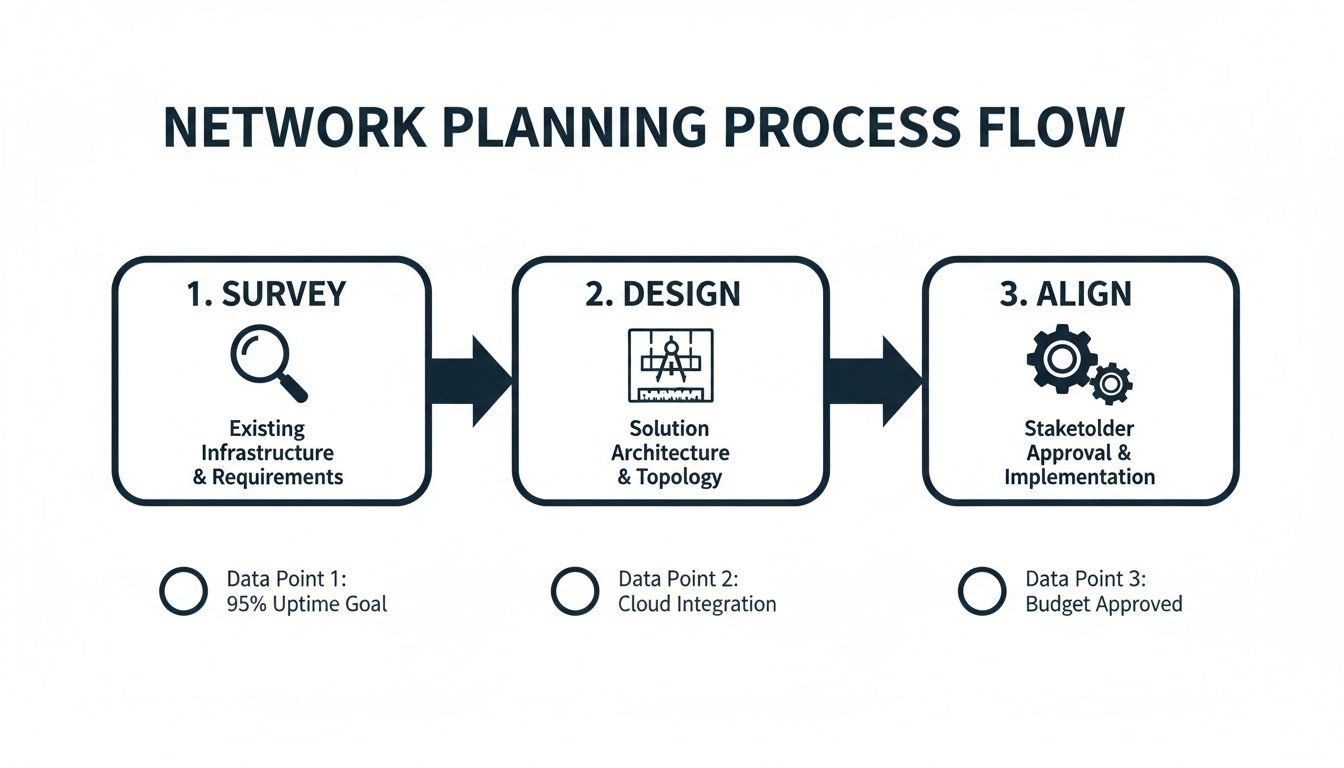
This illustrates how a successful installation is built on a methodical progression from survey and design to the final alignment, making sure every decision is driven by solid data.
Navigating Indoor and Outdoor Environments
Installing fibre optic cable indoors versus outdoors presents completely different challenges. Outdoor cabling has to stand up to the harsh UK weather, UV radiation, damp, and the risk of physical damage. This calls for tough, armoured cables protected inside ducting, which is often buried underground or run along aerial routes. Getting the right permits for any civil works and navigating building regulations is always the first, critical hurdle.
Inside, the game changes. The focus shifts to working within the limits of an existing building. In hospitals, for instance, installers must follow strict infection control rules and work around sensitive equipment and patients. For commercial buildings, especially during an office relocation, the work has to be planned meticulously to cause the least possible disruption.
While our focus here is on these complex commercial jobs, the basic idea of protecting the cable is universal. For anyone tackling a home project, this guide offers a good walkthrough: Fiber Optic Home Installation: A Simple Guide for Homeowners.
Choosing the Right Installation Method
The physical method we use to run the cable depends entirely on the pathway we've planned. In the professional world, two main techniques get the job done:
Cable Blowing: This is the modern approach, using compressed air to propel the fibre cable through pre-installed ducting. It's incredibly effective for long, straight runs—like connecting buildings across a campus—as it dramatically reduces friction and stress on the cable.
Cable Pulling: This is the traditional method, where the cable is manually or mechanically pulled through conduits or cable trays. It's essential for navigating pathways with lots of twists and turns inside a building. This takes real skill to maintain the right tension and not exceed the cable's bend radius—a classic mistake that can permanently ruin a fibre core.
An installer’s real expertise shines through in their ability to pick the right method for the job. A botched pull can create micro-fractures in the glass, causing signal degradation that might only show up in the final tests, leading to expensive delays.
The Precision of Splicing and Termination
Getting the cable in place is only half the job. The real craft in a fibre optic installation is how the ends are connected. Every connection point, or termination, is a potential source of signal loss, which is why meticulous, clean work is non-negotiable.
Fusion splicing is the gold standard for joining two fibres together. It uses an electric arc to literally melt and fuse the glass cores, creating a permanent bond that's stronger than the original fibre and adds almost zero signal loss. This is vital for long backbone runs where multiple segments of cable need to be joined.
At the endpoint, where the cable plugs into your network hardware, it needs to be terminated with a connector. This process involves stripping the cable, cleaving the fibre to a perfect 90-degree angle, and polishing it to a mirror finish. Any speck of dust or oil on the connector face can cripple your network's performance.
This is exactly why a certified and tested network delivery is so critical. These terminations are where components like SFP modules connect to your switches. Understanding the versatility and uses for SFP optic modules on network switches helps you appreciate why these connections have to be absolutely flawless.
Ultimately, mastering these technical details ensures the physical infrastructure is robust enough to deliver the speed and reliability promised on paper. As an Excel network accredited partner, we stick to these exacting standards on every job to ensure each installation qualifies for its 25-year equipment warranty, giving you long-term peace of mind.
Why Testing and Certification Are Non-Negotiable
A successful fibre optic cable installation doesn't end when the last cable is connected. In reality, that’s just the halfway point. Until every single link is rigorously tested and certified, all you have is a collection of expensive glass and plastic—not a high-performance network.
This final stage is what separates a professional, reliable infrastructure from a source of endless data network mistakes. Skipping or rushing this step is one of the most common and costly errors a business can make. Without documented proof of performance, you have no baseline, no quality guarantee, and no way to efficiently troubleshoot problems down the line.
A certified network, on the other hand, is a verified asset. It’s something you can count on for decades.

Demystifying Network Performance Testing
When we talk about a certified, tested network delivery, we’re referring to a specific set of standards-based tests that validate the quality of the installation. Two key tests form the foundation of this process, each giving a different but equally vital view of the network's health.
First up is Insertion Loss (IL) testing. This simply measures the total amount of light lost along a cable link, from the transmitter to the receiver. Every connection, splice, and even the length of the cable itself adds a tiny amount of loss. A 'pass' result confirms this total loss is well within the strict limits set by industry standards, ensuring your network equipment will operate flawlessly.
The second, more diagnostic tool is the Optical Time-Domain Reflectometer (OTDR). Think of an OTDR as radar for your fibre network. It sends a pulse of light down the cable and measures the light that reflects back, creating a detailed map of the entire link. This lets our engineers pinpoint the exact location and severity of any issues—like a bad splice, a tight bend, or a dirty connector—with incredible accuracy.
The True Meaning of a Certified Network
Getting a 'pass' on these tests is what turns a physical installation into a certified network. The results are then compiled into a detailed report that documents the performance of every single link. This documentation is your network's birth certificate and is absolutely essential for several reasons:
Performance Guarantee: It's your concrete proof that the network was installed correctly and meets the performance specifications you paid for.
Faster Troubleshooting: If a problem pops up months or years later, technicians can compare new test results against the original baseline to quickly identify what’s changed.
Future Upgrade Planning: The certification report gives you a clear inventory and performance benchmark, making it much easier to plan for future network expansions or hardware upgrades.
A network without certification is an unknown quantity. You're essentially flying blind, hoping that every one of the hundreds or thousands of connection points was made perfectly. Certified testing removes that guesswork and provides the concrete evidence needed for long-term confidence.
This meticulous approach is fast becoming the standard, not the exception, especially in demanding environments like commercial buildings and hospitals across the UK. In fact, UK fibre-optic cable manufacturing industry revenue is projected to hit £318.7 million in 2025–26. For IT managers, this highlights a big shift where standards-compliant testing is now core to business competitiveness. You can discover more insights about the UK's growing fibre industry from IBISWorld's analysis.
Unlocking the 25 Year Equipment Warranty
This is where the value of working with an accredited partner becomes crystal clear. Manufacturers like Excel only offer their comprehensive 25-year equipment warranty on installations performed by a certified and Excel network accredited partner. This warranty isn't just a marketing promise; it's a guarantee that's entirely dependent on a proven, standards-compliant installation.
To issue the warranty, the manufacturer requires a full set of 'pass' certification reports for every single link. This process ensures that:
Certified engineers performed the work correctly.
High-quality, approved components were used throughout.
The final installation meets or exceeds all performance standards.
By insisting on this level of quality control, the warranty provides complete peace of mind. It protects your investment against component failure for a quarter of a century, guaranteeing that the physical foundation of your network will support your business for years to come. From organising the server room to ensuring a tidy desk environment for end-users, it all rests on the integrity of the underlying certified cabling.
Effective Cable Management and Future-Proofing
You can have the fastest, best-certified network in the world, but if your server cabinet is a mess, that performance can be completely undermined. The final, and arguably one of the most critical, layers of a professional fibre optic cable installation is methodical cable management. This is so much more than just making things look pretty; it's a fundamental practice that directly impacts your network's reliability, how easy it is to maintain, and whether it can adapt to future demands.
Poor cable management is a classic, avoidable mistake. A tangled nest of cables makes it nearly impossible to trace faults, perform upgrades, or even add a new connection without risking an accidental disconnection of a critical service. An organised system, on the other hand, simplifies everything.
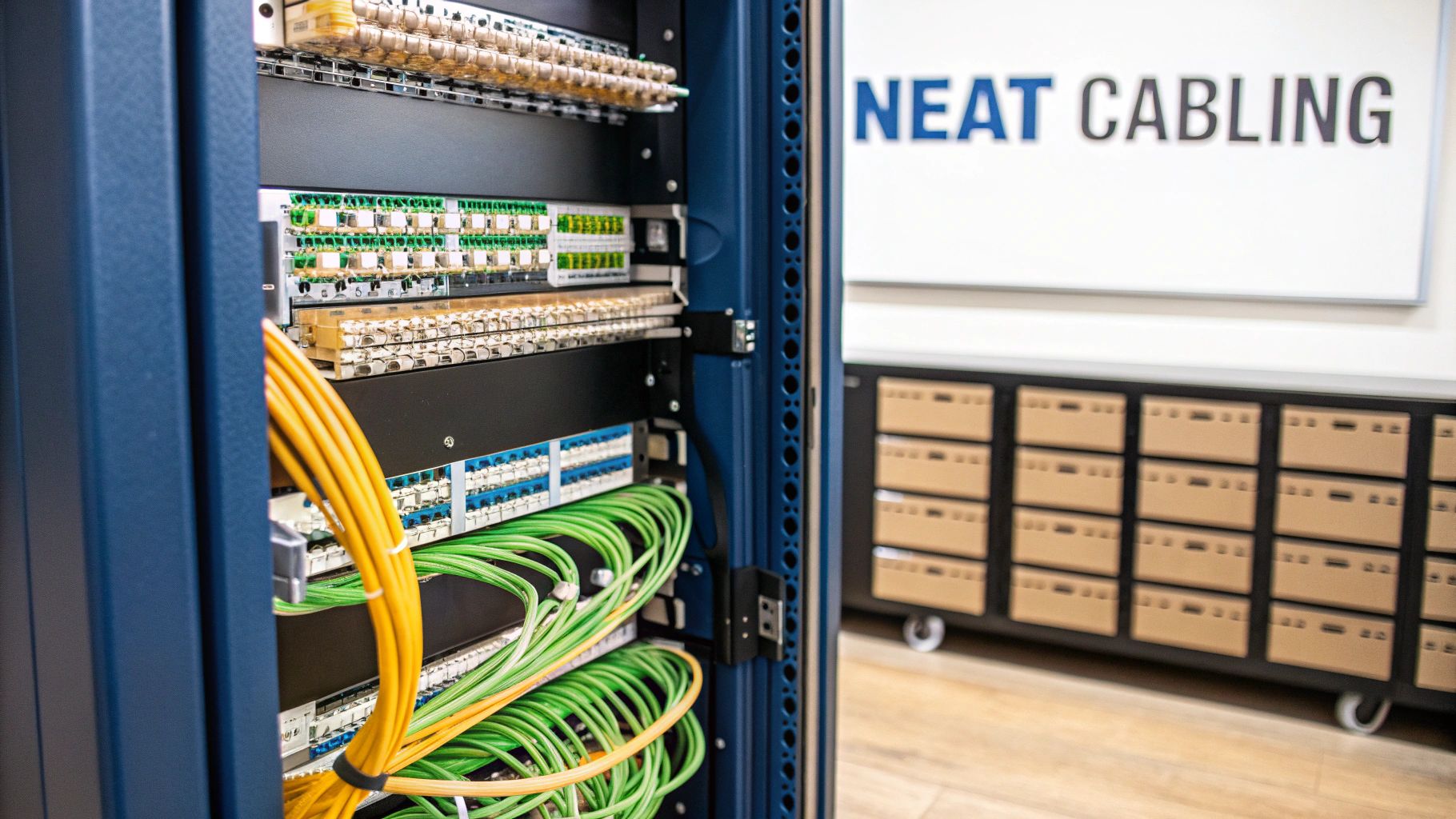
From the Server Room to the Tidy Desk
Great cable management starts in the data cabinet, but its principles should echo all the way out to the user's workspace. A clean, organised setup in the server room sets the standard for the entire network infrastructure, fostering a culture of precision and care.
The core principles we live by on every project include:
Logical Routing: We route cables through dedicated pathways and managers, ensuring they're never stretched taut across open spaces. This simple step prevents snagging and physical stress on the connectors, which is a common cause of failure.
Methodical Labelling: Every single cable is clearly labelled at both ends. This can genuinely turn a four-hour troubleshooting nightmare into a five-minute fix. It’s an absolute game-changer.
Maintaining Bend Radius: You simply cannot bend fibre optic cables sharply without risking damage to the delicate glass core. We meticulously ensure every cable adheres to the manufacturer's specified minimum bend radius, safeguarding signal integrity for the long haul.
This disciplined approach ensures that the high standards we hit during the installation and testing phases are maintained throughout the network's life. It’s the foundation for creating that tidy desk environment, where the cabling at the endpoint is just as neat and manageable as the backbone. To really see how this plays out in an office, you can explore the benefits of professional cable management and the impact it has on both safety and productivity.
Planning for Office Relocation and Future Growth
Here’s the thing: a well-managed network is an inherently future-proofed one. When your infrastructure is clearly documented and physically organised, adapting to change becomes dramatically easier and cheaper. A full-scale office relocation with equipment testing is the perfect real-world test where the value of this approach becomes crystal clear.
Imagine having to move your entire business's IT equipment. With a meticulously managed network, the process is streamlined and predictable. We can decommission, move, and recommission servers and switches with total confidence, knowing exactly what connects where. Every piece of equipment is tested before and after the move to ensure a seamless transition with minimal business disruption.
A documented and well-managed cabling system isn't just a convenience; it's a strategic asset. It dramatically reduces the risks associated with moves, adds, and changes, turning a potentially chaotic office relocation into a controlled, predictable project.
This forward-thinking approach also makes future upgrades a breeze. When it’s time to boost network speed or add capacity, an organised system allows for targeted, efficient work. There’s no need to spend hours untangling a "spaghetti junction" of wires just to replace a switch or patch in a new server. This methodical process is a hallmark of a properly certified, tested network delivery.
As an Excel network accredited partner, we build these principles into the DNA of every project. It's a key part of delivering a network that not only performs exceptionally on day one but also provides genuine long-term value. This commitment to quality and organisation is essential for unlocking the full 25-year equipment warranty, which protects your investment and guarantees performance for decades in demanding environments like commercial buildings and hospitals.
Choosing the Right Fibre Installation Partner
Your fibre optic cable installation project is only ever as good as the team you hire to deliver it. This is probably the single most important decision you'll make, as it dictates the quality, reliability, and long-term value of your entire network.
Get it wrong, and you could be heading for a world of data network mistakes. But get it right, and you're set up with a smooth, certified, and future-proofed asset. This isn't just about finding someone who can pull cables; it's about partnering with a specialist who understands the unique challenges of complex environments, from busy commercial buildings to sensitive hospitals. Their expertise is the difference between a project that causes major disruption and one that runs seamlessly in the background.
Credentials That Actually Matter
When you're vetting potential installers, it’s easy to get bogged down in technical jargon. The trick is to focus on credentials that give you tangible proof of quality and accountability. For us, one of the most critical is accreditation from a leading manufacturer.
Being an Excel network accredited partner is non-negotiable. This status isn't just a shiny badge; it’s your direct ticket to a manufacturer-backed 25 year equipment warranty. This warranty is only granted when an installation is performed by certified engineers and passes a strict set of performance tests. It’s your guarantee that the system will perform for decades.
A partner’s accreditations are your first line of defence against poor workmanship. They prove a commitment to ongoing training, adherence to industry standards, and a direct relationship with the manufacturer, which is vital for long-term support.
Experience in Your Specific Environment
Not all installations are created equal. An installer with heaps of experience in new-build offices might not be the right fit for a live hospital where infection control and zero disruption are the top priorities. You need to ask targeted questions about their experience in settings that mirror your own.
Commercial Buildings: Have they worked in occupied offices before? Can they map out a plan for out-of-hours work to keep your business running without a hitch?
Hospitals and Healthcare: Are they familiar with the specific regulations and hygiene protocols required in clinical environments?
Office Relocation Projects: Can they show you a track record of managing complex moves, including pre- and post-move equipment testing to guarantee a flawless Day One?
This kind of targeted experience is crucial. It shows they understand the operational headaches, not just the technical ones.
The broader UK context also plays a part here. Government-led initiatives like Project Gigabit have driven a massive expansion of our national fibre backbone. In fact, by January 2025, an impressive 73% of UK premises had access to full-fibre. This nationwide upgrade means businesses can now demand more from their in-building networks, making your choice of a high-calibre installation partner more critical than ever. You can read more about these national trends in these recent fibre broadband statistics.
A Commitment to Certified and Tested Network Delivery
Finally, any partner worth their salt must have an unwavering commitment to making sure your network is tested and certified. The project isn’t finished until you have a detailed report in your hands showing that every single link passes industry-standard performance tests.
This documentation is your proof that you got what you paid for. It’s also an essential tool for future troubleshooting and, critically, it’s what validates that 25-year warranty.
Any installer who treats testing as an afterthought is a major red flag. True professionals know that a certified, tested network delivery is the ultimate sign of a job well done, from the server room to the tidy desk.
Common Questions About Fibre Optic Installations
Even with a solid plan in hand, IT and facilities managers always have a few practical questions about what a commercial fibre optic cable installation actually involves. We get asked these all the time, so let's tackle the most common queries we see, from project timelines to the real-world value of a long-term warranty. The goal is to help you navigate your next big infrastructure project with your eyes wide open.
How Long Does a Typical Installation Take?
This is the classic "how long is a piece of string?" question, because no two projects are ever the same. A straightforward single-floor fit-out in a brand-new building with clear, accessible pathways might only take a few days. When the groundwork is already there, the physical install can be surprisingly quick.
Now, contrast that with a multi-floor installation in a live, operational hospital. That’s a whole different ball game. You’re working around patients, sensitive medical equipment, and strict hygiene protocols, which often means scheduling all the disruptive work for nights and weekends. A project like this, needing new vertical risers and meticulous planning, could easily stretch over several weeks to guarantee zero disruption to critical services.
The biggest variable in any installation timeline isn't the technology; it's the environment. Working in occupied commercial buildings or hospitals requires a level of planning and flexibility that goes far beyond the technical work itself, directly impacting the schedule.
What Is the Biggest Data Network Mistake to Avoid?
Honestly, the most expensive mistake we see has nothing to do with the tech itself. It's a failure of foresight. Installing a network that only just meets your requirements today is a recipe for expensive disruption down the line. When your needs grow—and they always do—you'll be forced into a costly and painful retrofitting project that could have been avoided.
The second critical error is failing to insist on proper testing and certification at the end of the job. An uncertified network is a complete unknown. It comes with no performance guarantees, makes troubleshooting a time-consuming nightmare, and completely invalidates those valuable long-term warranties. This is why a certified, tested network delivery should be a non-negotiable part of any serious business infrastructure project.
Why Is a 25 Year Equipment Warranty So Important?
A 25 year equipment warranty from a manufacturer like Excel, provided through an Excel network accredited partner, is your ultimate seal of quality and long-term reliability. It’s far more than a simple promise to replace a faulty part; it’s a comprehensive guarantee that the entire system was designed and installed to the highest possible performance standards.
This warranty certifies that:
The components used are top-tier quality.
The installation was carried out by certified engineers following proven best practices.
The finished network has been rigorously tested and proven to meet strict international standards.
For any business, this warranty protects a critical long-term asset. It ensures the physical layer, from the server room to the tidy desk, will support your network for decades. This is true whether you’re in a standard office or navigating a complex office relocation with equipment testing. It is the final proof that the job was done right.
Planning a complex infrastructure project requires a partner who understands the details from start to finish. At Constructive-IT, we specialise in delivering certified, warrantied network solutions for commercial buildings and hospitals across the UK. Get in touch today to discuss your next project.
Comments