


Mastering IT Infrastructure Project Management Strategies
- Craig Marston
- Oct 21, 2025
- 17 min read

IT infrastructure project management isn't just about ticking off tasks on a list. It's the specialised craft of planning, executing, and delivering an organisation's entire technology backbone. This goes way beyond simple project tracking; it’s about orchestrating everything from the initial server setups to large-scale fibre cable installation. To get it right, you need a unique mix of deep technical know-how and sharp strategic oversight to build a foundation that’s resilient, secure, and ready for growth.
What Is IT Infrastructure Project Management Really?

Think of a standard project manager like a film director, coordinating actors and scenes to create the final movie. An IT infrastructure project manager is more like the chief civil engineer. They're the ones responsible for designing and building the city’s entire power grid, water supply, and road network before anyone can even think about filming. Their work is the invisible, essential foundation that everything else relies on.
This is fundamentally different from managing a software project. While software projects deal with flexible code and can pivot quickly, infrastructure projects are all about tangible, physical assets. You can't just "undo" a poorly installed server rack or incorrectly laid network cabling. The stakes are much higher, lead times are longer, and the impact of a mistake can be far more severe, causing real-world disruption and significant financial loss.
The Physical Reality Of Infrastructure Projects
Managing physical hardware brings a whole set of challenges that software projects rarely encounter. These projects are defined by logistics, physical limitations, and long-term commitments.
Hardware Logistics: Success often depends on navigating complex supply chains for servers, routers, and switches, where lead times can easily stretch for months.
Physical Security: A huge part of the job is securing physical spaces like server rooms and data centres against both unauthorised access and environmental threats.
Vendor and Partner Coordination: Getting the job done right often means working with certified professionals, like an Excel network accredited partner, to ensure installation standards are flawless.
Long-Term Guarantees: Unlike a software bug that can be patched, physical kit has to be reliable for years. Securing a 25 year equipment warranty provides that crucial long-term peace of mind.
This focus on the physical world demands meticulous planning and foresight. A project to upgrade an office's structured cabling, for instance, requires precise coordination to keep disruption to a minimum. You can see what goes into a modern setup by exploring a proper network infrastructure design.
An infrastructure project's success is measured not just by its on-time delivery, but by its reliability five, ten, or even twenty years down the line. It's about building a foundation that supports future growth, not just meeting today's immediate needs.
To help break this down, let's look at the core components of modern IT infrastructure projects and what the management focus looks like for each.
Key Components of Modern IT Infrastructure Projects
Component | Description | Project Management Focus |
|---|---|---|
Network Cabling | The physical wiring (copper and fibre) that forms the core of the network. | Site surveys, route planning, minimising disruption during installation, standards compliance (e.g., TIA/EIA), and certification testing. |
Servers & Storage | Physical servers, storage area networks (SANs), and network-attached storage (NAS) that house data and applications. | Power and cooling calculations, rack layout planning, hardware procurement lead times, and physical installation logistics. |
Data Centres | The secure, climate-controlled facilities that house critical infrastructure. | Physical security planning, environmental monitoring, power redundancy (UPS, generators), and cooling system management. |
Wireless Networks | Wi-Fi access points, controllers, and related hardware providing wireless connectivity. | Wireless site surveys to map coverage and interference, access point placement, and security configuration. |
Each of these elements requires a specific set of skills and a hands-on approach that goes far beyond a simple Gantt chart.
From Blueprint To Certified Delivery
Ultimately, IT infrastructure project management is the art of turning a technical blueprint into a fully operational and dependable system. It’s a process that starts with a strategic business need and finishes with a certified, tested network delivery. This meticulous approach ensures the final infrastructure isn't just functional but also secure, scalable, and built to last—providing the robust technological bedrock an organisation needs to thrive.
The Five Phases of a Successful Infrastructure Project
Every solid IT infrastructure project, whether it's a new data centre build or a campus-wide network upgrade, follows a structured path. This isn't a chaotic scramble to the finish line; it’s a deliberate journey through five distinct phases. Getting your head around this framework is what turns a hugely complex undertaking into a manageable and predictable process.
The five core phases are Initiation, Planning, Execution, Monitoring, and Closure. A great way to think about this is like building a house. You wouldn't start laying bricks without an architect's blueprint, and you certainly wouldn't hand over the keys until every tap works and the electrics are fully signed off. It's the same principle here.
This visual flow breaks down the first three critical stages, showing how a project moves from an idea on paper to a physical reality.
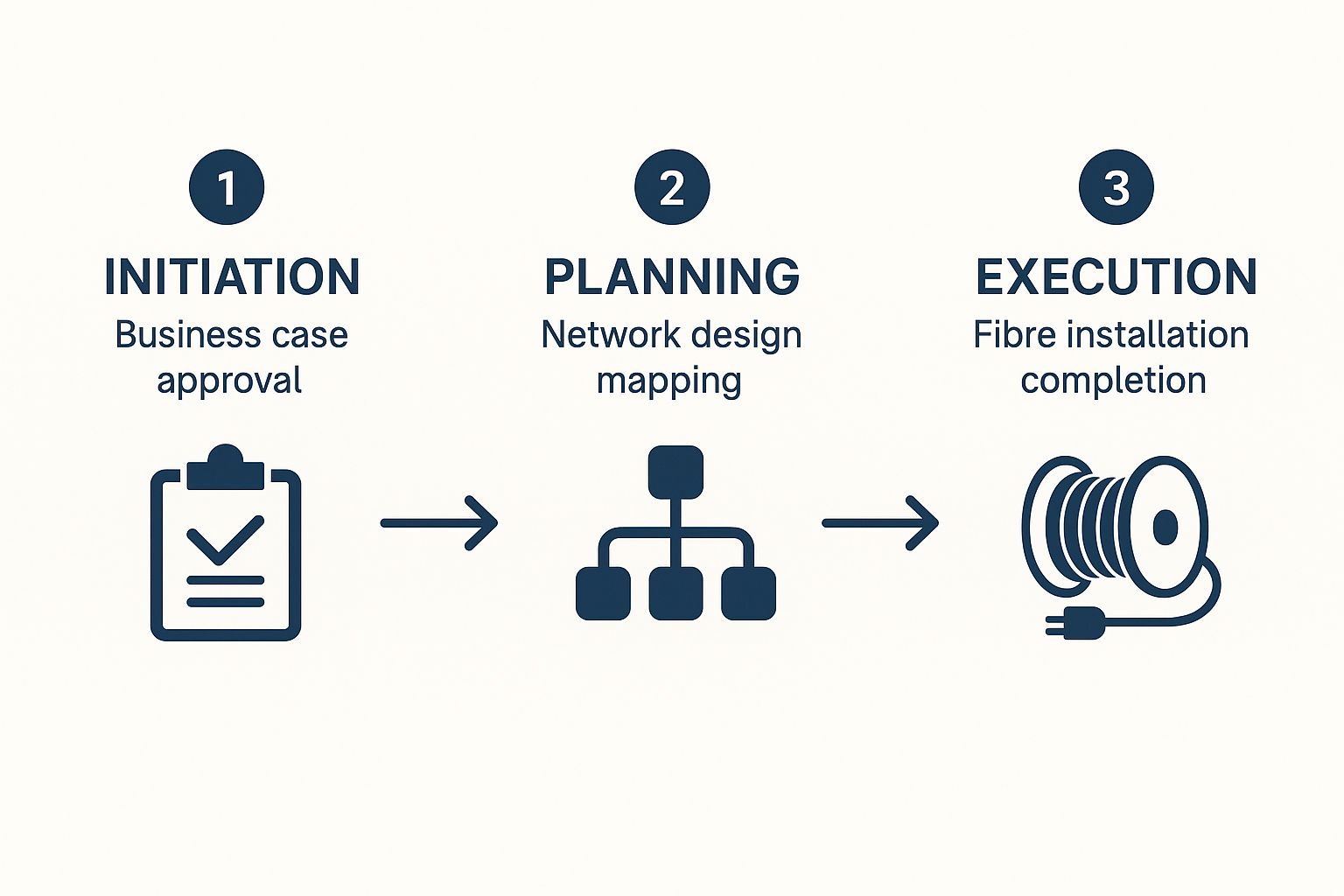
As the infographic shows, each phase delivers a tangible outcome, giving everyone the confidence to move on to the next stage.
Phase 1: Initiation
Every project begins not with a server rack, but with a real business need. This is the Initiation phase, where we establish the "why" behind the project and get the green light from key stakeholders. It’s all about proving the project’s value before a single cable is ordered.
For instance, picture a company whose creaking old network is slowing everyone down and hurting productivity. The initiation phase would involve putting together a solid business case. This document would spell out the problem, propose a fix (like a new cloud environment or a full network overhaul), and clearly outline the expected benefits, costs, and risks. The main goal here is to get an approved project charter—your official mandate to proceed.
Phase 2: Planning
Once you’ve got the go-ahead, the project moves into the meticulous Planning phase. This is arguably the most crucial stage of all. It’s where the project manager and their team create the detailed roadmap that will guide every decision from here on out. A thorough plan is your best defence against the dreaded scope creep and budget blowouts.
Let’s say you're upgrading the network across a multi-floor office. The planning phase would involve a checklist like this:
Detailed Site Surveys: Walking the floors to map out every data point, server room, and potential cabling path. No assumptions allowed.
Resource Allocation: Figuring out which engineers, technicians, and vendor partners are needed for each specific task.
Procurement Strategy: Getting all the necessary kit ordered from trusted suppliers—switches, routers, cabling, the lot.
Risk Assessment: Thinking ahead about what could go wrong. What if a hardware delivery is late? What if we find asbestos in the walls?
Asset Audits: You can’t plan a new system without knowing exactly what you have now. To get this right, you can learn how to perform an asset audit in our comprehensive guide.
The result of all this work is a comprehensive project plan that becomes the single source of truth for the entire team.
Phase 3: Execution
This is where the plan springs to life. The Execution phase is all about doing the actual work—installing hardware, configuring systems, and bringing the new infrastructure online. For a physical job, this means boots on the ground, with teams running cables, mounting equipment, and making it all happen.
Imagine a team of certified technicians performing a fibre cable installation. They don't just throw cables in; they work methodically, ensuring every connection is clean, secure, and meets strict industry standards. As an Excel network accredited partner, this phase is built on rigorous procedures that guarantee quality. It all leads to a certified, tested network delivery. The key is to stick to the plan while being agile enough to handle any real-world curveballs.
Phase 4: Monitoring and Control
Execution and Monitoring run side-by-side. Think of this phase as the project's central nervous system, constantly checking progress against the plan. It's about making sure the project stays on track, on budget, and meets the quality standards we promised.
Project managers use key performance indicators (KPIs) to keep a close eye on project health, tracking things like budget variance and schedule adherence. If a hardware shipment gets delayed, the PM is on it—assessing the impact and adjusting the plan to keep things moving. This constant oversight stops small hiccups from turning into major disasters.
Phase 5: Closure
The final phase, Closure, is about more than just finishing the last task. It’s a formal process for completing the project and handing it over smoothly to the operations team who will manage it day-to-day.
This involves finalising all the documentation, getting sign-off that all deliverables have been met, and holding a post-project review to capture lessons learned for next time. The ultimate goal is to hand over a fully functional system, backed by a 25 year equipment warranty, and officially mark the project as a success.
Choosing Your Project Management Playbook
When it comes to IT infrastructure project management, there isn't a single playbook that guarantees success. Choosing the right methodology is like picking the right tool for the job—you wouldn't use a sledgehammer to hang a picture frame. The best approach hinges entirely on your project's complexity, how stable its requirements are, and the level of flexibility you need.
Getting this decision right at the start is critical. It sets the tone for the entire project, shaping everything from your initial plans and stakeholder communication to how you handle inevitable curveballs. The three core playbooks you’ll be working with are Waterfall, Agile, and a pragmatic blend of the two, Hybrid.
The Waterfall Method: Rigidity and Predictability
The Waterfall methodology is the classic, linear approach to getting things done. Think of it like building a house: you pour the foundation, then build the frame, add the roof, and so on. Each phase has to be completely finished before the next one can begin, creating a predictable, step-by-step flow.
This rigid structure is also its greatest strength. It’s perfect for projects where the goals are crystal clear from day one and are highly unlikely to change.
A prime example is a new data centre build or a major fibre cable installation across an office building. The physical requirements are defined, the end goal is fixed, and success relies on meticulous upfront planning and sequential execution. There’s very little room for ambiguity when you’re dealing with concrete, steel, and precise cabling routes.
The Agile Method: Flexibility and Evolution
In sharp contrast, Agile is all about iteration and adaptation. Instead of one long, sequential process, projects are broken down into short cycles called "sprints." This allows teams to deliver value in small increments, get feedback, and adjust their course as they go.
Agile is the default choice for projects where you expect requirements to evolve. Imagine a phased migration to a hybrid cloud environment. The overall objective is clear, but the specific technical details and user needs might shift as the project moves forward and you learn more.
This methodology is built on collaboration and continuous improvement, which is why it’s a natural fit for software development. However, its principles are now being applied more and more to infrastructure projects with some uncertainty, like a campus-wide Wi-Fi upgrade that gets rolled out one building at a time.
The Hybrid Model: The Best of Both Worlds
For many modern infrastructure projects, neither pure Waterfall nor pure Agile feels quite right. This is where the Hybrid model steps in, offering a practical middle ground that combines the strengths of both. It pairs the detailed, upfront planning of Waterfall with the flexible execution of Agile.
The Hybrid approach gets one thing right about infrastructure projects: you absolutely need a solid plan for the physical stuff like ordering hardware, but you also need to be nimble enough to adapt to changing service configurations and stakeholder needs during the rollout.
For instance, a complete office network overhaul might use a Waterfall approach for the physical cabling and hardware installation. This ensures the foundational work, perhaps carried out by an Excel network accredited partner, is done perfectly the first time.
At the same time, configuring firewalls, network switches, and access policies could be managed using Agile sprints. This lets the team react to security feedback and user requests as they come up, leading to a certified, tested network delivery that’s both robust and fine-tuned to the business. The ultimate aim is a system backed by a 25 year equipment warranty, built with both precision and adaptability.
Waterfall vs Agile vs Hybrid for Infrastructure
Choosing the right playbook can feel daunting, but it doesn't have to be. This table breaks down the core differences to help you decide which methodology is the best fit for your specific infrastructure project.
A comparative guide to help you choose the most effective methodology for your specific project needs.
Methodology | Ideal For | Primary Strength | Key Weakness |
|---|---|---|---|
Waterfall | Projects with fixed, unchanging requirements, like new builds or structured cabling installations. | High predictability and control through detailed upfront planning. | Inflexible and slow to respond to changes once the project is underway. |
Agile | Projects where requirements may evolve, such as phased cloud migrations or software-defined networking. | Adaptability and rapid feedback loops, allowing for continuous improvement. | Can be difficult to apply to projects with heavy physical hardware dependencies and long lead times. |
Hybrid | Complex projects with both physical and configurable components, like a full office technology fit-out. | Balances upfront planning for hardware with flexible execution for software and configuration. | Requires skilled management to integrate two different mindsets and workflows effectively. |
In the end, the best IT infrastructure project management approach is the one that aligns with your project's unique character. By understanding these core playbooks, you can make an informed choice that puts you on the path to success from day one.
The Modern PMs Toolkit for Infrastructure Projects
Let's be honest: you can't run a complex IT infrastructure project from a spreadsheet anymore. Today's project managers rely on a whole toolkit of software to tame complexity, keep teams aligned, and stakeholders in the loop. These tools are the central nervous system of a project, turning plans and ideas into a single source of truth everyone can depend on.
Getting the right technology isn't a luxury; it’s a strategic move. It translates directly into smoother rollouts and fewer expensive mistakes. From mapping out every dependency to creating detailed network diagrams, the right platform brings the clarity you need to guide a project from a rough idea to a successful launch.
Core Project and Task Management Platforms
At the heart of any infrastructure project, you'll find a powerful management platform. This is where the big-picture strategy meets the day-to-day grind. These systems act as a central hub for assigning resources, managing timelines, and tracking progress against those all-important milestones.
Two giants dominate this space for good reason:
Jira: Originally built for software development, Jira’s incredible flexibility makes it a firm favourite for infrastructure projects. Its ability to handle intricate task dependencies is perfect for managing everything from server deployments to a multi-stage fibre cable installation.
Microsoft Project: As a long-standing staple in project management, MS Project really shines with traditional, Waterfall-style planning. Its robust Gantt charts and resource management features are ideal for projects with fixed timelines and clear, sequential phases.
The appetite for these solutions is growing fast. The UK project management software market hit USD 334.7 million in 2023 and is predicted to rocket past USD 1 billion by 2030. It’s no surprise when you see that platforms like Jira are already used by over 52,000 companies. This isn't just a trend; it shows how essential software has become to project success. You can explore the full market projections and software trends to see the data for yourself.
Specialised and Collaborative Tools
Beyond the core platforms, project managers need specialised tools to handle the unique challenges of infrastructure work. Visualising the plan and keeping everyone talking are just as critical as ticking off tasks.
A project plan is only as good as its communication. If the network diagram is unclear or the installation team is out of sync with the procurement schedule, even the best plan will falter during execution.
This is where a few other key applications come into play:
Visualisation Tools (e.g., Lucidchart, Microsoft Visio): Absolutely vital for creating detailed network diagrams, server rack layouts, and data centre floor plans. A clear visual guide prevents costly misunderstandings and ensures the physical installation matches the design perfectly.
Communication Hubs (e.g., Microsoft Teams, Slack): Real-time communication is non-negotiable. These platforms connect engineers, vendors, and stakeholders, letting them solve problems and share updates instantly without getting buried in email chains. Strong communication is a cornerstone of efficiency, a topic we explore more in our guide on how to improve network performance in UK offices.
By blending a central project management system with these specialised tools, project managers create an ecosystem that drives clarity, encourages collaboration, and ultimately, delivers successful projects.
Managing Risk and Guaranteeing Quality

In high-stakes IT infrastructure project management, crossing your fingers and hoping for the best just won’t cut it. Because these projects involve physical hardware and real-world installation, even a tiny oversight can blossom into a massive, long-term headache.
Proactive risk management and a relentless focus on quality aren't just buzzwords; they're the guardrails that protect your investment and ensure your systems run smoothly for years to come.
Thinking ahead to neutralise threats is a project manager's bread and butter. This means going way beyond a simple risk register. It’s about war-gaming real-world scenarios. What happens if a critical server shipment gets stuck in customs for weeks? How will you shield a new network from cyber threats the moment it goes live? A robust plan has clear, actionable answers ready to go.
Building Quality in From Day One
You don’t just inspect for quality at the end of an infrastructure project; you build it in at every single stage. This is all about preventing problems, not just fixing them after the fact. It begins with choosing the right partners and materials and finishes with cold, hard proof that the system performs exactly as it was designed to.
One of the best ways to lock in quality from the start is to work with certified professionals. For something as fundamental as a fibre cable installation, bringing in an Excel network accredited partner is a no-brainer. This certification isn't just a shiny badge; it's your assurance that the engineers live and breathe stringent installation standards, making sure every connection is perfect and built to last.
Quality assurance isn't a one-off check box. It's a continuous process that separates a network that merely works on day one from one that performs reliably for the next decade, backed by a proper warranty.
This commitment to high standards is becoming the norm. In the UK, industries like construction, which often overlap with IT projects, are adopting integrated management systems to boost accuracy and control. With an estimated 102,100 construction project managers in the UK by early 2025, there's a clear industry-wide push towards better standards, powered by technology. You can learn more about the growth of UK project management professionals on Statista.com.
The Non-Negotiables of Project Handover
As the project wraps up, the focus pivots to validation and long-term protection. This is the moment of truth, where all the promises made during planning are proven, and the new infrastructure is signed off as ready for business.
Two things are absolutely critical at this stage:
A Certified, Tested Network Delivery: Every single cable, port, and connection must be rigorously tested with specialised equipment. The project team must hand over detailed certification reports proving the infrastructure meets—or beats—industry performance standards. This isn't a quick "it works" check; it's documented proof of excellence.
A Long-Term Equipment Warranty: Your investment deserves to be protected. Securing a 25 year equipment warranty gives you lasting peace of mind. This guarantee protects the core components of your network against defects, safeguarding the project's value and minimising future operational risks.
Ultimately, great risk and quality management is about building a foundation of trust. By insisting on certified experts, a fully tested delivery, and a robust warranty, you turn a complex project into a reliable, long-term business asset.
Future-Proofing Your Infrastructure Projects
The core principles of good IT infrastructure project management don't change much, but the technology it wrangles is constantly on the move. To stay ahead of the game, you need to look beyond today’s deliverables and start thinking about the tech shifts that will define the networks of tomorrow. This forward-looking mindset ensures your infrastructure doesn't just work for now, but is ready for whatever comes next.
Keeping your project management skills sharp means getting to grips with the next wave of challenges and opportunities. Trends that once felt like distant buzzwords are quickly becoming everyday realities, and they’re already having a direct impact on project planning, execution, and long-term strategy.
The Rise of AI in Project Automation
Artificial Intelligence (AI) is rapidly shifting from a sci-fi concept into a genuinely useful tool in the project manager's kit. In the UK, plugging AI into projects is a major trend, helping teams automate fiddly, complex tasks and make smarter decisions backed by solid data. For example, AI algorithms can now chew through massive datasets to predict potential project risks or optimise how you assign resources, hitting a level of accuracy that’s incredibly difficult to achieve by hand.
This isn't just a future fantasy; it's happening right now. It's estimated that by 2025, around 30% of project managers will be using AI to automate parts of their work, and that number is only set to climb as the tech gets better. You can find more insights on technological trends in UK project management on globalbanking.ac.uk. This isn't about replacing people—it's about freeing up project managers to focus on the human side of things, like strategic leadership and stakeholder communication.
Sustainable Practices and Green IT
Another massive consideration for future projects is sustainability. "Green IT" has gone from a niche concern to a core business priority, shaping everything from the kit you buy to how you design your data centre. As a project manager, you'll increasingly be expected to deliver infrastructure that’s not just powerful, but also energy-efficient.
This breaks down into a few key areas:
Energy-Efficient Hardware: Picking servers, switches, and cooling systems that give you the best performance-per-watt.
Optimised Data Centre Design: Planning for smart airflow and cooling to slash the overall power bill.
Responsible E-Waste Management: Having a clear, ethical plan for disposing of or recycling old equipment when it's decommissioned.
Future-proofing an IT infrastructure project is as much about environmental responsibility as it is about technological readiness. A sustainable design reduces operational costs and aligns with corporate social responsibility goals, adding long-term value to the investment.
Embracing IoT and Hybrid-Cloud Models
Finally, two huge shifts are redrawing the map of the modern network: the explosion of Internet of Things (IoT) devices and the ongoing move to hybrid-cloud models. Both bring their own unique project management headaches. The sheer number of IoT devices—from smart sensors in a factory to security cameras in an office—demands a network foundation that is rock-solid, scalable, and seriously secure.
At the same time, the hybrid-cloud model has made things a lot more complex, mixing on-premise data centres with public cloud services. Managing this patchwork of interconnected systems requires a deep understanding of both physical and virtual infrastructure. You've got to ensure data flows smoothly and security policies are applied consistently, no matter where the hardware or service actually lives.
Answering Your IT Infrastructure Project Questions
It’s completely normal to have a few questions when you're navigating an IT infrastructure project. Whether you're a seasoned IT director mapping out a data centre refresh or a facilities manager overseeing your first network installation, getting clear answers is key.
Let's dive into some of the most common queries we hear. The goal here is to give you direct, practical insights that build on what we've already covered.
Cloud vs On-Premise: What’s the Real Difference?
The fundamental difference comes down to tangibility and who holds the keys.
On-premise projects are very hands-on. You're dealing with physical assets you can see and touch—servers, racks, switches, and all the cabling that ties them together. It’s a world of logistics, site access, and managing the lifecycle of that hardware. You have ultimate control over the environment, but that also means you carry all the responsibility for its maintenance, security, and uptime.
Cloud projects flip the script. Your focus shifts away from physical kit and towards configuring virtual resources and managing your relationship with the cloud provider. The real challenge becomes navigating service level agreements (SLAs), keeping an eye on subscription costs, and ensuring your data is secure in someone else’s data centre. You trade that direct control for incredible scalability and a welcome break from physical maintenance.
What Skills Really Matter for an Infrastructure PM?
Beyond the usual project management playbook, there are three skills that are absolutely non-negotiable for anyone leading an infrastructure project today:
Technical Literacy: You don't need to be a senior network engineer, but you absolutely must grasp the basics of networking, server hardware, and cloud architecture. Without it, you can't lead productive conversations, spot potential risks, or tell if a proposed solution actually makes sense.
Vendor Management: So much of modern infrastructure relies on third-party suppliers. The ability to negotiate a fair contract, build strong partner relationships, and hold those suppliers accountable for deadlines and quality is a game-changer.
Risk Management: This is where the pros really shine. A great infrastructure PM has an almost sixth sense for real-world risks. They're constantly thinking about things like supply chain delays on a fibre cable installation or potential power and cooling problems in a server room. This foresight is what separates a smooth project from a costly disaster.
The single most common mistake we see in a new network installation? Inadequate planning and a rushed site survey. Teams that skip this crucial phase often run into unforeseen structural problems, incorrect cabling paths, or insufficient power, blowing their budget and timeline out of the water. A thorough, professional survey isn't an expense—it's the best investment you can make.
Choosing the right partners is just as vital as having the right skills on your team. When you work with an Excel network accredited partner, you’re ensuring your installation meets the highest industry standards, and it's all backed by a 25 year equipment warranty. A certified, tested network delivery from a provider you trust takes the guesswork out of the equation and guarantees performance from day one.
At Constructive-IT, we have over 20 years of experience managing and delivering complex IT infrastructure projects across the UK. From initial design and certified cabling to post-deployment support, we ensure your network is secure, reliable, and ready for the future. Plan your next project with confidence by visiting us at https://www.constructive-it.co.uk.
Comments