


Your Essential Guide to Category 6a Cable for UK Networks
- Craig Marston
- Dec 17, 2025
- 15 min read

Category 6a cable is the modern workhorse for high-performance network infrastructure, built to reliably deliver 10 Gigabit per second (Gbps) speeds over the full 100-metre distance. Its superior design is what future-proofs commercial buildings, making sure they’re ready for the demands of next-generation technology.
Why Your Cabling Is a Strategic Decision
Think of your building's data network as its central nervous system. Just like the nervous system carries vital signals throughout the body, your network cabling is the backbone carrying the data that powers every modern operation—from video conferencing and cloud access to critical patient monitoring systems in a hospital.
Choosing the right cabling isn't just a technical tick-box exercise; it's a fundamental business decision that directly impacts productivity, reliability, and your capacity for future growth.
A Common (and Costly) Mistake
For decision-makers overseeing commercial buildings and hospitals, one of the most common and expensive data network mistakes is underestimating their cabling needs. Opting for an older, cheaper standard might seem like a smart saving today, but it creates a hidden bottleneck that will inevitably choke performance as data demands ramp up.
This is where Category 6a cable, often shortened to just Cat6a, becomes essential. It’s the difference between a network that just about works and one that performs flawlessly under pressure. Making sure your network is tested and certified is the only way to guarantee this performance.
To give you a quick overview, here are the key specs and ideal uses for Cat6a cabling.
Category 6a Cable At a Glance
Specification | Performance Metric | Ideal Commercial Application |
|---|---|---|
Data Rate | 10 Gbps | High-speed office LANs, data centre interconnects, and demanding workstations. |
Max Distance | 100 metres | Full-length horizontal cabling runs from comms rooms to desk outlets. |
Frequency | 500 MHz | Supporting high-bandwidth applications like HD video streaming and large file transfers. |
PoE Support | PoE++ (Up to 90W) | Powering high-draw devices like CCTV cameras, smart lighting, and VoIP phones. |
This table shows why Cat6a has become the go-to standard for new commercial installations where performance and future-readiness are non-negotiable.
The Motorway Analogy for Data Transfer
Imagine your network is a motorway. An older standard, like Cat6, is like a two-lane road that works fine when traffic is light. But the moment you add high-demand applications—think Power over Ethernet (PoE++) devices, VoIP phone systems, and high-resolution video streams—you’ve created a massive traffic jam. Data slows to a crawl, connections become unstable, and productivity grinds to a halt.
Category 6a is the equivalent of upgrading that road to a five-lane motorway. It operates at a frequency of 500 MHz—double that of Cat6—which provides a huge amount more bandwidth. This means more data can travel at the same time at high speeds without getting congested, ensuring your most critical applications run smoothly and reliably, every time.
Future-Proofing for Commercial and Healthcare Environments
In demanding environments like hospitals or large office complexes, investing in a robust, certified network from day one is absolutely crucial. A professionally installed Category 6a network gives you the headroom to adopt future technologies without the massive cost and disruption of a complete re-wire down the line.
The demand for high-performance cabling is only growing. Industry analysis points to the UK as a high-growth market, with the global Category 6A cable market projected to hit approximately USD 4.9 billion by 2032. You can find out more about the cabling market growth on dataintelo.com.
A properly planned infrastructure supports your data-intensive operations right from the start. For a deeper dive into different cabling options, check out our guide on the categories of computer network cables and how to choose the best one for your project. Making the right choice now ensures your building's infrastructure is an asset, not a liability.
Choosing the Right Cable: Cat6a vs Cat6 vs Fibre
Picking the right network cable is about more than just looking at speeds on a spec sheet. It’s about laying a foundation that can handle what your business needs today and what it will demand tomorrow. When we're scoping out a project for a commercial building or a hospital, the conversation almost always narrows down to three serious contenders: Category 6, Category 6a, and fibre optic cabling.
Getting your head around the practical differences between them is the key to making a decision that’s cost-effective, compliant with industry standards, and ready for the future. Each one has a specific job to do in a modern, high-performance network, from horizontal Cat6a runs to expert fibre cable installation for the backbone.
This decision tree gives you a quick visual guide to the key questions you need to ask when choosing your cabling.
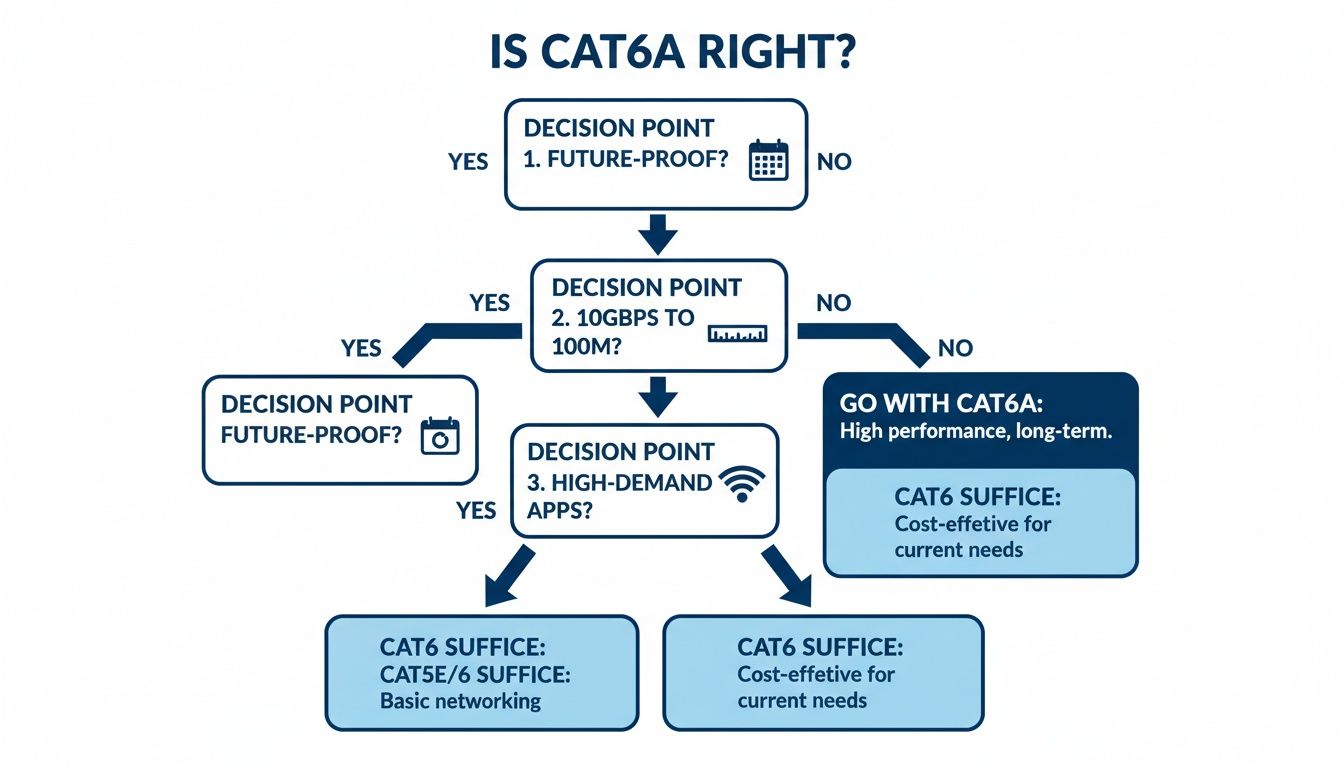
As you can see, the moment you need to guarantee 10Gbps speeds over full-length cable runs for demanding applications, Cat6a becomes the starting point.
The Critical Leap from Cat6 to Cat6a
At a glance, Cat6 and Cat6a cables might look the same, but in terms of performance, they’re worlds apart. Standard Cat6 can technically hit 10Gbps, but only over very short distances—usually up to 55 metres at best, and often less if there’s any significant electrical noise nearby.
This is where a Category 6a cable installation really shines. It's engineered from the ground up to reliably deliver that full 10Gbps speed over the entire 100-metre distance permitted by structured cabling standards. That makes it the only dependable copper solution for connecting workstations and devices across large office floors without the risk of performance dropping off a cliff.
A crucial, but often overlooked, benefit of Cat6a is its superior design for fighting off alien crosstalk (ANEXT). This is a specific type of interference that jumps between adjacent cables when they're bundled together. As data speeds climb, the signals become more vulnerable to this 'noise,' which causes errors and slows the whole network down. Cat6a’s tighter twists and beefier construction act as a natural shield, keeping the signal clean even in crowded cable trays.
To get a better feel for its predecessor, you can dive into our essential guide to Cat 6 cable, which provides a solid baseline for comparison.
Practical Comparison of Network Cabling Standards
To make the choice clearer, here's a look at how these cabling types stack up in the real world. This isn't just about specs, but about where each one fits best in a typical commercial project.
Cabling Type | Max Speed & Distance | Best For | Key Consideration |
|---|---|---|---|
Cat6 | 10Gbps up to 55m | General office use, VoIP, standard data points. | Cost-effective for 1Gbps networks, but limited for future 10Gbps upgrades over distance. |
Cat6a | 10Gbps up to 100m | High-performance workstations, Wi-Fi 6/7 access points, PoE devices, data centres. | The modern standard for future-proofing horizontal runs to the desk and end devices. |
Fibre Optic | 100Gbps+ over kilometres | Backbone links between comms rooms, connecting buildings, long-distance data transmission. | Unbeatable for speed and distance, but doesn't supply power (no PoE). |
Essentially, the choice comes down to balancing today's budget with tomorrow's performance needs. For any new installation aiming for longevity, Cat6a is the go-to copper standard, while fibre handles the heavy lifting between key network hubs.
Copper Workhorse vs Fibre Superhighway
The debate between Cat6a and fibre optic isn't about which one is "better"—it's about using the right tool for the right job. It’s best to think of them as two parts of a complete, robust network solution.
Category 6a: The Workhorse. This is your go-to for all the horizontal runs—the cables that snake out from the comms room to every user's desk, wireless access point, VoIP phone, and CCTV camera. Its ability to deliver Power over Ethernet (PoE) is a game-changer, powering devices right through the network cable and cutting out the need for separate electrical wiring.
Fibre Optic: The Superhighway. Fibre is completely unmatched for backbone connections. It’s the superhighway that links comms rooms together in a large building or connects separate buildings across a whole campus. Because it's immune to electromagnetic interference and can carry data for kilometres, a professional fibre cable installation is the only real choice for these high-capacity, long-distance links.
For most commercial setups, a hybrid approach works best. Fibre provides the high-speed backbone, and Cat6a cabling efficiently delivers that speed right to the end-user's device. For anyone wanting to broaden their knowledge on the fundamentals, this resource on common cable types and connectors is a great place to start.
Understanding Shielded vs Unshielded Cabling
When you’re choosing a Category 6a cable, one of the first decisions you'll face is whether to go for a shielded or unshielded version. This isn't just a minor technical detail; it’s your network's first and most important line of defence against electrical interference, ensuring your data signals stay clean, clear, and error-free.
To really get why this matters, we need to talk about a specific type of interference called Alien Crosstalk (ANEXT).
The Crowded Room Analogy for Alien Crosstalk
Imagine trying to have a clear conversation in a packed, noisy room. As more people start talking, their voices bleed into yours, making it harder and harder to hear. You start mishearing words or having to ask the other person to repeat themselves. This is a perfect real-world example of ANEXT.
When you bundle lots of data cables together in a tray or conduit, the electrical signals from one cable can "bleed" over and disrupt the signals in the cable next to it. This interference is like background noise, causing data errors, packet loss, and a noticeable drop in your network’s speed.
Shielding acts like a soundproof barrier between these conversations. By wrapping the cable's internal wires in a protective layer of foil or braid, it blocks external electrical noise and stops signals from interfering with each other. This ensures every bit of data is delivered exactly as it was sent.
Unshielded (UTP) vs Shielded (FTP) Category 6a Cable
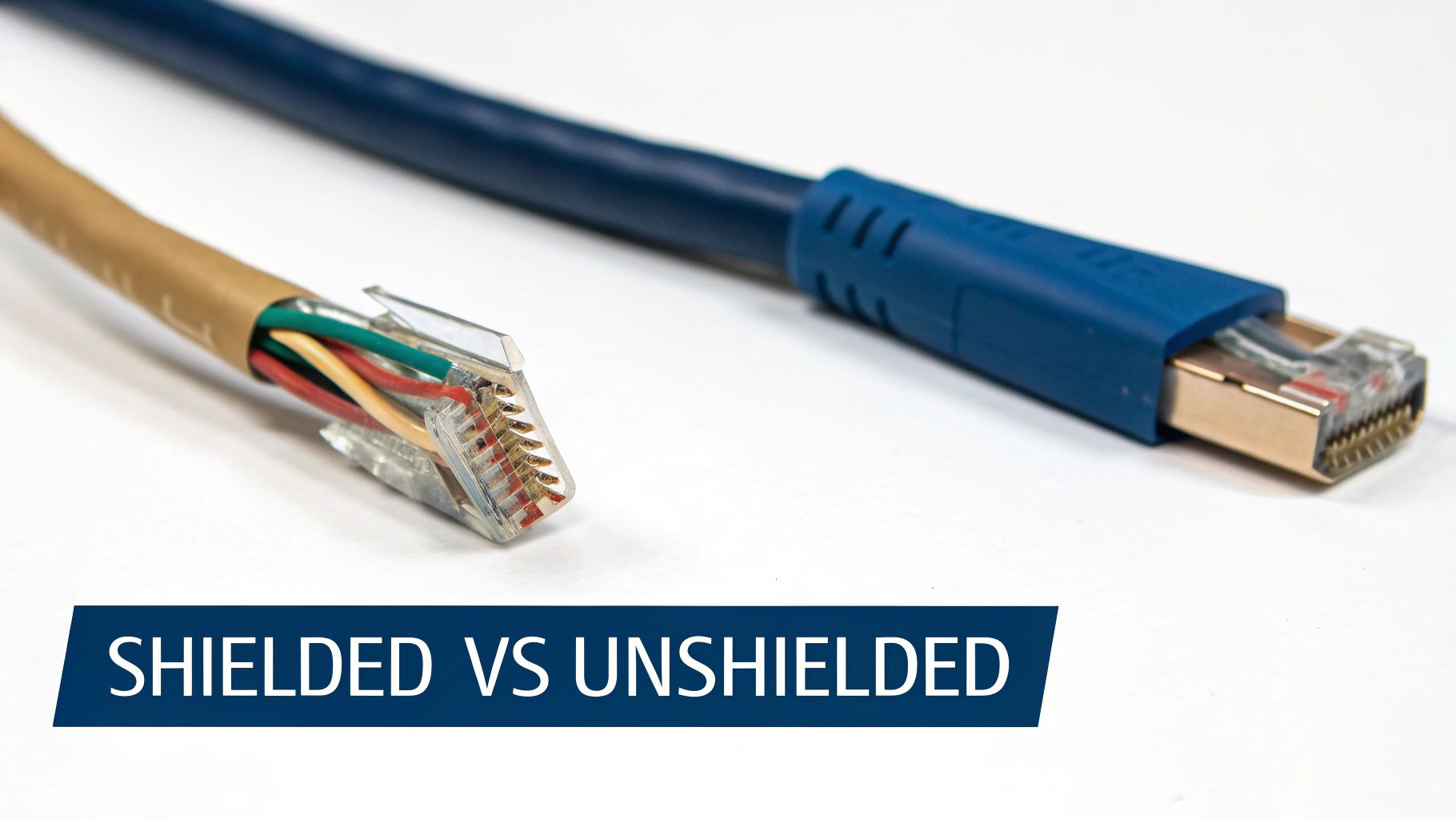
The two main options you'll come across are Unshielded Twisted Pair (UTP) and Foiled Twisted Pair (FTP), which is a common type of shielded cable.
Unshielded Twisted Pair (UTP): This is the more common and generally less expensive option. Cat6a UTP cables use a thicker outer jacket and clever internal designs to reduce some ANEXT, which makes them perfectly suitable for standard office environments where there isn't much electromagnetic interference (EMI).
Foiled Twisted Pair (FTP): This cable has an extra layer of foil shielding wrapped around the twisted pairs. It’s vital that this shield is properly grounded during installation to work effectively, but once it is, it provides fantastic protection against EMI and practically eliminates ANEXT.
This distinction becomes absolutely critical in environments where the integrity of your signal is everything. In electrically "noisy" settings, the choice becomes very clear.
When Shielded Cable Is Non-Negotiable
While UTP is absolutely fine for many commercial buildings, certain environments produce high levels of EMI that can completely cripple an unshielded network. In these scenarios, using shielded FTP or STP (Shielded Twisted Pair) Cat6a cabling is non-negotiable.
Think of places like:
Hospitals: Where sensitive medical equipment, such as MRI and X-ray machines, generates significant EMI.
Manufacturing Floors: Filled with heavy machinery, motors, and industrial equipment running nearby.
Data Centres: Where cables are packed densely together, massively increasing the risk of ANEXT.
In these situations, the extra investment in shielded cabling is a small price to pay for a network that's robust, reliable, and secure. This growing preference for shielded variants is something we're seeing across the market. The adoption of Category 6A in the UK has sped up significantly, with more than half of Cat6a connections now being supplied as shielded variants.
As an Excel Networking accredited partner, we see this trend first-hand. In fact, Excel's UK market share for Cat6A hit 22% based on 2022 sales, highlighting just how big this shift is. You can read more about these UK market developments and Excel's growth online.
Real World Applications for Category 6a Cabling
Technical specs like 10Gbps and 500 MHz are one thing, but where the investment really pays off is seeing what that power enables in a busy office or a critical healthcare setting. A category 6a cable network isn't just a collection of passive wires in the wall; it’s the active backbone that makes modern technology work.
Let’s get practical and look at how Cat6a supports the devices and systems that organisations depend on every single day. This is where abstract data speeds turn into real-world results.

Powering the Modern High-Performance Office
In today's commercial buildings, the network does so much more than just connect a few computers. It needs to deliver a flawless, high-speed experience for an entire ecosystem of connected devices.
A professionally installed Cat6a infrastructure is the foundation for:
Next-Generation Wi-Fi: The latest Wi-Fi 6 and 7 access points are seriously fast, but they need a multi-gigabit connection to the core network to deliver on their promise. Cat6a provides the essential 10Gbps link that stops your wired network from becoming a bottleneck for wireless users.
Advanced Security Systems: High-resolution 4K CCTV cameras generate huge streams of data. Cat6a ensures this video is transmitted smoothly and reliably, without the dropped frames or lag that could compromise your security monitoring.
Integrated AV Systems: From interactive whiteboards in the boardroom to digital signage in reception, modern audio-visual kit needs a stable, high-speed connection to work without a hitch.
Lag-Free Video Conferencing: With hybrid working as the new normal, glitchy video calls just aren't acceptable. Cat6a delivers the consistent bandwidth needed to kill stuttering and connection drops, keeping your team productive.
The real game-changer here is Power over Ethernet, especially the latest PoE++ standard. Cat6a is built to handle its higher power delivery (up to 90W), letting you power all these devices—cameras, access points, even some AV gear—directly through the network cable. This massively simplifies installation, reduces the need for electricians, and contributes to better cable management and a "tidy desk" philosophy across the entire building.
Mission-Critical Reliability in Healthcare Environments
Nowhere is network reliability more vital than in a hospital. Here, a dropped connection isn't just an annoyance; it can have a direct impact on patient care. The robust, interference-resistant design of Cat6a makes it the clear choice for these demanding environments.
In a hospital, a certified network delivery using Cat6a provides unwavering support for:
Life-Saving Patient Monitoring: The devices tracking a patient's vital signs in real-time need a connection that is absolutely rock-solid and free from interference. The superior construction of Cat6a, especially shielded versions, ensures these critical data streams are never compromised.
Medical Imaging Equipment: MRI, CT, and X-ray machines produce enormous files that need to get to specialists for diagnosis without delay. The 10Gbps speed of Cat6a means these images are transferred in seconds, not minutes, helping to speed up treatment plans.
Secure Data Access: Clinicians need instant access to electronic health records from anywhere in the hospital. A high-performance Cat6a network guarantees this access is fast and reliable, whether they're at a fixed workstation or using a mobile device linked to a powerful Wi-Fi access point.
For both our commercial and healthcare clients, the goal is always the same: avoid common data network mistakes by building an infrastructure that can handle not just today's demands, but tomorrow's as well. This ensures that when you undertake an office relocation or a new build, your network is an asset that performs from day one, backed by the confidence of a fully tested network delivery.
Why Professional Installation and Cable Management Matter
Investing in top-quality Category 6a cable is a brilliant start, but all that performance potential can be completely wasted by a shoddy installation. The best cable in the world is only as good as the person fitting it, and tiny, seemingly insignificant mistakes can cripple network speeds, cause infuriating connection drops, and lead to hours of troubleshooting down the line.
These common but costly data network mistakes are often invisible to the naked eye but have a huge impact on performance. A cable bent just a little too sharply, a poorly terminated connector, or data lines run too close to a power source can all introduce enough signal degradation to throttle a 10Gbps link.
This is where the value of working with an accredited, professional partner becomes crystal clear. It's not just about plugging in cables; it’s about a methodical approach that guarantees every single link performs to its certified standard from day one.
Applying a Tidy Desk Philosophy to Your Network
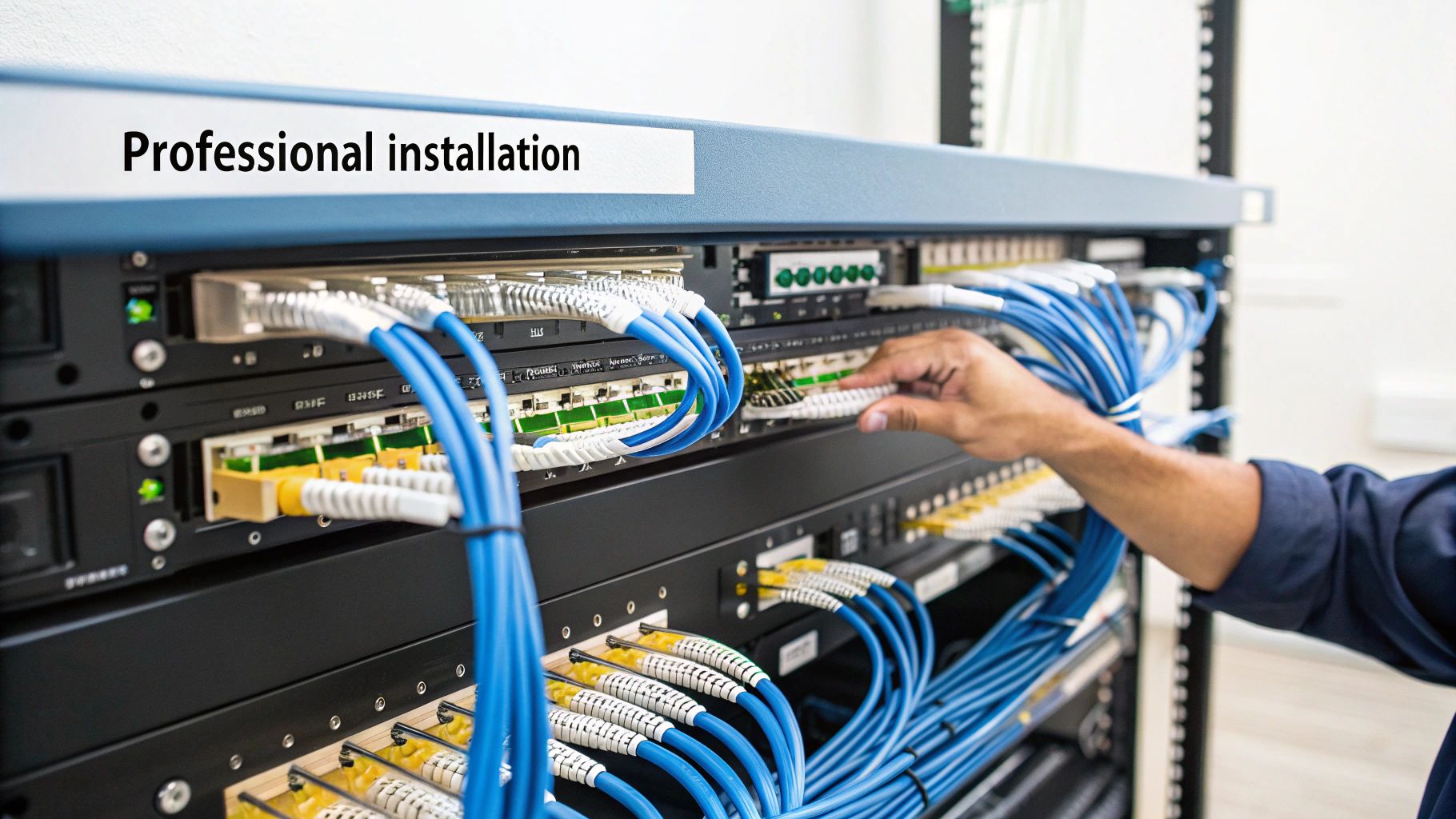
We believe in a ‘tidy desk’ philosophy for your communications cabinet. A neatly organised comms room with professional cable management isn’t just about looking good—it is absolutely essential for performance, maintenance, and future upgrades. A tangled mess of cables, what we call a 'spaghetti cabinet', is always a sign of deeper problems.
A professionally managed cabinet ensures that cables are properly supported, bend radii are respected, and there's adequate airflow to keep equipment cool. This organised approach makes troubleshooting faster, reduces the risk of accidental disconnection, and simplifies adding new connections in the future.
This meticulous attention to detail extends way beyond the cabinet. It applies to every single cable run, termination, and patch panel throughout your building, whether it's a large commercial office or a critical hospital wing. For those planning a major project, our essential guide to data cabling installation offers a deeper look into the best practices we follow.
The Value of an Accredited Partner
Choosing an installer with a recognised accreditation, such as being an Excel Network Accredited Partner, gives you a layer of assurance that your project is in safe hands. This status means the engineers have been trained to meet the manufacturer's exacting standards for installation and testing.
This formal certification process is what unlocks the 25-year equipment warranty. This long-term protection is only available when the system is installed by a certified partner and every link is proven to meet performance standards through rigorous testing.
A professional installation ensures:
Performance: Every cable link is tested and certified to deliver the full bandwidth and speed you paid for. No guesswork.
Reliability: Proper installation techniques minimise the risk of physical damage and electromagnetic interference that cause dropouts.
Scalability: A well-managed infrastructure makes it far simpler and more cost-effective to expand your network as your organisation grows.
Whether you're fitting out a new commercial building or undertaking an office relocation, getting the installation right the first time is crucial. It’s the difference between a network that’s a constant headache and one that reliably supports your operations for years to come.
The Importance of Network Testing, Certification, and Warranties
So, how can you be absolutely certain the brand-new network you’ve invested in actually delivers the performance you paid for? The answer lies in the final, critical step of any professional installation: rigorous testing and certification. This process is your ultimate proof of a job well done and the key to protecting your investment for the long haul.
A certified network delivery is a world away from just plugging everything in to see if the lights blink. It involves using specialised cable analysers to test every single link in your new infrastructure, from the comms cabinet right through to the desk outlet. These tools measure performance against tough international standards, verifying everything from signal strength and data throughput to how well the cable resists interference.
The end result is a detailed report for every connection, giving you concrete proof that your new category 6a cable network meets or exceeds its performance specifications. It's not just a piece of paper; it's your guarantee of quality.
Unlocking Your 25-Year Equipment Warranty
This certification process is also what activates the manufacturer’s warranty. As an Excel Network Accredited Partner, our certified installations are backed by a comprehensive 25-year equipment warranty. This long-term protection covers every single Excel Networking component, from the cable itself to the patch panels and outlets.
This warranty provides decades of peace of mind, assuring you that the physical foundation of your network is protected against component failure. It’s an assurance you only get when the system is installed by a trained, accredited partner who can provide a full set of passing test results.
Without this certified proof, a manufacturer simply can't guarantee their products will perform as intended, leaving your significant investment completely unprotected.
Maintaining Performance During an Office Relocation
Network integrity becomes absolutely critical during major changes like an office relocation. Moving an entire infrastructure, even with the most careful planning, can risk damaging sensitive connections. Cables can get stretched, bent too sharply, or re-terminated incorrectly, leading to performance issues that aren't immediately obvious.
This is exactly why re-testing and re-certification are essential after a move. Before your team gets back to work, a thorough test of the re-established network ensures:
Integrity: Verifies that no cables were damaged during the upheaval of the move.
Performance: Confirms that the network still meets its original performance standards in the new layout.
Readiness: Guarantees your infrastructure is ready to support business operations without any nasty surprises.
Taking this crucial step of office relocation with equipment testing prevents frustrating connectivity problems and ensures your network continues to perform flawlessly in its new home. The growing reliance on high-performance cabling in the UK commercial sector really underscores its importance. Market projections show Category 6A as a leading copper segment, with one forecast estimating it will hold roughly 38.5% of the data-centre copper cabling market by 2025. You can discover more about these market insights on futuremarketinsights.com.
Your Category 6a Questions, Answered
After digging into the technical specs and real-world uses of Category 6a cable, a few common questions always pop up during the planning stage. Here are some straight-talking answers to help you make the right call for your network infrastructure, especially if you're looking at a commercial building or hospital project.
Is Category 6a Really Worth the Extra Cost Over Cat6?
For any new commercial installation, our answer is a firm yes. It’s a common misconception that standard Cat6 is "good enough" for 10GbE speeds, but the reality is it can only handle that kind of bandwidth over very short distances, typically less than 55 metres. This is a major limitation in most real-world office layouts.
Only a properly certified Category 6a installation guarantees that full 10GbE performance across the entire 100-metre cable run. This isn't just about meeting today's needs; it's about building an infrastructure that can handle the high-bandwidth devices and applications of tomorrow. Think of it as a one-time investment that prevents a costly and massively disruptive re-wire in just a few years.
Can I Just Use Cat6a Connectors on My Old Cat6 Cable?
While you might be able to physically click them together, doing so is one of the classic data network mistakes. Mixing and matching components from different categories creates a "hybrid" system that will only ever perform as well as its weakest link—which in this case, is the Cat6 cable.
To achieve genuine Cat6a performance and, crucially, to qualify for a 25-year equipment warranty, every single component in the chain must be Cat6a rated. This includes the cable, patch panels, wall outlets, and connectors. There are simply no shortcuts to a certified, high-performance system.
How Do I Know If My Installer Is Properly Certified?
A truly professional installer will always have the credentials to back up their claims. The first thing to look for is official partner status with a major manufacturer, such as being an Excel Networking Accredited Partner. This status is proof that they’ve undergone specific training and are held to the manufacturer's high standards.
But the real proof is in the pudding. Upon project completion, you should always demand to see the detailed test reports for every single link. A professional will provide these results from a specialised cable analyser as definitive proof of a compliant, tested network delivery. This documentation is your ultimate guarantee that the installation will perform as promised, whether it's a new build or an office relocation with equipment testing.
This commitment to certification ensures that everything from cable management to signal integrity meets the highest industry standards, preventing frustrating performance issues down the line. It's the only way to be certain your network is genuinely ready for the demands of a modern commercial environment.
For professional network planning, installation, and certification that guarantees performance, partner with Constructive-IT. Our expertise ensures your infrastructure is robust, reliable, and ready for the future. Find out more at https://www.constructive-it.co.uk.
Comments