


Your Guide to Category 6a Cables for Commercial Networks
- Craig Marston
- Dec 23, 2025
- 15 min read

Category 6a has become the go-to standard for any modern commercial network, and for good reason. It provides the essential muscle for high-speed data transfer, comfortably supporting 10 Gigabit Ethernet (10GbE) over long distances. For demanding environments like hospitals or large corporate offices, it's the only sensible choice for future-proofing your infrastructure.
Why Modern Businesses Run on Category 6a Cables
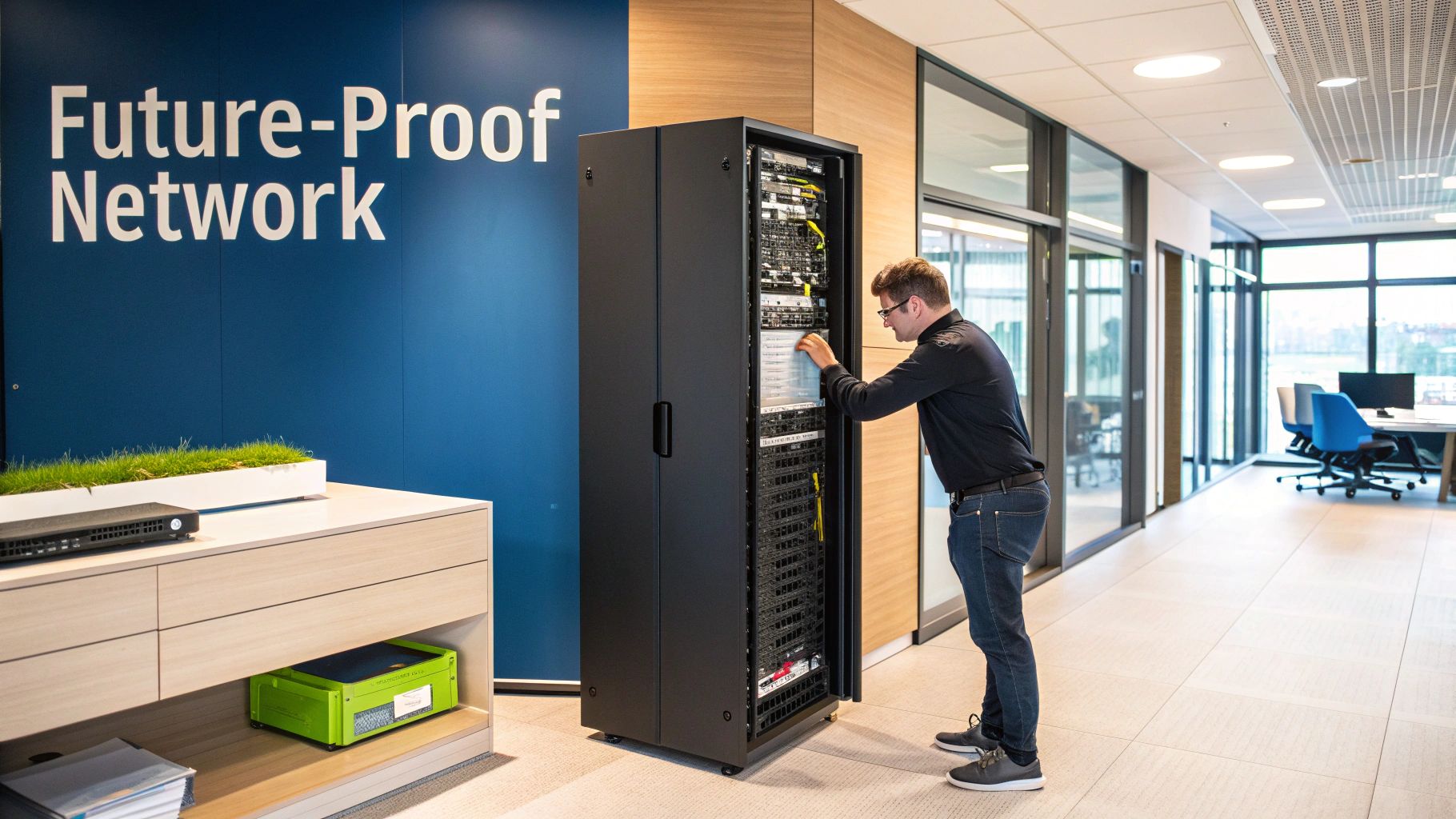
In any commercial building, whether it's a bustling headquarters or a mission-critical hospital wing, the data network is the central nervous system. The cabling is what carries every single digital interaction, and getting this choice right is absolutely fundamental to your operational success.
Think of your network infrastructure as a motorway. Older cables are like single-lane country roads, easily clogged by today's heavy data traffic. Category 6a cables, on the other hand, are the multi-lane superhighway, built to handle huge volumes of data today while leaving plenty of room for the even greater demands of tomorrow.
Future-Proofing Your Commercial Infrastructure
Investing in a data network isn’t just about meeting today’s needs; it’s about building a foundation that will support your organisation's growth for the next decade. This is where Cat6a cabling really proves its worth, providing the raw capacity for high-speed applications that are fast becoming standard.
Too many common data network mistakes come from choosing cheaper, lower-spec cabling that quickly becomes a bottleneck. A properly planned Cat6a installation ensures your building is ready for:
High-speed connectivity for every user, supporting data-heavy tasks without a hint of lag.
Power over Ethernet (PoE) devices, from advanced VoIP phones and Wi-Fi 6 access points to modern security cameras.
Office relocations and reconfigurations, giving you a powerful and flexible backbone that adapts as your business changes.
A professional installation is the difference between simply buying cables and deploying a guaranteed, high-performance asset. Without certified testing, even the best components can fail, leading to costly diagnostic work and downtime.
The true value of a Cat6a network is only unlocked through meticulous installation and verification. As an Excel Network accredited partner, we make sure every cable is expertly installed, tested, and certified to meet the most stringent performance standards.
This process is what activates a 25-year equipment warranty, turning your cabling from a simple purchase into a secure, long-term investment. This guarantee covers the entire system, not just the cables, offering you complete peace of mind. A certified, tested network delivery means your infrastructure will perform exactly as designed—from the server room right to the tidy desk of each employee. It’s a promise of reliability, backed by proof.
To break it down, here’s a quick look at the major advantages Cat6a brings to the table.
Category 6a at a Glance: Key Advantages
Feature | Benefit for Your Business |
|---|---|
10GbE Performance | Supports current and future high-bandwidth applications, completely eliminating network lag. |
Superior Shielding | Protects against data corruption in busy commercial environments with high interference. |
Long-Term Reliability | A certified installation provides a robust foundation that will last well over 10 years. |
25-Year Warranty | Guarantees both component and system performance, fully protecting your investment. |
These benefits aren't just technical specs on a datasheet; they translate directly into a more efficient, reliable, and future-ready workplace.
Breaking Down Cat6a Technical Specifications
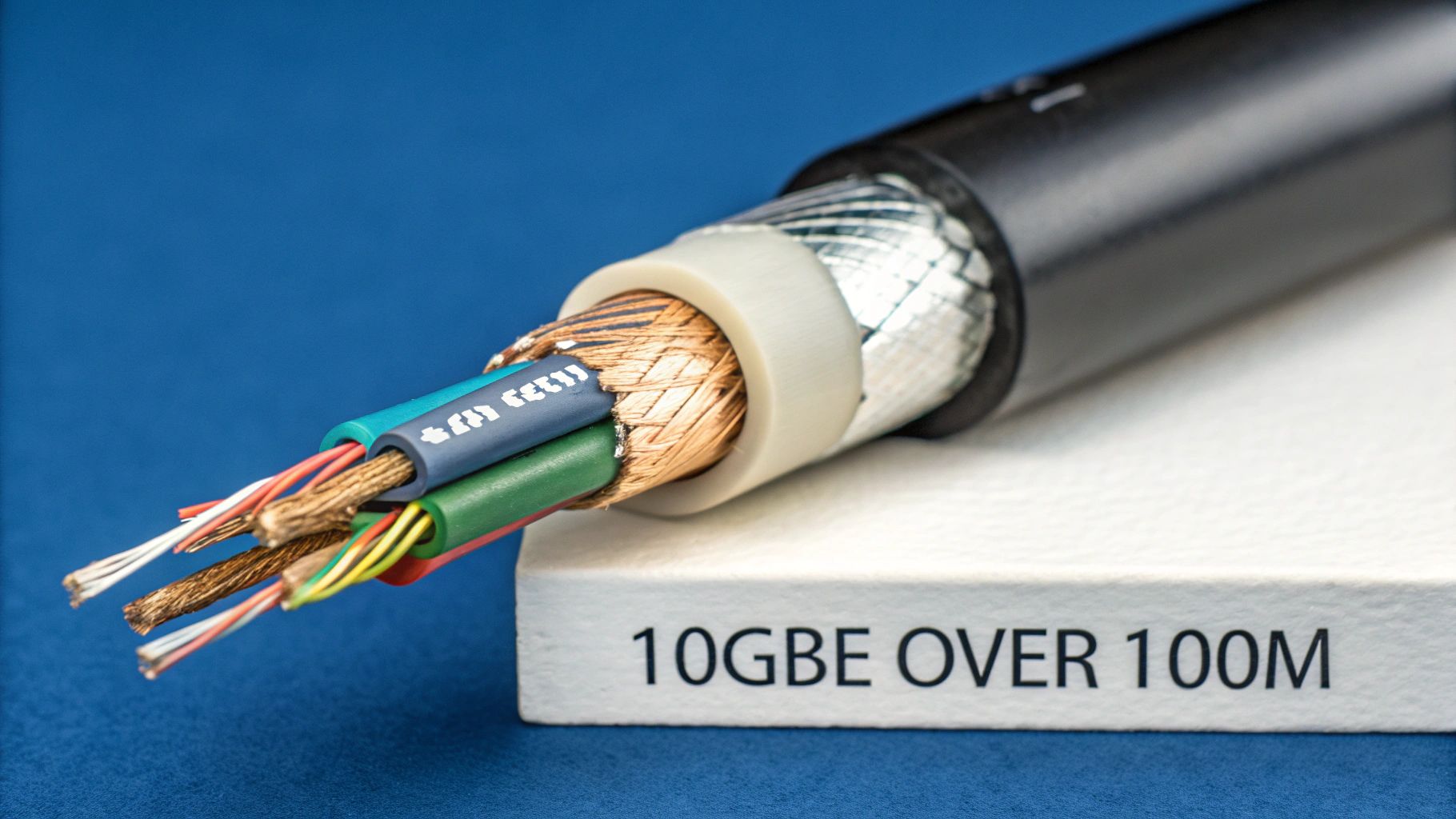
To really get why category 6a cables are the go-to standard for modern businesses, you need to look under the bonnet at the specs that give them their muscle. These aren't just abstract numbers; they define the cable's ability to deliver a fast, solid, and interference-free network for years to come.
The two big headline figures for Cat6a are its speed and bandwidth. It’s engineered to reliably handle 10 Gigabit Ethernet (10GbE)—that’s a massive 10,000 megabits per second—over the full 100-metre distance. This is a game-changer in commercial spaces like large open-plan offices or sprawling hospital floors, where long cable runs are just a fact of life.
This impressive performance is all down to the cable's bandwidth.
Understanding Bandwidth and Frequency
Cat6a operates at a frequency of 500 MHz, which is double that of its predecessor, Cat6. Think of bandwidth as the width of a motorway; a wider motorway allows more cars to travel at top speed without causing a traffic jam.
In the same way, the 500 MHz bandwidth of Cat6a creates a much wider "data pipe." It can handle more data from more devices simultaneously, preventing the network slowdowns that kill productivity and disrupt critical business operations. This high capacity is what keeps things running smoothly, even with dozens of people hammering the network with video calls and large file transfers.
But raw speed and a wide pipe are only half the battle. To maintain that performance in a busy building, the cable has to protect the data it’s carrying. This is where shielding becomes absolutely non-negotiable.
The Critical Role of Shielding
In any commercial environment, you’ll find hundreds of data cables crammed together in ceiling voids, conduits, and riser cupboards. When high-speed signals race down these cables, they generate a small amount of electromagnetic interference that can easily "bleed" over into adjacent cables.
This phenomenon has a name: alien crosstalk (AXT).
Think of alien crosstalk like trying to have a quiet conversation in a crowded, noisy room. The sound from other people's chats bleeds into yours, making it hard to hear clearly. In a network, this "noise" corrupts the data signal, leading to errors and forcing re-transmissions that slow everything down to a crawl.
To fight this, professional-grade Cat6a cables use a specific type of shielding. While basic Unshielded Twisted Pair (UTP) cables exist, they offer zero protection against alien crosstalk and are completely unsuitable for 10GbE installations in a commercial setting.
The correct choice is Foiled/Unshielded Twisted Pair (F/UTP). This design wraps an overall foil shield around all four twisted pairs inside the main cable jacket.
The Foil Shield: This metallic layer acts as a barrier, blocking interference from getting in or out. It contains the signal within its own cable while shielding it from the noise generated by its neighbours.
Data Integrity: By neutralising alien crosstalk, the F/UTP shield ensures the data signal arrives clean and strong. This is absolutely vital for maintaining consistent 10GbE speeds from the comms room all the way to the user's desk.
This robust shielding, combined with the higher bandwidth, makes F/UTP Cat6a the only sensible choice for new structured cabling installations. It’s the technical foundation of a certified network, protecting your investment and guaranteeing performance when it matters most. Getting this right from the start is how you avoid the most common data network mistakes that plague businesses down the line.
Guaranteed Performance Through Professional Installation and Certification
Buying boxes of high-quality category 6a cable is only the first step. The true performance of your network—its speed, reliability, and longevity—is decided entirely by the quality of the installation. Even the best cable in the world can be crippled by sloppy workmanship, turning a smart investment into a source of constant frustration.
Realising the full potential of Cat6a isn't about the cable itself; it's about meticulous installation, comprehensive testing, and official certification by accredited professionals. Without this, your 10GbE-ready infrastructure is just a pile of parts with no performance guarantee. That’s why professional deployment isn't an optional extra; it's absolutely essential.
So many networks are sabotaged from day one by common, avoidable mistakes. These aren't obscure technical faults but basic errors that plague improperly managed installations, especially in places like commercial buildings and hospitals where performance is non-negotiable.
Common Installation Mistakes That Cripple Networks
Simple errors during installation can have a massive impact on network speed and stability. An improperly installed Cat6a network won't just run slow; it will fail certification tests and will never deliver the 10GbE speeds you paid for.
Here are the key mistakes to avoid:
Improper Terminations: The connections at the patch panel and wall outlet are the most common points of failure. If the twisted pairs are untwisted too much or terminated poorly, it introduces signal loss and crosstalk that kills performance.
Exceeding the Bend Radius: Cat6a cables have a strict minimum bend radius. Kinking the cable or yanking it around sharp corners permanently damages the internal structure, destroying its ability to carry a high-frequency signal.
Sloppy Cable Management: A tangled mess of cables behind a rack isn't just untidy—it's a performance risk. Poorly managed bundles can dramatically increase alien crosstalk and make future maintenance a complete nightmare.
These seemingly small issues stack up, creating a network plagued by slow speeds and intermittent connection drops that are incredibly difficult to diagnose after the fact. The only way to prevent them is to get the installation right the first time.
The Certification Process: Your Proof of Quality
A professional installation always concludes with the most important step: testing and certification. This is where our engineers use advanced diagnostic tools, like industry-standard Fluke testers, to verify that every single connection meets the strict performance standards defined by the TIA and ISO for Category 6a.
This isn't just a simple "does it work?" check. The tester sends high-frequency signals down each cable and measures a full range of performance parameters, including insertion loss, return loss, and, crucially, alien crosstalk. Making sure your network is tested and certified is critical. A detailed report is generated for every single link, from the patch panel to the desk outlet, providing documented proof that the infrastructure is free from faults and can truly support 10Gbps.
This certified report is your ultimate assurance of quality. It proves that the network has been installed to exacting standards and is ready to perform under pressure. It's the official sign-off that transforms your cabling project into a reliable, high-performance business asset.
And what's more, this certification is the key that unlocks long-term protection for your investment.
Securing Your 25-Year Equipment Warranty
Reputable cabling manufacturers like Excel Networking stand behind their products, but only when they're installed correctly by trained and accredited partners. At Constructive-IT, as an Excel Network accredited partner, our certified delivery is what activates the comprehensive 25-year equipment warranty. This warranty covers the entire end-to-end system—cables, connectors, and patch panels—guaranteeing its performance for decades.
This long-term peace of mind is invaluable, especially during major projects like an office relocation with equipment testing, where the whole system is put under stress. The guarantee ensures that from the server room to every tidy desk, your network is robust, reliable, and built to last. It’s a commitment backed by one of the UK’s leading cabling brands.
The market reflects this trust in quality. Excel Networking has grown its position in the UK Category 6A cabling market to an impressive 22% market share. This growth is built on a reputation for premium, compliant, and warranty-backed infrastructure.
Ultimately, choosing the right components is only half the battle. To ensure your network delivers on its promise, you must insist on a fully tested and certified installation from a trusted partner. Learn more about the importance of choosing network cabling installers you can trust in our detailed guide.
Choosing the Right Cable: Cat6a vs Cat6 vs Fibre Optics
Making the right cabling choice for your network is a critical decision, a careful balance between the immediate budget and the performance you’ll need for the next decade. When you’re weighing up Category 6a cables, their older sibling Cat6, and high-speed fibre optics, you’re defining what your network will be capable of for a long time to come. Each has a specific, and important, role to play in a well-designed commercial infrastructure.
The most common point of confusion we see is between Cat6 and Cat6a. On paper, both can technically handle a 10 Gigabit Ethernet (10GbE) connection, but their real-world performance is worlds apart. This isn't just a minor technical detail; it’s a fundamental limitation that can make or break your network's future.
The market data confirms the industry is moving on. While Cat6 still holds a chunk of the market, Cat6a is clearly the future. Projections show the Cat6A LAN cable segment is set to grow at a blistering 15.4% compound annual growth rate from 2025 to 2032. This lines up perfectly with the UK government's £250 million 5G Diversification Strategy, which will only crank up the demand for high-speed, utterly reliable network infrastructure. You can explore the numbers in more detail in this UK Ethernet cable market analysis from Lucintel.
The Critical Difference: Distance Makes or Breaks Performance
The one factor that defines the difference between Cat6 and Cat6a is distance. It’s that simple. A Cat6 cable can only maintain a stable 10GbE connection over a very short run—typically somewhere between 37 and 55 metres. In a commercial building, where cable runs from a comms room often stretch much further than this, Cat6 just isn't a viable option for future-proofing.
Category 6a, on the other hand, was specifically engineered to guarantee full 10GbE performance over the entire 100-metre channel length permitted by TIA/ISO standards. This makes it the only practical copper-based choice for delivering genuine high speeds to every desk in a modern office or every critical device in a hospital. For a deeper dive into its predecessor, check out our essential guide to Cat6 cable.
When to Choose Fibre Optics
This is where fibre optic cabling enters the picture. While Cat6a is the undisputed king of horizontal, in-building cabling runs, fibre is the champion of the network backbone. Our expertise also extends to fibre cable installation. Its incredible ability to transmit data over huge distances—often kilometres—with virtually zero signal degradation makes it essential for linking different buildings on a campus or connecting comms rooms across multiple floors in a high-rise.
Think of it this way:
Fibre Optics: The high-speed national motorway system connecting major cities (your comms rooms and buildings).
Category 6a: The final A-roads and local streets that deliver traffic from the motorway exit directly to every house and business (your user desks and devices).
Using fibre for every single desk connection would be prohibitively expensive and, frankly, overkill. Instead, a smart network design uses fibre for the heavy-lifting backbone and Cat6a for cost-effective, high-performance horizontal runs to the user. This hybrid approach delivers the best of both worlds: blistering speed where it matters most and practical performance everywhere else.
To make this clearer, we've put together a simple table comparing the three main contenders.
Cabling Comparison: Cat6 vs Cat6a vs Fibre Optic
This table breaks down the key performance metrics and ideal scenarios for each cabling type in a commercial setting, helping you see at a glance which tool is right for which job.
Specification | Category 6 | Category 6a | Fibre Optic |
|---|---|---|---|
Max Speed | 10GbE (at short distances) | 10GbE (guaranteed) | 100GbE+ |
Max Distance | 55m (at 10GbE) / 100m (at 1GbE) | 100m (at 10GbE) | Kilometres |
Frequency | 250 MHz | 500 MHz | N/A (light transmission) |
Best Use Case | Budget-conscious 1GbE networks, small offices. | Modern commercial buildings and hospitals, anywhere 10GbE to the desk is required. | Network backbones, data centre interconnects, campus-wide links between buildings. |
Cost | Low | Medium | High (for transceivers/electronics) |
As you can see, the decision isn’t about which cable is "best" overall, but which is best for a specific application. Cat6a hits the sweet spot for delivering future-ready performance to the user, while fibre optic is the only choice for the high-capacity links that tie everything together.
The flowchart below illustrates the clear path to securing a guaranteed, long-term warranty on your cabling investment—a benefit that hinges entirely on professional, certified installation.
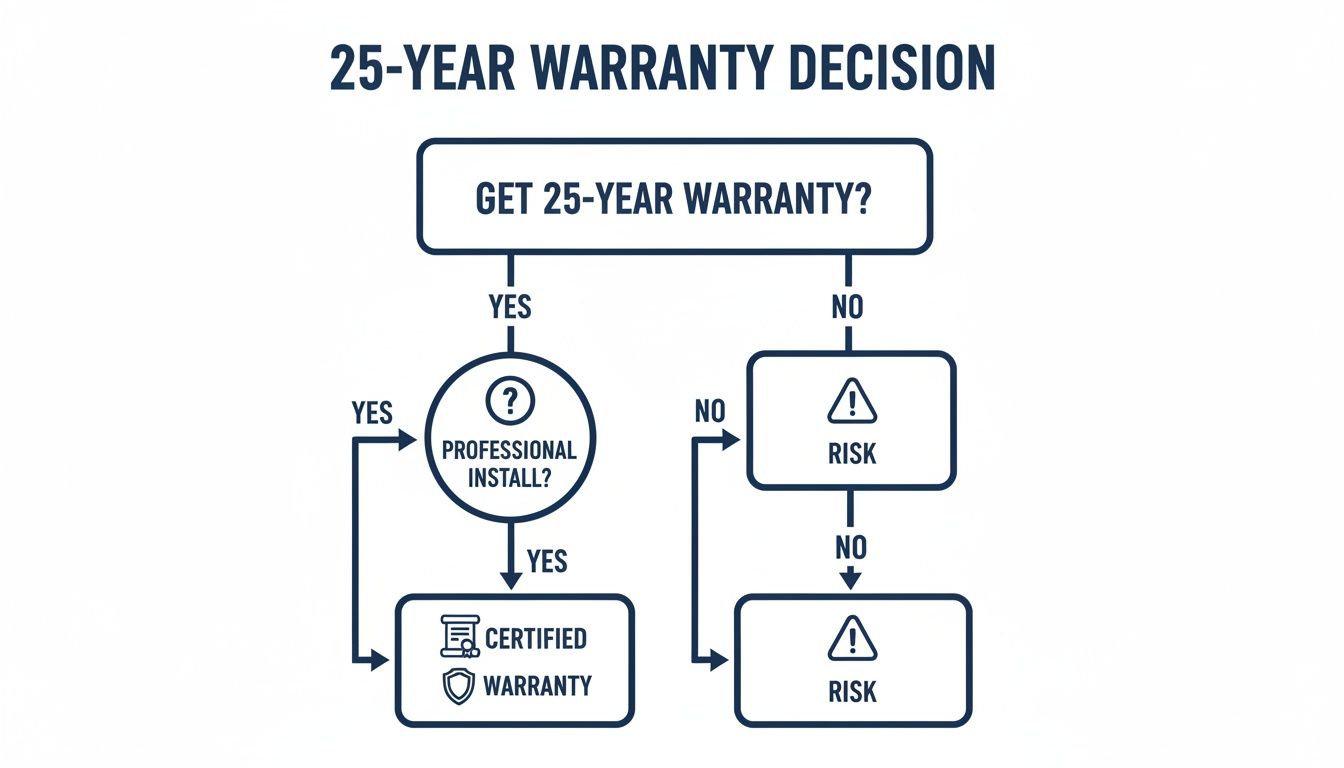
This decision tree highlights a simple truth: a manufacturer's warranty is only activated through certified, professional installation. Anything else leaves you carrying the risk of underperformance and future costs.
Ultimately, the choice comes down to the specific application within your infrastructure. For any connection running from a local comms room out to a user's desk, category 6a cables provide the ideal blend of performance and value. For the long-distance links that tie your entire network together, fibre is the essential component. Making sure your network is tested and certified by an accredited partner like Constructive-IT ensures that whichever solution you choose, it performs exactly as intended and is backed by a full 25-year equipment warranty.
Planning Your Cat6a Project from Strategy to Tidy Desks
Rolling out a successful Category 6a network, especially during something as high-stakes as an office relocation with equipment testing, is about much more than just pulling cables through walls. It starts with a clear strategy, a plan that lines up your network infrastructure with your actual business goals. The aim is to deliver a powerful, reliable asset that’s ready to support your team from the moment they walk in.
A well-managed project doesn't begin with cables, but with questions. What are your data demands right now? What will they look like in five, or even ten years? Getting this planning right helps you sidestep common data network mistakes, like underestimating future bandwidth needs, which often leads to a costly rip-and-replace job down the line.
From Decommissioning to Certified Delivery
An office move is the perfect time to modernise your infrastructure, but it adds a lot of moving parts. A smooth transition needs a partner who can manage the entire process, from carefully decommissioning old kit in your previous space to deploying and certifying the new network before your team even sets foot in the door.
This end-to-end management is vital. It ensures nothing gets missed, from the initial site survey to the final, exhaustive testing of every single connection. The goal is a certified, tested network delivery, where every port performs exactly as promised, ready to support your business without a single hitch on day one.
A truly successful project doesn’t just end with a working network; it ends with documented proof of its performance. That certification is your guarantee that every cable meets tough industry standards and is ready to deliver full 10GbE speeds under real-world pressure.
This level of detail is also essential for regulatory compliance, a non-negotiable part of any commercial installation in the UK.
Adhering to UK Compliance and Safety Standards
In commercial buildings and hospitals (not houses), all cabling has to meet strict fire safety regulations. Any installed category 6a cables must carry a specific fire safety rating, known as a Euroclass rating. The standard for UK public and commercial spaces is typically Euroclass B2ca, which signifies low smoke production and minimal flame spread.
Using non-compliant cables isn't just a serious safety risk; it can also invalidate your insurance and lead to hefty legal penalties. Working with an accredited partner ensures that every component, from the cables in the ceiling voids to the patch panels in the comms room, is fully compliant and fit for purpose. This commitment to standards underpins the integrity of the whole project.
The reliance on this kind of robust infrastructure is growing fast. Globally, Category 6A is projected to hold a 38.5% share in data centre cabling by 2025. This trend highlights its perfect fit for UK commercial environments, where its backward compatibility allows for seamless upgrades as data traffic from cloud and AI services continues to climb. You can explore more on these trends in the structured cabling market report from Expert Market Research.
The Final Touch: Professional Cable Management
The last, most visible measure of a quality installation is at the user’s desk. A network project isn't really finished until it helps create a clean, organised, and productive workspace. This is where professional cable management makes all the difference.
A meticulously planned installation ensures that every desk gets the connectivity it needs without a chaotic jumble of wires. Thoughtful routing, under-desk trays, and clean termination points create a tidy desk setup that looks good and works better. It reduces trip hazards, makes cleaning easier, and simplifies any future moves or changes for your IT team. To get a better handle on the operational perks, you can read our guide on the benefits of professional cable management.
Ultimately, from the big-picture strategy down to the final tidy-up, a successful Cat6a project delivers a warrantied, high-performance network that will empower your organisation for years.
Your Cat6a Questions, Answered
Even when you’ve got the technical specs down, a few practical questions always pop up when planning a network project. Let's get straight into the most common queries we hear about category 6a cables, with clear answers to help you make the right call.
Is Cat6a Really Worth the Extra Cost Compared to Cat6?
For any new commercial installation, the answer is a resounding yes. While Cat6a parts have a higher ticket price, the total cost of ownership is actually far lower. Think about it: the biggest single expense in any cabling project is the labour to install it, and that cost is almost identical whether you’re putting in Cat6 or Cat6a.
Opting for Cat6 might feel like a savvy initial saving, but it's a gamble. You could be forced into a hugely disruptive and expensive re-cabling project in just a few years to keep up with data demands. Investing in a properly installed Cat6a network gives you a 10GbE-ready foundation built to last 10-15 years. It's a much smarter, more cost-effective long-term play.
It’s all about protecting your business from the massive cost and operational headache of a premature network overhaul. It's the difference between building a house on solid foundations versus a cheaper alternative that might need underpinning later.
Can I Use Cat6a Cables with My Existing Network Gear?
Absolutely. One of the best things about Category 6a is that it’s fully backward compatible with all previous Ethernet standards, including Cat6 and Cat5e. You can install a rock-solid Cat6a cabling infrastructure today, and it will work perfectly with your current switches, routers, and PCs running at 1 Gigabit speeds.
This gives you a sensible, phased approach to network upgrades. First, you build the reliable, high-capacity "motorway" with a certified Cat6a installation. Later on, as your business grows and budgets free up, you can upgrade the "vehicles"—your active kit like switches and servers—to 10GbE devices without ever having to touch the physical wiring again.
What Does a “Certified Network Delivery” Actually Mean?
A certified, tested network delivery is your ultimate proof that the job has been done right. It confirms that every single cable run—from the comms room to the desk—has been electronically tested with specialised hardware to verify it meets the strict performance standards for Category 6a set by bodies like the TIA and ISO.
As an Excel Network accredited partner, our engineers provide a detailed test report for every link. This document validates critical performance metrics like alien crosstalk, return loss, and insertion loss. It’s your guarantee that the network is free from installation faults and is fully capable of running at its maximum 10Gbps speed.
This certification is the final, essential step that transforms a collection of high-quality components into a cohesive, reliable system. Critically, it is the mandatory requirement for activating the comprehensive 25-year equipment warranty, protecting your investment for the long term.
Without it, you have no verifiable proof of performance and no warranty coverage.
Why Is Shielding So Important for Cat6a in Commercial Buildings?
In commercial environments like offices and hospitals, shielding is non-negotiable for Cat6a. These spaces are often buzzing with sources of electromagnetic interference (EMI)—things like power lines, fluorescent lighting, and big HVAC motors—all of which can corrupt data signals on unshielded cables.
Even more importantly, when you bundle dozens of high-speed cables together in trays and conduits, they can interfere with each other. This is known as alien crosstalk, where signals from one cable "bleed" over and disrupt transmissions on its neighbours. At the 500 MHz frequencies Cat6a uses, this interference can cause serious data errors and throttle network performance.
The foil shield in F/UTP (Foiled/Unshielded Twisted Pair) category 6a cables acts as a protective barrier. It blocks external EMI and contains the cable's own signal, preserving data integrity and ensuring the stable, reliable 10GbE performance your business depends on. Making sure your network is tested and certified validates that this shielding is working correctly across the entire installation.
Ready to build a network foundation that guarantees performance and future-readiness? The experts at Constructive-IT specialise in designing and deploying fully certified and warrantied Cat6a and fibre cable installation solutions for commercial buildings and hospitals across the UK.
Comments