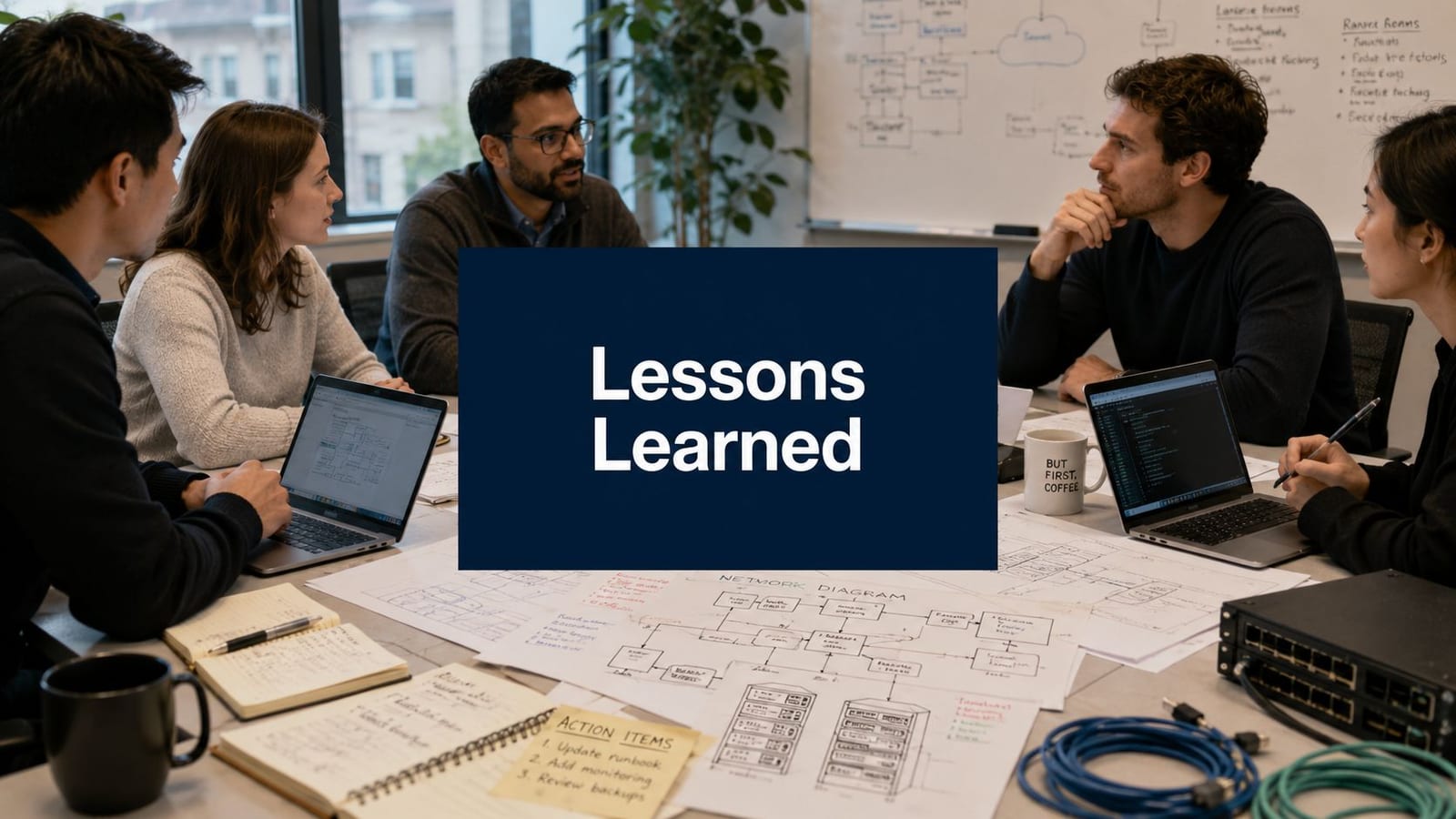
You only need one painful repeat mistake to realise your project team doesn't have a lessons learned process. It has a filing habit.
A network cabinet turns up on the right floor but the wrong wall. The power feeds are signed off but not labelled in a way the cutover team can use at 2am. Access control goes live, but the CCTV view for the delivery entrance was never checked against the final door swing. Then someone says, “Didn't this happen on the last move?”
That question is the whole problem. If the answer lives in someone's memory, a buried closeout document, or a vague line in a handover pack, it won't protect the next office relocation, server room build, or autonomous unmanned building rollout. Good lessons learned documentation isn't admin. It's operational control.
Why Most Lessons Learned End Up on a Shelf
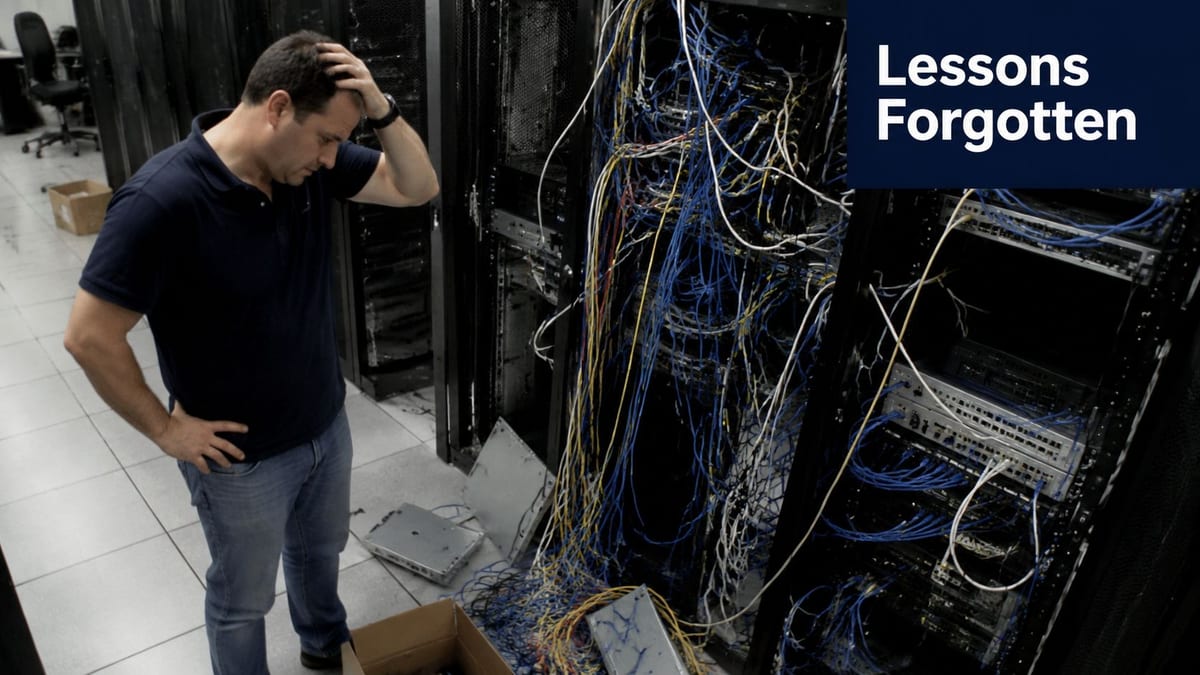
The pattern is familiar. A project finishes late, everyone is tired, and a retrospective gets squeezed into the last available half-hour. People list a few frustrations, someone writes “comms could be better”, and the document is uploaded to a folder nobody checks at the next kick-off.
That's how repeat errors survive.
What the document is actually for
In UK project practice, lessons learned documentation is a formal knowledge-management step, not an informal note-taking exercise. The Association for Project Management defines lessons learned as “documented experiences” that can improve future management of projects, programmes, and portfolios, as set out in its guidance on lessons learned in project management.
That definition matters in infrastructure work because the same risks return under different labels. Office moves repeat access issues, floorbox surprises, cabling route clashes, patching errors, Wi-Fi dead spots, contractor sequencing problems, and change-control gaps. Server room projects repeat cooling assumptions, rack layout compromises, power-path confusion, and dependency failures between electrical and IT trades.
If the record is structured, teams can retrieve it before they make the same decision again.
Practical rule: If your lessons learned document can't be used during planning, it isn't protecting delivery.
Why box-ticking fails in technical environments
Most failed lessons learned efforts have the same weaknesses:
- They're too late: Teams wait until final closeout, when details have already gone soft.
- They're too vague: “Communication issue” tells nobody what failed, when, or how to prevent it.
- They blame people: Once the document reads like a complaint log, the useful detail disappears.
- They aren't linked to action: No owner, no due date, no process change.
- They ignore integrated design: In real building work, access, power, data, CCTV, containment, and certification affect each other. Treat them separately and the lesson is incomplete.
That last point matters even more on unmanned building projects. In practice, unmanned building management means a site or unit can operate securely without a permanently staffed reception, on-site facilities desk, or resident IT presence. The building still needs controlled entry, monitored spaces, resilient power, reliable connectivity, remote visibility, and maintainable systems. If access control is specified in isolation from power resilience and network availability, the design will look tidy on paper and become awkward in operation.
Why these projects are different
A live office move or a server room expansion punishes weak documentation because rework is expensive and disruption is visible. A missed cabinet location is not just a drawing issue. It affects structured cabling, patch lead lengths, containment, power provision, cooling path, cutover timing, and user disruption.
The same is true when building autonomous unmanned units. Battery-less NFC proximity locks might be the right choice in some environments because they reduce battery maintenance, simplify estate management, and suit controlled low-footfall spaces. But they only work well when door hardware, emergency egress, reader location, network assumptions, and fallback procedures are designed together.
Lessons learned documentation should capture those dependencies, not just the symptom that went wrong.
Designing Your Lessons Learned Framework
Teams don't get consistent results from good intentions. They get them from a system.
A workable framework needs to exist before the next project starts, not after the next project slips. UK-aligned guidance describes a five-stage workflow of identify, document, analyse, store and retrieve, with the strongest setups capturing feedback in real time, at phase gates, and at project close, as outlined by Knowledge Train's project management lessons learned guidance.
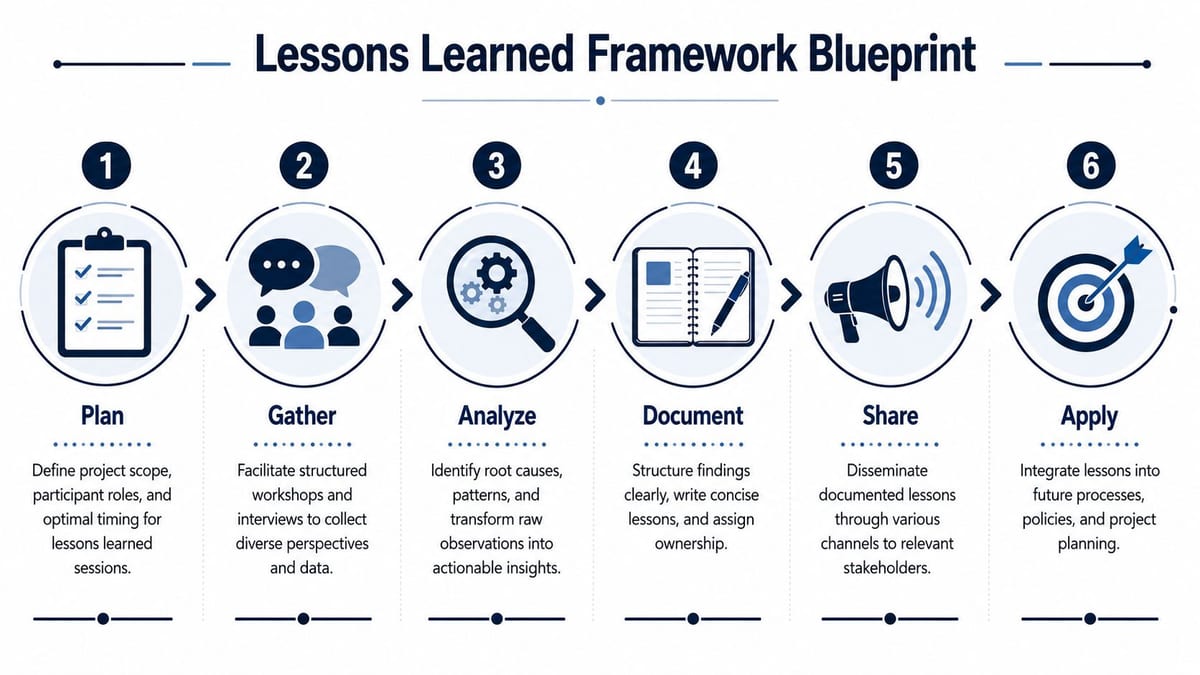
Build the framework before you need it
If you manage office fit-outs, relocations, CCTV upgrades, or commercial electrical installation and certification, the framework should sit inside project governance from day one.
Use a simple operating model:
| Stage | What happens in practice | What often goes wrong |
|---|---|---|
| Identify | Capture issues, wins, near-misses, and workarounds during delivery | Teams rely on memory |
| Document | Record each lesson in a standard format | Notes become free-text waffle |
| Analyse | Group patterns and find root causes | Symptoms get mistaken for causes |
| Store | Put lessons in a searchable repository | Files vanish into project folders |
| Retrieve | Review relevant lessons at kick-off and planning | Nobody checks the archive |
A neutral facilitator helps. That doesn't need to be a consultant. It can be a PMO lead, senior project manager, delivery manager, or someone not directly defending their own decisions in the room.
What your template needs
PMI-style guidance recommends structured fields such as category, lesson learned, action taken, how the action was derived, root cause, and keywords. That format is useful because it forces discipline.
A practical template for infrastructure projects should include:
- Project context: Site type, phase, live or vacant environment, key dependencies.
- Trigger event: What happened, when, and during which work package.
- Operational impact: Delay, rework, access constraint, outage risk, compliance issue, or coordination failure.
- Root cause: Not the visible failure. The actual cause underneath it.
- Recommended change: What must change in drawings, sequencing, approvals, standards, or procurement.
- Owner and due date: The action log entry that turns the lesson into a control.
- Tags: Project type, technology, supplier, risk class, building system.
For multi-discipline building projects, add one more field. Interface affected. That's where you note whether the lesson sits between power and data, access and fire, CCTV and door positioning, or electrical certification and commissioning.
Design around recurring building risks
The fastest way to make lessons learned documentation useful is to align categories with the work you deliver.
For office moves and autonomous sites, common categories include:
- Access control and security: Door hardware, credentials, lock type, emergency override, CCTV coverage.
- Power and electrical: Distribution, isolation, resilience, labelling, testing, certification.
- Network and data: Cabinet location, patching, structured cabling, Wi-Fi, WAN handoff, device commissioning.
- Mechanical and room environment: Cooling path, rack spacing, dust control, working clearance.
- Operational readiness: Support model, maintenance access, remote monitoring, spares, response routes.
A lot of teams also benefit from reviewing broader project management solutions for property owners when they're coordinating building, estates, and infrastructure decisions together. The useful part isn't the label. It's seeing the project as a joined-up operating environment rather than a stack of separate work packages.
Where IT scope overlaps directly with workplace delivery, it also helps to tie lessons into existing support standards and implementation playbooks such as IT infrastructure support guidance.
A framework only works when people can use it quickly under delivery pressure.
The Art of Capturing Meaningful Insights
A bad session produces grievances. A good one produces reusable operational detail.
That means stopping people from saying, “The supplier was poor,” and pushing until the team can describe the actual failure. Was the issue unclear issue ownership, no agreed RFI route, missing design freeze, incomplete room survey, or a sequencing clash between electricians and network engineers?

Use evidence before opinion
Strong lessons learned documentation is built around measurable operational data, not just reflection. Current guidance recommends recording impact using timelines, cycle time, estimation accuracy, incident reports, and rework, then classifying findings into repeatable themes such as planning, communication, or tooling, as explained in Plane's guide on how to document lessons learned from projects.
For technical building work, that translates well into project evidence such as:
- Programme records: Delay points, waiting periods, missed dependencies, resequencing.
- Site issues: Snag lists, permit problems, failed access windows, containment clashes.
- Commissioning evidence: Test failures, patching errors, incomplete labels, sign-off gaps.
- Operations feedback: User complaints, support tickets after go-live, remote access issues.
- Compliance records: Electrical certification delays, incomplete asset records, missing O&M details.
Ask better questions
A capture session doesn't need to be long. It needs to be disciplined.
Use prompts that force specificity:
- What happened?
- What was the direct effect on delivery or operation?
- What was the earliest warning sign?
- What made the issue possible?
- What should be changed in standards, planning, or sequence?
- Who owns that change?
That approach works well on projects involving CCTV, commercial electrical work, and secure access because those trades tend to expose handoff failures. One contractor assumes another has tested a feed. Someone else assumes the final camera angle can be adjusted later. The key lesson is often that nobody defined the interface owner.
Examples that are useful and examples that are worthless
Here's the difference.
| Weak lesson | Useful lesson |
|---|---|
| Communication was poor | Door schedule changed after cabling mark-up, but the access-control update did not trigger a revised CCTV field-of-view check |
| Power setup caused delays | Final rack layout required power repositioning because cabinet depth and rear clearance were not validated during room survey |
| Lock choice was problematic | Battery replacement burden was too high for low-footfall remote units, so battery-less NFC proximity locks were adopted where door traffic, fail-safe design, and maintenance model supported them |
The point isn't to make every entry long. The point is to make it testable.
Write the lesson so a project manager can act on it, an engineer can verify it, and an operations lead can maintain it.
What to capture on unmanned building projects
Projects involving fully autonomous unmanned building units need a broader lens than a typical fit-out review because operations continue after handover without regular on-site intervention.
Capture lessons around:
- Credential strategy: Who issues access, revokes it, and audits it.
- Locking approach: Why battery-less NFC proximity locks were chosen or rejected, and under what operating conditions.
- Remote visibility: Whether CCTV views, alarms, and alerts support real response.
- Power dependency: What happens to access, networking, and monitoring during electrical interruption.
- Maintenance access: How engineers enter the unit safely when systems fail.
- Certification and compliance: Whether electrical installation, testing, and documentation match the support model.
Many unmanned building projects fail because designers optimise for installation and forget operation. The system works on commissioning day. It's awkward for the next three years.
Beyond Post-Project Reviews
The biggest weakness in lessons learned documentation is timing.
If you wait until the end of a long office move, network refresh, NHS refurbishment, or server room upgrade, people remember the drama but forget the sequence. The detail that would have prevented the issue gets replaced by broad opinion.
A rapid review of high-quality lessons learned found that lessons can be developed during implementation, which can reduce memory bias and improve ongoing effectiveness, as discussed in the review published by the US National Library of Medicine.
Why in-flight capture works better
In-flight reviews catch the project while it's still honest. The mark-up drawings are still open. The failed access request is still in the mailbox. The engineer who found the containment clash still remembers exactly what was wrong.
That matters on live environments where downtime has a real business cost. In an office fit-out, one missed room dependency can shift multiple trades. In a network upgrade, one undocumented workaround can become the next outage.
For practical rhythm, use short “micro-lessons” after events such as:
- Design changes that alter door positions, cabinet locations, or equipment layout
- Near misses involving safety, access, or unplanned service risk
- Critical path delays caused by supplier sequencing or approvals
- Commissioning failures in CCTV, access control, Wi-Fi, or power sign-off
- Go-live support issues that expose weak preparation
What belongs during the project and what belongs at the end
This split helps.
| Capture during delivery | Capture at close |
|---|---|
| Specific events and evidence | Cross-project patterns |
| Root causes while fresh | Governance changes |
| Immediate corrective actions | Template and standards updates |
| New risks to monitor on current work | Training and onboarding changes |
A lot of teams need structure to make those conversations happen. If you need a prompt set that keeps the discussion moving without turning it into a blame session, effective team retrospective templates can be adapted well for phase-gate and incident reviews.
For workplace projects with live dependencies, it also helps to map those review points against the kind of delivery sequence seen in office fit-out planning work, where infrastructure, occupancy, and contractor access all intersect.
The trigger for immediate change
Not every lesson needs a policy rewrite. Some need same-week action.
If a remote building loses network visibility because the access control panel and communications equipment share an untested power assumption, you don't wait for closeout. If an NFC-based door setup is physically sound but awkward for emergency maintenance access, you change the procedure while the project is still live.
The best teams treat lessons learned documentation as a live control board. The closeout report becomes the summary, not the first draft.
Storing and Sharing for Maximum Impact
A well-run workshop still fails if the output disappears into a folder called “Project Docs Final FINAL”.
Storage is not clerical. It determines whether knowledge can influence the next decision.
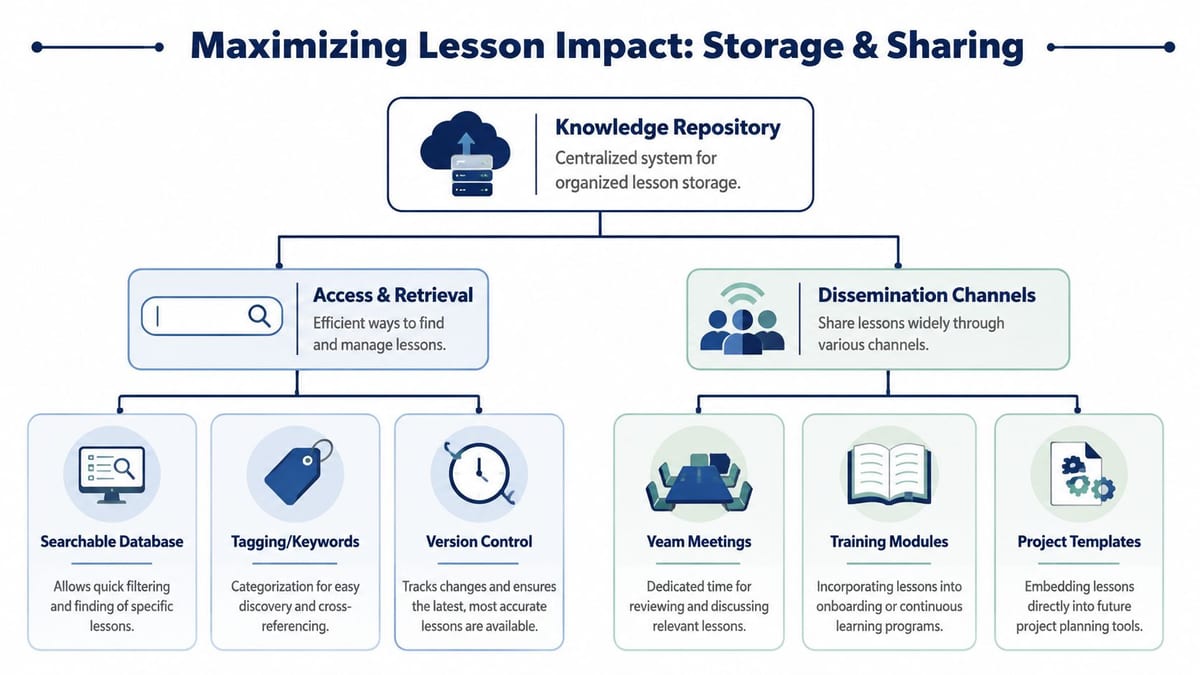
Build one place people will actually search
Most firms don't need specialist software to start. SharePoint, Confluence, a well-structured Teams site, or an internal PMO database can work if the logic is right.
The repository should be searchable by:
- Project type such as office move, server room build, CCTV rollout, autonomous unit
- System such as Wi-Fi, access control, structured cabling, electrical
- Risk area such as power dependency, approval delay, supplier coordination
- Building condition such as live environment, phased occupation, remote site
- Keywords linked to the lesson and root cause
The file structure matters less than search behaviour. If project managers can't find a relevant lesson in under a minute, they won't use it during planning.
Distil before you distribute
Senior stakeholders rarely read long closeout packs. They will read a sharp summary if it helps decisions.
PMI-style practice recommends concise executive summaries, and that principle is useful here. For leadership teams, reduce the detail to the handful of decisions that affect standards, budget assumptions, procurement controls, and programme sequencing.
For delivery teams, keep the full version available with tags, supporting files, and linked actions.
A simple distribution model works well:
| Audience | Format | Purpose |
|---|---|---|
| Directors and sponsors | Short summary | Decision and governance changes |
| Project managers | Searchable lesson log | Planning and risk control |
| Engineers and site leads | Technical entries with evidence | Execution and commissioning |
| Operations and support | Handover-linked lessons | Maintainability and response |
This short explainer is worth watching if you're reviewing how your repository and review process should support actual reuse:
Retrieval matters more than archiving
The common failure point is simple. Teams store lessons after the project but don't retrieve them before the next one.
That's why I prefer repositories linked to templates. If your office move checklist, server room readiness sheet, or commissioning pack can point to relevant prior lessons, the knowledge becomes part of delivery. The same applies to storage design and documentation standards around equipment, backups, and handover material. Good reference architecture often starts with disciplined operational information, much like the thinking behind network attached storage planning.
The lesson isn't valuable because it exists. It's valuable because the next team sees it before they commit to the same mistake.
Making Lessons Learned Stick
The final step isn't writing the report. It's changing how the next project starts.
If your team has to review previous lessons at kick-off, planning quality improves. If that review is optional, everyone says they'll come back to it later. They usually don't.
Put governance behind the process
UK guidance recommends tracking reuse rate and repeat-issue reduction, and one practitioner source cites a 27% higher success rate when lessons learned are actively applied in its discussion of retrospective techniques and lessons learned. The more important operational point is the same source's warning that the process fails when it's treated as a formality rather than an active control.
That's why every material lesson should sit in a separate action log with:
- A named owner
- A due date
- A status
- A linked process, template, or standard to update
- Evidence that the change was applied
Without that action layer, the document becomes commentary.
What success looks like in practice
You don't need an elaborate maturity model. You need visible habits.
A working system usually has these signs:
- Kick-offs include prior lesson review: Relevant lessons are selected before planning locks in.
- Standards get updated: Room survey forms, rack layouts, access schedules, CCTV checklists, and electrical sign-off packs reflect the learning.
- Design is integrated earlier: Access, power, and data are reviewed together, especially on unmanned or low-touch buildings.
- Maintenance is considered before handover: Locking choice, remote support, CCTV visibility, and engineer access are tested against the actual operating model.
- Repeat pain becomes obvious: If the same issue appears again, the owner has to explain why the previous action didn't close it.
Where many unmanned building projects still go wrong
Lessons learned documentation can save a lot of grief.
Teams often treat autonomous or unmanned building units as an installation problem. They choose hardware, install connectivity, certify power, and tick off security devices. But operation is the harder part. Someone still has to control access rights, maintain door hardware, review CCTV, support remote faults, and recover from communication loss.
Battery-less NFC proximity locks are often selected for good reasons. They remove the battery maintenance cycle, reduce site visits, and suit spaces where you want low-touch controlled entry. But they are not automatically the right answer everywhere. Door usage, fail-state requirements, environmental conditions, emergency procedures, and the availability of local override all matter. The lesson to document isn't “NFC locks worked well”. It's why they were appropriate for that building model and under what constraints.
Leaders in digital operations often make the same point from another angle. They build repeatable systems, then tighten accountability around them. That theme comes through clearly in these insights on DXP leadership, and it applies just as much to physical infrastructure programmes as it does to digital platforms.
The closed loop that prevents repeat mistakes
The strongest lessons learned documentation creates a loop:
- Capture the issue while the facts are fresh.
- Record it in a structured format.
- Assign an owner and due date.
- Update the live process, template, or standard.
- Review that change at the next kick-off.
- Check whether the issue repeats.
That loop is what turns closeout admin into a delivery advantage.
If your projects involve office relocations, server room builds, CCTV, commercial electrical installation and certification, or fully autonomous unmanned building units, you're not dealing with one discipline at a time. You're dealing with interfaces. That's exactly where repeat mistakes happen, and exactly where a proper lessons learned system earns its keep.
If you're planning a complex relocation, fit-out, server room expansion, or autonomous building deployment, working with a team that treats lessons learned as an operational control can save a lot of avoidable disruption. Constructive-IT supports UK organisations with end-to-end infrastructure delivery for office moves, network upgrades, structured cabling, CCTV, electrical works, and secure building environments designed to be maintainable long after handover.