
The most popular advice on smart building sensors is also the least useful. It usually starts with a shopping list of devices, then jumps straight to dashboards, energy savings, and a glossy idea of an autonomous building. That's backwards.
In UK commercial offices and NHS estates, unmanned building projects usually struggle for a simpler reason. Teams buy sensors before they've designed how the building will be powered, how data will move, and how people will gain access when no one is permanently on site. The result is a building that looks smart in a tender document and behaves unpredictably in service.
That matters more now because the UK smart buildings market was valued at about USD 6.9 billion in 2024 and is projected to reach about USD 18.6 billion by 2033, with an implied 11.6% CAGR over 2025 to 2033, according to Butlr's overview of the UK smart buildings market. Growth on that scale means sensor deployment is moving from optional enhancement to standard planning in office relocations, fit-outs, and operational upgrades.
The Reality of Smart Buildings Why Most Projects Fail
Most failed smart building projects don't fail because the sensors were bad. They fail because the design team treated power, data, and access as separate packages.
Facilities appoint one contractor for electrical works. IT handles network connectivity. Security specifies locks, intercoms, CCTV, and badge control. Each package may work in isolation. The building still under-delivers because no one designed the handoffs between them.
A meeting room occupancy sensor is useless if the Wi-Fi in that part of the floor is unstable. A networked lock becomes a maintenance burden if battery replacement was never planned. A BMS alarm isn't much help if the CCTV system can't validate what happened at the same time. In an unmanned site, those gaps become operational faults, not minor inconveniences.
Waymap's smart building insights are useful here because they frame smart buildings as an operational environment, not just a collection of devices. That's the right way to think about it. A sensor only becomes valuable when it fits into a building that can act on its data reliably.
Practical rule: If your access consultant, electrical contractor, and network engineer aren't working from the same building logic, you're not designing an unmanned building. You're buying disconnected components.
What works is dull in the best possible sense. Clear zoning. Proper cabling routes. resilient power design. Door hardware chosen for real maintenance conditions. Sensor data tied to systems that can respond. Smart building sensors matter, but only after the infrastructure basics are organised.
What Unmanned Building Management Actually Means
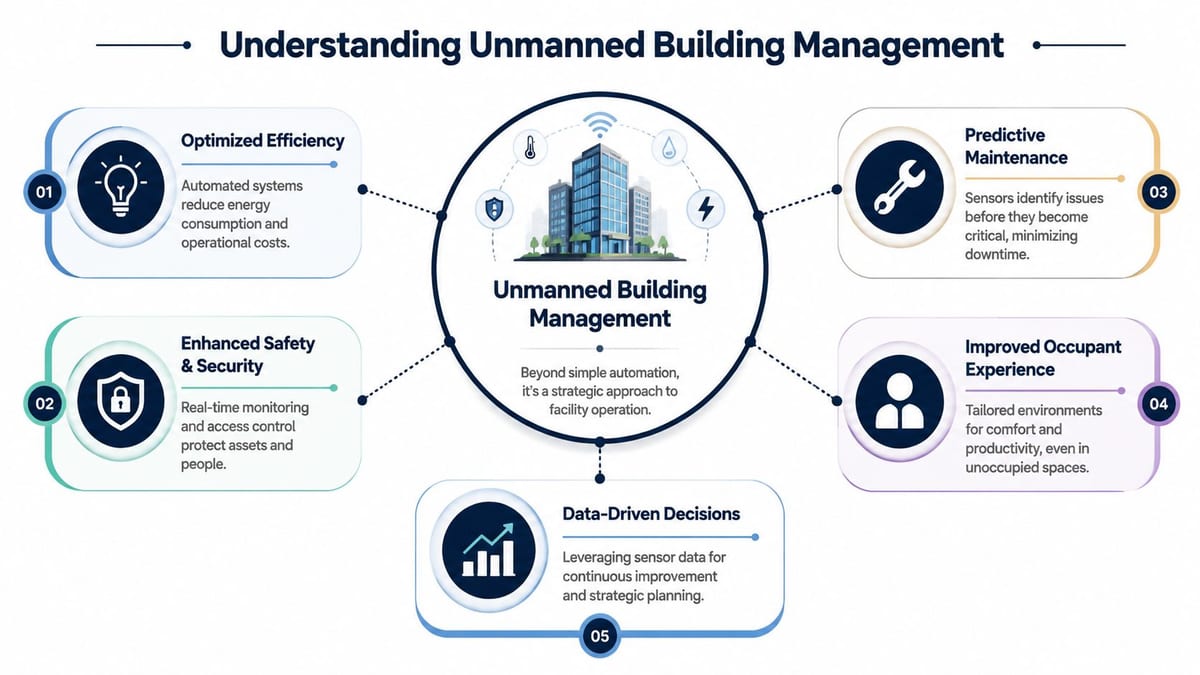
Unmanned building management doesn't mean an empty building. It means a building can run routine operations safely and predictably without constant on-site human intervention.
That includes opening and securing areas by schedule or credential, adjusting lighting and HVAC to actual use, flagging faults automatically, and letting remote teams verify conditions before they send anyone to site. In practice, the best comparison is autopilot. The building still needs oversight, but it shouldn't need someone physically present for every ordinary event.
What it looks like on a live site
In a commercial office, that might mean:
- Arrival management where approved staff and contractors enter through NFC credentials, doors log events automatically, and selected areas are accessible only during approved windows.
- Environmental control where occupancy and environmental inputs tell the BMS when to reduce ventilation or lighting in lightly used areas.
- Remote fault handling where facilities teams see whether an issue is local, widespread, or caused by loss of network, power, or equipment.
- Security verification where CCTV, door events, and alarm triggers can be reviewed together instead of as separate systems.
In an NHS setting, the same model applies but with stricter expectations. Estates teams need dependable access records, resilient network paths, clear segregation between clinical and non-clinical infrastructure, and a support model that doesn't interrupt services.
Automation isn't the same as autonomy
A lot of buildings are automated but not autonomous. They have timers, some sensors, perhaps a BMS front end, but they still depend on staff doing daily manual checks because the underlying systems don't trust each other.
That usually traces back to transport and topology. If the wireless design is weak, your sensor estate becomes patchy. If the wired backbone wasn't planned for mixed traffic, cameras, controllers, and building devices compete for the same capacity. Good design starts with the network fabric, not the dashboard, which is why a grounding in Ethernet and wireless design for building infrastructure matters before any procurement list is finalised.
A genuinely unmanned building still has people responsible for it. It just stops wasting their time on avoidable routine intervention.
What the operating model changes
When the model is right, facilities staff stop walking buildings to prove lights are off or doors are shut. IT stops firefighting mystery endpoints that were installed without proper segmentation. Security stops relying on standalone systems that can't share context.
That's the core value. Fewer manual checks, better response to faults, cleaner evidence, and less dependence on someone being physically present to keep an ordinary day moving.
Key Sensor Types and Their UK Applications
The useful way to assess smart building sensors isn't by asking which devices are available. It's by asking which building decision each device improves.
The UK policy context matters here. The 2021 Net Zero Strategy increased pressure on commercial buildings to cut energy use, and smart-building technologies are increasingly specified for performance monitoring rather than comfort alone, as outlined in Milesight's review of IoT sensor adoption in smart buildings. That shifts sensors from nice-to-have gadgets into operational instrumentation.
Where each sensor type earns its place
| Sensor Type | Primary Use Case | UK-Specific Driver |
|---|---|---|
| Occupancy sensors | Demand-led HVAC, space use, cleaning triggers | Office hybrid working patterns, estate rationalisation, fit-out efficiency |
| Environmental sensors | Temperature, humidity, air quality, comfort monitoring | Operational evidence for indoor conditions and better ventilation decisions |
| Energy and building performance sensors | Metering at circuit, panel, or device level, plus plant performance | Energy optimisation, carbon reporting, and better visibility of system waste |
| Lighting sensors | Daylight harvesting and presence-led switching | Reduced lighting waste and better control in open-plan and shared spaces |
| Access and security sensors | Door state, credential events, motion in protected zones | Controlled entry, audit trails, and integration with wider security operations |
| Water leak sensors | Early leak detection in high-risk spaces | Protection of comms rooms, data areas, plant spaces, and sensitive NHS environments |
| CCTV-linked analytics | Visual verification of alarms, incidents, and out-of-hours activity | Remote validation in low-staff or unmanned operational periods |
Occupancy and environmental sensing
Occupancy data is often the trigger that makes other systems smarter. It tells you whether a space is occupied, not just booked on paper. In offices, that affects ventilation and cleaning. In NHS and clinical support buildings, it helps separate true demand from static schedules that keep systems running at full output.
Environmental sensors then provide the condition layer. Temperature, humidity, and air-quality monitoring help estates teams decide whether a comfort complaint is caused by crowding, ventilation drift, or plant faults. Used properly, these sensors support operational decisions. Used badly, they merely generate alerts.
Energy, lighting, and access
Energy and HVAC performance sensors are the most direct route to measurable savings. In the UK, smart sensors enable a 15 to 20% reduction in HVAC-related energy use, and enterprises in NHS and public sector facilities with high sensor density achieve an average 18% total energy saving, which gives teams a credible basis for ROI planning. That verified figure appears in the approved data set for this article.
Lighting sensors are straightforward when they're used for their real purpose. Presence detection and daylight response can reduce waste, but they're not a substitute for proper space analytics. A lighting PIR that turns lights on and off doesn't tell you how a meeting suite is used over time.
Access sensors matter most in unmanned operation. Door contacts, credential events, and alarm states become part of the building's decision-making. If a secure room is opened outside policy, the building should know. If a plant room door is forced, CCTV should validate it quickly. If you're comparing approaches to integrated access hardware and sensor-led entry control, Splash Access Mv solutions are a useful example of how vendors are packaging sensing and access together.
For CCTV specifically, the lesson is simple. Don't bolt it on later. Camera coverage, power, recording, retention, and network load need to be planned as part of the same building stack, especially in larger fit-outs and relocations. A practical reference point is this guide to installing CCTV systems in commercial environments.
The Critical Triad Designing Power Data and Access Together
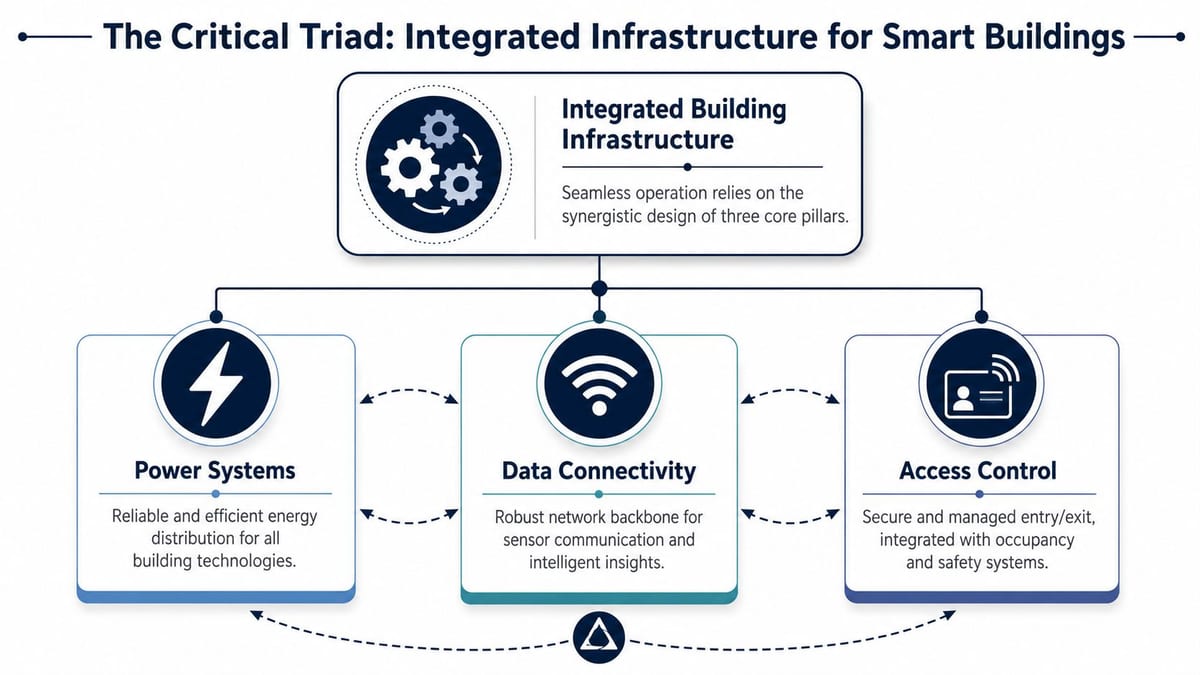
The most reliable way to think about an unmanned building is as a three-legged stool. The legs are power, data, and access. If one is weak, the whole thing wobbles.
That sounds obvious, but projects still split these into different workstreams and expect integration to happen later. It rarely does. Door hardware needs power decisions. Sensor placement depends on network reach. CCTV retention affects switching and storage. Building out a fully autonomous unmanned building unit only works when those choices are made together.
Power has to be boring and dependable
For sensors, controllers, readers, cameras, and edge devices, power design decides whether the building is maintainable. In many commercial fit-outs, Power over Ethernet is the cleanest answer for fixed devices because it simplifies delivery, centralises control, and reduces the number of separate local power supplies to maintain. The catch is that PoE design has to be intentional. Switch capacity, cable pathways, heat, and resilience all matter.
A useful technical starting point is understanding how Power over Ethernet cabling affects building device deployment. In practice, PoE works best for fixed endpoints with predictable bandwidth and a defined support model, such as cameras, access readers, intercoms, and many sensor gateways.
Commercial electrical installation and certification still sit underneath all of this. Smart systems don't reduce the need for proper electrical design. They increase it. Containment, distribution, isolation, safe testing, and certification become more important because more operational functions now depend on them.
Data must be designed like infrastructure, not convenience
Wireless sensors are attractive because they speed up installation, especially in occupied sites. That doesn't mean every sensor should be wireless. The right question is whether the device is mission critical, whether battery maintenance is acceptable, and what happens if the local wireless environment degrades.
Structured cabling is still the backbone for fixed, high-value systems. Wi-Fi is often appropriate for mobile devices, selected sensors, and temporary overlays. In retrofit-heavy buildings, a mixed model is usually best. Hardwire what must never disappear. Use wireless where physical disruption would be disproportionate.
Site reality: Older offices don't fail because they're old. They fail because teams pretend old constraints don't matter until commissioning.
That's why network surveys, rack space checks, switch loading, and pathway audits matter before procurement. If a riser is full or a legacy BMS cabinet has no sensible integration route, that affects the design immediately.
Access is where unmanned buildings either work or become a maintenance treadmill
Access control isn't just about keeping the wrong people out. In an unmanned building, it also governs scheduled access, contractor visits, incident response, and the audit trail around all of them.
Battery-less, NFC proximity locks are often the right choice where teams want low routine maintenance and clean user journeys. The practical reasons are simple:
- No battery replacement round means there's no recurring programme of site visits just to keep locks alive.
- Fewer hidden failures because you're not discovering low batteries when a seldom-used door suddenly matters.
- Cleaner credential handling when staff already use NFC-capable credentials or managed devices.
- Better fit for low-touch sites where there may not be anyone nearby to notice early warning signs on door hardware.
That doesn't mean battery-less locks are always correct. Some doors still need different hardware, different fire strategy coordination, or a different integration path. But for many internal doors in modern commercial and managed public-sector environments, they remove one of the most annoying operational burdens in unmanned estates.
What integrated design changes on the ground
When power, data, and access are designed together, the building behaves consistently. Doors report state correctly. Cameras stay online when they should. Sensor data arrives when expected. The BMS and security layer can act on the same truth.
When they're designed separately, every small fault becomes a blame chain. Electrical says the circuit is live. IT says the switch is up. Security says the reader is online. The door still doesn't work. That's the outcome integrated planning prevents.
Turning Sensor Data Into Secure and Compliant Intelligence
Installing smart building sensors is the easy part. The harder part is deciding which data matters, how long it should be retained, who can trust it, and what you'll do when systems disagree.

In UK commercial and NHS settings, that matters because sensor data is increasingly used to support governance, maintenance, and compliance decisions. It isn't enough for a dashboard to look plausible. The output needs to stand up to scrutiny.
According to Occuspace's discussion of audit-ready smart building data, buying decisions are increasingly shaped by operational resilience and cyber-risk, and sensor output can be persuasive without being defensible if calibration, time-synchronisation, and data governance are weak. That's exactly the risk facilities and IT teams need to avoid.
What audit-ready actually requires
Audit-ready data comes from a controlled chain:
- Calibrated devices with a clear record of what was installed, where, and when it was last checked
- Time-synchronised systems so CCTV events, access logs, alarms, and BMS records line up properly
- Defined ownership across estates, IT, and security, so there's no ambiguity about who validates, stores, and reviews what
- Retention rules that reflect operational need and legal obligations rather than vendor defaults
If a room sensor says a space was occupied, the access logs say nobody entered, and the CCTV view shows cleaning staff present, the issue isn't “bad data”. It's the absence of a rule for reconciling evidence across systems.
Secure handling matters as much as sensing
Most projects should isolate building devices from general user traffic. Sensor networks, access control, CCTV, and BMS integrations all deserve deliberate segmentation, controlled permissions, and monitored interfaces into wider corporate systems.
That doesn't have to mean overengineering. It does mean recognising that every connected door controller, camera, and gateway is part of your operational attack surface.
A short technical explainer can help non-specialists align on the principle before detailed design work starts:
If you can't show how a reading was produced, transported, stored, and validated, don't rely on it for compliance.
The practical output
Good sensor intelligence is simple to use. It answers questions such as:
- Was the area occupied when the HVAC remained at full load?
- Which door event lines up with this alarm?
- Did the temperature excursion happen before or after the plant fault?
- Can estates, IT, and security all see the same timeline?
That's when sensor data becomes operational evidence instead of background noise.
A Project Checklist for Your Next UK Building Fit-Out
Most UK smart sensor projects happen in existing buildings, not pristine shells. Government-backed analysis highlighted in ACEEE's work on non-domestic buildings and smart controls reinforces the practical point: retrofit conditions, existing systems, and integration quality shape outcomes more than the sensors alone.
That's why a fit-out checklist needs to start with constraints, not wish lists.
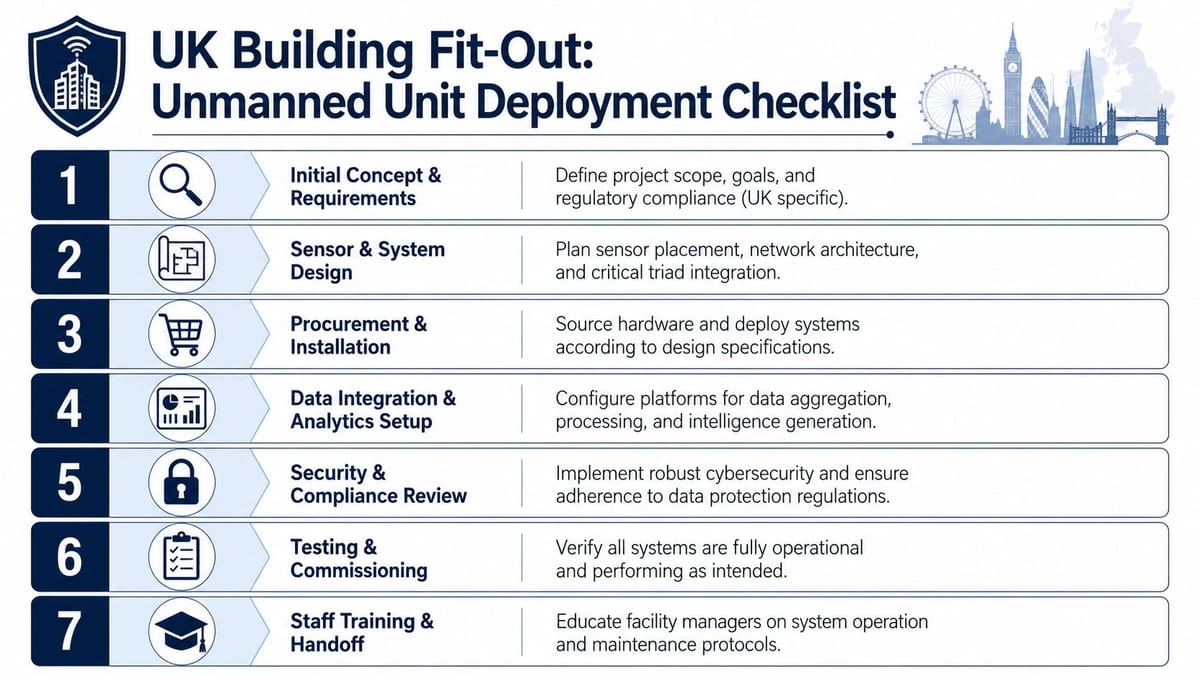
Seven checks that stop expensive mistakes
Define the operating model first Decide what “unmanned” means for your site. Out-of-hours only is different from low-touch weekday operation. NHS support buildings differ from multi-tenant offices. The access model, response model, and resilience expectations should be written down before any hardware list appears.
Survey the building properly
Check risers, containment, cabinet space, legacy BMS interfaces, power availability, comms room condition, and wireless coverage. In older offices, partial rewires and undocumented changes are common. Assumptions cost time.Design the triad together
Put power, data, and access in one coordinated design review. If a door needs a controller, ask where it gets power, how it reports state, where the cabling lands, and what happens if the network path fails.Choose sensors by decision value
Don't install devices because they look modern. Install them because they improve a specific decision, such as reducing HVAC load in underused zones, proving entry to restricted areas, or alerting to leaks near critical equipment.
Commissioning is where good intent is tested
Build installation and certification into the programme
Commercial electrical installation and certification, structured cabling testing, CCTV commissioning, lock programming, and network sign-off all need programme time. If those tasks are compressed at the end, faults get pushed into live operations.Test cross-system behaviour, not single devices
A sensor passing power-on self-test tells you very little. Test full workflows. Does a forced door event appear in the access platform, trigger the right alert, and allow CCTV verification? Does occupancy change actually alter local environmental control?
Commissioning should prove the building can operate unattended, not just prove that individual devices switch on.
- Plan maintenance before handover
Every smart building sensor estate needs a maintenance model. That includes firmware approach, spare hardware policy, calibration responsibilities, lock lifecycle checks, cable records, and ownership of first-line troubleshooting.
Where these systems are commonly used
The most common deployments are practical, not futuristic:
- Commercial office fit-outs with hybrid occupancy, managed meeting suites, and out-of-hours access
- NHS support and administrative buildings where estates teams need evidence, security, and low-disruption operation
- Multi-site estates where remote verification reduces unnecessary call-outs
- Data-sensitive areas such as server rooms, comms spaces, and plant areas where access, leak detection, and CCTV need to work together
A building doesn't need to be architecturally iconic to benefit. It needs repeatable operations, dependable infrastructure, and a support model that matches reality.
Calculating the True ROI and Total Cost of Ownership
ROI discussions around smart building sensors often get distorted because teams only count the hardware and the projected utility saving. That's not enough for a serious business case.
Start with the cost side. Include sensors, controllers, gateways, lock hardware, readers, switching, storage, software licensing, structured cabling, electrical works, commissioning, certification, and the labour needed to maintain the system after handover. If the project depends on network upgrades or server room changes, include those too. Unmanned building systems often look affordable until the supporting infrastructure is priced properly.
Where the measurable return usually comes from
There is one hard operational benchmark available here. In the UK, smart sensors enable a 15 to 20% reduction in HVAC-related energy use, and in NHS and public sector facilities with high sensor density, enterprises achieve an average 18% total energy saving. Those figures are part of the verified data set for this article and are the strongest basis for a quantified ROI discussion.
Everything else should be framed accurately and qualitatively unless you have your own estate data. Teams often realise value through fewer manual checks, better fault triage, cleaner security evidence, less wasted lighting and conditioning, and lower maintenance overhead when access hardware is chosen sensibly. Those benefits are real, but they need to be assessed against your own building operations rather than generic marketing claims.
TCO is where many projects are won or lost
A low purchase price can hide an expensive operating model. Battery changes, poor wireless reliability, proprietary software, awkward integrations, and unclear support ownership can turn a reasonable project into a recurring burden.
That's why it helps to think in TCO terms, not just capex. The same logic shows up in other technology buying decisions too. If you want a broader framework for weighing platform cost, support burden, and risk over time, Querio's data tool insights make the principle clear even outside the building sector.
The financial question worth asking
The useful question isn't “Will smart building sensors save money?” They often can.
The better question is this: Will this specific design reduce cost and risk after installation, or will it create a permanent maintenance obligation that the building team has to carry?
If the power design is clean, the data path is reliable, the access model is low-friction, and the outputs are operationally useful, the answer is usually favourable. If not, the cheapest quote can become the most expensive building to run.
If you're planning an office relocation, fit-out, CCTV upgrade, server room expansion, or a wider move toward unmanned building operation, Constructive-IT can help you scope the infrastructure properly before isolated decisions turn into expensive rework. The strongest projects start with surveys, integrated design, and a support model that fits how the building will be used.