


A Complete Guide to Data Center Relocation Services
- Craig Marston
- Jan 9
- 15 min read

Relocating a data centre isn't just a big IT project; it's the professional, managed process of moving your entire digital nerve centre from one building to another. This is an incredibly high-stakes operation where one small mistake can lead to catastrophic downtime, which is exactly why bringing in a specialist partner is non-negotiable. The goal is to move beyond a simple physical transfer and treat it as a strategic upgrade of your core network infrastructure.
Why Your Data Centre Move Needs a Specialist
Moving a data centre is worlds apart from a standard office relocation. We’re not talking about desks and chairs here; we’re talking about strategically transplanting the heart of your entire organisation. For businesses in sectors like healthcare—especially hospitals—and large commercial buildings, any disruption is simply not an option. The risks tied to data network mistakes are immense, ranging from crippling downtime to severe data loss.

Engaging a specialist partner transforms the move from a logistical nightmare into a golden opportunity to improve your infrastructure. A successful relocation hinges on meticulous planning and certified expertise, making sure every single component, from the servers down to the last cable, is handled with precision. This is where the line between a simple mover and a true technology partner becomes crystal clear.
The Value of Certified Expertise and Warranties
Choosing an Excel network accredited partner brings a level of assurance that you just can't get with a generalist moving company. This accreditation isn't just a badge; it's a mark of commitment to the highest industry standards. The process involves designing and implementing a rock-solid network, often including high-performance fibre cable installation, that is genuinely built to last.
This dedication to quality gives you several massive advantages:
Certified and Tested Network Delivery: Every cable and connection gets rigorously tested before, during, and after the move. Making sure your network is tested and certified guarantees it performs optimally from the moment it goes live in the new location.
25-Year Equipment Warranty: Working with an accredited installer unlocks extensive manufacturer warranties. This long-term guarantee on cabling and components offers total peace of mind, knowing your foundational infrastructure is secure for decades.
Professional Cable Management: A specialist ensures your new setup is not just functional but also impeccably organised. Proper cable management is far more than a "tidy desk" aesthetic; it's absolutely crucial for airflow, cooling efficiency, and simplified future maintenance.
A data centre relocation is the perfect opportunity to fix all those infrastructure compromises made over the years. It allows you to build a network foundation that not only supports you today but is also engineered for future growth—all backed by a performance guarantee.
Ultimately, a specialist provides an end-to-end service. That includes a full office relocation with equipment testing, making sure your network isn't just reconnected, but truly optimised for its new home.
The Blueprint for a Seamless Relocation
Success in any high-stakes project is decided long before the first server is unplugged. This is especially true when it comes to relocating a data centre. The discovery and planning phase isn't just a preliminary step; it's the very foundation the entire project rests on. A rushed or incomplete blueprint is the number one cause of common data network mistakes that lead to painful downtime and spiralling costs.

This initial stage goes way beyond a simple asset list. While knowing what you have is important, understanding how it all works together is absolutely critical. It’s about creating a detailed migration blueprint through collaborative engineering, intensive dependency mapping, and thorough site surveys of both your old and new locations.
Beyond the Inventory List
A simple list of servers and switches just won't cut it. True planning means taking a deep dive into the interdependencies between your applications, virtual machines, and physical hardware. We need to map out precisely how data flows across your network to understand the real-world impact of moving each and every component. A smooth relocation demands a detailed strategy, much like the comprehensive commercial moving solutions that tackle complex logistics beyond just shifting boxes from A to B.
This deep-dive process involves:
Application Dependency Mapping: Pinpointing which servers support which business-critical applications and exactly how they communicate with each other.
Hardware and Software Audits: Documenting firmware versions, configurations, and warranty status for every single piece of equipment.
Stakeholder Interviews: Actually talking to department heads and application owners to understand their specific needs and uptime requirements.
For a detailed walkthrough on this crucial first step, our guide on how to perform an asset audit provides a properly structured approach. This meticulous work prevents that classic nightmare scenario where a seemingly minor server is powered down, only to take out a critical business function everyone forgot about.
Site Surveys and Risk Mitigation
Detailed site surveys of both the current and destination facilities are completely non-negotiable. These assessments go far beyond just measuring floor space; they analyse the core infrastructure that will support your operations. We evaluate everything from power distribution and cooling capacity to rack layouts and physical security, ensuring the new environment can handle your current and future needs.
Take a real-world example: an NHS hospital trust planning a relocation. Here, the primary goal is maintaining 100% availability for patient record systems and critical clinical applications. There is zero room for error.
For a hospital, even a few minutes of downtime isn’t just an inconvenience; it can have serious operational consequences. The planning phase must identify every single point of failure and build robust contingency plans to ensure continuity of care throughout the entire migration window.
This is where a specialist partner proves their worth. We identify potential logistical hurdles that others might miss, from lift access and loading bay restrictions in commercial buildings to the unique compliance requirements found in hospitals. This risk assessment allows us to create a detailed, minute-by-minute cutover plan that accounts for every variable, ensuring a smooth transition.
The Power of a Certified Plan
Ultimately, this blueprinting phase culminates in a detailed roadmap. This document outlines not just the physical move but also the complete network design for the new location. It includes plans for fibre cable installation and structured cabling, designed by an Excel network accredited partner to guarantee performance.
This certified design is what enables a full 25-year equipment warranty, giving you long-term confidence in your new infrastructure. The plan also specifies rigorous post-move equipment testing procedures. By making sure your network is tested and certified from day one, we deliver a validated, high-performance environment ready for your team. This focus on a certified, tested network delivery is the difference between simply moving equipment and executing a strategic infrastructure upgrade.
Designing Your Future-Proof Network Infrastructure
A data centre relocation is a rare chance to leave old problems behind. This isn’t just about moving servers; it’s a golden opportunity to engineer the network your organisation will depend on for the next decade. Forget simply recreating your old setup—this is your moment to build a high-performance, resilient infrastructure from the ground up and sidestep the common network mistakes that plague legacy systems.

This design phase is where the real value of specialist partners comes into sharp focus. It’s about more than just a lift-and-shift. It’s about creating a structured cabling system that can handle tomorrow’s demands, not just today's. By choosing the right components and an expert installation partner, you’re not just moving kit; you’re investing in performance, reliability, and long-term peace of mind.
The Bedrock of Performance: Structured Cabling
The backbone of any modern network—especially in demanding environments like commercial buildings and hospitals—is its structured cabling. Everything else depends on this physical layer, and getting it right is non-negotiable. Opting for cheap components or a rushed installation is a recipe for persistent bottlenecks and troubleshooting nightmares.
We build our network designs around best-in-class components to guarantee performance and longevity. This includes:
Excel Cat6a Cabling: This provides the high-bandwidth copper connectivity needed for server-to-switch links and high-speed user access points, delivering reliable 10-Gigabit Ethernet performance.
High-Density Fibre Cable Installation: Absolutely essential for the core network backbone. It connects racks and comms rooms across the site with near-limitless bandwidth and total immunity to interference.
As an Excel network accredited partner, our designs and installations stick to the strictest industry standards. This accreditation is more than a badge; it's your assurance of quality and the key to unlocking a powerful long-term benefit.
Securing Your Investment with a 25-Year Warranty
One of the biggest advantages of a professionally designed and installed network is the warranty that stands behind it. When an accredited partner like us installs a complete Excel networking system, the entire installation is covered by a comprehensive 25-year equipment warranty.
This isn't just a warranty on a single switch or patch panel. It’s a guarantee covering the end-to-end performance of your entire passive cabling infrastructure. For organisations like NHS trusts where long-term reliability is paramount, this provides an incredible level of financial protection and operational confidence. It’s invaluable.
More Than Just a Tidy Desk: The Art of Cable Management
Professional cable management is often mistaken for a purely aesthetic choice—the IT equivalent of a 'tidy desk'. In reality, it’s one of the most critical elements of a high-performance data centre. Let’s be clear: poorly managed cables can wreak havoc.
Improper cabling obstructs airflow, causing equipment to overheat and shortening its lifespan. It also turns routine maintenance into a complex and risky job, where tracing a single cable can take hours and potentially lead to an accidental outage.
Professional cable management isn't about looking neat; it's a core engineering principle that directly impacts system performance, cooling efficiency, and operational safety. A well-managed rack simplifies maintenance, reduces human error, and ensures your equipment runs within optimal thermal ranges.
Our approach ensures every cable is precisely routed, labelled, and secured. We consider everything from bend radius to the separation of power and data lines to eliminate interference. This meticulous work is central to delivering a certified, tested network delivery that performs flawlessly from day one. To get a better handle on organising your core hardware, check out our guide to selecting and installing network server racks, which covers best practices for layout and management.
Ultimately, a successful move concludes with thorough testing. We ensure every component, from the core network to integrated systems like telecoms and CCTV, is fully functional and certified before handover, confirming your new infrastructure is robust, scalable, and ready for whatever comes next.
Executing the Migration with Precision
After months of meticulous planning, designing, and strategising, the time finally comes to put the blueprint into action. This is the execution phase, where a data centre relocation is won or lost. It’s a carefully choreographed sequence of events, managed with military precision to get your operations from the old site to the new with the absolute minimum of friction and downtime.
This phase is so much more than just a physical move. It’s about de-risking every single step, from building out configurations in a safe, parallel environment to having a clear escape route if things don’t go exactly as planned. It’s where the value of a professional team becomes crystal clear, turning potential chaos into a controlled, predictable process.
The Power of Pre-Move Staging
One of the most effective ways to avoid common data network mistakes is by staging the new environment before the move. Instead of waiting for move day to discover a surprise configuration issue or hardware incompatibility, we build a parallel environment at the new site well in advance. This lets us install and set up new racks, power distribution units, and core networking hardware before your live equipment even leaves the old facility.
This staging process typically includes:
Installing and testing the core network: We lay down the foundational structured cabling, including any new fibre cable installation, and test every single connection from end to end.
Pre-configuring hardware: New switches, routers, and firewalls are set up and configured according to the approved design, ready to go live.
Validating power and cooling: We make sure the new environment can handle the heat and power loads of your systems long before they arrive.
This approach effectively turns the migration into a much simpler process. It becomes a case of moving servers into a pre-validated, ready-to-go environment, which massively reduces the pressure and complexity of the actual cutover window. For a deeper dive into the power setup within the racks, our complete guide to the rack-mounted PDU for UK data centres explains just how critical this component is.
Navigating the Cutover Window
The cutover window is the specific, agreed-upon time when live services are shut down at the old site and brought online at the new one. For organisations in busy commercial buildings and hospitals, this window is often incredibly tight—usually overnight or during a weekend to minimise the impact on operations. Managing this period demands a detailed, minute-by-minute runbook that every team member follows to the letter.
Each step is documented, from the exact shutdown sequence of your servers to the specific order for powering on equipment at the new location. This ensures that interdependent systems are brought up in the correct order, preventing application failures caused by a missing database or authentication service.
A well-executed cutover isn't about speed; it's about precision and control. Every action is pre-planned and ticked off a master checklist, ensuring nothing is missed and the process remains predictable from start to finish.
As part of executing the migration with precision, it's also vital to consider the responsible disposal of decommissioned assets. You need a solid plan for any hardware not making the journey. To help, you can consult this quick guide on recycling data center equipment for best practices.
The Professional Safety Net: A Rollback Plan
Despite the most thorough planning, unforeseen issues can crop up. That’s why a documented rollback plan isn’t a sign of doubt, but a mark of professional readiness. It’s an essential safety net that provides a clear, pre-agreed procedure for aborting the migration and returning to the original operational state if a critical problem occurs.
A robust rollback plan defines:
Go/No-Go Triggers: Specific, measurable criteria that must be met to either proceed with the cutover or trigger a rollback.
Step-by-Step Reversal: A clear set of instructions for reactivating the old site and failing services back over.
Communication Protocols: Who needs to be informed, and when, if a rollback is initiated.
Having this plan in place gives decision-makers the confidence to act swiftly, preventing a minor hiccup from escalating into a prolonged, business-damaging outage. It ensures that no matter what happens, business continuity remains the top priority.
Finally, the migration isn’t truly complete once the power is on. Our certified engineers provide on-site 'go-live' support, remaining present as your teams begin using the new systems. This ensures that any immediate issues can be resolved instantly, guaranteeing a smooth handover and validating that the network is performing exactly as designed.
To help visualise the key stages, we've outlined a high-level checklist that covers the critical path of a data centre relocation. This table highlights the main phases and tasks, offering a clear roadmap from start to finish.
Data Center Relocation Critical Path Checklist
Phase | Key Tasks | Primary Responsibility (Example) |
|---|---|---|
1. Planning & Discovery | Define project scope, goals, and budget. Identify key stakeholders and establish communication channels. | Project Manager / IT Director |
2. Asset & Site Surveys | Conduct a detailed audit of all hardware, software, and dependencies. Survey both existing and new sites. | Network Engineering Team |
3. Risk Assessment | Identify potential risks (technical, logistical, business impact) and develop mitigation strategies. | Project Manager / Risk Officer |
4. Network & Cabling Design | Design the new network architecture, rack layouts, and structured cabling plan based on survey findings. | Lead Network Engineer |
5. Pre-Move Staging | Install and test new racks, power, cooling, and core networking hardware at the new site. | Infrastructure Team |
6. Migration Cutover | Execute the move based on the detailed runbook, including shutdown, transport, and power-on sequences. | Migration Team / All Stakeholders |
7. Rollback Plan Execution | (If needed) Initiate the pre-agreed rollback procedure to restore services at the original site. | Senior Management / Project Manager |
8. Post-Move Validation | Conduct comprehensive testing of all systems, applications, and network performance post-migration. | IT Operations / Application Owners |
This checklist serves as a foundational guide. A successful project depends on filling in each of these phases with meticulous detail, clear ownership, and constant communication. It’s the framework that transforms a daunting challenge into a manageable and successful outcome.
Post-Move Validation and Performance Certification
The last server is racked, the final cable is patched, and the systems are powering up. It’s a huge moment, and it’s tempting to think the job is done. But for a professional data centre relocation, this is where the most critical phase begins: proving, with hard data, that your new environment is performing exactly as it should.
The project isn't truly finished until we can certify that everything—from the physical cabling right up to the end-user applications—is running flawlessly. This isn't about a quick "can I ping the server?" check. It's a systematic process of validation that ensures the promises made in the planning stage have been delivered, and that you’re protected from subtle but damaging data network mistakes that could undermine the entire project.
This process is a controlled sequence. The staging and cutover phases are designed to flow directly into validation, but with a rollback plan always ready as a safety net.
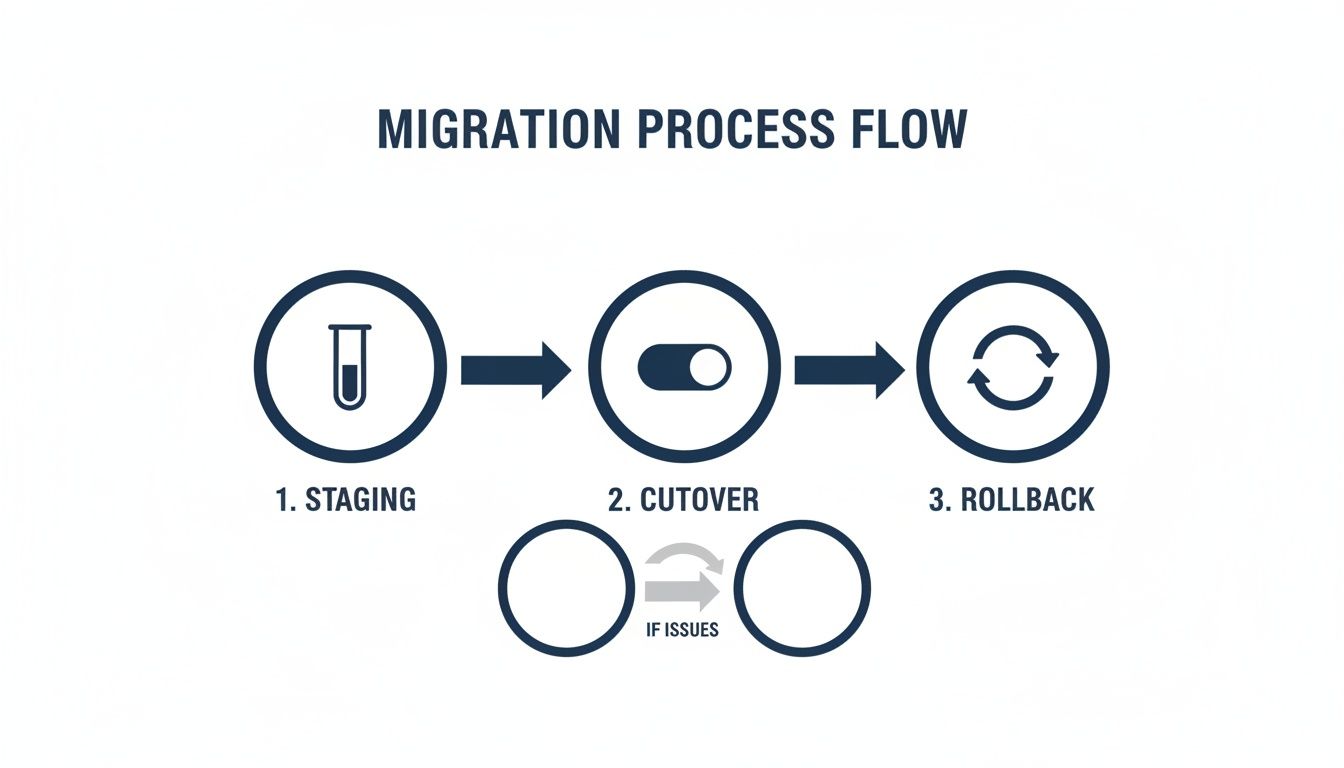
As the flow shows, we don’t burn the boats. The ability to roll back is a crucial part of the process and remains in place until we have confirmation that the post-move validation is a complete success.
The Foundation of Trust: Certified Network Delivery
A new network has to do more than just work; it has to perform under pressure. Our commitment to a certified, tested network delivery is the absolute cornerstone of our service. We don't just say the network is good—we prove it.
That’s why we test every single structured cable we install, both copper and fibre, using advanced Fluke Network analysers. This isn’t a spot check; every link is individually tested against tough TIA and ISO performance standards. We measure key metrics like insertion loss, return loss, and crosstalk to verify that the cabling can handle the high-speed traffic it was built for.
You receive a detailed test report for every single cable. This document is your guarantee that the physical layer is flawless and performs to spec. It’s this meticulous approach that underpins the 25-year equipment warranty.
As an Excel network accredited partner, this level of certification isn't optional. The warranty is only validated after this comprehensive testing is signed off, giving you long-term assurance that your infrastructure is built to last. It’s all about making sure your network is tested and certified to the highest industry standards.
From Infrastructure to User Experience
A perfectly certified physical network is the foundation, but it's only half the story. The ultimate measure of success is whether the business applications your staff and customers depend on are fully functional and responsive. Now we move from infrastructure validation to real-world performance testing.
This is a multi-layered approach:
System Functionality Checks: We’ll work directly with your IT team, running through a pre-agreed checklist to confirm servers are talking to each other, databases are connected, and core systems are online.
Application Performance Testing: We then go a level deeper to test the actual user experience. Are file access speeds where they should be? Are the response times for critical applications within acceptable limits?
User Acceptance Testing (UAT): This is the final, crucial step. We bring in key users from your departments to test their actual day-to-day workflows. This confirms that, from their perspective, the office relocation with equipment testing has been a complete success.
This thorough validation is especially vital in sensitive environments like commercial buildings and hospitals, where even a tiny drop in performance can have serious operational consequences. By validating everything from the physical port to the end-user click, we ensure your data centre relocation delivers on its core promise: a more robust and reliable technology foundation for your organisation.
Common Data Centre Relocation Questions
When you're staring down the barrel of a data centre relocation, the questions start piling up fast. We get it. Drawing on decades of hands-on experience in high-stakes commercial and NHS environments, we've pulled together straight answers to the most common concerns we hear from IT and Operations Managers.
This is where the rubber meets the road—practical advice to help you navigate your move with confidence.
What Is the Single Biggest Mistake Companies Make?
By far the most common and costly mistake is underestimating the complex web of interdependencies between applications and hardware. It’s a classic planning failure.
Most organisations are pretty good at creating an inventory of their physical kit. Where they fall short is mapping out how all their applications, virtual machines, and data flows actually talk to each other. This oversight is a leading cause of avoidable data network mistakes.
This planning gap is what leads to those weekend-from-hell cutover scenarios. A server that someone thought was non-critical gets powered down, and suddenly a core business process grinds to a halt. The only way to avoid this is with a proper discovery phase, complete with detailed dependency mapping and talking to the people who actually use the systems day-to-day. It’s not about what you have, but precisely how it all works together.
How Do You Ensure Our Network Is Ready After the Move?
Readiness isn't a guess; it's something we prove with a rigorous, multi-stage testing and certification process. A blinking light on a network switch means very little.
Every single structured cable we install—from the copper patch leads to the fibre cable installation backbone—is individually tested with advanced Fluke Network analysers. This isn't a spot check. It's a comprehensive process that certifies every link meets, and usually exceeds, strict industry performance standards.
Making sure your network is tested and certified is non-negotiable. We provide a detailed report for every link, which validates the quality of the installation and serves as the foundation for the 25-year equipment warranty. This is the ultimate proof of a successful, high-performance network.
Beyond the physical cabling, we work with your teams to run end-to-end performance validation and user acceptance testing. This confirms that all applications are running exactly as they should before we even think about signing off the project. Whether it’s an office relocation with equipment testing or a full data centre lift-and-shift, our status as an Excel network accredited partner means we deliver a certified, tested network delivery every time.
Can You Handle Relocations for Sensitive Environments?
Absolutely. We have extensive, hands-on experience delivering data center relocation services in some of the most sensitive and regulated environments you can imagine, including active NHS hospitals and large-scale commercial buildings. We know that in these places, uptime isn't a goal—it's a clinical or operational necessity. We do not handle relocations for residential houses.
Our planning for these projects is meticulous. It includes detailed risk assessments, robust contingency plans for every critical system, and tight coordination with your facilities and compliance teams. We ensure every aspect of our work, from the cable management pathways to the final rack layout, strictly adheres to all relevant building and industry-specific codes.
The entire process is designed to be seamless, secure, and fully compliant. It gives you the peace of mind that your critical operations are in safe hands. We manage everything to ensure a smooth transition without disrupting your daily operations—a must-have in environments where there is simply no room for error. We focus on delivering a functional and tidy setup, avoiding the pitfalls of a messy server room that will only cause headaches down the line.
For over 20 years, Constructive-IT has delivered secure, warrantied network infrastructure projects for UK businesses. If you're planning a relocation and need an expert partner to minimise downtime and guarantee performance, schedule your initial consultation with us today. Learn more at https://www.constructive-it.co.uk.
Comments