


A Practical Guide to Fibre Optic Cabling
- Craig Marston
- Jan 25
- 14 min read

Fibre optic cabling is simply a way of sending information using pulses of light down incredibly thin strands of glass or plastic. This method blows traditional copper cables out of the water when it comes to speed and the sheer volume of data it can handle, which is why it’s the non-negotiable backbone for any modern, high-performance network. For any business that depends on fast, reliable data, it’s the essential plumbing that makes everything else work.
What Is Fibre Optic Cabling and Why Does It Matter?
Think of your company’s data network like a transport system. The old copper wiring is like a maze of busy city streets—it gets the job done for local journeys, but it gets congested easily, causing frustrating slowdowns.
In that analogy, fibre optic cabling is the multi-lane motorway. It’s a dedicated, high-capacity expressway that lets enormous amounts of data travel literally at the speed of light, with no traffic jams. Instead of sluggish electrical signals, it uses pulses of light, which is just fundamentally faster and far more reliable.
This isn't just some technical footnote; it has a huge, real-world impact on your business. Investing in a professional fibre optic cabling installation isn’t an IT expense—it’s a strategic move that directly boosts operational efficiency, team productivity, and your capacity for future growth.
The Real-World Impact on Business Operations
A solid fibre network is the foundation that all modern business is built on. Without it, even the most powerful software and cutting-edge hardware will be stuck in the slow lane. The benefits are felt right across the board, in every single department.
Just think about these common scenarios:
Seamless Collaboration: Video conferences that are crystal-clear, without the dreaded lag or dropped connections, become the standard, not a lucky exception.
Instant Cloud Access: Your team can open and work on huge files stored in the cloud as if they were sitting on their own hard drives, wiping out those soul-destroying wait times.
Powering Advanced Tech: Data-hungry applications, from complex design software to the AI and machine learning tools that are just around the corner, run without a hitch.
Rock-Solid Reliability: Fibre is completely immune to the electromagnetic interference you get from power lines or heavy machinery, which means a cleaner signal and a far more stable network.
A well-planned fibre installation is more than just an IT upgrade; it's a critical business asset. It ensures your infrastructure can handle not only today’s data demands but also the exponential growth you’re planning for in the years ahead.
Why Planning Is So Crucial During a Fit-Out or Relocation
The absolute best time to install or upgrade your network is during an office fit-out, renovation, or move. Weaving the fibre optic cabling into the fabric of the building during the construction phase is vastly more efficient and cost-effective than trying to retrofit it into a finished space.
Doing it this way allows for the smartest possible routing, causes zero disruption to your day-to-day operations, and guarantees the network design is perfectly matched to your building’s layout and your company’s unique needs. Planning this core infrastructure from day one prevents future bottlenecks and avoids the need for expensive, disruptive overhauls down the line. It’s about laying a solid foundation your business can build on for years to come.
Choosing the Right Fibre: Singlemode vs Multimode
Picking the right type of fibre optic cabling is one of those foundational decisions that will dictate your network's performance, reach, and cost for years to come. It all boils down to two main contenders: singlemode (OS) and multimode (OM) fibre. Getting your head around the fundamental difference between them is the key to making a smart investment.
Think of it like this: singlemode fibre is a highly focused laser pointer. It sends a single, concentrated beam of light down a razor-thin glass core. Because the beam is so precise and direct, it can travel for miles with barely any distortion. This makes it the undisputed champion for long-distance jobs, like connecting buildings across a campus or linking your office to a remote data centre.
Multimode fibre, on the other hand, is more like a flashlight. It uses a much wider core that lets multiple beams of light bounce their way down the cable simultaneously. This works perfectly over shorter distances—wiring up a single office floor or connecting servers within the same data centre rack, for example. But over longer runs, that scattered light signal starts to degrade. This makes it a great, cost-effective solution for localised, high-bandwidth needs.
This simple decision tree can help you visualise when it's time to move past traditional copper cabling and embrace the speed of fibre.
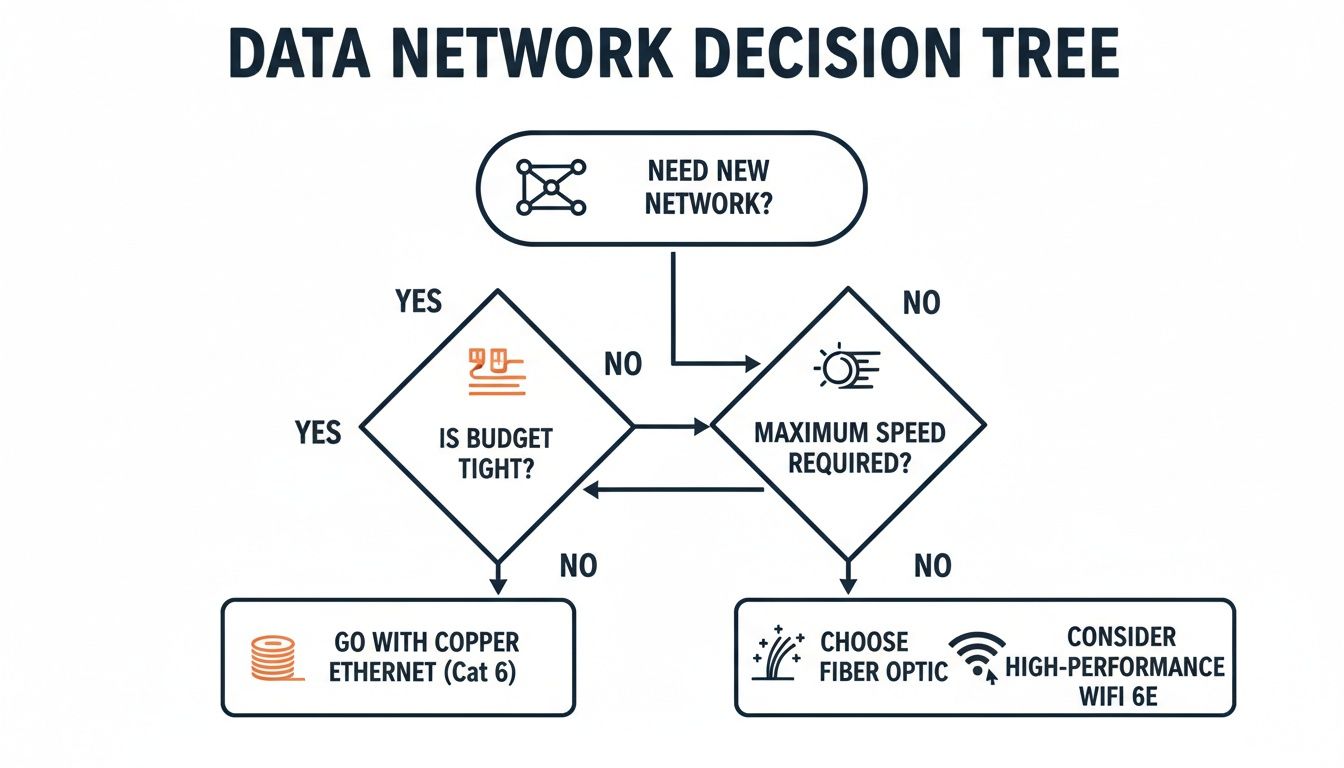
The key takeaway here is that once speed and future-proofing become top priorities, fibre optic cabling isn't just an option—it becomes a necessity.
Understanding Multimode Ratings: OM3, OM4, and OM5
If you decide multimode is the right fit, you'll see different ratings like OM3, OM4, and OM5. These aren't just random labels; they represent generational improvements in bandwidth and the distance the cable can push high-speed data.
OM3 Fibre: This was the go-to standard for 10 Gigabit Ethernet (GbE) over distances up to 300 metres. It’s still a solid, budget-friendly choice for many standard office networks.
OM4 Fibre: A step up from OM3, this cable handles 10 GbE up to 550 metres and can even support 100 GbE over 150 metres. It gives you a lot more headroom for future upgrades.
OM5 Fibre: Also known as wideband multimode fibre, OM5 is engineered for the data centre. It uses clever technology to send multiple signals over a single fibre strand, massively boosting capacity for emerging 400G applications.
Your choice here is a balance between your immediate needs, your growth plans, and your budget. OM3 might get the job done today, but investing in OM4 or OM5 is a smart move that adds valuable future-proofing to your network. For an even deeper dive, check out our detailed guide on singlemode fibre cables.
The choice between singlemode and multimode fibre isn't just a technical detail—it's a strategic decision that aligns your physical infrastructure with your business's long-term operational goals and technological ambitions.
This decision is more critical than ever, with the whole country shifting towards high-speed connectivity. Openreach recently hit a record 529,000 full fibre (FTTP) net additions in a single quarter, bringing its subscriber base to 6.53 million. This massive surge shows the pivotal shift to full fibre optics across the UK, making the right cable choice a cornerstone of modern infrastructure planning.
Singlemode vs Multimode Fibre At a Glance
To help simplify the decision, here’s a quick-glance table breaking down the key differences. It’s a handy reference to see which cable type lines up best with your project's demands.
Feature | Singlemode Fibre (OS) | Multimode Fibre (OM) |
|---|---|---|
Best For | Long-distance links (e.g., between buildings) | Short-distance links (e.g., within an office or data centre) |
Core Diameter | Tiny (around 9 microns), allowing one light path | Larger (50 or 62.5 microns), allowing multiple light paths |
Bandwidth | Virtually unlimited | Limited by the cable rating (OM3, OM4, OM5) |
Distance | Can span many miles without significant signal loss | Effective up to around 550 metres, depending on the rating |
Cost | Higher initial cost for transceivers/electronics | Lower cost for transceivers, making it more affordable for short runs |
Ultimately, the table shows a clear trade-off. Multimode has its place for contained, short-range networks, but singlemode is built for distance, scale, and whatever the future holds.
Fibre Optics: The Backbone of Unmanned Building Management
Fibre optic cabling is the critical nervous system for the next generation of smart, autonomous buildings. Unmanned building management means creating spaces—from self-storage units and co-working offices to residential blocks and student accommodation—that operate securely and efficiently without needing permanent staff on site. In practice, this means integrating access control, security systems, power, and data into a single, reliable ecosystem.
This high-speed, interference-free connectivity provided by fibre is what enables real-time monitoring of CCTV, instant response from smart locks, and seamless management of environmental controls from a central, remote location.
Why Many Unmanned Building Projects Fail
The promise of automated efficiency is compelling, but many unmanned projects fail because they are built on a weak foundation. The single biggest mistake is designing access, power, and data systems as separate, isolated components.
When these three pillars aren’t planned together, you create a system with multiple points of failure. A power outage can disable the data network, rendering the access control useless. A weak data signal can prevent CCTV from recording critical events. True autonomy requires a holistic design where these elements support each other.
Many projects fail due to:
Poor Integration: Using incompatible systems that don’t communicate effectively.
Unreliable Connectivity: Relying on consumer-grade broadband or Wi-Fi that isn't robust enough for mission-critical security.
Lack of Redundancy: No backup plan for power or data loss, leaving the building vulnerable.
A successful installation requires a unified approach. A single, high-capacity fibre optic cabling backbone, combined with a certified commercial electrical installation and an integrated power backup strategy, is the only way to build a truly resilient unmanned facility.
Practical Solutions for Autonomous Buildings
For a fully autonomous unit to function, every component must be chosen for maximum reliability and minimum maintenance.
Access Control: Battery-less, NFC proximity locks are a game-changer. They remove the single most common failure point: dead batteries. Powered directly by the user's smartphone, they are exceptionally reliable and eliminate the operational headache of scheduling battery replacements across hundreds of doors.
Security: High-definition IP CCTV cameras rely on the high bandwidth of fibre optic cabling to stream clear footage without lag. The data network must be robust enough to handle multiple high-resolution streams simultaneously, ensuring complete site visibility.
Operational Considerations: Remote management is key. A centralised system allows for instant revocation of access, remote door unlocking for maintenance staff, and real-time monitoring of all systems, dramatically reducing operational overheads.
By designing power, access control, and data connectivity as a single, interdependent system built on a fibre optic foundation, you create an autonomous building that is secure, efficient, and genuinely low-maintenance.
Planning a Successful Fibre Optic Installation
A high-performance network is rarely an accident. It’s the direct result of meticulous planning that happens long before the first strand of fibre is ever pulled. A thorough site survey and a detailed plan are the most critical steps in the entire process, acting as the blueprint that prevents costly mistakes, delays, and frustrating performance issues down the line.
Great planning starts with understanding the physical environment. This means walking the site to map out the most efficient and safest pathways for the cables. The goal is to find the path of least resistance, avoiding potential hazards and obstructions that could compromise the integrity of the installation.
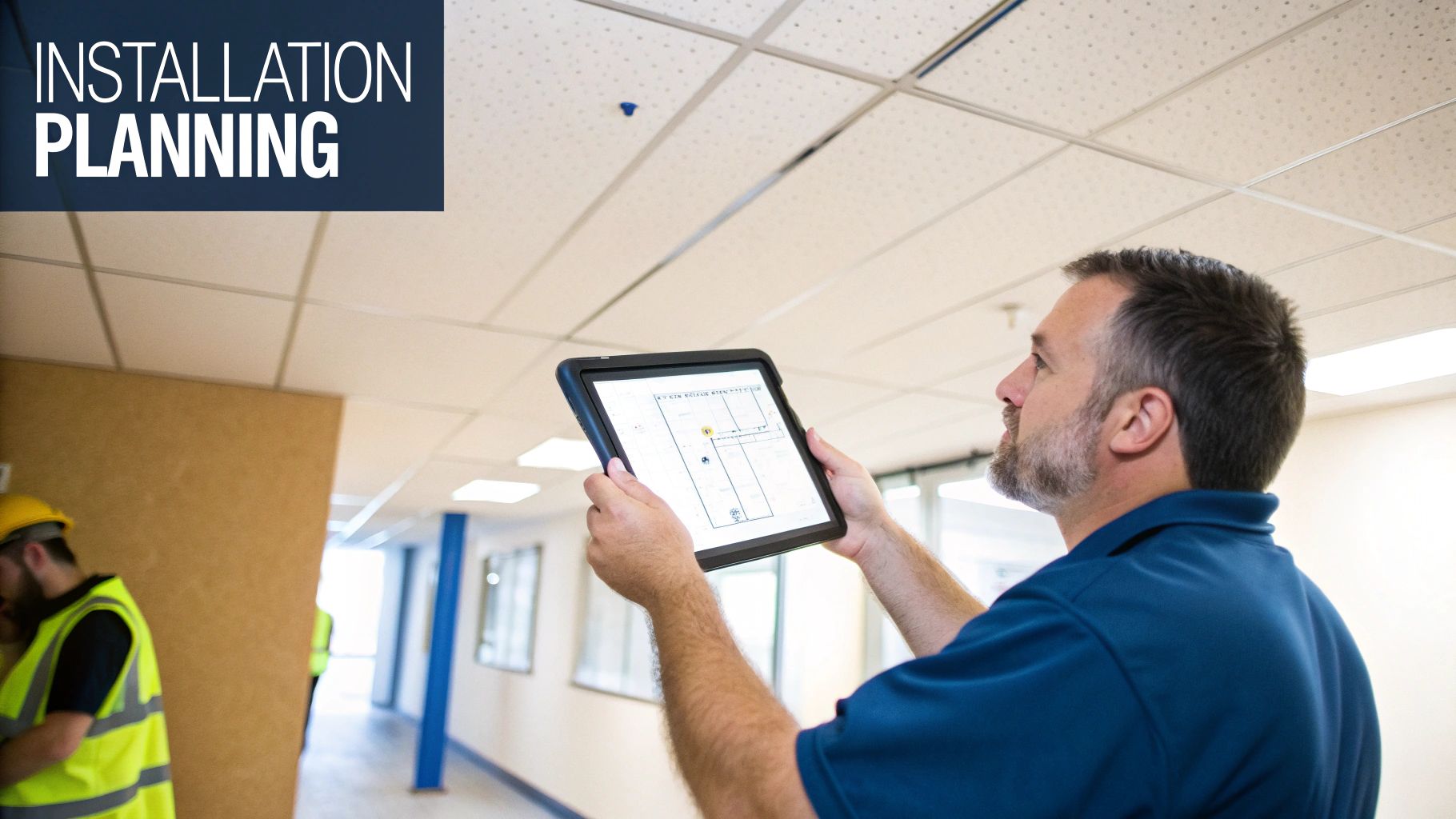
This initial survey is about more than just finding a clear run. It involves a detailed assessment of the entire building infrastructure to ensure the network is both robust and compliant.
The Pre-Installation Site Survey Checklist
A professional site survey is a systematic process. It’s all about identifying and documenting every single element that could impact the installation, ensuring no detail gets overlooked. Collaborating with your installation partner on these points is non-negotiable for a smooth project.
Here are the key areas we cover:
Identifying Obstructions: Pinpointing potential problem areas like high-voltage power lines (whose conduits can obstruct pathways), as well as HVAC ducting, plumbing, and other existing services.
Calculating Distances Accurately: Precisely measuring cable run lengths is essential. This confirms that the chosen fibre type will maintain signal integrity over the required distance without any loss of performance.
Assessing Environmental Conditions: We look at factors like temperature, humidity, and potential exposure to moisture or chemicals in places like basements or industrial spaces. This dictates the type of protective jacketing the fibre cable will need.
Planning for Server Rooms: Designing the layout of comms rooms from the outset is crucial. This includes planning for cabinet placement, power distribution, and making sure there’s adequate cooling to support the network equipment.
The fastest way from Point A to Point B isn't always a straight line, especially in complex buildings. The art of a good site survey is designing a route that balances efficiency with long-term safety and performance, avoiding sensitive areas that create future headaches.
This careful planning phase is fundamental to designing a resilient network. Our guide on data cabling installation provides further insights into the structured process.
Aligning with the UK's Fibre Expansion
The importance of getting your own private network infrastructure right is mirrored by the rapid expansion happening across the country. An impressive 86% of UK homes—equating to 25.9 million premises—now have access to gigabit-capable broadband.
This growth is being driven by initiatives like Project Gigabit, with nearly three-quarters of premises now able to access full fibre. You can explore more about these UK fibre broadband statistics on Uswitch.com.
This national upgrade highlights the rising expectation for high-speed connectivity. A well-planned internal fibre project ensures your business can fully take advantage of these external network improvements, creating a seamless, high-performance connection from the outside world right to your employees' desktops. By mapping out every detail, you ensure your installation is completed on time, within budget, and with minimal disruption to your business.
Installation Best Practices, Testing and Certification
Executing a flawless installation is what separates a fibre optic network that simply works from one that excels for decades. The difference comes down to meticulous attention to detail, sticking to professional standards, and a ruthless commitment to testing. These aren't just about keeping things neat; they're fundamental to the long-term reliability and performance of your entire network.
Even a perfectly planned route can be completely undermined by poor installation techniques. For example, every single cable has a specified minimum bend radius – that’s the tightest it can be bent before the fragile glass core is damaged and signal loss occurs. Respecting this limit is non-negotiable. Sharp bends create micro-fractures that can degrade or completely block the light signal, leading to intermittent failures that are notoriously difficult to track down later on.
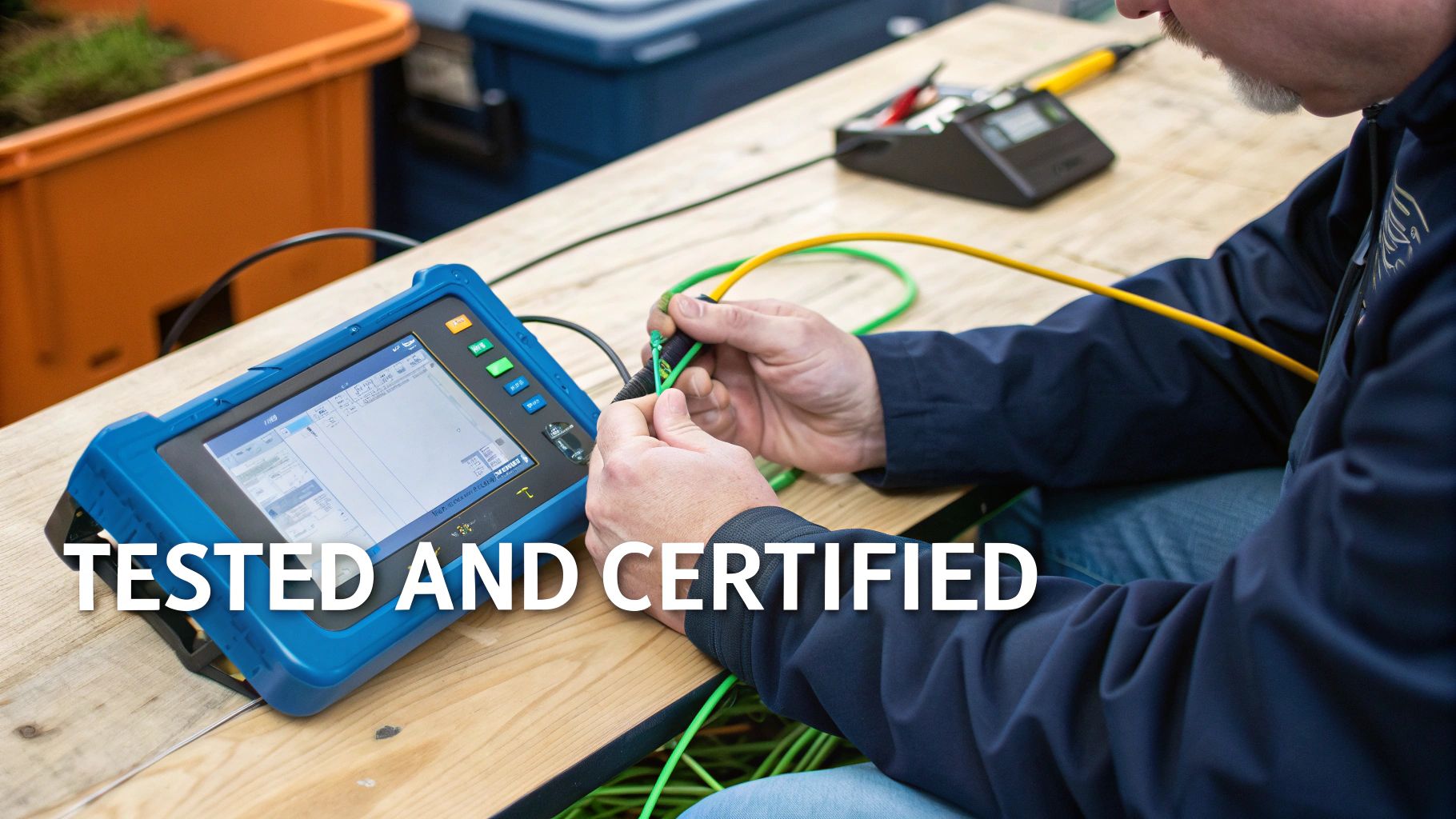
This same precision extends to how individual fibres are joined together. Proper termination and splicing are essential skills for creating clean, strong connections that let light pass through with minimal disruption. It’s all about ensuring the highest possible signal quality makes it from one end of the network to the other.
The Critical Role of Polarity and Labelling
One of the most common, and completely avoidable, sources of failure in a new fibre network is incorrect polarity. In simple terms, polarity makes sure the transmitter (Tx) at one end of a cable connects correctly to the receiver (Rx) at the other. If Tx is mistakenly plugged into Tx, data flow just stops. Dead.
Maintaining correct polarity is straightforward in a simple point-to-point link, but it gets much more complex in a structured cabling system with multiple patch panels and segments. This is where a clear, consistent, and logical labelling system becomes absolutely invaluable.
Meticulous labelling isn't just an admin task; it's a core part of a professional installation. It provides a clear roadmap for the entire network, drastically simplifying future maintenance, troubleshooting, and upgrades. It saves countless hours and prevents costly errors down the line.
Every cable, port, and patch panel must be clearly labelled according to industry standards. This creates an intuitive system that allows any technician to understand the network's layout at a glance, making moves, adds, and changes a smooth and efficient process instead of a chaotic guessing game.
Why Professional Testing and Certification Is Non-Negotiable
The final, and arguably most important, phase of any installation is comprehensive testing and certification. This is the quality control step that validates the entire installation, providing you with concrete proof that every single link performs exactly as it should. Without this, you’re essentially flying blind, just hoping that the network meets the performance standards you've paid for.
Professional installers use advanced testing tools to verify every aspect of the fibre's performance. The key pieces of kit are:
Optical Loss Test Set (OLTS): This tool measures the total amount of light lost along a cable link, also known as insertion loss. It confirms the signal drop is within the acceptable limits defined by industry standards.
Optical Time Domain Reflectometer (OTDR): An OTDR is a powerful diagnostic tool that sends a pulse of light down the fibre and analyses the reflection. It can pinpoint the exact location of faults like sharp bends, bad splices, or dirty connectors, providing a detailed map of the entire cable run.
This rigorous process generates a detailed test report for every single link in your network. This documentation is your official certification, proving that the installation meets or exceeds all relevant performance standards. And crucially, this certification is what activates the 25-year manufacturer's warranty, protecting your investment and guaranteeing the long-term performance and reliability of your new fibre optic network.
Future-Proofing Your Business with Fibre Optics
When you invest in a fibre optic cabling infrastructure, you’re not just solving today’s problems. You’re making a strategic decision to prepare for the inevitable demands of tomorrow. It’s about laying down a high-capacity, scalable foundation that ensures your business isn’t playing catch-up as technology accelerates.
Think about it. A robust fibre network is the only realistic way to support the next wave of business-critical technologies. The explosion of Internet of Things (IoT) devices, the immense data crunching needed for artificial intelligence (AI), and the move towards 400G Ethernet are all set to put an unprecedented strain on older network infrastructures. Getting ready now prevents a hugely expensive and disruptive overhaul later on.
Building for Growth and Scalability
Future-proofing your network isn’t some abstract concept; it’s a practical process that involves making smart, forward-thinking choices during the initial installation. It all comes down to building in extra capacity from day one, so your network can grow seamlessly right alongside your business.
Here are a few essential tactics we always recommend:
Installing Spare Capacity: Always, always run more fibre strands than you currently need. The cost of the extra cable itself is a drop in the ocean compared to the labour cost of pulling new cables later. These spare 'dark fibres' give you instant scalability for future expansion.
Choosing Higher-Grade Fibre: Opting for a higher specification of fibre, like OM4 or OS2, gives you much greater bandwidth and distance capabilities. This ensures your cabling can handle next-generation hardware and faster speeds without having to be replaced.
Designing for Flexibility: A well-designed, structured cabling system with crystal-clear labelling makes it incredibly simple to add, move, or change network connections. This adaptability is key to managing an evolving workplace.
A future-proofed network isn't an expense; it's an asset that adds long-term value to your commercial property and operational resilience to your business. It’s the digital equivalent of laying foundations strong enough for a skyscraper, even if you’re only building a three-storey building today.
Aligning with the UK's Data Explosion
This kind of strategic planning is fast becoming a competitive necessity, not just a nice-to-have. The UK’s data centre capacity is set to double from 3.3 gigawatts to 6.3 gigawatts by 2030, a surge driven by massive investments in AI. This trend puts a massive spotlight on the role of fibre optics in delivering the low-latency, high-speed data transmission that modern data centres depend on. You can find more insights about this forecast on ibisworld.com.
Your internal network has to be ready to handle this tidal wave of data. For businesses looking to future-proof their wider network connectivity, modern solutions like SD-WAN managed services often rely on the high-speed, reliable foundation that only fibre optics can provide.
By investing in a scalable fibre infrastructure now, you’re ensuring your business stays agile, competitive, and ready for whatever comes next.
Partnering for a Seamless Network Upgrade
A high-performance fibre optic cabling network isn't something that just happens. It's the result of sharp strategic planning, technical precision, and an unwavering commitment to quality. From picking the right singlemode or multimode cable to ensuring every single connection is perfectly terminated and certified, a successful project is built from dozens of critical steps. Each decision builds on the last, creating a network that’s not just fast and reliable today, but is ready for whatever you throw at it tomorrow.
This methodical approach is what sets your business up for success, whether you’re tackling an office move, a new building fit-out, or a complex data centre expansion. A properly engineered network becomes a durable asset, underpinning every digital interaction and allowing your organisation to operate at its full potential. The goal is always the same: a seamless, professional installation that delivers immediate performance gains and real long-term value.
Taking the Next Step
Kicking off a network upgrade can feel like a massive undertaking, with so many moving parts and technical details to consider. A successful outcome always hinges on a partnership that blends your own organisational knowledge with specialist technical expertise. For large-scale or particularly complex fibre optic deployments, it often makes sense to work with experienced mechanical and electrical specialists who can manage the entire infrastructure upgrade from top to bottom.
The whole process should start with a detailed conversation, focused entirely on what you want to achieve. This initial chat is crucial for lining up the technical solution with your real-world operational needs and budget.
A truly effective network upgrade is a collaborative effort. It combines deep technical expertise with a clear understanding of your business objectives to deliver a solution that is both powerful and practical, ensuring it serves your organisation well for years to come.
This partnership approach means every aspect of the project gets meticulously planned and executed. From the initial site survey and network design right through to the final installation and certification, a dedicated team manages the entire process. This gives you a single point of contact and clear accountability, guaranteeing a smooth project that keeps disruption to a minimum and delivers a future-ready network. By working together, we can ensure your new fibre optic system is installed correctly, on time, and ready to support your business's growth and innovation.
Whether you are building out fully autonomous unmanned units or upgrading your core business network, getting the foundation right is critical. The expert team at Constructive-IT is here to help you plan and execute a seamless fibre optic cabling installation, backed by a 25-year warranty and over two decades of experience. Schedule a consultation today to ensure your project is a success. Learn more and get in touch at constructive-it.co.uk.
Comments