


Fibre Optic Single Mode Cable Explained
- Craig Marston
- Nov 28, 2025
- 13 min read

Think of your network data like a high-speed train. Some cables are like the local service, stopping frequently and losing momentum. Single-mode fibre, on the other hand, is the non-stop express line, built for pure speed over astonishing distances. It’s how you future-proof your business infrastructure against whatever data demands come next.
Why Single-Mode Fibre is Your Network's Superhighway
Let’s get practical. Imagine data travelling down a fibre optic cable as a simple beam of light. A multimode cable is like shining a wide torch down a large pipe; the light bounces off the walls, scattering and losing energy as it goes.
In complete contrast, a single-mode fibre cable is like a perfectly aimed laser beam fired down a microscopic tunnel. Its incredibly narrow core forces the light to travel along a single, direct path. This allows the signal to travel for miles and miles with almost no loss of quality or strength.
This one fundamental difference is what gives single-mode its incredible power. It's the technology that forms the backbone for connecting different buildings across a campus, linking up regional data centres, and powering the ultra-fast connections that modern businesses absolutely depend on. As your data needs inevitably grow, this is the technology that ensures your network never becomes the bottleneck.
The Foundation of Modern Networks
It's no surprise that single-mode optical cable makes up the largest segment of the UK's fibre-optic cable manufacturing industry. These cables are precision-engineered to transmit information using just one ray of light, which allows for much higher transmission rates over distances up to fifty times greater than their multimode cousins.
While the initial cost for the transmitting and receiving equipment can be higher, its performance for any kind of long-distance communication is simply unmatched.
A common mistake we see is businesses treating their cabling as a simple commodity. In reality, the quality of your network's physical layer dictates its ultimate speed, reliability, and how well it can scale in the future. Investing in professionally installed single-mode fibre is a direct investment in your organisation's long-term productivity.
Unlocking Performance Through Professional Installation
Just choosing single-mode fibre isn't enough to guarantee these benefits, though. The raw potential of this powerful technology is only truly unlocked through meticulous, expert installation. A professional fibre cable installation by an Excel network accredited partner, like us, ensures every connection is flawless, every cable is managed for peak performance, and the entire system is rigorously tested and certified.
This professional approach delivers two critical advantages:
Certified, tested network delivery: You get documented proof that your network performs to exact specifications right from day one. This is absolutely essential during an office relocation with equipment testing or a new fit-out.
A 25 year equipment warranty: This provides genuine long-term peace of mind, knowing your network is a reliable, guaranteed asset you can build your business on.
Single Mode vs. Multimode At a Glance
To make the choice clearer, it helps to see the core differences side-by-side. Think of single-mode as the specialist for long-haul, high-speed journeys, while multimode is the cost-effective choice for shorter trips within a building.
Feature | Single Mode Fibre (The Express Train) | Multimode Fibre (The Local Train) |
|---|---|---|
Core Diameter | Tiny (9 microns). Like a laser beam. | Larger (50 or 62.5 microns). Like a torch. |
Light Path | A single, direct path. No bouncing. | Multiple paths that bounce off the core walls. |
Distance | Excellent for long distances (up to 100km+). | Best for shorter runs (up to 550m). |
Bandwidth | Virtually unlimited bandwidth potential. | Limited by modal dispersion over distance. |
Light Source | Requires more precise, often more costly, lasers. | Uses less expensive LEDs or VCSELs. |
Common Use | Campus backbones, data centre interconnects, telecom networks. | Local Area Networks (LANs), data centres (short links). |
Ultimately, the right choice depends entirely on the job at hand. For connecting buildings or preparing for future bandwidth needs, single-mode is the clear winner.
In the end, a professional installation transforms a high-performance cable into a dependable network superhighway you can rely on for years to come. For a deeper look at the different cable types, check out our quick guide to fast, reliable networking.
Decoding Single Mode Specifications and Standards
Getting into the technical weeds of single mode fibre doesn't have to be a headache. But if you're planning a new installation or an office move, understanding a few key details is crucial. Why? Because these specs directly translate into how well your network actually performs day-to-day.
The most important specification to wrap your head around is the core diameter. Single mode fibre has a ridiculously small core—just 9 microns across (that’s 9 millionths of a metre). This tiny, pin-prick of a pathway is the secret sauce behind its long-distance muscle. It forces a single, focused beam of light to travel in a dead-straight line, which means virtually no distortion or signal fade. In the real world, that means crystal-clear video calls between sites and lightning-fast data transfers become your new normal.
This infographic breaks down the core benefits delivered by professional single mode fibre installations.
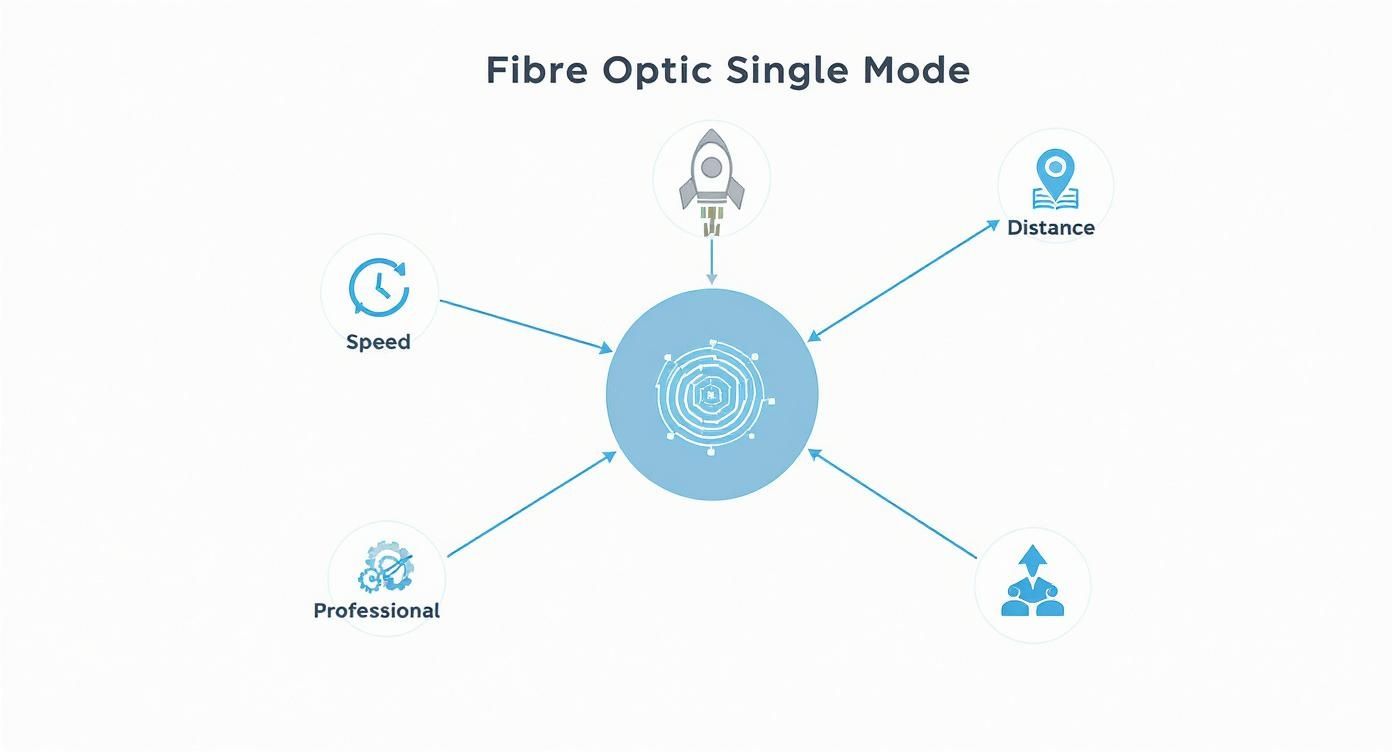
As you can see, mind-blowing speed and distance only happen when the installation is handled by experts and properly certified.
Understanding OS1 vs OS2 Standards
When you start looking at single mode fibre, you'll quickly run into two main standards: OS1 and OS2. They're both single mode cables, but they are built for very different jobs and performance levels. You can think of them as two different generations of the same core technology.
OS1: This is the older standard. It was typically used for indoor runs, like connecting different floors inside the same building. The problem is, it suffers from higher attenuation (signal loss), which really caps its effective distance and bandwidth. For the high-speed demands of today, it just doesn't cut it anymore.
OS2: This is the modern, high-performance standard that's now the default choice for both indoor and outdoor applications. OS2 fibre is constructed in a way that dramatically reduces signal loss. This allows it to support huge bandwidth—we're talking 40G and 100G—over incredibly long distances, often stretching for many kilometres.
Let's be blunt: for any new build, office relocation with equipment testing, or network upgrade, OS2 is the only logical choice. It gives you the performance headroom to support your business's data needs for years to come. It turns your infrastructure into a genuine asset, not a bottleneck waiting to happen.
Choosing OS2 for your network backbone is a strategic investment in future-proofing. It ensures that as your data needs grow, your physical cabling infrastructure is already prepared to handle the load, preventing the need for a costly and disruptive replacement down the line.
Ultimately, picking the right standard is just the first step. The next, and arguably more important, part is getting it installed correctly by a certified partner. This guarantees the network is properly certified and tested, capable of delivering the performance you're paying for. Plus, a professional fibre cable installation from an Excel network accredited partner like us comes with a 25 year equipment warranty, giving you long-term peace of mind for your most critical network infrastructure.
The Critical Role of Professional Installation
All the potential locked inside single-mode fibre optic cabling only comes to life when it's installed meticulously by a professional. Picking the right cable is the first step, sure, but the skill of the installer is what truly unlocks its performance. It's the difference between having a lightning-fast digital backbone and owning an expensive, unreliable source of network headaches.
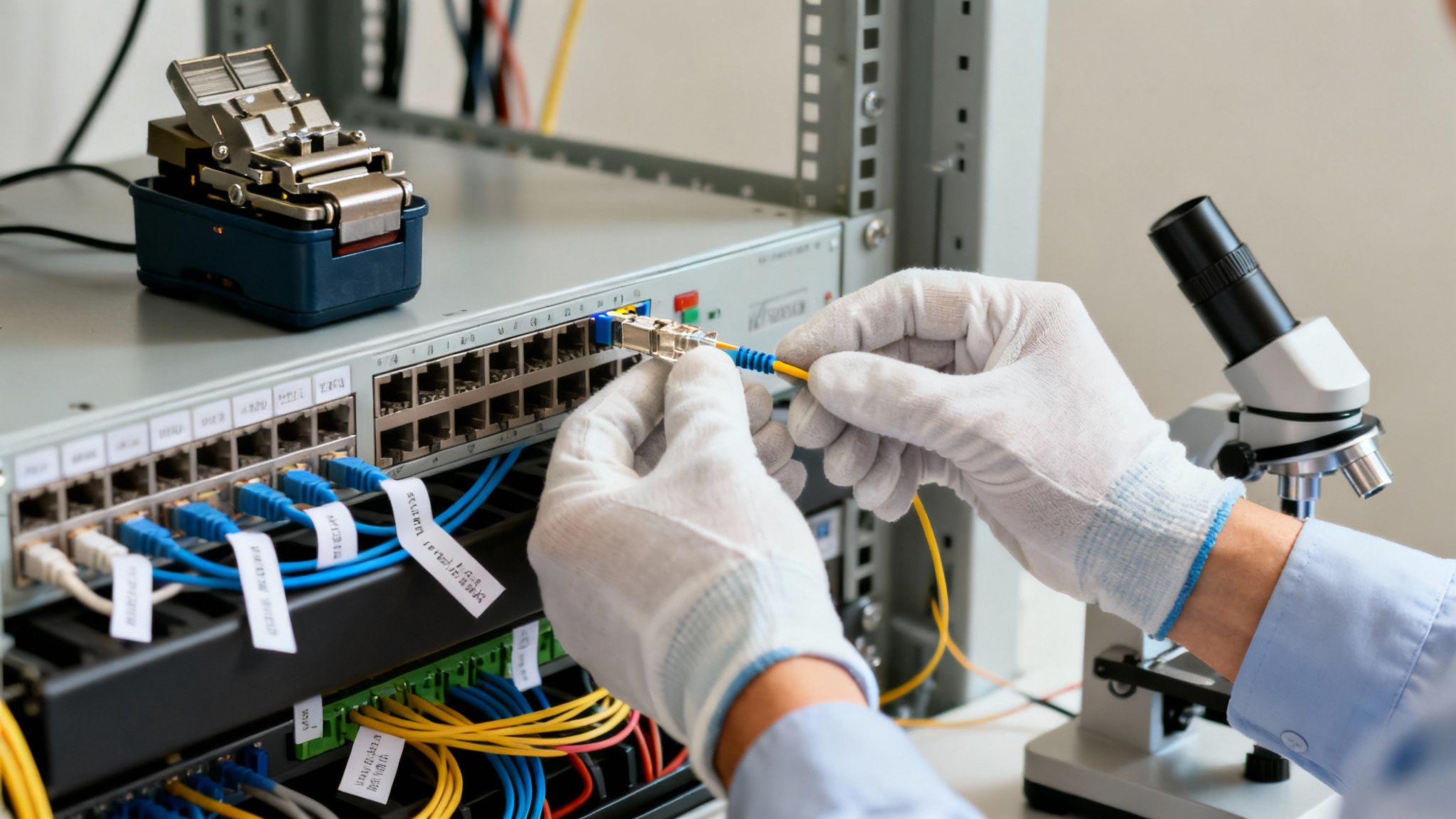
Why the fuss? Because single-mode fibre, with its incredibly fine 9-micron glass core, is a precision instrument. It demands expert handling. The slightest mistake—a micro-fracture, too much stress, or a bend that’s just a bit too tight—can degrade or even completely block the light signal. One small deviation from best practice can turn your major investment into a major bottleneck.
It’s clear this technology is here to stay. The UK government threw its weight behind fibre infrastructure in 2023, funnelling major funding into a mass expansion of FTTP (Fibre to the Premises). The goal is ambitious: full fibre coverage across the nation by 2025. This government push has massively grown the UK fibre optic cable market as demand for faster, more dependable data transmission just keeps climbing. You can read more about the growing fibre optic market trends on futuremarketinsights.com.
Why Accreditation Matters
This is exactly why working with an Excel network accredited partner isn't just a good idea—it's non-negotiable. That accreditation is more than a badge; it's your guarantee of quality and proof that strict industry standards will be followed. Certified engineers are trained in the specific, delicate techniques needed for a successful fibre cable installation.
These are the non-negotiables they live by:
Maintaining Bend Radius: Every single cable has a minimum bend radius. Pushing it past that limit causes permanent damage to the glass core, leading to huge signal loss.
Flawless Connector Termination: Even a microscopic speck of dust on a connector end-face can completely disrupt the signal. Professionals use specialised tools to make sure every termination is perfectly clean and aligned.
Certified, tested network delivery: The job isn’t done until the network is fully certified and tested. This gives you documented proof that the system is performing exactly as specified.
When you partner with an accredited installer, you also get the backing of a 25 year equipment warranty. That’s long-term peace of mind, knowing your network is a reliable and protected asset.
The Impact of Professional Cable Management
Beyond the high-tech stuff, a professional installation always includes methodical cable management. This isn't just about making server racks look tidy; it directly impacts performance and safety. When cables are routed properly, it prevents them from being crushed or strained, which is key to maintaining signal integrity for years to come.
A well-managed cabling infrastructure is the hallmark of a professional installation. It not only optimises performance and simplifies future maintenance but also contributes to a safer and more organised work environment, from the server room to the tidy desk at each workstation.
This attention to detail becomes absolutely vital during something like an office relocation with equipment testing. A certified partner ensures that every single connection is re-established correctly, tested thoroughly, and ready for your team to hit the ground running from day one. You can explore a deeper dive into this topic in our complete fibre cable installation guide.
Real-World Applications Where Single Mode Excels
So, where does fibre optic single mode cabling really prove its worth? It shines brightest in any scenario that demands immense speed over serious distances. Its unique properties make it the only sensible choice for building the digital arteries that power modern organisations, ensuring data flows without a hint of restriction or delay.

Picture a sprawling university or a large business campus with multiple buildings. Connecting them all with a reliable, high-bandwidth network is absolutely essential for day-to-day operations. This is a classic case where single mode excels, effortlessly linking sites kilometres apart while maintaining flawless signal integrity for thousands of users.
Building a Future-Ready Data Backbone
Even inside a single multi-story office, single mode fibre often acts as the central data backbone. It connects the main server room to network closets on each floor, creating a powerful internal highway. This setup is more than capable of handling the enormous traffic loads from countless devices—a task where lesser cables would quickly become a frustrating bottleneck.
This capability stretches far beyond one building. Think about the huge networks connecting regional data centres. As the demand for high-performance networks explodes, especially with the growth of modern data center infrastructure, single mode fibre is the go-to solution. It's the core technology that enables the seamless, low-latency communication vital for cloud computing and disaster recovery.
Choosing the right cabling is a strategic decision, not just a technical one. A professionally executed fibre cable installation directly supports business growth, innovation, and resilience by creating a network that can handle future demands without a complete overhaul.
Powering Innovation and Connectivity
The rapid rise of AI, cloud services, and Fibre to the Premises (FTTP) broadband has only intensified the need for the exact low-latency, high-bandwidth connections that single mode delivers so well.
If your business is planning an office relocation with equipment testing or a new build, specifying a single mode backbone is one of the most important steps you can take to future-proof your investment.
This infrastructure is fundamental for a productive workplace. Professional cable management ensures this backbone is not only powerful but also organised and reliable, contributing to a tidy desk environment and eliminating connectivity headaches. When the installation is handled by an Excel network accredited partner, it's certified, tested, and backed by a 25 year equipment warranty, giving you complete, long-term operational confidence.
Testing and Certifying Your Network for Peak Performance
A high-performance fibre optic single mode network isn’t really finished until you’ve proven it works perfectly under pressure. This final step—rigorous testing and certification—is your ultimate quality guarantee. It’s what turns a bundle of cables and connectors into a reliable, high-speed asset you can depend on for years to come.
A proper certified, tested network delivery is much more than just plugging things in to see if the lights turn green. Our technicians use advanced tools like Optical Loss Test Sets (OLTS) and Optical Time-Domain Reflectometers (OTDR) to measure signal performance with absolute precision. These devices send pulses of light down the fibre, allowing us to spot even the tiniest imperfections that could cause problems later on.
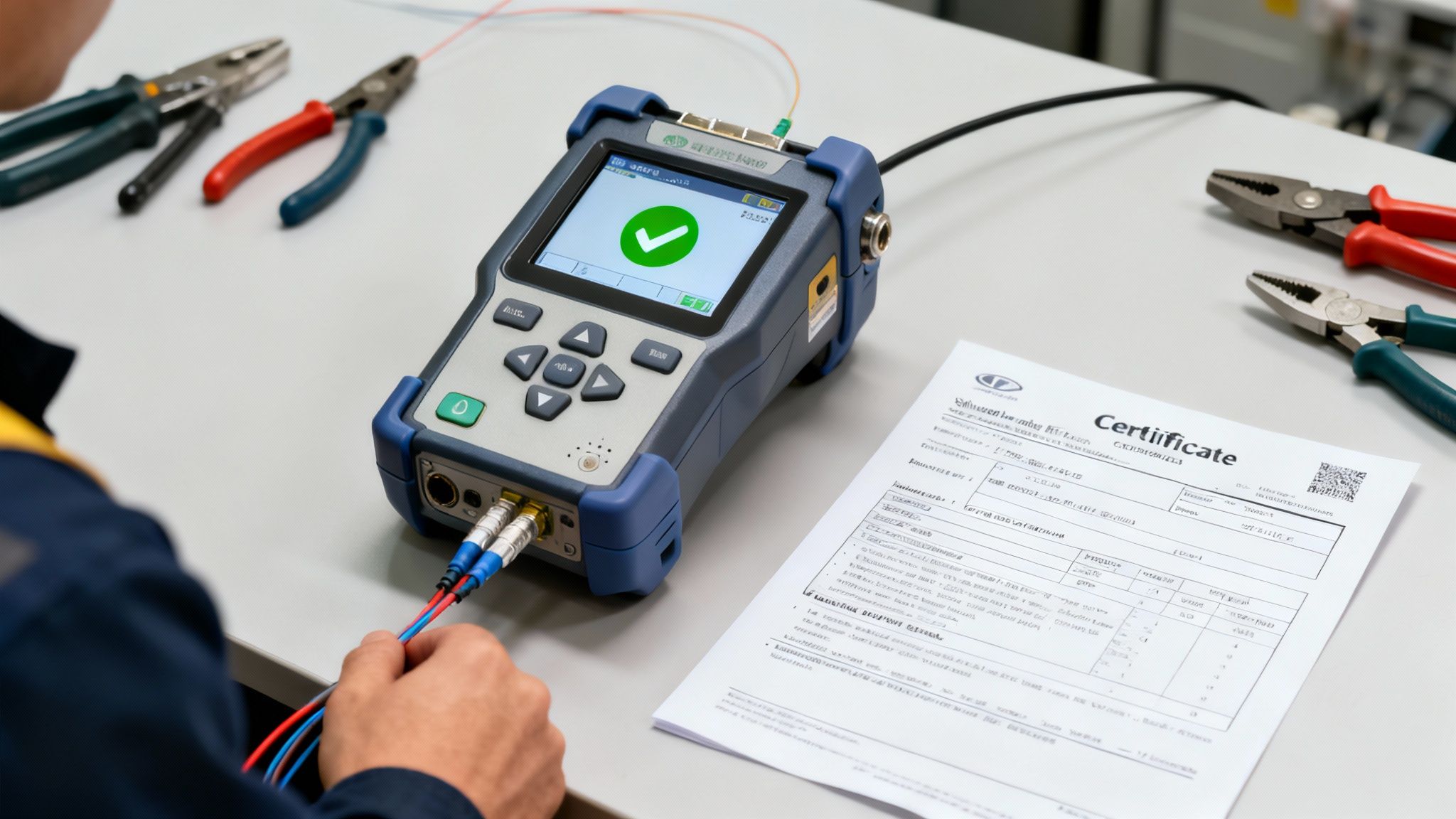
This process is absolutely critical for catching and fixing common issues before they lead to expensive downtime. Problems like dirty connectors, poor splices, or tight cable bends are identified and sorted out on the spot, ensuring the network meets strict performance standards from day one.
Why Certification Is Vital for Office Relocations
The importance of this verification process gets amplified during an office relocation with equipment testing. Moving an entire business is stressful enough without throwing network gremlins into the mix.
A certified network ensures your team can walk into a new space, connect their devices, and be productive immediately. It takes the guesswork out of the equation and gives you concrete proof that your infrastructure will perform exactly as it should, backed by a detailed test report for every single link.
This meticulous approach is exactly what an Excel network accredited partner delivers. It's a commitment that guarantees not just connectivity, but peak performance supported by a 25 year equipment warranty. Good cable management and a tidy desk are the visible signs of a quality job, but it’s the certified test results that provide genuine peace of mind.
The potential of single-mode fibre just keeps growing. Researchers at UCL recently smashed the data transmission record for a field-deployed single-mode fibre, hitting an incredible 300.28 terabits per second (Tb/s) over a 39-kilometre run. This just goes to show the incredible capacity of the technology when it's installed and maintained correctly. You can discover more about these record-breaking findings on ucl.ac.uk.
By ensuring your network is professionally certified, you're building on a foundation that’s more than ready for whatever the future throws at it. For more on this, check out our guide on how network performance monitoring can improve UK office networks.
Choosing the Right Partner for Your Cabling Project
Picking the right installation partner is every bit as important as choosing the correct fibre optic single mode cable for your network. Your investment in top-tier infrastructure can be completely wasted by a shoddy installation. The right team transforms your project from a simple purchase into a strategic asset, making sure your network runs flawlessly from day one and for years to come.
This decision goes way beyond just looking at the bottom line of a quote. It’s about checking their expertise, understanding the guarantees they offer, and making sure their process is locked in with industry best practices. A well-planned and perfectly executed installation is the bedrock of a reliable network that can support your business without a hiccup.
Verifying Installer Accreditation
First things first: you absolutely have to confirm an installer's credentials. Look for a partner who is officially accredited by a leading cabling system manufacturer. For example, as an Excel network accredited partner, we are held to the highest possible industry standards on every single project we handle.
This accreditation is your seal of quality. It means the engineers have undergone specific training and are proven to follow the exact methods needed for a successful fibre cable installation. They get the critical details right, from maintaining the proper bend radius to ensuring flawless connector termination—all the stuff that protects your investment.
Choosing an accredited partner is the single most effective way to de-risk your project. It guarantees that your installation will be managed by certified professionals who are committed to delivering a network that meets and exceeds all performance specs.
Understanding Your Warranty and Guarantees
One of the biggest perks of working with an accredited installer is gaining access to solid warranty programmes. Any professional partner worth their salt should offer a comprehensive 25 year equipment warranty on their structured cabling systems. This isn't just a piece of paper; it’s a long-term promise of performance and reliability.
Before you sign anything, ask for the specifics on what the warranty covers. Does it include both the components and the performance? This kind of long-term protection provides genuine peace of mind, ensuring your network infrastructure remains a dependable asset for decades.
Insisting on a Certified and Tested Delivery
Finally, a professional partner will always finish their work with a certified, tested network delivery. This is non-negotiable. It involves using specialised equipment to test every single link, giving you a detailed report that proves the network performs exactly as it should.
This step is especially crucial during an office relocation with equipment testing. It ensures your team can be productive the moment they walk into the new space. Methodical cable management supports this, leading to a tidy desk environment and a well-organised server room that’s free from performance-killing clutter.
Your Single Mode Fibre Questions Answered
We get a lot of questions about single mode fibre optic cabling. Let’s tackle some of the most common ones to help you understand where it fits and the long-term value it brings to your business network.
Why Does Single Mode Fibre Have a Higher Installation Cost?
It's a common misconception that the cable itself is the expensive part. The higher initial cost actually comes from the more precise and powerful electronics needed to drive it. The transceivers that generate and read the highly focused laser signal for single mode fibre are a bit more sophisticated than the simple LEDs used for multimode.
However, once you start looking at applications covering any real distance, single mode quickly becomes the most cost-effective and reliable choice. That upfront investment pays you back in spades through superior performance, massive reach, and future scalability.
Can I Use Single Mode Fibre for Short Distances?
Absolutely. While multimode has traditionally been the go-to for short runs inside a building, specifying a single mode fibre backbone from the get-go is a brilliant future-proofing strategy.
Think of it as laying a foundation that can handle enormous increases in bandwidth for years to come, without needing a disruptive and costly rip-and-replace project down the line. It's a particularly smart move for new builds or during a major office relocation with equipment testing, where you have the perfect chance to get it right from day one.
Planning your fibre cable installation with future capacity in mind is crucial. As an Excel network accredited partner, we design systems that not only meet today’s needs but are ready for tomorrow's demands, all delivered as a certified, tested network.
What’s the Real Difference Between OS1 and OS2 Fibre?
Both OS1 and OS2 are single mode standards, but for any modern installation, OS2 is the only one you should be considering. It’s simply a better cable.
OS1: This is an older standard, really only intended for short indoor runs. Its main limitation is higher signal loss (attenuation), which caps its performance.
OS2: This is the current, superior standard for both indoor and outdoor use. It boasts significantly lower attenuation, allowing it to easily support huge bandwidths like 40G and 100G over much, much longer distances.
For any new project, insisting on OS2 fibre is non-negotiable. It guarantees your network can support future growth and allows us to back the installation with a comprehensive 25 year equipment warranty.
For a professionally planned and installed network that’s built to last, partner with Constructive-IT. Get in touch today to discuss your next project.
Comments