


Coax Over Ethernet: A Practical Guide for Modern Commercial Networks
- Craig Marston
- Jan 8
- 16 min read

Coax over Ethernet is a clever bit of tech that sends high-speed internet data through the existing coaxial TV cables already hidden in your building’s walls. In short, it turns old TV points into fully functional, high-performance network ports.
This simple idea lets you build a stable, wired network without the massive disruption and eye-watering cost of pulling brand new Ethernet or fibre optic cabling through the entire building.
A Smart Alternative to Disruptive Network Rewiring
If you're an IT manager in charge of a large commercial building or hospital, the thought of a major network upgrade can be a real headache. The prospect of running new Cat6 or a full fibre cable installation often means serious operational disruption, soaring installation costs, and a host of logistical nightmares—especially in older, listed, or architecturally complex buildings. This is a common sticking point during any office relocation or fit-out.
This is exactly where coax over Ethernet comes into its own as a powerful, pragmatic solution. It lets you repurpose the existing coaxial cabling—the very same wires that once delivered television signals—to provide stable, gigabit-speed Ethernet connections right where you need them.
The Modern Approach to Existing Infrastructure
Think of it like upgrading an old, reliable railway line to support modern high-speed trains instead of building an entirely new one from scratch. Rather than the messy, intrusive work of drilling through walls and ceilings, you can create a robust data network using an asset that's already in place. For any environment where business continuity is king, this approach is a game-changer.
When you're weighing up your network upgrade options, you have to look at the bigger picture, including the significant cost implications of a full office fit-out. A complete rewiring project adds a hefty line item to that budget.
By using the existing coaxial infrastructure, organisations can achieve modern network performance while minimising physical disruption and controlling capital expenditure. This is a strategic advantage for any large-scale IT project.
Avoiding Common Data Network Mistakes
One of the biggest data network mistakes we see is the assumption that a full rip-and-replace is the only way to get better performance. A professionally planned coax over Ethernet deployment offers a solid alternative, but it absolutely requires expertise to get it right. Making sure your network is tested and certified is non-negotiable.
As an Excel network accredited partner, we ensure that any solution we deliver—whether it’s brand new fibre or a coax-based system—meets the most stringent performance standards. A certified, tested network delivery, complete with meticulous cable management for a tidy desk environment, provides you with total confidence and a long-term 25 year equipment warranty. This is especially critical during an office relocation with equipment testing, ensuring seamless operations from day one in commercial buildings and hospitals.
This guide will walk you through how the technology works, what you need to consider for a successful deployment, and how to make the right call for your next project.
How Coax Over Ethernet Technology Actually Works
Sending modern, high-speed data down old-fashioned television cables sounds a bit like magic, but the principle behind it is surprisingly straightforward. The whole system hinges on a pair of specialised adapters that act as clever translators, bridging the gap between your standard Ethernet network and the coaxial cabling that’s already wired throughout your building.
It works like this: at one end, an adapter plugs into your network switch with a normal Ethernet cable. This little box takes the digital signal and converts it into a high-frequency signal that can travel perfectly along the existing coaxial wire. Down the line at its destination—maybe a new office desk or a recently installed CCTV camera—a second adapter receives that signal and instantly translates it back into a standard Ethernet connection, ready for any network device you want to plug in.
This conversion is the heart of coax over Ethernet, but there are a few different ways to get the job done. The two leading technologies you’ll come across are MoCA and G.hn.
Understanding MoCA Technology
MoCA, which stands for Multimedia over Coax Alliance, is probably the best-known standard in this space. It was originally cooked up to distribute high-definition video around homes, but it has since evolved into a seriously robust solution for commercial environments. Think of MoCA as a highly efficient traffic controller for your coaxial cables.
It cleverly operates on specific high-frequency bands, typically above 1,125 MHz. This is important because it allows the data signal to run on the same cable as other services, like a building’s existing TV system, without causing any interference. Modern versions like MoCA 2.5 can hit theoretical speeds of up to 2.5 Gbps, which means a rock-solid 1 Gbps connection is a very realistic goal in most commercial buildings with decent-quality cabling.
The real standout feature of MoCA in a business setting is its incredibly low latency. Because it was built from the ground up for real-time video streaming, it’s brilliant at minimising delay. This is absolutely critical for things like VoIP phone systems, video conferencing, and IP security cameras, where even a tiny bit of lag can ruin the experience.
Exploring the G.hn Standard
The other major player is G.hn, a versatile standard developed by the International Telecommunication Union (ITU). While MoCA is a specialist built purely for coax, G.hn was designed to be more of a jack-of-all-trades. It’s capable of sending network signals over coaxial cables, old telephone lines, and even the building's electrical power lines. For complex older buildings with a mishmash of wiring types, this flexibility is a huge plus.
G.hn works by automatically scanning for and using the best available frequency bands to send data, which helps it to power through noisy or crowded signal environments. For IT managers wrestling with unpredictable legacy wiring in older hospitals or office blocks, this adaptability can be a lifesaver. It delivers comparable gigabit-level speeds and is often seen as a direct and powerful competitor to MoCA.
To make the choice a bit clearer, here’s a quick rundown of how these technologies stack up for business use.
Comparing Coax Over Ethernet Technologies
This table offers a quick comparison of the leading technologies used for sending Ethernet signals over coaxial cables, highlighting their primary strengths for commercial applications.
Technology | Typical Speeds | Common Use Case | Key Advantage |
|---|---|---|---|
MoCA | Up to 2.5 Gbps | VoIP, video conferencing, IP cameras | Extremely low latency, ideal for real-time apps |
G.hn | Up to 2 Gbps | Mixed-wiring environments, older buildings | Highly versatile—works on coax, phone, & power lines |
Extenders | 10/100 Mbps | Single point-to-point links (e.g., one camera) | Simple and low-cost for basic, short-range needs |
Baluns | 10/100 Mbps | Legacy analogue CCTV to IP camera upgrades | Passive (no power needed), very cost-effective |
Ultimately, the decision often comes down to the specifics of the building and what you need the network to do. A system that needs the absolute lowest latency for sensitive applications might lean towards MoCA. A project dealing with multiple types of old wiring, on the other hand, could benefit from the get-out-of-jail-free card that G.hn’s versatility offers.
Either way, both technologies achieve the same brilliant goal: they turn an overlooked and underused asset into a high-performance network pathway. Instead of facing a disruptive and expensive rewiring project, you can get a certified and tested network that delivers the speed and reliability your business needs, often backed by a 25 year equipment warranty when installed by an accredited partner.
Key Planning Considerations for Your Office or Hospital
Successfully reusing old coax cabling for a modern data network isn't a simple "plug and play" job, especially in a professional setting like a commercial building or hospital. Before you commit to this route, a thorough, honest evaluation of your existing infrastructure is the single most critical step. This groundwork is what prevents common data network mistakes and sets realistic performance expectations from day one.
The first job is to get into the walls and ceilings to identify the type and condition of the coaxial cabling already there. Most commercial buildings will have either RG59 or the more modern RG6 cable. RG6 is what you want to see; it has a thicker central conductor and better shielding, making it far more capable of handling the high-frequency signals needed for gigabit speeds. You can usually tell which is which by reading the text printed along the cable's outer jacket.
This is how it works in principle: an Ethernet signal is converted by an adapter, sent down the existing coax cable, and then converted back to Ethernet at the other end.
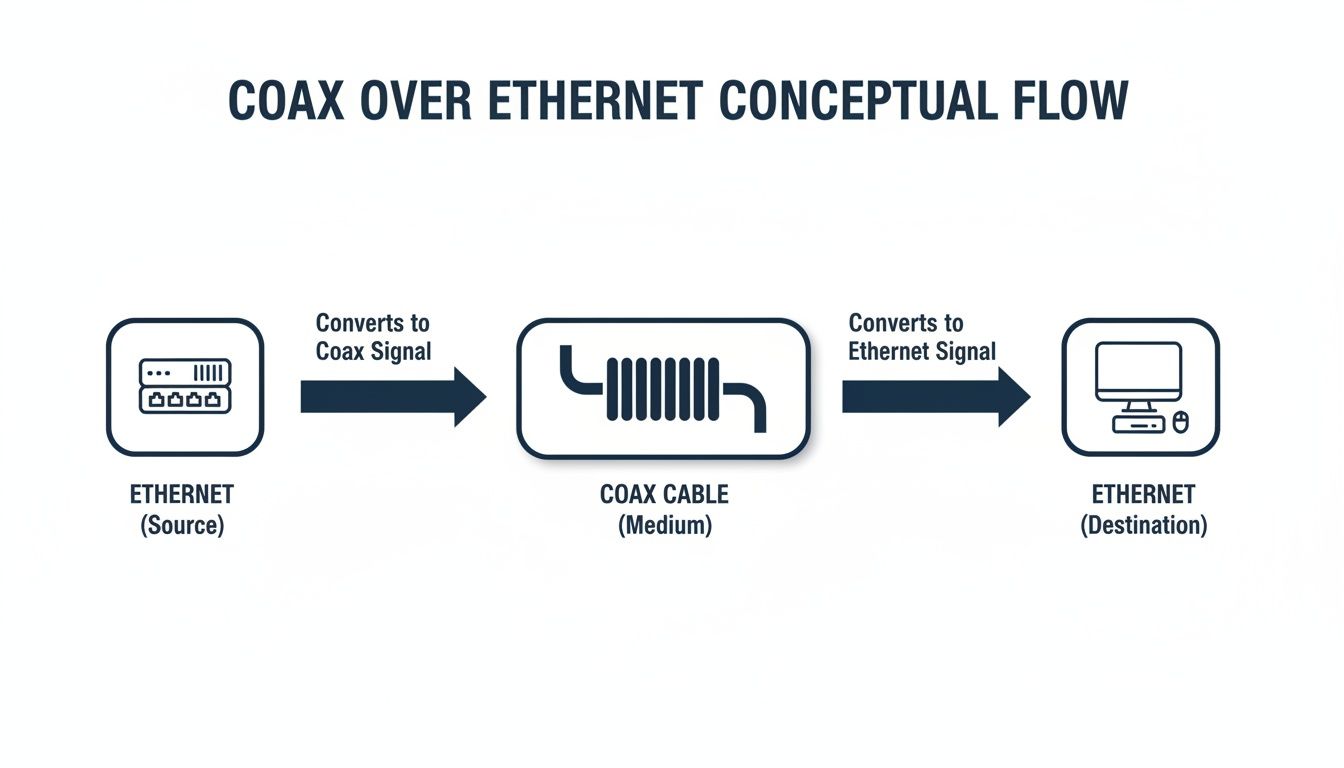
It’s all about using a matched pair of adapters to seamlessly bridge the gap between your standard network hardware and that legacy coaxial infrastructure.
Assessing Cable and Component Health
Beyond just the cable type, you have to meticulously inspect the physical condition of the entire run. Over the years, connectors can get corroded, loose, or damaged, and any one of these issues will seriously degrade the signal quality. A reliable connection depends entirely on pristine termination points.
Just as important are the splitters. Lots of older buildings are full of cheap, low-frequency splitters designed for old-school analogue TV. These are completely unsuitable for high-speed data and will act as a major bottleneck, killing your performance.
A professional audit should identify and replace any legacy splitters with modern, high-frequency versions rated for at least 1675 MHz. This single step is often the difference between a flaky connection and a rock-solid, certified network.
During this assessment, you also need to think about cable length. While MoCA technology can work over runs up to 90 metres (around 300 feet), performance will always be best on shorter, more direct runs. Mapping out the cable paths helps you set realistic throughput and latency expectations for each connection point. You can learn more about the specifics of modern coaxial cabling in our guide to RG6 cable for UK commercial buildings.
Security and Interference Mitigation
Security is completely non-negotiable in any corporate or healthcare environment. There’s a common misconception that coax is less secure than Ethernet, but modern adapters come equipped with robust encryption. MoCA 2.5, for example, includes 128-bit AES encryption that has to be enabled during setup. This creates a secure, private network between the adapters, effectively preventing anyone from snooping on your data.
Signal interference is another key planning factor. Coaxial cables can be susceptible to noise from nearby electrical wiring, motors, or other sources of electromagnetic interference (EMI).
Your pre-deployment plan should include a few steps to mitigate this risk:
Install Point of Entry (PoE) Filters: A PoE filter should be installed right where the main coaxial line enters your building. This small device is vital; it stops your network signals from leaking out and prevents external noise from coming in.
Ensure Proper Grounding: Verify that the entire coaxial network is properly grounded. This is a basic but often overlooked step that prevents electrical noise from degrading the signal.
Use High-Quality Shielded Cable: If you need to run any new sections of coax, always use quad-shielded RG6 cable. It offers the maximum possible protection against interference.
This thorough planning process is essential for reusing legacy infrastructure effectively. With the UK government’s Project Gigabit investing up to £5 billion to deliver gigabit broadband to over 99% of premises by 2030, technologies like this are becoming crucial. Coax-to-Ethernet adapters allow network teams to overlay high-speed services on old cabling in buildings where running new fibre just isn't feasible, all while avoiding major construction work.
As an Excel network accredited partner, we believe that any network installation—whether it's brand new or repurposed—must be rigorously tested and certified. This approach guarantees performance and gives you the peace of mind of a 25 year equipment warranty, ensuring your network is a reliable asset for years to come.
Common Installation Mistakes You Must Avoid
A successful coax over ethernet project hinges on sidestepping the common pitfalls that can turn a smart upgrade into an unreliable, underperforming network. We’ve seen it too many times: a risky ‘plug and pray’ approach where adapters are connected without any real thought or analysis. This strategy almost always leads to frustrating data network mistakes down the line.
The single most critical error is failing to properly audit the existing coaxial infrastructure before you even think about plugging anything in. Assuming all coax is created equal is a recipe for disaster. Old, damaged connectors, poor terminations, and hidden breaks in the line can cripple your network’s performance right from the start.
Another frequent oversight is ignoring the little components that connect the cables. Many commercial buildings, especially older ones, are riddled with cheap, low-frequency splitters left over from the days of analogue TV. These act as massive bottlenecks for high-speed data, severely choking your bandwidth and causing infuriating, intermittent connection drops.
Overlooking Signal Integrity and Noise
A major danger in any coax over ethernet installation is underestimating the impact of signal noise. While coaxial cables are shielded, they can still pick up electromagnetic interference (EMI) from nearby power lines, fluorescent lighting, or heavy machinery. Ignoring this can lead to data corruption and packet loss, creating a network that seems to work one minute and fails the next.
This is especially true in complex environments like hospitals, where countless electronic devices operate in close quarters. Without a professional survey to identify and mitigate these sources of interference, your network's reliability is left completely to chance—a risk simply not worth taking when mission-critical systems are involved.
A certified network delivery isn't just about speed; it's about guaranteed reliability. Every connection must be professionally tested and verified to ensure it can withstand the electrical noise of a busy commercial environment. This is the difference between a functional network and a resilient one.
Proper testing and certification measures signal strength, noise levels, and data integrity across every single run. This process weeds out potential failures before they can impact your operations, ensuring the final installation is both robust and dependable.
Neglecting Cable Management and Future Needs
Finally, one of the most visible yet commonly ignored mistakes is poor cable management. While the main goal is a functional network, leaving a tangled mess of wires behind creates a maintenance nightmare for your IT team. A tidy, well-organised installation doesn’t just look professional; it makes future troubleshooting and upgrades infinitely simpler.
Poor cable management leads directly to:
Accidental Disconnections: Tightly pulled or tangled cables can easily become dislodged, causing sudden and hard-to-diagnose outages.
Difficulty Troubleshooting: When a problem pops up, tracing a single cable through a chaotic bundle is a time-consuming and frustrating task.
Increased Downtime: The longer it takes to identify and fix a problem, the more downtime your business suffers. A tidy desk and server room setup is a direct investment in operational continuity.
As an Excel network accredited partner, we believe that a professional installation must be meticulously organised, tested, and certified. This approach not only ensures optimal performance from day one but also unlocks the assurance of a 25 year equipment warranty. This provides long-term peace of mind for crucial projects, from office relocations with equipment testing to hospital wing fit-outs.
When to Choose Coax vs New Structured Cabling
Deciding between reusing your building’s existing coax cables and running brand-new structured cabling is one of those critical infrastructure choices. There’s no single right answer here; the best path is always dictated by your project’s specific constraints, your goals, and the realities of your commercial building or hospital. It’s a decision that needs a clear-eyed comparison of both strategies.
A full, brand-new structured cabling installation using Cat6 or a fibre cable installation is the undisputed gold standard for network performance and future-proofing. If you’re fitting out a new build, designing the core network for a data centre, or you absolutely must have guaranteed speeds of 10Gbps and beyond, then this is the way to go. You get a clean slate, ensuring every single component meets the highest benchmarks, all backed up by a professional, certified network delivery.
However, that top-tier performance comes with very real costs, both in money and disruption. Running new cables means drilling, installing containment, and patching up walls and ceilings. It’s a process that can be slow, messy, and sometimes, just completely unfeasible.
The Strategic Case for Coax Over Ethernet
This is exactly where coax over ethernet comes into its own as a brilliantly pragmatic and powerful alternative. It often becomes the superior choice in situations where the disruption and cost of new cabling are simply too high a price to pay.
Think about these common scenarios where reusing coax is the smarter move:
Listed Buildings and Architecturally Sensitive Sites: For historic buildings or NHS hospitals with strict rules on structural changes, running new cables can turn into an administrative and logistical nightmare. Coax over ethernet lets you roll out a gigabit-speed network with zero structural impact.
Projects with Tight Timelines and Budgets: Office relocations and fit-outs nearly always have a ticking clock. A full rewire can add weeks to your project and send costs spiralling. Tapping into existing coax can get a high-performance network up and running in a fraction of the time for a much lower outlay.
Hard-to-Reach Areas: Getting a network connection to a remote corner of a warehouse, a newly added hospital wing, or an outbuilding can be incredibly difficult. If there's already a coax cable running to that spot, you can establish a reliable connection in hours, not days.
Real-World Application: An NHS Hospital Upgrade
Picture an NHS hospital that needs to connect new IP-based medical devices and access points in an older, fully operational wing. The top priority is boosting connectivity without disrupting patient care or interfering with sensitive equipment. Drilling into walls and pulling new cables through active wards is a non-starter due to the noise, dust, and operational risk.
In this scenario, using the building's existing coaxial TV outlets provides a perfect solution. A certified installation can quickly and quietly convert these points into secure, gigabit-capable network ports, bringing modern connectivity to patient rooms and nurses' stations with minimal fuss. This strategic choice justifies the infrastructure decision to stakeholders by prioritising patient safety and operational continuity.
The economics for UK enterprises are also compelling. For UK enterprises, the economics of reusing coax via Ethernet-over-coax are shaped by both declining telecoms carrier revenue and growing structured cabling demand. The wired telecommunications carriers industry in the UK is projected to see revenue fall at a –3.5% CAGR over the five years to 2025–26, down to about £14.4 billion. As an accredited partner, we see how coax-over-Ethernet allows organisations to achieve gigabit-class connectivity on legacy coax while they progressively invest in new Cat6 and fibre trunks with a 25 year equipment warranty. Discover more insights from IBISWorld on UK telecommunications trends.
Ultimately, the choice is a strategic one. For anyone looking to get their head around the fundamental differences in modern cabling, you can learn more by checking out our guide on the categories of computer network cables. Choosing coax over ethernet isn't about settling for second best; it's about making a smart, tactical decision that delivers the performance you need while respecting the realities of your budget, timeline, and physical environment.
Best Practices for Deployment and Network Certification
A professional coax over ethernet deployment isn’t about just plugging in adapters; it’s a methodical process built on structure and precision. For mission-critical spaces like commercial buildings and hospitals, a successful installation follows a clear path from the initial survey to the final handover, guaranteeing every connection is reliable, manageable, and secure.
It all starts with a detailed site survey where every single coaxial run is mapped and tested. This is far more than a quick visual check. We use specialised equipment to measure signal loss and sniff out potential sources of noise, which is a critical first step during an office relocation with equipment testing to verify the integrity of legacy cabling before a single piece of new kit is connected.
After the survey, the physical installation has to follow strict best practices. This means using proper termination techniques for all connectors and choosing commercial-grade, high-frequency splitters. Amateur setups often fall down here, using cheap components that kill the signal and cause intermittent faults—some of the most frustrating problems to troubleshoot on any data network.
The Importance of Professional Cable Management
For a professional job, effective cable management is non-negotiable. A tangled mess of wires behind desks or in comms rooms isn't just ugly; it’s a direct cause of future network headaches and makes any maintenance or upgrades a nightmare. A tidy, well-organised setup is the foundation of long-term reliability.
This is especially true in the UK, where the quirks of older buildings often throw up unique challenges. In the hybrid fibre-coax (HFC) setups common in many cities, fibre runs to a local node before coaxial cables feed individual premises. Inside these buildings, old TV distribution systems can become ready-made pathways for data. Research on the UK coaxial market shows a steady demand for these solutions, particularly in buildings where running new fibre cable installation is difficult, like listed commercial properties or NHS estates where structural changes are off-limits.
The Final Step: Network Certification and Warranty
The final phase is the most important one and the step that truly separates an amateur setup from a professionally engineered solution: network certification.
Certification involves rigorously testing every single connection point with specialised diagnostic tools. This isn't just a simple speed test; it verifies key performance metrics like bandwidth stability, latency consistency, and packet loss under load to guarantee the network meets documented standards.
This meticulous testing and verification process confirms that the network performs exactly as designed. It gives IT managers documented proof of performance, which is essential for a smooth handover. It’s also how we, as an Excel network accredited partner, can provide a 25 year equipment warranty on our installations. You can find more details on our structured approach in our essential guide to data cabling installation. A certified network delivery provides the ultimate peace of mind, ensuring your infrastructure is a robust and dependable asset for years to come.
Your Coax Over Ethernet Questions, Answered
When you're looking at a coax over Ethernet solution for a commercial building or hospital, a few practical questions always come up. IT managers need to be sure about performance, security, and how it all works in the real world. Getting clear answers is vital for dodging common data network mistakes, especially when the stakes are high during an office relocation.
Here are the straight answers to the questions we hear most often.
Can I Use The Same Coax Cable For TV And Ethernet?
Yes, in most scenarios, this is absolutely possible. Technologies like MoCA are cleverly designed to use frequencies that don’t clash with your existing TV signals. With the right filters and high-frequency splitters installed, your data and video can happily share the same cable without interfering with each other.
But, and this is a big but, it has to be professionally validated. A proper site survey is non-negotiable to check the cable quality and fit the correct components to stop any signal degradation. For any business or hospital where network reliability is mission-critical, this is a step you simply can't skip.
What Kind Of Speeds Can I Realistically Expect?
Modern coax over Ethernet solutions can be surprisingly fast, with standards like MoCA 2.5 hitting theoretical speeds of up to 2.5 Gbps. Back in the real world, though, that performance will depend on the quality of your RG6 cabling, how long the cable runs are, and how many splitters are in the way.
For most commercial setups with well-maintained coax, a stable and reliable 1 Gbps connection is a very realistic goal. The only way to know for certain is to have it professionally tested. This gives you a proper performance baseline before you commit to a full deployment.
Making sure your network is tested and certified is the only way to guarantee performance. This process moves beyond theoretical speeds to provide documented proof of real-world capability, ensuring the solution meets your specific operational needs.
Is Coax Over Ethernet Secure For A Corporate Network?
Absolutely. This is a common worry, but modern adapters are built with security front and centre. The leading technologies come with strong, built-in encryption, like 128-bit AES, to shield all the data travelling over the coaxial network.
When this is switched on during setup, it creates a secure, private link between the adapters, making it impossible for unauthorised devices to snoop on your network traffic. This makes the connection just as secure as a standard Ethernet cable and perfectly suited for sensitive business data in a corporate or hospital environment. A professional, certified, tested network delivery ensures these security features are locked in correctly from day one.
A professionally planned and executed network infrastructure is the bedrock of your business operations. As an Excel network accredited partner, Constructive-IT provides certified installations with a 25 year equipment warranty, ensuring your network is a reliable asset for years to come. Schedule your no-obligation consultation today to discuss your next project.
Comments