


Designing the Modern NHS Network A Practical Guide
- Craig Marston
- Jan 15
- 16 min read

Think of an NHS network as the digital central nervous system of a healthcare trust. It's the critical infrastructure that connects every patient record, medical device, and clinical professional, making sure vital data flows securely and instantly to wherever it’s needed for patient care.
What Is a Modern NHS Network
A modern NHS network is much more than just a jumble of cables and switches. It's the absolute foundation for every part of contemporary healthcare. Everything from Electronic Patient Records (EPRs) and telehealth consultations to complex medical imaging and real-time device monitoring relies on it. Put simply, without a robust, high-performance network, these clinical functions just can't work properly.
The Health and Social Care Network (HSCN) acts as the main data superhighway for this whole ecosystem. It’s a private, secure network purpose-built for sensitive health data, creating a protected environment that’s a world away from the risks of the public internet. This ensures confidential patient information is always shielded from outside threats.
The Challenge of Legacy Infrastructure
The problem is, many NHS trusts are stuck with ageing infrastructure that was never designed for today's colossal data demands. Outdated hardware, not enough bandwidth, and patchy Wi-Fi coverage create daily frustrations and very real risks for clinical staff. This tech deficit is a major roadblock to delivering efficient patient care.
Legacy IT is a persistent headache across the NHS. A 2019 BMA survey revealed that 56% of doctors felt it significantly added to their daily workload, with a staggering 57% saying their electronic medical records systems were not fit for purpose. These aren't just numbers; they show the direct, negative impact of poor network performance on frontline healthcare.
A crucial part of a modern NHS network is its ability to support seamless data exchange and connected care. Getting to grips with healthcare interoperability is essential here. This ability for different systems to actually "talk" to each other is fundamental to building a truly joined-up care system.
To put all the essential pieces in one place, here’s a look at what makes up a resilient and compliant NHS network.
Core Components of a Modern NHS Network
This table outlines the essential pillars required to build a resilient and compliant network infrastructure within any NHS environment.
Component | Role in Patient Care | Key Design Goal |
|---|---|---|
High-Speed Cabling | Ensures instant access to EPRs and medical imaging. | Future-proofed with high-bandwidth fibre and copper. |
Robust Wi-Fi | Enables mobile workstations and real-time device monitoring. | Seamless, high-density coverage across all clinical areas. |
Network Security | Protects sensitive patient data from cyber threats. | Layered defence with firewalls, segmentation, and access control. |
Resilience & Redundancy | Prevents downtime that could risk patient safety. | No single point of failure in critical network paths. |
Scalability | Accommodates new medical devices and digital services. | Modular design that can grow without a complete overhaul. |
Each of these components is a non-negotiable part of a network that can handle the demands of modern medicine.
Why a Forward-Thinking Design Matters
Investing in a modern network is no longer a "nice-to-have"—it's an absolute necessity for patient safety and operational efficiency. A well-designed NHS network delivers the speed, reliability, and security needed to support next-generation clinical tools and hit digital transformation targets. It's the platform on which future medical innovation will be built.
The key characteristics of a modern NHS network really boil down to this:
High Availability: The network has to be resilient, with built-in redundancy to stop any downtime from impacting patient care. There’s no room for error.
Robust Security: Strong defences are critical to protect against cyber threats and ensure the trust meets strict data protection regulations.
Scalability: The infrastructure must be able to grow with the trust, easily handling more devices, users, and data-heavy applications over time.
Ultimately, a forward-thinking network design shifts an NHS trust from being reactive to proactive. It gives IT managers the confidence to support clinical goals, knowing the tech foundation is ready for whatever comes next.
Mastering HSCN Connectivity and Resilience
The Health and Social care Network (HSCN) is the official backbone for all data moving around the NHS, having taken over from the older N3 network. Think of it as a private, high-speed motorway system built purely for health and social care organisations. Unlike its rigid predecessor, HSCN is a competitive marketplace, giving trusts a much wider choice of certified providers and service levels.
This is a big deal. It empowers NHS IT managers to finally find a connectivity partner that genuinely fits their clinical needs and budget. The core promise of HSCN isn't just about faster speeds; it's about embedding higher security and resilience standards—the absolute bedrock of a reliable NHS network built for modern healthcare.
Navigating the HSCN Marketplace
Choosing the right HSCN provider is a critical decision, and it’s definitely not about just picking the cheapest quote. You're looking for a partner who gets the unique pressures of a clinical environment. You need to size them up based on their network performance, their security credentials, and their ability to offer solutions that can scale as your trust grows.
A few key factors should be on your checklist:
Service Level Agreements (SLAs): What guarantees are they putting on the table for uptime and performance? Make sure these promises align with your clinical need for non-stop operation.
Security and Compliance: Does the provider meet all the necessary NHS Digital standards? Do they hold certifications like Cyber Essentials Plus?
Scalability and Flexibility: If you roll out new AI-driven diagnostic tools or a fleet of IoT medical devices next year, can they bump up your bandwidth easily?
Getting this selection process right ensures your connection to the national healthcare infrastructure is robust, secure, and ready for whatever comes next.
The True Meaning of Network Resilience
In a hospital, network downtime isn't just an inconvenience; it can have a direct, immediate impact on patient care. This is why the concept of resilience is so incredibly important. The gold standard everyone talks about is "five nines" availability, which means 99.999% uptime. It sounds impressive, but what does it mean in the real world? It means your network should be down for no more than 5.26 minutes over an entire year.
Achieving that level of reliability demands a network designed with no single point of failure. Every critical piece of the puzzle, from the fibre cables coming into the building to the core switches, must have a backup ready to take over instantly.
You don't get to five nines by accident. It has to be engineered into the very fabric of your network right from the start.
Practical Strategies for Unbreakable Connectivity
So, how do you actually build this level of resilience into your NHS network? It all comes down to implementing specific, practical strategies that create layers of redundancy. The goal is simple: if one path fails, data must seamlessly reroute through another without anyone in A&E or on the wards even noticing.
Here are two of the most fundamental strategies for getting there:
Diverse Fibre Routing: This is non-negotiable. It means bringing at least two separate fibre optic cables into your hospital from physically different routes. If a digger accidentally severs one cable during nearby construction work—and believe me, it happens more often than you'd think—the other connection stays live and keeps you online.
Failover Connections: This is all about having a secondary connection ready to take the reins automatically. You might have a primary HSCN link from one provider and a backup from another. Even better, modern solutions like SD-WAN can manage multiple links intelligently, automatically balancing traffic for the best performance and providing instant, seamless failover. If you want to dig deeper into how this works, you can learn more about SD-WAN's role in our practical guide for IT managers.
By designing your network with these principles baked in, you create a robust infrastructure that can shrug off unexpected outages and guarantee your clinicians have the digital tools they need, 24/7.
Achieving DSPT Compliance Through Network Design
In any healthcare setting, protecting patient data isn’t just good practice; it's a legal and ethical imperative. Your NHS network is the first and most important line of defence in upholding that duty. This is where the Data Security and Protection Toolkit (DSPT) comes in, and achieving compliance starts with smart, security-first network architecture.
The DSPT isn't just a box-ticking exercise. It’s a framework that requires organisations to prove they are actively practising good data security. A well-designed network is what moves you from simply claiming compliance on paper to demonstrating it through solid, technical controls that safeguard sensitive information around the clock.
The Power of Network Segmentation
One of the most powerful strategies for bolstering security is network segmentation. Think of your hospital's entire network as a ship. If you have one big, open cargo hold and it springs a leak, the whole vessel is in danger of sinking. Segmentation is like building watertight compartments into that ship.
If one area is breached, the damage is contained and can’t spread to other critical zones. In the real world, this means creating completely separate network segments for different functions.
Clinical Networks: A fortress-like zone reserved exclusively for Electronic Patient Record (EPR) systems, medical imaging archives (PACS), and vital diagnostic equipment. Access is locked down.
Medical IoT Devices: A dedicated segment for internet-connected devices like infusion pumps or patient monitors, isolating them so a compromised device can't access the core clinical network.
Guest Wi-Fi: A totally isolated network for patients and visitors, giving them internet access with absolutely no pathway into internal NHS systems.
Building Management Systems: Another segregated zone for things like HVAC and CCTV, preventing them from becoming a backdoor into more sensitive areas.
This approach dramatically shrinks your attack surface and is the cornerstone of a defensible network design that aligns perfectly with DSPT principles.
This concept map shows how the core principles of the Health and Social Care Network (HSCN) enable a secure and robust infrastructure.
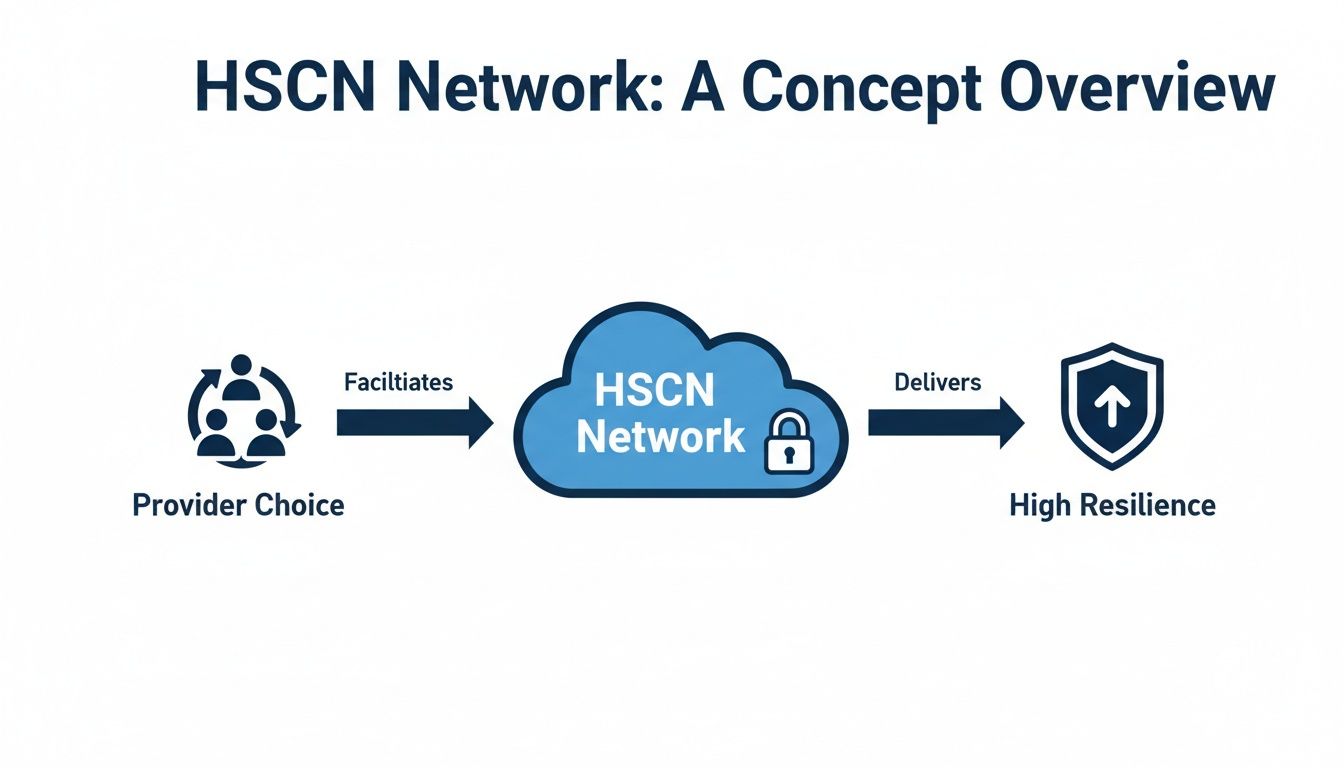
As the diagram shows, the security and resilience mandated by the HSCN are foundational building blocks for a DSPT-compliant network.
Essential Security Safeguards
Beyond segmentation, a few other technical safeguards are essential for creating a truly secure NHS network. These aren't just abstract technologies; they are the digital locks, alarms, and security guards protecting your organisation’s most valuable asset: patient data.
Think of a next-generation firewall (NGFW) as the main security checkpoint at your hospital's entrance. It doesn't just check IDs (IP addresses); it actually inspects the contents of the traffic, looking for suspicious activity or malicious code before it can ever get inside.
A well-architected network is the foundation of DSPT compliance. It's not about buying more security products; it's about designing an infrastructure where security is built-in, not bolted on as an afterthought. This proactive stance is what separates truly secure organisations from those that are merely compliant on paper.
Meanwhile, Intrusion Detection and Prevention Systems (IDPS) act like patrol guards already inside the network. They constantly monitor for unusual behaviour that might signal a threat—like someone trying to access a server they shouldn't—and can automatically block the attempt and alert IT staff.
Securing the Modern Workforce
Finally, with the rise of remote consultations and flexible working, securing remote access is non-negotiable. A Virtual Private Network (VPN) creates an encrypted, private tunnel from a clinician's device straight back to the hospital network, making sure any data sent is completely unreadable to outsiders.
Adding Multi-Factor Authentication (MFA) provides another crucial layer of security, demanding a second form of verification (like a code from a mobile app) on top of a password. This one simple step makes it exponentially harder for an unauthorised user to get in, even if they manage to steal someone's login details. Together, these measures form a robust framework, transforming your network from a simple utility into a powerful tool for achieving and maintaining DSPT compliance.
Building the Physical Foundation for Clinical Care

It’s easy to focus on the advanced clinical software and secure digital systems, but they’re all completely reliant on the physical infrastructure humming away beneath them. This foundational layer—the structured cabling and wireless networks—is the bedrock of every single digital interaction in a hospital.
Getting this part right from the very beginning isn’t just a technical task; it's a strategic move for long-term clinical success.
Without a rock-solid physical layer, even the most brilliantly designed NHS network will suffer from bottlenecks, instability, and infuriatingly poor performance. The only way to prevent costly and disruptive rework down the line is through proactive planning during a new build or major refurbishment. This ensures the network can handle not just today’s medical tech, but whatever is coming next.
Choosing the Right Cabling for the Job
Not all cables are created equal. Picking the right type for each specific area of a hospital is crucial for striking that perfect balance between performance and cost. The choice between copper and fibre optic cabling comes down to one thing: the data demands of that location.
Structured cabling is what links everything, from admin workstations to critical network switches. Here’s a quick rundown of the most common standards you’ll find in modern healthcare settings:
Category 6 (Cat6): Perfectly fine for standard administrative offices and clerical workstations where data needs are predictable. It delivers reliable speeds up to 1 Gigabit per second (Gbps).
Category 6a (Cat6a): The clear winner for clinical areas and locations with higher data traffic. It supports 10 Gbps speeds, making it ideal for connecting high-performance Wi-Fi access points and data-heavy workstations.
Fibre Optic Cabling: Absolutely essential for the network backbone—the main arteries connecting server rooms and comms cabinets across a large hospital campus. Its immense bandwidth is non-negotiable for departments like radiology, where enormous medical imaging files are constantly being moved around.
By mapping these cabling types to specific departmental needs, you build a network that is both high-performing and cost-effective. For a deeper dive into the specifics, check out our essential guide to data cabling installation.
The Unique Challenge of Clinical Wi-Fi
Designing a Wi-Fi network for a hospital is a completely different beast to deploying one in an office. The clinical environment is notoriously difficult for wireless signals, packed with dense building materials, specialised medical gear, and a constant need for flawless connectivity for mobile staff.
Clinicians depend on mobile devices—from tablets for accessing patient records to Wi-Fi-enabled Vocera communication badges—as they move between wards, treatment rooms, and surgical suites. A dropped connection at a critical moment is simply not an option.
A successful clinical Wi-Fi deployment hinges on meticulous planning and professional site surveys. It's about ensuring complete coverage with no dead zones and engineering seamless roaming so a clinician’s device can hand off between access points without any interruption to their workflow.
This requires careful placement of access points to navigate signal interference from lead-lined walls in X-ray departments or the electromagnetic noise thrown off by MRI machines. The goal is to deliver a wireless experience that feels just as reliable and robust as plugging in a cable.
Avoiding the Pitfalls of Ageing Infrastructure
Failing to invest in the physical layer has severe consequences that directly impact patient care. Old cables and outdated wireless hardware simply cannot keep up with modern digital medicine, leading to system slowdowns and potential failures. This isn't just a theoretical risk; it's a reality many trusts are facing.
Take the Dartford and Gravesham NHS Trust, for example. Their networking infrastructure has become so outdated, with much of it being over five years old, that it’s now rated at an 'extremely high' risk level. A recent Trust Board Paper explained that the obsolete equipment is no longer supported by vendors and is prone to failure, directly threatening the digital clinical systems that frontline staff rely on every single day.
Strategic planning and timely upgrades of this physical foundation are essential to prevent these kinds of scenarios, ensuring the NHS network remains a reliable asset rather than a critical liability.
Powering Medical Devices and Cloud Services
Modern healthcare runs on a constant conversation between thousands of connected devices on-site and powerful applications in the cloud. A truly effective NHS network has to be built to handle both, making sure clinical equipment at the bedside and national cloud services work flawlessly, all the time.
This means your network needs to be just as comfortable handling the low-bandwidth chatter from an IoT infusion pump as it is managing the massive data streams for remote diagnostics. A well-planned Local Area Network (LAN) and Wide Area Network (WAN) is the essential bridge that makes this digital transformation a reality.
Supporting the Clinical Internet of Things
Walk into any hospital today, and you'll find a growing army of Internet of Things (IoT) medical devices. We’re talking about mobile diagnostic carts, smart beds that track patient vitals, and automated medication dispensers. These bits of kit are fantastic for efficiency and patient safety, but they put some unique demands on the Wi-Fi.
Every single device needs a stable, secure, and uninterrupted connection to do its job. This is where a professional Wi-Fi survey becomes non-negotiable. It’s about more than just checking for a strong signal; it’s about guaranteeing that every piece of equipment, from a stationary monitor to a mobile X-ray machine, has the bandwidth and low latency it needs to function without a hitch.
The On-Premise Gateway to the NHS Cloud
While clinical devices are the hands and feet on the ground, your on-premise network is also the gateway to the NHS’s wider cloud strategy. With a £13 billion investment in digital transformation, the NHS is going all-in on a multi-cloud approach to revolutionise healthcare. This shift powers national services like the NHS App and the Electronic Prescription Service (EPS), all of which depend on fast, reliable access from local trusts.
Your local network is the 'last mile' of this national strategy. If the on-site infrastructure is sluggish or flaky, clinicians and patients simply won't be able to use these essential cloud-hosted tools—no matter how powerful the central systems are.
A high-performance LAN and WAN is what makes the national cloud strategy a local reality. It’s the critical link that ensures every clinician can instantly access the tools and data they need, supporting massive data flows to platforms like Microsoft Azure and AWS.
This is why foundational elements like uninterruptible power supplies (UPS) are so vital in every comms room. Rock-solid power is the first step towards a rock-solid network.
Power, Stability, and Protection
A stable power supply is the unsung hero of network reliability. Even a split-second power flicker can cause switches and servers to reboot, leading to major clinical disruption. That’s why a smart power management strategy is a core part of any NHS network design.
This strategy involves a few key layers of protection:
Uninterruptible Power Supplies (UPS): These are the battery backups that provide instant power during an outage, giving critical systems enough time to shut down gracefully or for generators to kick in.
Commercial Electrical Installation: Professional installation and certification of power infrastructure ensure it meets safety standards and can handle the load of modern IT equipment without risk.
Surge Protection: It's not just about outages. Proactive measures for protecting valuable electronics from power surges are vital for safeguarding sensitive equipment and keeping the network up and running.
By designing power and data infrastructure together, NHS IT teams can build a truly resilient network—one that supports both the physical devices at the bedside and the critical cloud services that define modern patient care.
Your Blueprint for a Successful NHS Network Project
Pulling off a major network overhaul or relocation inside a live hospital is a massive undertaking. It’s not just about technical skill; it’s about meticulous planning and a phased approach that puts patient care first by causing as little disruption as possible.
A successful NHS network project hinges on a clear, well-defined roadmap. This isn't something you can figure out as you go. The entire process has to start long before a single cable is pulled, ensuring the final installation is delivered on time, within budget, and meets the tough performance and compliance standards the NHS demands.
Stage 1: Discovery and Strategic Planning
This first stage is, without a doubt, the most important part of the entire project. Get this wrong, and you’ll be fighting fires all the way through. It's all about deep listening and thorough investigation to understand what the trust really needs, not just what's on a technical spec sheet. The goal here is to build a complete picture of where you are now and where you need to be.
Key activities during this stage include:
Comprehensive Site Surveys: This means getting on the ground and physically inspecting every area. We’re talking wards, theatres, clinics, and dusty comms rooms, assessing the state of existing cabling, power, and environmental conditions.
Stakeholder Consultations: Engaging with clinical leads, department heads, and facilities managers isn't optional. Their input is absolutely vital for understanding clinical workflows and scheduling work to avoid interrupting patient care. You can't just shut down a ward because it's convenient for the engineers.
Asset and Infrastructure Audits: You need a detailed inventory of every piece of network hardware, the cabling infrastructure, and all connected devices. This forms the baseline for the new design.
The information gathered here feeds directly into a detailed project plan and a network design that’s perfectly aligned with the trust’s clinical and operational goals.
A successful NHS network project is built on collaboration. The initial planning stage isn't just about mapping ports; it's about mapping clinical needs to a technical solution that actively supports better patient outcomes.
Stage 2: Design and Implementation
With a solid plan in place, the project moves into the execution phase. This is where the detailed design is translated into a physical reality, and where meticulous project management becomes critical. Working within an active hospital means safety and hygiene protocols are paramount.
This phase is managed through clear, structured steps:
Phased Installation Scheduling: All work is carefully planned, often taking place out of hours or during scheduled departmental downtime. The goal is zero impact on clinical services.
Professional Installation: Our certified engineers handle all the structured cabling, hardware mounting, and electrical work, sticking rigidly to industry best practices and NHS standards.
Rigorous Testing and Certification: Every single data point is tested and certified using advanced equipment like Fluke testers. This isn't just a quick check; it guarantees performance and provides the trust with a full 25-year manufacturer-backed warranty on the entire cabling infrastructure.
Stage 3: Handover and Ongoing Support
The project isn’t finished when the last cable is plugged in. It concludes with a seamless handover to your in-house IT team. This means providing complete documentation—detailed network diagrams, comprehensive test results, and full asset registers.
By making sure your team has everything they need from day one, the new NHS network can be managed effectively for years to come. Working with a specialist partner who can guide you through this entire process transforms a daunting challenge into a predictable, successful outcome, empowering you to approach your next network initiative with confidence.
Building Autonomous and Unmanned Units
A growing trend in extending healthcare and administrative services involves creating fully autonomous, unmanned building units. These could be remote diagnostic clinics, secure document storage facilities, or administrative outposts. In practice, unmanned building management means creating a space that operates securely and efficiently without daily human intervention. This requires a tightly integrated system where access control, power management, and data connectivity are designed as a single, cohesive unit.
Why Unmanned Building Projects Often Fail
Many initiatives fail because they treat critical systems as separate components. A project might have a great data network but a poor access control system, or a solid security setup that fails during a power cut. The most common pitfall is a lack of integration; if the access system can't communicate with the network or the power management system, the building is not truly autonomous. This siloed approach leads to operational gaps, security vulnerabilities, and ultimately, project failure.
Integrating Access, Power, and Data
To succeed, access, power, and data must be designed together from the ground up.
Access: Instead of traditional locks, battery-less, NFC proximity locks are a game-changer. Staff use a smartphone app to power and unlock the door via NFC, creating a digital audit trail. This eliminates the maintenance headache of dead batteries and the security risk of lost keys.
Power: The building needs resilient power for network equipment and essential services like CCTV. This means certified commercial electrical installation with UPS backups and potentially solar or generator options for true autonomy.
Data: A reliable data link is the brain of the operation, connecting the access control system, CCTV, and any other sensors back to a central monitoring point.
For operational resilience, maintenance must be planned. This includes remote monitoring of network uptime and power status, as well as scheduled physical checks. Systems like this are commonly used for remote communication hubs, secure archive facilities, and pop-up clinics where deploying full-time staff is impractical.
Planning a network project that meets the demanding standards of a modern healthcare environment requires specialist expertise. The team at Constructive-IT has over 20 years of experience delivering secure, warrantied, and resilient network infrastructure for the NHS.
Whether you're upgrading an existing hospital or building out a fully autonomous unmanned unit, a robust and integrated infrastructure is key. Schedule a consultation to discuss your project requirements.
Comments