


How Does SD WAN Work a Practical Guide for IT Managers
- Craig Marston
- Jan 2
- 16 min read

Software-Defined Wide Area Networking (SD-WAN) works by adding a smart, virtual layer right on top of your existing physical network connections. Think of it as a Waze or Google Maps for your company's data; it intelligently routes traffic over the best available path—whether that’s fibre, broadband, or 4G/5G—to make sure your critical applications always get VIP treatment.
Unlocking Network Agility with SD WAN
Picture your traditional Wide Area Network (WAN) as a commuter train stuck on a fixed track. It gets you there, but it’s totally inflexible. It follows the same route every single day, regardless of signal failures or congestion ahead.
SD-WAN, on the other hand, is like a dynamic sat-nav, constantly checking traffic conditions in real time. If one of your internet lines gets congested or slows down, it automatically and seamlessly reroutes your data down a faster, clearer path. The best part? It all happens instantly, without anyone needing to lift a finger.
This software-first approach is a massive shift away from the old, hardware-centric way of doing things. Instead of being locked into expensive, rigid circuits from a single provider, you get centralised control over your entire network from one dashboard. This is a game-changer for modern businesses, especially those juggling multiple sites or navigating complex projects like an office relocation with equipment testing.
The Foundation of Modern Connectivity
SD-WAN doesn’t get rid of your physical connections; it just makes them work a whole lot smarter. It creates an intelligent overlay that pulls together all your existing circuits, including:
Fibre Cable Installation: The high-speed, reliable backbone of your network.
Business Broadband: Cost-effective connections perfect for general internet use and less critical traffic.
4G/5G Mobile Networks: Fantastic for backup connectivity or even as a primary link where wired options are poor.
By pooling these different resources, SD-WAN builds a single, resilient, high-performing network. It’s no surprise its adoption is skyrocketing. The UK currently leads Europe with a 30.9% share of the SD-WAN market, and forecasts show that over 60% of European enterprises will be using it by 2025—a huge jump from just 35% in 2022.
To help you decide if it's the right fit, we’ve put together a quick comparison.
Traditional WAN vs SD WAN at a Glance
This table breaks down the key differences between a legacy network and a modern SD-WAN setup.
Feature | Traditional WAN (e.g., MPLS) | SD-WAN |
|---|---|---|
Traffic Routing | Follows fixed, pre-configured paths. Inflexible. | Dynamic, real-time routing based on application needs. |
Management | Complex, device-by-device configuration. Requires on-site IT. | Centralised management from a single, cloud-based dashboard. |
Cost | High, reliant on expensive private circuits (MPLS). | Lower TCO. Uses a mix of affordable broadband, fibre, and 4G/5G. |
Agility | Slow to adapt. New sites can take weeks or months to connect. | Rapid deployment. New sites can be brought online in days. |
Security | Security policies are complex and inconsistent across sites. | Integrated, centrally managed security policies applied everywhere. |
Application Visibility | Limited insight into application performance. | Deep visibility into app performance and network health. |
As you can see, the move to SD-WAN is about gaining control, flexibility, and a much clearer view of what's actually happening on your network.
A certified, tested network delivery is the bedrock upon which a successful SD-WAN solution is built. Without a solid physical layer, even the most intelligent software can't perform at its best. This covers everything from the initial fibre cable installation to ensuring every tidy desk has a well-managed connection point.
Ultimately, getting to grips with how SD-WAN works is the first step towards transforming your organisation's connectivity. It shifts the focus from managing individual physical links to orchestrating application performance across your entire network. To better understand the traditional frameworks SD-WAN improves upon, you can learn more about the differences between LAN and WAN networks in our detailed guide. This technology ensures that whether you're moving an entire office or upgrading a critical hospital wing, your network stays robust, secure, and ready for whatever you throw at it next.
Understanding the Core Architecture of SD-WAN
To really get your head around how SD-WAN works, you have to look under the bonnet at its core architecture. The technology's real magic comes from separating the network’s brain (the control plane) from its body (the physical hardware). This setup is built on three essential layers that work together perfectly.
This separation is what finally frees IT teams from the painstaking, device-by-device configuration of old-school networks. Instead of manually setting up routers at each location, you manage the entire network from one central point, pushing out policies that apply across every site instantly.
For any organisation planning a major fit-out in commercial buildings and hospitals, this architecture is a massive advantage. It means new sites can be brought online faster, common data network mistakes are easier to avoid, and the whole network is more efficient from day one.
The Three Pillars of SD-WAN Architecture
The SD-WAN framework is built on three distinct but interconnected parts. Each has a specific job in delivering smart, automated, and resilient connectivity across your entire business, from the main data centre to the most remote branch office.
The Edge: This is the physical or virtual hardware installed at your branch offices, data centres, and even in home offices. Think of these appliances as the hands-on workers on the ground, carrying out the routing decisions sent down from the central controller.
The Controller: Often called the control plane, this is the centralised brain of the entire operation. It holds all the routing tables, security policies, and application priorities. It makes real-time decisions on how to direct traffic and pushes those instructions out to all the edge devices.
The Orchestrator: This is your command centre. The orchestrator is the single-pane-of-glass management interface—a dashboard where you configure policies, monitor network health, and roll out new sites with zero-touch provisioning. It translates your business goals into technical rules for the controller.
The diagram below shows how this SD-WAN intelligence creates a virtual ‘overlay’ network that intelligently manages traffic across all your underlying physical connections, like fibre, broadband, and mobile networks.
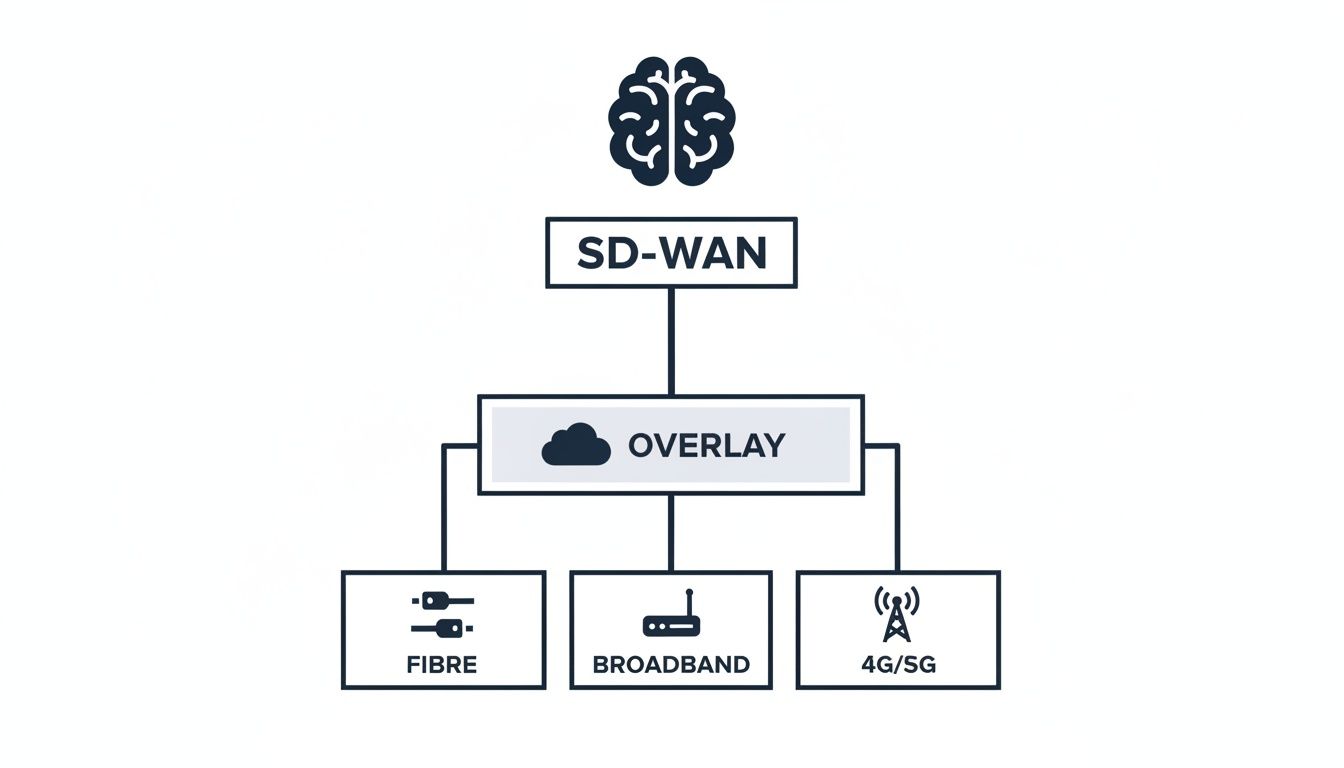
This hierarchy makes it clear: the real power of SD-WAN isn’t in the physical cables but in the intelligent software layer that controls them.
Why This Separation of Powers Matters
Decoupling the control plane from the data plane is the fundamental concept that makes SD-WAN so powerful. In legacy networks, each router made its own decisions based on limited, local information. If you needed to change a company-wide security policy, you’d have to update every single device one by one—a process that’s slow and riddled with potential for human error.
With SD-WAN, you define the policy just once in the orchestrator. For example, you might create a rule that all Microsoft Teams traffic must use the primary fibre optic connection to guarantee the best quality.
The controller then communicates this rule to every edge device across the network. Instantly, your policy is enforced consistently everywhere, from London to Manchester, with no manual intervention needed.
This architectural shift is a game-changer. It turns network management from a reactive, hardware-focused chore into a proactive, application-focused strategy. You stop worrying about individual links and start thinking about delivering a great user experience.
This is especially critical in environments like hospitals, where a certified, tested network delivery is non-negotiable. The reliability of SD-WAN, built on a professionally installed fibre cable infrastructure, ensures that critical clinical applications are always prioritised and available. For businesses, this means sidestepping costly downtime during an office relocation and ensuring every employee has a reliable connection from a tidy, well-managed desk setup. This approach, backed by an Excel network accredited partner and a 25 year equipment warranty, guarantees long-term performance and complete peace of mind.
How SD-WAN Intelligently Steers Your Traffic

This is where the real magic of SD-WAN happens. Instead of lumping all your data together and hoping for the best, the system acts like a smart traffic controller, making sure the most important stuff gets priority. It can actually identify different types of application traffic and make instant decisions on the best path for each packet to take.
Think about a typical day in a busy office or hospital. A director is on a critical video call, the sales team is busy updating the cloud CRM, and dozens of other staff are sending everyday emails. On a traditional network, all this traffic fights for the same slice of bandwidth, which is why video calls get choppy and important applications slow to a crawl.
SD-WAN fixes this because it understands context. It knows a video call can't handle delays, while an email can wait a few extra milliseconds. It will automatically push that video traffic over your high-performance fibre line, while sending less urgent data over a standard broadband connection. This all happens on the fly, keeping everything running smoothly for the user and preventing network logjams.
Application-Aware Routing in Action
The secret behind this intelligent steering is something called application-aware routing. SD-WAN doesn't just see a stream of anonymous data; it recognises the specific application each packet belongs to, whether that's Microsoft Teams, Salesforce, patient record software, or just someone browsing the web.
To achieve this, it looks inside the data passing through. This is where technologies like Deep Packet Inspection (DPI) come into play, allowing the system to classify traffic according to the business rules you've set.
For instance, you can create simple policies that dictate:
Voice and Video: Must always use the connection with the lowest latency and jitter, which is usually your dedicated fibre line.
Cloud Applications (CRM, ERP): Prioritise the link with the most bandwidth and best reliability.
Bulk Data Transfers (Backups): Send these over a cheaper broadband connection, maybe even scheduling them for after-hours.
General Web Browsing: Treat this as 'best effort' traffic, using whatever connection has capacity to spare.
This level of control is a lifesaver during a complex project like an office move. You can guarantee that your essential business systems will stay online and perform flawlessly, even while the physical relocation is underway.
Dynamic Path Selection and QoS
Beyond just knowing what the applications are, SD-WAN is constantly checking the health of every available network path. It keeps a real-time scorecard on key metrics like latency, jitter, and packet loss across your entire WAN.
This continuous monitoring is the heart of how SD-WAN maintains quality. If a primary fibre line suddenly starts dropping packets, the system will automatically and seamlessly reroute critical traffic to a stable backup connection, like 4G/5G, often without the user noticing so much as a flicker.
This automated Quality of Service (QoS) is a world away from the rigid, manual configurations of old-school networks. It’s a dynamic, self-healing system that just adapts to changing conditions. Edge devices at each site handle this automatically, applying policies to steer traffic down the optimal path, no matter if it's fibre, LTE, or standard broadband.
This intelligent routing has a direct and immediate impact on productivity. When your team isn't battling a slow network, they can focus on their jobs. This is especially true after an office move when everyone is trying to get settled; a perfectly performing network makes the whole transition feel smooth. By taking this proactive approach, IT teams can stop constantly firefighting network problems and start strategically managing application performance. For more tips on keeping your network running at its best, have a look at our guide on how network performance monitoring can improve UK office networks.
Building a Reliable Foundation for Your SD-WAN
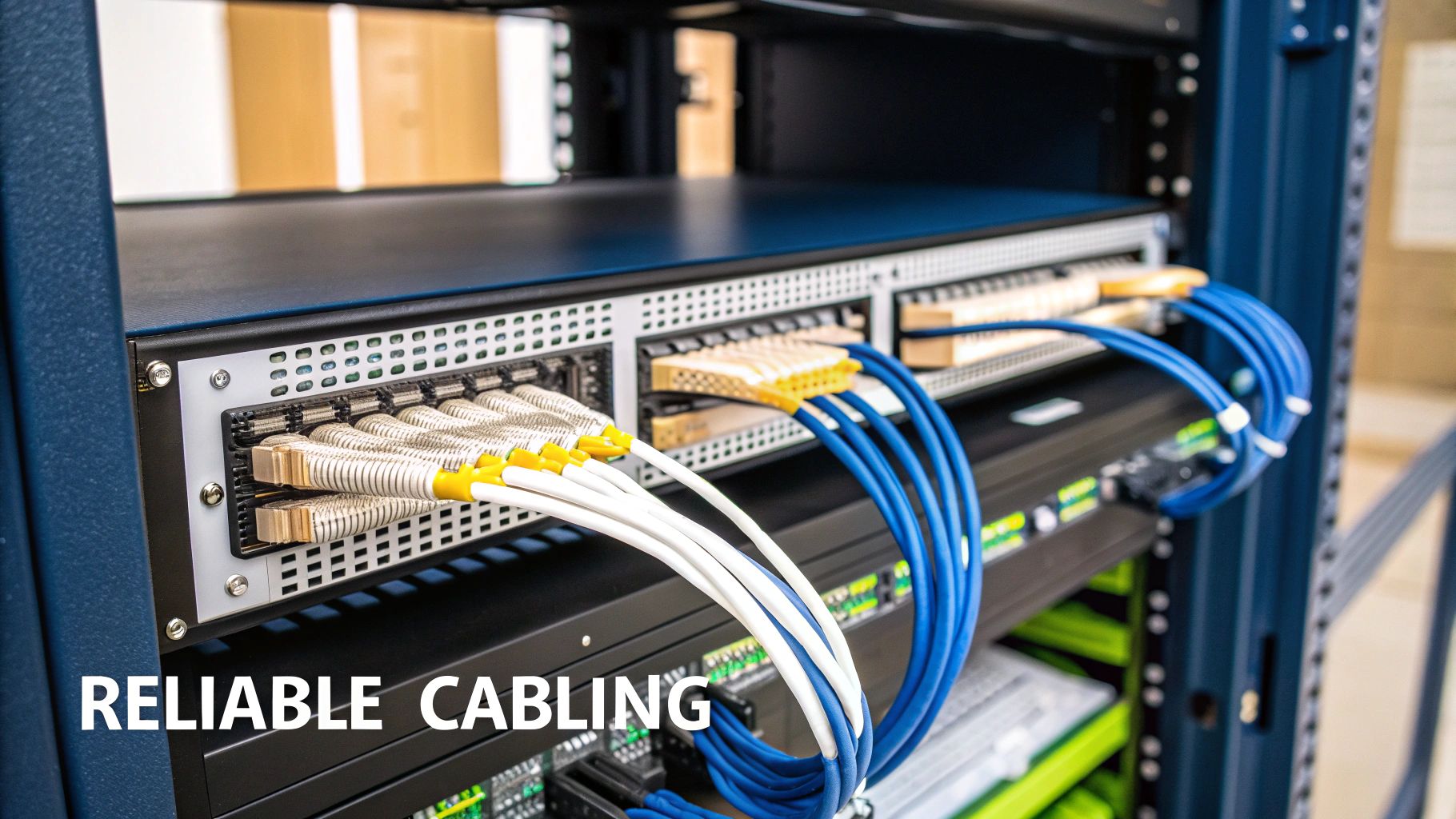
The intelligent software behind SD-WAN is incredibly powerful, but it’s only ever as good as the physical network it runs on. It’s a simple truth. While the system can cleverly route traffic around a congested broadband line, it can’t magically fix a faulty cable or a poorly terminated connection.
This is where the sophisticated world of software-defined networking meets the undeniable importance of the physical layer. An SD-WAN can't compensate for fundamental data network mistakes. If the underlying structured cabling is unreliable, your advanced software will spend all its time firefighting problems instead of actually optimising performance.
That’s why a professionally installed and certified network foundation is completely non-negotiable for any successful SD-WAN deployment. It’s the bedrock of your entire IT operation, and making sure your network is tested and certified from the start is crucial.
The Role of Professional Cabling Installation
To get the most from your investment, your physical infrastructure must be designed and installed to the highest standards. A professional fibre cable installation, for instance, provides the high-speed, low-latency backbone that critical applications need to thrive.
Similarly, high-quality structured cabling ensures every single user has a dependable connection. As an Excel network accredited partner, we know that quality goes far beyond just the components. It’s about the entire process, from the initial design right through to final testing.
Certified and Tested Network Delivery: Every cable and connection point must be rigorously tested with specialised equipment to verify its performance. This certification guarantees that your network can handle the speeds it was designed for, eliminating guesswork and preventing future bottlenecks.
Tidy Cable Management: A neatly organised server rack isn't just about aesthetics. Proper cable management prevents accidental disconnections, makes troubleshooting a breeze, and improves airflow, which can extend the life of your equipment. It also helps maintain a tidy desk policy across the office.
Future-Proofing Your Investment: A professionally installed system, backed by a 25 year equipment warranty, ensures your network will reliably support high-speed data transfer for years. This provides genuine long-term peace of mind and a stable platform for future growth.
This meticulous attention to detail is especially important during an office relocation with equipment testing. Conducting thorough equipment testing before and after the move confirms that every part of your infrastructure is ready to support the new SD-WAN environment from day one.
Think of your network cabling like the foundations of a skyscraper. You wouldn't build a state-of-the-art building on weak or untested ground. In the same way, you shouldn't deploy an advanced SD-WAN solution on a network infrastructure that hasn't been professionally installed, certified, and proven to be reliable.
Connecting Physical Reliability to SD-WAN Performance
When your physical layer is robust, your SD-WAN can finally operate at its full potential. The software’s intelligent routing decisions are based on one simple assumption: that the available paths are fundamentally sound. A certified network provides that assurance.
This means the SD-WAN controller receives accurate performance data, allowing it to make genuinely smart decisions. It can confidently route a high-priority video call over a fibre optic link, knowing that the cable itself is performing flawlessly. It's this synergy between hardware and software that delivers the exceptional user experience you're aiming for.
To build a truly robust system, it’s essential to understand all the components involved. You can learn more in our guide to what is network infrastructure and its role as your business backbone. Ultimately, a solid foundation ensures your SD-WAN isn’t just a clever idea—it’s a practical and powerful reality.
Integrating Modern Security with SD-WAN
In a world of distributed teams and cloud apps, relying on a traditional, perimeter-based security model is like locking the front door of your office but leaving all the windows wide open. Security can't be an afterthought bolted onto the network anymore; it has to be woven directly into its fabric. This is where SD-WAN completely changes the game by making security an inherent part of how your network operates.
Instead of dragging all traffic back to a central firewall—a slow and clunky process known as 'tromboning'—SD-WAN pushes security enforcement right out to the network edge. This means solid protection is applied exactly where users and applications connect, whether that's in the main office, a remote branch, or a hospital wing. The result is a consistent security posture everywhere, all managed from one central dashboard.
Built-in Security Features of SD-WAN
Modern SD-WAN solutions aren't just about routing traffic; they come packed with a powerful suite of integrated security tools that protect your network from the inside out. This approach simplifies management and closes the dangerous gaps that often appear between separate, single-function security products.
Key security capabilities typically include:
Next-Generation Firewall (NGFW): This goes way beyond simple port blocking. It provides deep packet inspection, intrusion prevention systems (IPS), and advanced malware protection at every single branch location.
Secure VPN Overlays: All traffic travelling across the SD-WAN fabric is automatically encrypted within secure tunnels. This keeps sensitive data safe as it moves between sites over public internet connections.
Micro-segmentation: This is a powerful technique for carving your network into small, isolated zones. If a threat were to compromise one segment, micro-segmentation contains it, stopping it from moving sideways to infect other parts of your network.
By centralising security policy management, your IT team can define a rule once and have it instantly enforced across dozens or even hundreds of sites. This gets rid of the risk of human error from manual configurations and ensures consistent protection for all users, no matter where they are.
The Emergence of SASE
This tight marriage of networking and security is the foundation of a modern framework known as Secure Access Service Edge (SASE). SASE combines SD-WAN capabilities with a suite of cloud-delivered security services, creating a single, converged solution that securely connects any user to any application, anywhere.
Think of it like this: SD-WAN provides the intelligent, high-performance motorways for your data, while SASE layers on the comprehensive security stack needed for today's hybrid work environment. This convergence is quickly becoming the new industry standard. At its core, SD-WAN decouples networking hardware from software, enabling a virtual overlay that monitors app performance.
The market certainly reflects this shift. By 2026, Gartner expects 60% of new UK SD-WAN purchases to be bundled with SASE, a huge jump from just 15% in 2022 as organisations get to grips with more complex security needs. Even so, on-premise deployment still holds a 68% share, making it a popular choice for regulated UK sectors like healthcare and finance that demand robust, on-site control. You can explore more about these industry trends and discover further insights on SD-WAN adoption at TWC IT Solutions.
This model is especially vital in places like commercial buildings and hospitals, where a breach can have severe consequences. For these organisations, the ability to enforce granular access policies, protect sensitive data, and maintain compliance is non-negotiable. SD-WAN, as the cornerstone of SASE, delivers the control and visibility needed to achieve this, making sure that performance and security go hand-in-hand without compromise. It’s a crucial element in any plan for an office relocation or major network upgrade.
Your Blueprint for a Successful SD-WAN Migration
Moving to SD-WAN is a major strategic project, not just a simple technology swap. A successful migration hinges on meticulous planning and professional implementation, ensuring your investment delivers its full potential from day one. Without a clear plan, you risk overlooking critical details that can lead to common data network mistakes and poor performance down the road.
This is especially true during a large-scale project like an office relocation with equipment testing, where the network must be fully operational and stress-tested before staff even walk through the door. The same goes for sensitive environments like hospitals, where network stability isn't just a convenience—it's non-negotiable. The hard work of a successful transition begins long before any new hardware is unboxed.
Pre-Deployment Planning: Your Essential Checklist
Before you even think about ordering equipment, you need to conduct a thorough audit of your current network. This initial phase is all about gathering the data needed to design an SD-WAN solution that genuinely aligns with your business objectives. Rushing this step is a recipe for disaster.
Your pre-deployment checklist must include:
Network Performance Audit: Get a real-world picture of your existing WAN connections. Pinpoint current bandwidth usage, identify peak traffic times, and find existing performance bottlenecks like latency or packet loss that are already frustrating your users.
Application Identification: Catalogue every single application running across your network. You need to distinguish between your business-critical services (like VoIP or your CRM system) and less essential traffic. This is what will inform your new, intelligent routing policies.
Physical Infrastructure Assessment: Take a hard look at your underlying structured cabling. An SD-WAN solution is smart, but it's not magic—it can't fix poor physical connections. A professional fibre cable installation partner can identify and sort out any underlying issues.
A common mistake is just assuming the existing cabling is 'good enough'. Having your network professionally tested and certified by an Excel network accredited partner before you start is non-negotiable. This guarantees the physical layer can actually support the new, intelligent overlay you're building on top of it.
Executing a Flawless Migration
With a solid plan in hand, the focus shifts to execution. This is where professional project management becomes vital, making sure every step is completed correctly and on schedule to minimise disruption to your business. The goal is a seamless cutover, not a chaotic scramble.
Key execution steps include:
Choosing the Right Partner: Don't just pick any IT firm. Select a certified partner with proven experience in both SD-WAN deployment and physical network infrastructure. Look for tangible guarantees, like a 25 year equipment warranty on all cabling components.
Phased Rollout Strategy: If you're a multi-site organisation, a phased deployment is the smart move. Start with a single pilot site to test all your policies and iron out any kinks before rolling the solution out across the entire business.
Post-Migration Testing: After you go live, conduct thorough equipment testing to validate that all applications are performing exactly as expected. This is your final check to confirm that traffic is being routed correctly and your performance targets are being hit.
A well-executed migration ensures your new SD-WAN works just as you intended. From perfect cable management at every tidy desk to the flawless performance of critical applications in commercial buildings and hospitals, success is rooted in expert planning and a detail-oriented approach.
Your SD-WAN Questions, Answered
Planning a network upgrade or an office move always brings up a few practical questions. Getting straight answers is key to making the right call. Here, we tackle some of the most common queries we hear from IT managers about making the switch to SD-WAN.
How Does SD-WAN Actually Help with an Office Relocation?
Think of it as having your new network ready to go before you’ve even packed the first box. With SD-WAN, all your network rules and policies are managed in one central place, not on individual routers. This means we can pre-configure the entire setup for your new site long before moving day.
Once your new fibre cable installation is complete, it’s practically plug-and-play. The new hardware just needs power and an internet connection. It then automatically connects to the central controller, downloads its configuration, and comes to life. This zero-touch approach slashes the time and technical skill needed on-site, ensuring your team is back online with consistent performance from day one, right after we’ve completed our final equipment testing.
Can I Run SD-WAN Over My Existing Office Cabling?
Yes, you absolutely can, but there's a big "but" attached. SD-WAN is a brilliant overlay technology—it makes intelligent decisions about how to route your traffic. What it can't do is fix a faulty foundation. If your existing cabling is old, poorly installed, or damaged, you'll never see the full benefit. Performance will be inconsistent, and you'll be chasing phantom problems.
For your network to deliver on its promise, the physical infrastructure has to be rock-solid. That’s why we always insist on a certified, tested network delivery. Working with an Excel network accredited partner like us ensures your cabling is installed to exact specifications, giving you a reliable base for your new SD-WAN. It’s what unlocks the 25 year equipment warranty, protecting your investment for the long haul.
Does SD-WAN Improve Security and Cable Management at the Same Time?
It certainly does. On the security front, modern SD-WAN solutions bake features like next-generation firewalls, intrusion prevention, and secure web gateways directly into the network fabric. This gets rid of the need for multiple separate security boxes at each site and lets you manage all your security policies from that same central dashboard. It’s a much cleaner and more consistent way to protect your network.
While SD-WAN software doesn't physically tidy your server room, its architecture naturally leads to better cable management. Because one SD-WAN appliance can replace a whole stack of traditional routers, firewalls, and WAN optimisation devices, you have far less hardware to rack and connect. This simplification complements a good tidy desk policy across the office and makes troubleshooting much easier, whether you're in a commercial building or a complex environment like a hospital.
For over 20 years, Constructive-IT has delivered expert network infrastructure solutions for UK businesses undergoing office relocations and performance upgrades. We ensure your network is tested, certified, and ready for the future.
Discover how we can support your next project at https://www.constructive-it.co.uk.
Comments