


Ethernet Over Coaxial: A Practical Guide to Upgrading Your Network
- Craig Marston
- Jan 3
- 12 min read

Picture this: upgrading your entire office network without the dust, noise, and chaos of tearing open walls or pulling hundreds of metres of new cable. That's the practical, real-world power of Ethernet over Coaxial (EoC), a smart technology that repurposes your existing TV or CCTV wiring to carry high-speed network data. It’s a strategic choice for getting a reliable network up and running while keeping disruption to an absolute minimum, especially for commercial buildings and hospitals.
What Is Ethernet Over Coaxial?
At its core, Ethernet over Coaxial is a method for sending high-speed network data through the same coaxial cables traditionally used for television or security cameras. Think of your existing coax wiring as a multi-lane motorway; EoC technology simply creates a dedicated, high-speed lane just for your network traffic.
This allows your data to travel securely and quickly right alongside other signals without any interference. It's an incredibly effective solution for commercial buildings and hospitals where running new fibre or Cat6 cables is impractical, disruptive, or even forbidden due to building regulations. For any business planning an office relocation, it's a powerful way to get a robust, wired network online in record time with thorough equipment testing.
Why Choose EoC for Commercial Projects?
The main reason businesses turn to EoC is its ability to deliver a modern, high-performance network without the significant disruption of a full-scale cabling project. It’s a fantastic way to avoid common data network mistakes that often come from rushed or poorly planned installations. For facilities managers, this translates to a faster, cleaner, and more cost-effective upgrade.
Here are the key benefits for commercial environments:
Minimal Disruption: In sensitive places like hospitals or busy offices, EoC avoids the noise, dust, and downtime that comes with pulling new cables through walls and ceilings.
Cost Efficiency: Reusing the infrastructure that’s already in the walls dramatically cuts down the material and labour costs you’d face with a new fibre cable installation.
Rapid Deployment: An office relocation with equipment testing can be finished far more quickly when the existing wiring is used, helping you get back to business as usual.
Certified Performance: When installed by a certified professional, an EoC network can be fully tested and certified, guaranteeing rock-solid performance.
An Ethernet over Coaxial solution isn't a compromise; it's a strategic decision. For environments where downtime is unacceptable and structural changes are complex, it offers a path to a modern, certified network delivery with less risk and expenditure.
Ensuring a Quality Installation
Simply plugging in a few adapters isn't going to cut it for a commercial-grade network. A professional installation is absolutely essential to guarantee the performance and reliability your business depends on. As an Excel network accredited partner, we know that making sure your network is tested and certified must include meticulous planning and testing.
This involves certifying the quality of the existing coax, ensuring every connection is solid, and performing thorough equipment testing. Professional cable management is also crucial for maintaining a tidy desk environment and an organised comms room. Ultimately, making sure your network is tested and certified is the only way to secure a long-term 25 year equipment warranty and ensure your infrastructure is built to last.
For UK businesses, leveraging existing coaxial infrastructure is a proven strategy; you can explore the benefits of a wired network for UK businesses in our detailed guide. Across the UK, this technology has been critical for extending high-speed networks in commercial buildings and hospitals, with EoC solutions now sustaining 15 million connections and accounting for 47.20% of the fixed connectivity market. This approach can reduce cabling costs by up to 60% compared to new installs. You can find more data on UK fixed connectivity trends on Mordor Intelligence.
Choosing the Right EoC Technology for Your Business
Once you’ve decided that Ethernet over Coaxial is the smart play for your project, the next question is which flavour to choose. Not all EoC solutions are cut from the same cloth, and the technology you pick will directly impact your network's performance, cost, and the complexity of the rollout. Getting this right is the key to delivering a stable, certified network.
The three main contenders you’ll come across in the commercial space are MoCA (Multimedia over Coax Alliance), G.hn, and dedicated Ethernet extenders. Think of it like choosing between a versatile multi-tool and a specialist instrument; the best one for your project depends entirely on what you’re trying to achieve.
For example, are you trying to connect multiple rooms across an entire office floor in a new fit-out? Or do you just need a simple, bulletproof link between a central comms room and a single, distant security camera? Understanding the job at hand is everything.
This decision tree shows the first critical step: figuring out if reusing the coax you already have is the most practical path forward.
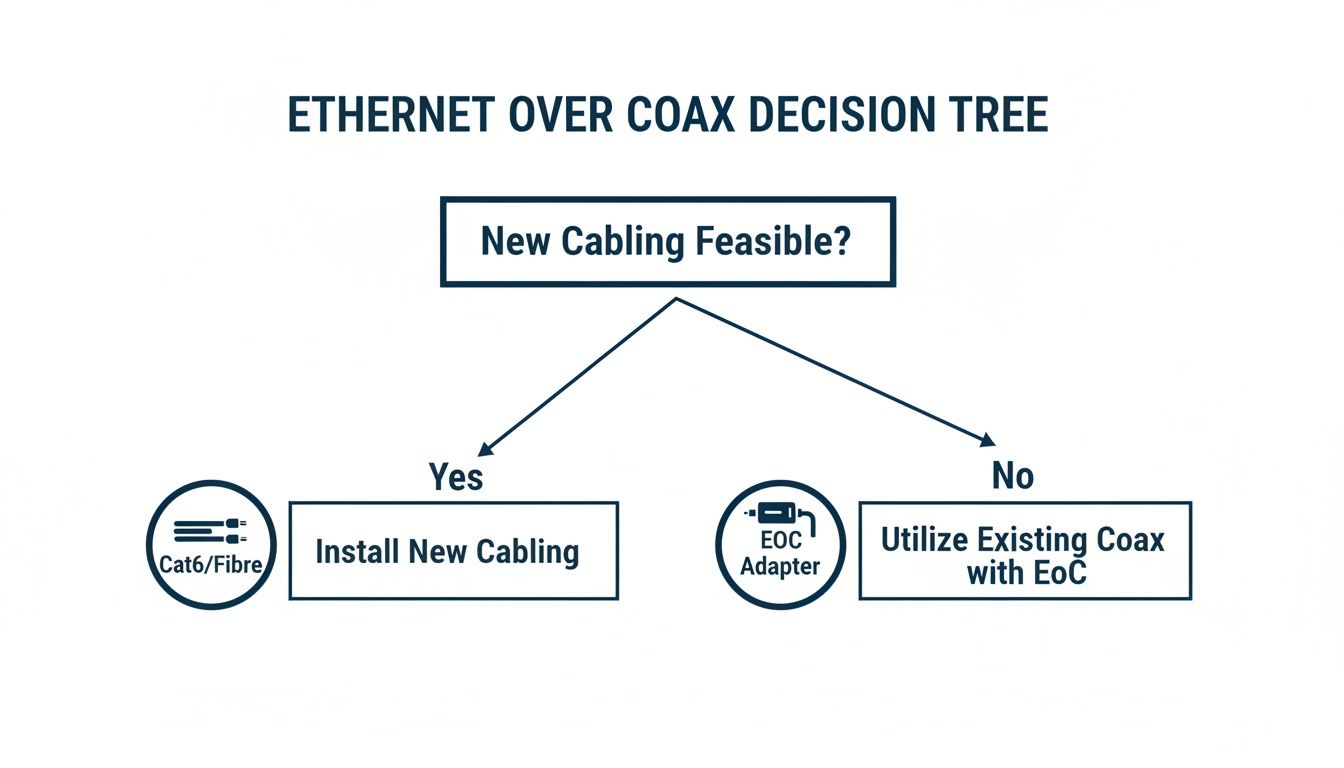
As the diagram shows, when pulling brand new fibre cabling just isn't on the cards—whether due to cost, disruption, or building restrictions—EoC steps in as the go-to alternative.
Comparing the Core Technologies
MoCA is often praised for its high performance and reliability, making it a fantastic choice for creating a multi-point network connecting several locations. Picture it as building a small, private network over your coax wiring, perfect for linking multiple desks or meeting rooms back to a central point. It really shines in environments that need stable, gigabit-level speeds.
G.hn is another standard that can run over coax, but it also works over power lines and phone lines, which makes it incredibly versatile. It's a strong competitor to MoCA and often delivers comparable speeds. The choice between the two can sometimes boil down to the specific chipsets inside the adapters and the quality of your existing wiring, which is exactly why professional equipment testing is so important.
Dedicated Ethernet extenders, on the other hand, are built for one job and one job only: creating a simple, highly reliable point-to-point connection over a long distance. These are the perfect solution for linking a main network switch to a remote device, like a wireless access point or a single workstation in a hard-to-reach corner of a warehouse or hospital.
MoCA vs G.hn vs Dedicated Extenders At a Glance
To make the decision clearer, it helps to see the technologies side-by-side. This table breaks down the key features that really matter for a commercial deployment.
Feature | MoCA (Multimedia over Coax Alliance) | G.hn (HomeGrid Forum) | Dedicated Ethernet Extenders |
|---|---|---|---|
Best Use Case | Multi-point networks connecting several rooms or devices. | Versatile multi-point networks, often used in mixed-wiring environments. | Simple, long-distance point-to-point connections. |
Typical Speeds | Up to 2.5 Gbps shared bandwidth across all devices. | Up to 2 Gbps shared bandwidth, depending on the medium. | Stable 100 Mbps to 1 Gbps, focused on reliability over distance. |
Complexity | Moderate setup, requires compatible adapters and proper splitter configuration. | Moderate setup, can be more complex in mixed-media deployments. | Very simple plug-and-play installation for a single link. |
Scalability | Excellent for adding multiple nodes (up to 16) to the same network. | Good scalability, though performance may vary with more nodes. | Not scalable; designed for a single, dedicated connection only. |
Ultimately, choosing the right technology is the foundation for building a network that can be fully certified and backed by a 25-year equipment warranty. An experienced Excel network accredited partner can properly assess your site's specific needs during an office relocation or upgrade, recommending the solution that guarantees performance without compromise.
Avoiding Common Pitfalls in Coaxial Network Upgrades
An Ethernet over Coaxial deployment is only as strong as the wiring it runs on. While it’s a fantastic alternative to pulling brand new fibre through a building, treating it as a simple "plug and play" solution is one of the biggest data network mistakes a business can make. The underlying health of your coaxial infrastructure is the single biggest factor that will determine success or failure.
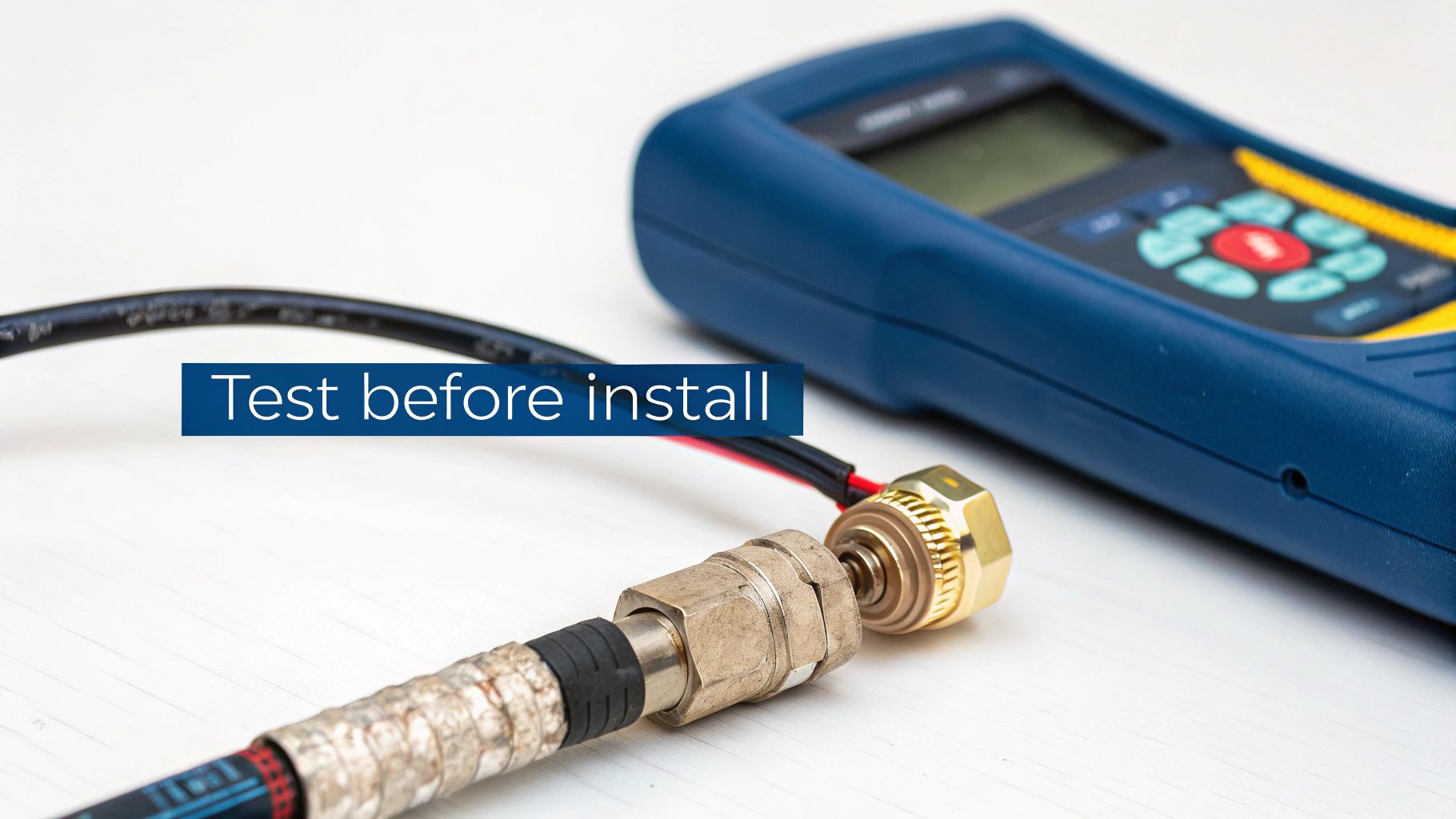
Hidden issues like poor-quality connectors, excessive cable distances, or the wrong type of signal splitters can absolutely cripple performance. Signal degradation is a silent killer of network speed, turning a promising gigabit connection into a frustratingly slow and unstable link. This is especially true in large commercial buildings or hospitals where the cable runs can be extensive and completely undocumented.
The Non-Negotiable Site Survey
This is precisely why a professional site survey and comprehensive cable testing are absolutely non-negotiable before you commit to buying any hardware. Without this crucial first step, you are essentially investing in technology with no guarantee it will work as expected. A certified technician needs to get hands-on to assess the physical and electrical integrity of your legacy coax.
Key assessment points include:
Signal Loss (Attenuation): Measuring just how much the signal weakens over distance to ensure it remains strong enough to carry high-speed data from end to end.
Connector Quality: Inspecting every single connection point for corrosion, poor crimping, or physical damage that could introduce crippling interference.
Splitter Compatibility: Hunting down and replacing old, low-frequency TV splitters that simply aren't designed to handle the higher frequencies required for data.
Cable Path Tracing: Verifying the entire cable run is intact and correctly routed—a vital step in older buildings with a maze of complex, undocumented wiring.
A certified network delivery isn't just about the final handover; it begins with verifying the foundation. Skipping a pre-installation audit is like building a new office floor without checking the building’s structural plans first.
This methodical approach ensures that the performance you plan for is the performance you actually get. In the UK, for instance, where hybrid coax networks are widespread, this diligence is key. Cable-based EoC and FTTC connections, often boosted with extenders, together hold a massive 47.20% market share. Leveraging this existing infrastructure properly has driven a 13% quarterly surge in high-speed connections. A structured cabling plan, incorporating properly tested EoC, can cut deployment times by as much as 40% in office relocations, and when certified, comes with a 25-year warranty. You can find out more about these trends in these UK business broadband statistics on yellowcom.co.uk. As an Excel network accredited partner, we ensure every cable is tested and certified, guaranteeing rock-solid reliability from day one.
When to Choose Coax Over New Cat6 or Fibre Cabling
Deciding whether to breathe new life into existing coaxial cabling or to bite the bullet and invest in a brand-new Cat6 or fibre installation is a major fork in the road. While modern cables are undeniably the future, Ethernet over Coax (EoC) offers a seriously smart, strategic fix in situations where pulling new wires is impractical, disruptive, or just too expensive.
The right decision often has less to do with raw speed specs and more to do with the physical realities of your building.
Think of it as choosing the right tool for the job. You wouldn't use a sledgehammer to hang a picture frame. In the same way, launching a massive re-cabling project isn’t always the best move, especially when a perfectly good data highway already exists inside your walls. EoC absolutely shines in these specific, often high-stakes, scenarios.
Scenarios Where EoC Is the Smartest Choice
Some environments are practically tailor-made for an EoC solution. In these cases, the benefits of minimal disruption, rapid deployment, and immediate cost savings completely eclipse the long-term advantages of new fibre. As an experienced Excel network accredited partner, we see EoC deliver exceptional value in these situations all the time.
A few classic examples include:
Heritage or Listed Buildings: When architectural preservation is the top priority and drilling through historic walls is a complete non-starter, EoC uses the infrastructure that’s already there without leaving a single mark.
Hospitals and Healthcare Facilities: Getting reliable connectivity to a busy hospital ward can’t come at the cost of patient care. EoC avoids the dust, noise, and downtime of a full re-cabling, meaning critical operations can carry on without a hitch.
Phased Office Relocation Projects: For businesses moving in stages, EoC allows you to set up a temporary, fully functional network in a new space almost instantly. This keeps the business running smoothly long before the final fit-out is complete.
Solving the "Last 100 Metres" Problem
One of the most powerful ways to use EoC is in a hybrid strategy. Many modern commercial buildings have a high-speed fibre backbone running between floors or to central comms rooms. The problem is, extending that super-fast connection to every single desk or device can be incredibly complex and costly.
This is what’s known in the industry as the “last 100 metres” problem.
Ethernet over Coaxial brilliantly bridges this final gap. It allows a business to connect its state-of-the-art fibre backbone to individual user workstations, access points, or CCTV cameras using the legacy coax that's already in place, offering the best of both worlds.
This approach gives you a certified, tested network delivery without the final, most disruptive phase of a cabling project. It’s a pragmatic solution that balances performance with practical constraints, ensuring tidy desk spaces through effective cable management.
If you’re keen to learn more about the latest cabling standards, you can find a wealth of information in our essential guide to Cat 6 cable. Ultimately, a properly planned EoC installation, backed by a 25 year equipment warranty, is a fantastic way to avoid common data network mistakes and deliver solid performance right where you need it.
Your Blueprint for a Professional Installation and Network Certification
Putting an Ethernet over Coaxial network into a commercial building or hospital isn't as simple as plugging in a few adapters and hoping for the best. To do it right, you need a methodical approach that guarantees the network performs as expected from day one. This is the blueprint for turning a potential networking headache into a real strategic asset, ensuring the system you pay for is the system that gets delivered.

The real work begins long before any hardware is unboxed. It all starts with a detailed site survey and a thorough audit of the existing coax wiring to make sure it's up to the job. Only then can you select the right components to hit your specific performance targets.
From Cable Management to Final Sign-Off
A professional installation is where the plan comes to life. Good technicians are obsessed with meticulous cable management, making sure comms rooms are organised and every connection contributes to that clean 'tidy desk' environment for your team. This focus is absolutely essential during a fast-paced office relocation, where equipment testing needs to be both rapid and flawless.
But the final, most critical stage is performance verification and network certification. This goes far beyond a simple speed test.
A certified network delivery means every single connection has been rigorously tested against industry standards using specialised equipment. It’s your documented proof that the infrastructure can reliably handle the data loads it was designed for, forming the bedrock of a robust network.
The Value of a Certified Partner and a Rock-Solid Warranty
Bringing in an Excel network accredited partner for your project is the only way to guarantee this level of quality. A certified and tested network is your ticket to securing a 25-year equipment warranty, which provides genuine, long-term peace of mind. This guarantee protects your investment and confirms your network is truly built to last. Understanding how to pick the right team is vital, so check out our guide on choosing network cabling installers you can trust for more detailed advice.
EoC is still a vital part of the UK's network infrastructure, especially for facilities managers in commercial buildings and hospitals where running new fibre just isn't an option. While full-fibre connections are on the rise, EoC underpins millions of connections in these tricky environments. For an office relocation, it can slash project costs by 50% compared to a fibre-only fit-out while supporting all your critical systems without a hitch.
Your Ethernet Over Coaxial Questions, Answered
Taking the plunge on any network technology always brings up a few practical questions. Getting straight answers is key to making the right call for your business's infrastructure. Here, we tackle the most common queries we hear from IT managers, so you can move forward with confidence.
Is Ethernet Over Coaxial Secure Enough for a Corporate Network?
Yes, absolutely. This isn't the same as just plugging into an old TV aerial socket. Modern EoC technologies like MoCA are built for business and come with strong, built-in encryption, such as AES-128.
When properly set up by a professional installer from an Excel network accredited partner, the network is segmented and secured just like a traditional Ethernet network. This makes it a perfectly viable and safe choice for corporate use in commercial buildings and even sensitive environments like hospitals.
Will Network Data Interfere With Our CCTV or TV Signals?
No, and that’s a common misconception. EoC systems are cleverly designed to operate on completely different frequency bands than your standard cable TV or CCTV signals.
Think of it as having separate, dedicated lanes on the same motorway; the data traffic has its own lane, and the video signals have theirs. This smart engineering prevents interference, allowing Ethernet data and video to run on the same coaxial cable without tripping over each other. It’s a crucial feature that makes it a great alternative to a full professional fibre cable installation.
What Speeds Can We Realistically Expect From EoC?
Real-world speeds will always depend on the quality of your existing coaxial cabling, the specific technology you choose (like MoCA 2.5), and the distances involved.
While some technologies advertise headline speeds of over 2 Gbps, a realistic expectation for a typical office relocation with equipment testing is a stable, reliable connection between 500 Mbps and 1 Gbps. This is more than enough grunt for most office applications and is backed by a 25 year equipment warranty when installed correctly.
The key takeaway here is that with professional planning, meticulous cable management for a tidy desk environment, and thorough equipment testing, Ethernet over Coaxial is a secure, reliable, and high-performance solution for modern business networks.
For over 20 years, Constructive-IT has delivered secure, warrantied network infrastructure solutions for UK businesses undergoing office relocations and fit-outs. From initial design to a fully certified network delivery, our team ensures your project is completed with minimal disruption. Schedule a consultation.
Comments