


N3 NHS Network: Building the Foundation for Autonomous Buildings
- Craig Marston
- Jan 16
- 15 min read

Unmanned building management is all about creating a self-sufficient property where access, power, data, and security work together flawlessly, without needing someone on-site every day. Instead of relying on staff to be physically present, the building intelligently manages itself, handling everything from letting in a contractor to monitoring its own vital signs. It’s a complete shift away from traditional, hands-on facility operations.
What Is Unmanned Building Management Really?
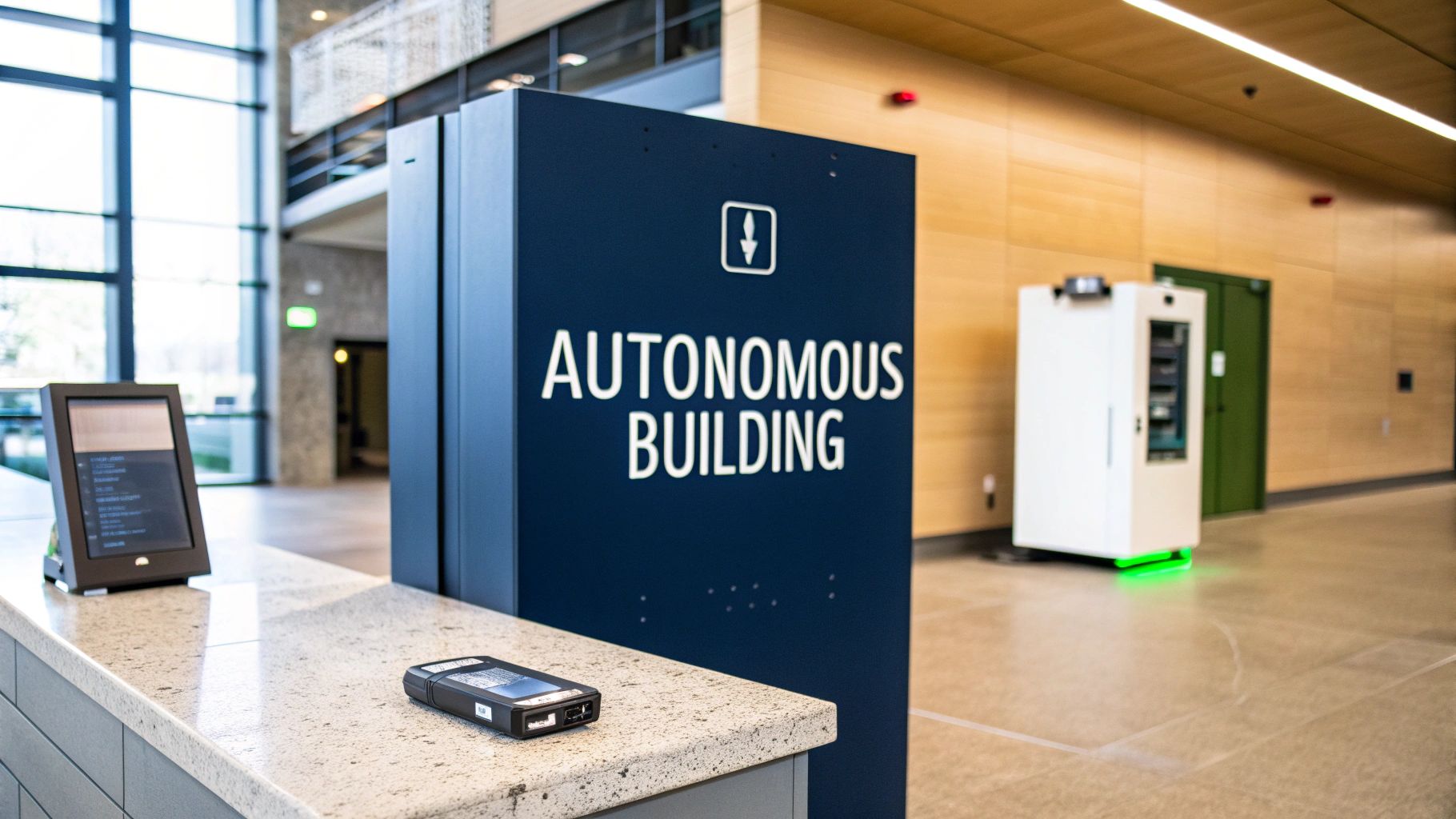
Let's get past the jargon. In practice, unmanned building management means engineering a truly autonomous property with its own nervous system, one that can operate securely and efficiently all on its own. It's not just about remote monitoring; it's about intelligent automation.
Think of the difference between a classic car and a modern electric one. A traditional building is like that classic car—it needs constant manual input. Staff have to physically turn keys, walk the floors to check meters, manually reset servers, and be there in person to let anyone in. Every critical function depends on a person being on-site.
An unmanned building, however, is designed from the ground up like a modern EV, with integrated systems that talk to each other and manage themselves. Physical keys are replaced with secure digital credentials. Manual checks are swapped for real-time data from a network of sensors and smart systems.
The Autonomous Ecosystem
This level of autonomy is only possible when three foundational pillars—access, power, and data—are designed to work as a single, cohesive unit. Each one has to support the others to create a resilient, self-sufficient environment.
Intelligent Access Control: This means using systems like battery-less, NFC proximity locks that grant entry via a smartphone or keycard. It completely removes the need for physical keys and on-site staff to manage who comes and goes.
Resilient Power Infrastructure: A certified commercial electrical installation, complete with backup power solutions, is non-negotiable. This ensures that critical systems like security cameras, network hardware, and access control hubs stay online even during a power outage.
Reliable Data Connectivity: The entire ecosystem is built on a stable network. High-performance structured cabling and a well-designed network ensure every device can report its status and receive commands instantly.
Moving Beyond Simple Remote Control
It’s vital to understand the difference between true autonomy and basic remote control. Being able to view a CCTV feed on your phone or unlock a door from an app doesn’t make a building "unmanned" in the proper sense. True autonomy means the building can handle routine operations—and even some emergencies—without direct, real-time human commands.
An autonomous building’s intelligence is baked into its infrastructure. The system should be able to grant pre-approved, time-limited access to a maintenance worker, log their entry and exit, and notify managers of the completed task—all without a single manual command from you.
This deep integration is what delivers the real-world benefits: lower operational costs, tighter security, and far greater efficiency. The table below breaks down the fundamental shift from conventional building operations to a modern, autonomous management model.
Key Differences Traditional vs Unmanned Building Management
Operational Aspect | Traditional Manned Building | Modern Unmanned Building |
|---|---|---|
Access Control | Physical keys; on-site staff required to grant entry. | Digital credentials (NFC, mobile); pre-authorised, time-limited access. |
System Monitoring | Manual checks; visual inspections by staff. | Real-time sensor data; automated alerts for faults or anomalies. |
Power Management | Dependent on mains power; manual reset after an outage. | Redundant power with UPS/generator; seamless, automatic switchover. |
Security | On-site guards; reactive response to alarms. | Integrated cameras and sensors; proactive, automated security protocols. |
Maintenance | Scheduled walk-throughs; staff must be present to supervise. | Predictive maintenance alerts; automated access for approved vendors. |
These systems are commonly used in data centres, remote telecoms sites, self-storage facilities, and multi-unit commercial properties where operational efficiency and security are paramount.
To truly get this right, you need to think about the whole picture, which involves adopting robust infrastructure monitoring best practices. By designing these core systems to work in concert from day one, a building transforms from a passive structure into an active, intelligent asset.
Why So Many Unmanned Building Projects Stumble
The dream of a fully automated, self-sufficient building is a powerful one. But the reality is that many projects fail because of a fragmented, siloed approach to planning. Different teams—security, IT, and facilities—make decisions in isolation, leading to systems that clash instead of collaborate.
It happens all the time. The security team picks an access control system, the facilities team sorts out the power, and the IT department designs the network. Without a single, unified strategy, these critical systems end up clashing, creating a building that’s anything but autonomous.
This disjointed approach creates predictable—and damaging—points of failure. For example, a cutting-edge access control system gets the green light, but its locks need a constant network connection to work. The moment the building’s internet inevitably drops, every single door becomes a deadbolt, locking staff out and creating a security nightmare. This entire crisis could have been sidestepped if the access and data systems had been designed as one integrated solution from the start.
The Domino Effect of Poor Integration
Another classic pitfall is underestimating what the building actually needs to run. A team might install a sophisticated CCTV network with dozens of high-definition cameras, only to find out the power infrastructure was never designed to keep them online during an outage. When the mains power fails, the backup system can't handle the load, and the entire surveillance network goes dark at the exact moment it’s needed most.
These aren't just isolated incidents; they're symptoms of a fundamentally broken process.
A siloed design process guarantees a siloed result. If access, power, and data are planned separately, they will operate separately, creating a fragile system where the failure of one component can bring down the entire building's autonomous functions.
This isn’t just anecdotal, either. Industry reports show that over 65% of project failures are a direct result of poor integration between core systems. On the flip side, projects that took a unified design approach from day one were four times more likely to hit their operational and financial targets. You can explore the findings on how integrated systems impact project success in more detail.
Overlooking the Network Foundation
The data network is the central nervous system of any unmanned building, but its importance is often massively underestimated. It’s not just about providing a bit of Wi-Fi. It's about building a rock-solid foundation that can reliably support every single smart device, from the door locks and CCTV cameras to environmental sensors and the building management system.
Just think about the data demands in a secure facility, like one connected to the N3 NHS network or its successor, the HSCN. The integrity and availability of that link are non-negotiable. If the local network cabling or hardware is flaky, it completely undermines the security and function of the entire operation.
Some of the most common networking mistakes we see include:
Insufficient Bandwidth: Failing to account for the massive data load from multiple HD CCTV streams running 24/7.
Lack of Redundancy: Designing a network with single points of failure, where one faulty switch can take an entire floor offline.
Poor Cabling Infrastructure: Using cheap, substandard structured cabling that can't support high-speed data reliably, leading to intermittent connection problems that are a nightmare to diagnose.
At the end of the day, a successful unmanned building isn't just a collection of smart gadgets. It's a single, cohesive system where every part is designed to support the others. That requires a holistic strategy right from day one, where access control, commercial electrical installation, and data networking are planned and implemented together by a team that understands exactly how they need to interact.
Integrating Access, Power, and Data: The Core Blueprint
To build a genuinely autonomous facility, you can't just bolt on smart devices as an afterthought. Success comes from a deliberate, unified strategy where access, power, and data must be designed together as a single, interconnected system from the very first blueprint. Thinking of them in isolation is the number one reason unmanned building projects fail.
This integrated approach means each component is designed to support the others, creating a resilient structure where the whole is far greater than the sum of its parts. Let's break down this core blueprint into its three essential pillars.
The visual below shows exactly how project failure happens when these core pillars—access, power, and data—are treated as separate silos instead of a unified system.
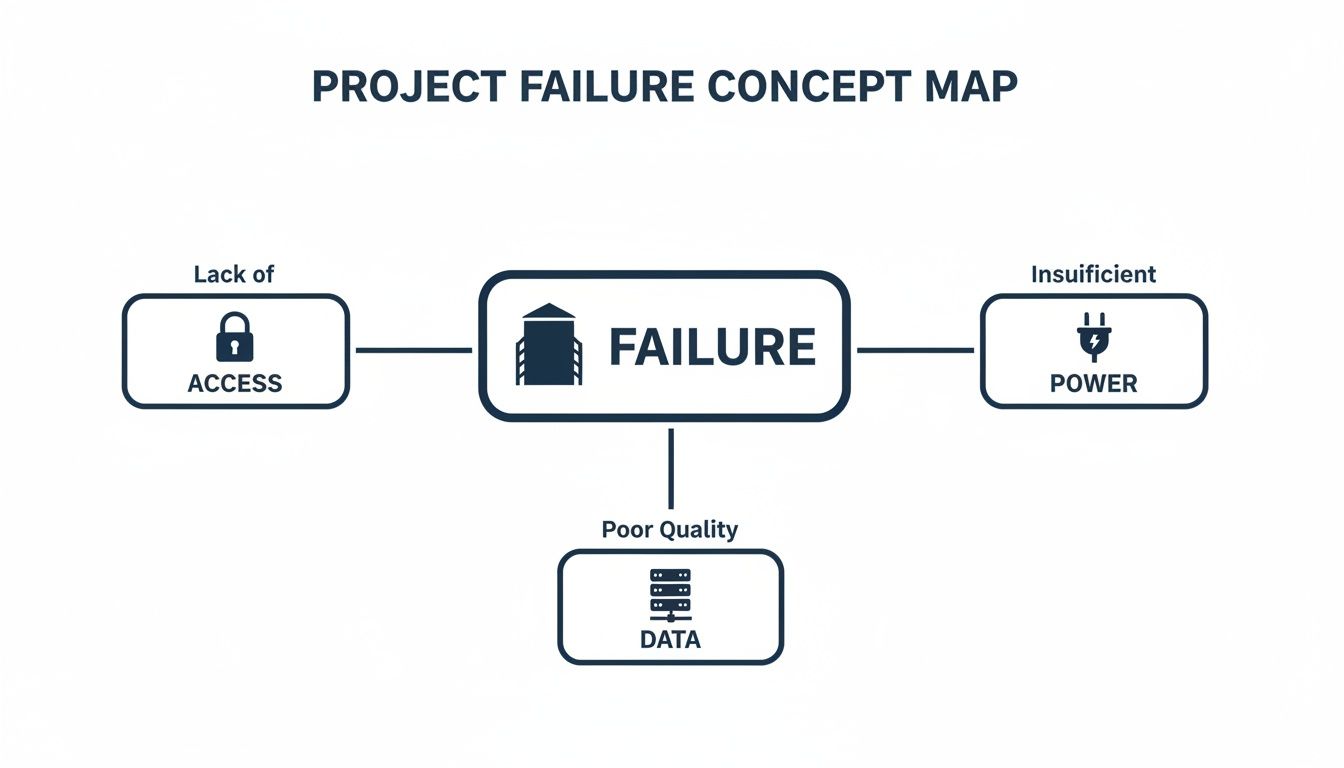
As you can see, when these elements aren't designed in concert, it creates critical points of failure that completely undermine the project's stability and autonomy.
Access Control Built for Autonomy
In an unmanned environment, access control is your first line of defence and your most important operational tool. The technology you choose has huge knock-on effects for maintenance, reliability, and security. This is exactly why battery-less, NFC proximity locks are such a game-changer for autonomous buildings.
Traditional battery-powered smart locks are a constant maintenance headache. Technicians have to be sent out just to replace dead batteries, which is both inefficient and costly. More importantly, a dead battery creates a critical point of failure that can lock out authorised personnel at the worst possible moment.
Battery-less NFC locks sidestep this problem entirely. They draw power from the user's device—a smartphone or NFC card—at the moment of contact. This elegant solution means they stay functional even during a total power outage or network failure, giving you unparalleled reliability. For sites where guaranteed access is non-negotiable, this feature is crucial.
Power: The Unseen Foundation
Your building’s autonomous functions are completely dependent on a consistent and clean power supply. A standard electrical setup just won't cut it. A truly robust power infrastructure needs a certified commercial electrical installation that’s been designed specifically to support critical systems.
This involves several key components working together:
Dedicated Circuits: Essential hardware like CCTV recorders, access control hubs, and network switches must be on their own dedicated circuits. This prevents them from being taken down by overloads from other building systems.
Uninterruptible Power Supply (UPS): A commercial-grade UPS provides instant battery backup during a power cut, preventing sensitive electronics from shutting down improperly and keeping systems online during short outages.
Backup Generators: For long-term resilience, a generator can keep the entire building's critical functions running indefinitely. This ensures systems like those connected to the N3 NHS network or HSCN remain operational no matter what.
Without this level of electrical design, even the most advanced smart systems are just one power flicker away from becoming useless.
Data: The Central Nervous System
Data connectivity is the invisible thread that ties every component of your unmanned building together. It’s not just about having an internet connection; it's about creating a rock-solid, high-performance internal network that lets all your systems talk to each other without interruption. The backbone of this communication is a resilient network design, built on high-quality structured cabling.
A building's intelligence is limited by the quality of its network. If your access control panel can't talk to the central server, or your CCTV camera can't send its feed, your building isn't autonomous—it's just offline.
Ensuring this reliability means planning the network infrastructure right alongside the power and access systems from day one. This involves mapping out cable runs, planning for network redundancy to eliminate single points of failure, and making sure you have enough bandwidth for data-heavy applications like high-definition video surveillance. For a deeper dive into the specifics, you can learn more about designing the modern NHS network with these principles in mind.
By weaving these three elements—access, power, and data—into a single, cohesive design from the start, you create a foundation that is secure, resilient, and truly autonomous.
Choosing Your Locks: The Case for Battery-Less NFC
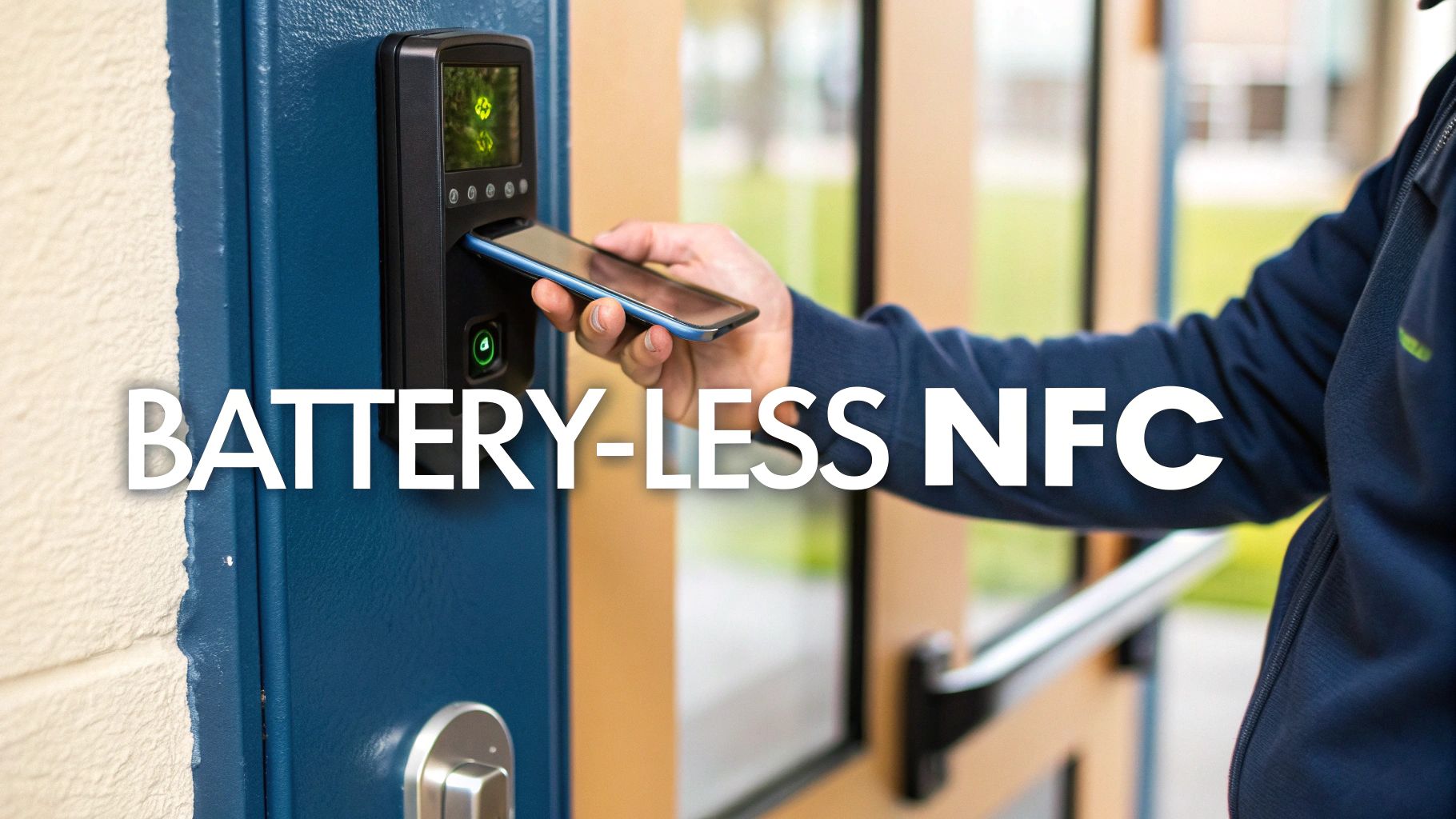
When you're running a building with no permanent staff on-site, the reliability of your door locks isn't just a nice feature—it's the very foundation of your business model. A single failed lock can spiral into an expensive emergency call-out, grind operations to a halt, and punch a hole in your security. For real-world unmanned operations, battery-less NFC proximity locks are the superior choice.
While the market is full of battery-operated smart locks and systems that depend on a network connection, they come with significant weak spots. Batteries introduce a constant, nagging maintenance headache, while network-reliant locks become expensive paperweights the second your internet drops. For a truly resilient unmanned building, you need a solution that engineers these points of failure out from the very start.
Freedom From Maintenance
The most powerful real-world reason for choosing battery-less, NFC-powered locks is freedom from the relentless cycle of maintenance. Imagine never again having to send a technician to a remote site just to swap a dead battery in a crucial door lock. This isn't a minor tweak to your operations; it's a major cost saving.
Facilities management data shows that battery replacements for smart locks can account for up to 40% of all maintenance call-outs for unmanned commercial properties. By switching to battery-less NFC, businesses can slash these specific operational costs by an average of 75% over five years, all while making their security tougher by removing a common weak link.
The technology works by drawing a tiny sip of power directly from the user's device—be it a smartphone or an NFC card—at the exact moment of use. The lock itself sits completely dormant, using no power at all, until an authorised credential wakes it up. This makes it an incredibly efficient and dependable solution built for the long haul.
Unshakeable Reliability During Outages
Beyond ditching the maintenance runs, the real superpower of battery-less NFC locks is their reliability when everything else goes wrong. Because they don't need the building's power or its data network to work, they remain fully functional even in a worst-case scenario.
Think about these all-too-common situations where other systems would let you down:
Complete Power Outage: Your building's backup generator might keep the lights and critical systems on, but what about less essential areas? An NFC lock on a storeroom or back office will continue to work perfectly, no questions asked.
Internet or Network Failure: If a network switch gives up or your broadband connection dies, any lock that needs to 'phone home' to a server becomes a useless brick. Battery-less NFC locks handle authentication locally, ensuring access is never held hostage by network downtime.
This built-in resilience makes battery-less NFC the perfect choice for any critical infrastructure, remote site, or multi-unit commercial property where guaranteed access is non-negotiable, no matter what's happening outside.
A Clear Comparison to The Alternatives
When you put battery-less NFC technology side-by-side with the common alternatives, its advantages for unmanned sites become crystal clear. Each of the other options comes with a major operational compromise that NFC neatly solves.
Feature | Battery-Less NFC Locks | Battery-Powered Smart Locks | Network-Reliant Locks |
|---|---|---|---|
Power Source | User's device (phone/card) | Internal batteries | Mains power, often with battery backup |
Maintenance | Virtually zero; no batteries to change. | High; requires regular battery checks and replacements. | Moderate; dependent on power backup systems. |
Power Outage | Fully functional. | Functional until battery dies. | Fails unless on dedicated UPS. |
Network Outage | Fully functional. | Functional (local credentials). | Fails completely. |
Best Use Case | Unmanned, critical, and remote sites. | Residential or low-traffic commercial doors. | High-traffic internal doors with stable power/network. |
To get the most out of these systems, it helps to have a good grasp of the basics. For anyone new to the field, understanding RFID card technology provides a great foundation, as NFC is essentially a specialised form of RFID.
Ultimately, choosing the right lock is all about reducing risk and boosting long-term efficiency. Of course, the technology is only half the battle; the quality of the installation is just as vital, which is why finding a certified access control installer you can trust is a crucial step in any project. For any unmanned building, battery-less NFC delivers a superior blend of reliability, low maintenance, and total peace of mind.
Operational Realities and Long-Term Maintenance
An unmanned building isn't a project you can just set up and walk away from. It's a living asset that needs intelligent design and proactive monitoring to stay secure, functional, and compliant. Swapping on-site staff for remote management makes your long-term maintenance and operational strategy absolutely critical.
The effectiveness of this remote management all comes down to the quality of the systems you build it on. Every single task, from checking on an incident to giving a contractor temporary access, relies entirely on the integrated power and data infrastructure working flawlessly in the background. This is where the long-term reality of running an autonomous building really hits home.
The Ever-Watchful Eye of CCTV
A solid CCTV system is the cornerstone of remote oversight for any unmanned facility. It provides the visual verification needed for both real-time incident response and post-event analysis. However, its reliability is directly chained to the infrastructure that keeps it running.
High-definition cameras are incredibly data-hungry, streaming massive amounts of information 24/7. This demands a network with enough bandwidth to handle that constant load without choking other critical systems, like connections to the secure N3 NHS network. Furthermore, these cameras must stay online during a power cut, which makes a certified electrical installation with a UPS backup completely non-negotiable.
Maintaining Compliance and Safety
Beyond just security, running a commercial property comes with serious legal and safety responsibilities. A certified commercial electrical installation isn't just a nice-to-have for reliability; it's a mandatory requirement for compliance and insurance. And this involves more than just the initial setup.
Regular inspection, testing, and certification are essential to ensure the electrical system remains safe and up to code. This proactive maintenance helps catch faults before they can lead to system failures, data loss, or even fire hazards. A well-documented history of professional maintenance is vital for both insurance and regulatory purposes.
The true cost of an unmanned building isn't just in the initial setup, but in the long-term operational integrity of its core systems. Proactive maintenance isn't an expense; it's an investment in uninterrupted service and security.
Simplifying Management Through Smart Design
A well-designed autonomous building makes long-term maintenance far more efficient. Building out fully autonomous unmanned building units requires an integrated approach that simplifies management and dramatically cuts down on costly site visits. The real goal is to solve problems remotely before they turn into critical failures.
A unified management system can give you powerful tools to make operations smoother:
Remote Diagnostics: Intelligent network hardware can flag up a failing switch or a faulty access point long before it actually affects operations. This lets a technician sort the issue out proactively, often without ever needing to set foot on-site.
Centralised Access Management: Instead of juggling physical keys, a single dashboard allows you to grant, revoke, or change access for hundreds of users across multiple units instantly and securely.
Automated System Alerts: The building can essentially monitor its own health. It can send automated alerts for power fluctuations, network problems, or security breaches, allowing for an immediate and targeted response.
This level of remote control is only possible with a resilient and professionally installed network infrastructure. By building your autonomous units on a solid foundation, you transform facility management from a reactive headache into a proactive, data-driven strategy. This ensures your investment stays secure, efficient, and valuable for years to come.
Your Partner in Building Autonomy
Building a truly autonomous facility is a high-stakes project. Success hinges on a partner who gets the bigger picture—that the smart locks are useless if the power fails, and the CCTV system is just an expensive decoration without a rock-solid network. In this world, a holistic approach isn't just a nice-to-have; it's the only way to get it right.
Fragmented planning is a blueprint for failure. When you have electrical, data, and security contractors all working in their own little bubbles, you’re practically inviting unforeseen conflicts and vulnerabilities. In stark contrast, an integrated design creates a secure, reliable, and genuinely autonomous building that works flawlessly from day one.
The Unified Solution for Autonomy
The path to a successful unmanned building is through a single, end-to-end service. This approach weaves certified electrical installation, structured data cabling, and the deployment of advanced access control and CCTV into one cohesive strategy. By engineering these core pillars to work in concert from the very beginning, we eliminate the integration gaps that doom so many of these projects.
An analysis of unmanned commercial properties found a massive difference in outcomes. Facilities built with an integrated infrastructure partner from the design phase experienced 90% fewer critical system failures in their first year compared to those who sourced contractors separately. This unified approach also slashed project completion times by an average of 20%. You can learn more about how integrated project design boosts ROI.
True autonomy isn't achieved by just adding smart devices to a building; it's built on an infrastructure where every single component is designed to support the others. This foundational synergy is the key to creating a facility that is genuinely secure, resilient, and self-sufficient.
Putting together a fully autonomous unit demands expertise that cuts across multiple disciplines. It requires a deep understanding of how power loads affect sensitive network hardware, and how a split-second of network lag can compromise your entire security protocol.
We provide the comprehensive, multi-disciplinary expertise needed to design and deliver these complex projects. From the initial consultation to the final certification, our integrated team ensures your next unmanned building is built on a foundation of security, reliability, and true autonomy. Let's build it right, together.
Answering Your Key Questions
When you're considering the shift to an unmanned facility, a few practical questions always come up. Getting straight answers is key to moving forward with confidence. Here, we tackle the most common queries we hear from clients.
What Happens to NFC Locks if the Building Loses Power?
This is where the clever design of battery-less NFC technology really shines. The lock itself has no independent power source to fail. It’s energised for a split second by the user's device—be it a smartphone or an access card—at the precise moment they tap it.
This means that even during a total power outage, access is never compromised. It’s an incredibly resilient solution, perfectly suited for unmanned sites where guaranteed entry is non-negotiable, no matter what’s happening with the grid.
How Do You Manage Access for Maintenance Teams?
Modern unmanned systems give you incredibly flexible control right from your screen. You can grant temporary, time-limited digital keys to maintenance staff or contractors through a central software platform, accessible from anywhere.
Access can be restricted to specific doors or time windows, and every single entry is logged, giving you a complete and detailed audit trail. This approach completely eliminates the security risks and logistical nightmares that come with handing out physical keys.
Are Unmanned Buildings Less Secure Than Manned Ones?
It’s a common concern, but when designed correctly with an integrated strategy, an unmanned building can be significantly more secure. Human error is one of the biggest causes of security breaches, and a well-designed autonomous system removes issues like lost keys or doors accidentally left unlocked.
With robust digital access control, comprehensive CCTV monitoring, and automated alerts for any unusual activity, you gain greater control and visibility over your property 24/7. This creates a more secure environment than many traditional, staffed methods can offer.
By combining these elements, the building actively monitors and protects itself, providing a much higher level of security and assurance.
Building a truly autonomous facility requires a partner who understands how access, power, and data must work together in perfect harmony. Our team specialises in designing and delivering the integrated infrastructure that makes secure, unmanned buildings a reality.
Comments