


What Is a DAS System and How Does It Eliminate Dead Zones
- Craig Marston
- Dec 28, 2025
- 14 min read

A Distributed Antenna System (or DAS, as you'll hear it called) is essentially a dedicated mobile signal network for the inside of your building. It's a professional-grade solution that picks up strong 4G and 5G signals from outside and carefully redistributes them wherever they're needed. It's the definitive answer to dropped calls and sluggish mobile data that plague so many modern commercial buildings and hospitals.
How Does a DAS Actually Work?
Imagine you’re trying to fill a massive concert hall with crystal-clear sound using just one giant speaker. You'd get deafeningly loud spots right at the front and frustratingly quiet zones at the back. A Distributed Antenna System solves this exact problem, but for mobile phone signals inside large buildings.
At its heart, a DAS is a purpose-built network designed to fix one of modern construction's biggest headaches: terrible indoor mobile reception. This isn't just another Wi-Fi booster or a simple signal repeater you'd buy off the shelf; it's a serious piece of infrastructure. The system captures a clean, reliable mobile signal from outside and methodically rebroadcasts it throughout a facility, guaranteeing consistent coverage in every corner.
Why Do Brand-New Buildings Have Such Awful Signal?
It’s a fair question. Why would a shiny, high-spec office building struggle with something as basic as a phone call? The problem often lies in the very materials used to build it. Energy-efficient glass, thick concrete, and steel frameworks are fantastic for insulation and structural strength, but they are also incredibly effective at blocking the radio frequency (RF) waves our phones depend on.
This creates a frustrating paradox. The most advanced commercial buildings and hospitals can unintentionally become "Faraday cages," leading to real-world problems:
Dropped calls during important client conversations.
Unsent emails and messages that grind workflows to a halt.
Slow or non-existent mobile data, crippling productivity for staff and visitors.
Complete dead zones in critical areas like basements, central core offices, and large conference rooms.
The Role of a DAS in Keeping a Business Running
A DAS tackles these issues head-on by creating an even blanket of mobile coverage. It all starts with capturing a clean signal from a nearby phone mast—if you're curious, you can learn more about how to find mobile mast locations in the UK. That signal is then amplified and sent through a dedicated network of fibre optic cables to a series of small, discreet antennas placed in strategic locations throughout the building.
This isn't just about convenience; it's a critical component of modern business infrastructure. In environments like hospitals, reliable communication is non-negotiable. For commercial enterprises, especially during an office relocation, ensuring seamless connectivity from day one prevents costly data network mistakes and operational downtime. A professionally installed DAS is the definitive answer to eliminating signal dead zones for good.
How a DAS Distributes Reliable Mobile Signal
A Distributed Antenna System takes a strong mobile signal from outside, gives it a serious boost, and then carefully delivers it wherever you need it inside. Think of it as a high-tech delivery service for your mobile signal, making sure it reaches every corner of your building, from a basement server room to a patient's bedside in a hospital.
The whole process starts outside, usually up on the roof. This is where the donor antenna is installed. Its only job is to lock onto the cleanest, strongest 4G and 5G signals it can find from the nearest mobile network towers.
Once that high-quality signal is captured, it’s sent to the heart of the system.
Boosting and Preparing the Signal
From the donor antenna, the signal travels down to a central unit, often called a Bi-Directional Amplifier (BDA) or signal booster. This bit of kit takes the perfectly good outdoor signal and cranks up its power. This step is crucial because the signal will inevitably lose strength as it travels through the building’s walls and floors.
With the signal boosted, it's ready for the most important part of its journey: distribution. It's at this stage that the quality of your cabling infrastructure becomes non-negotiable. It's the system's backbone, and getting it wrong is a classic mistake that can undermine the entire investment.
This simple diagram shows the three-step journey a signal takes from outside to inside your building.
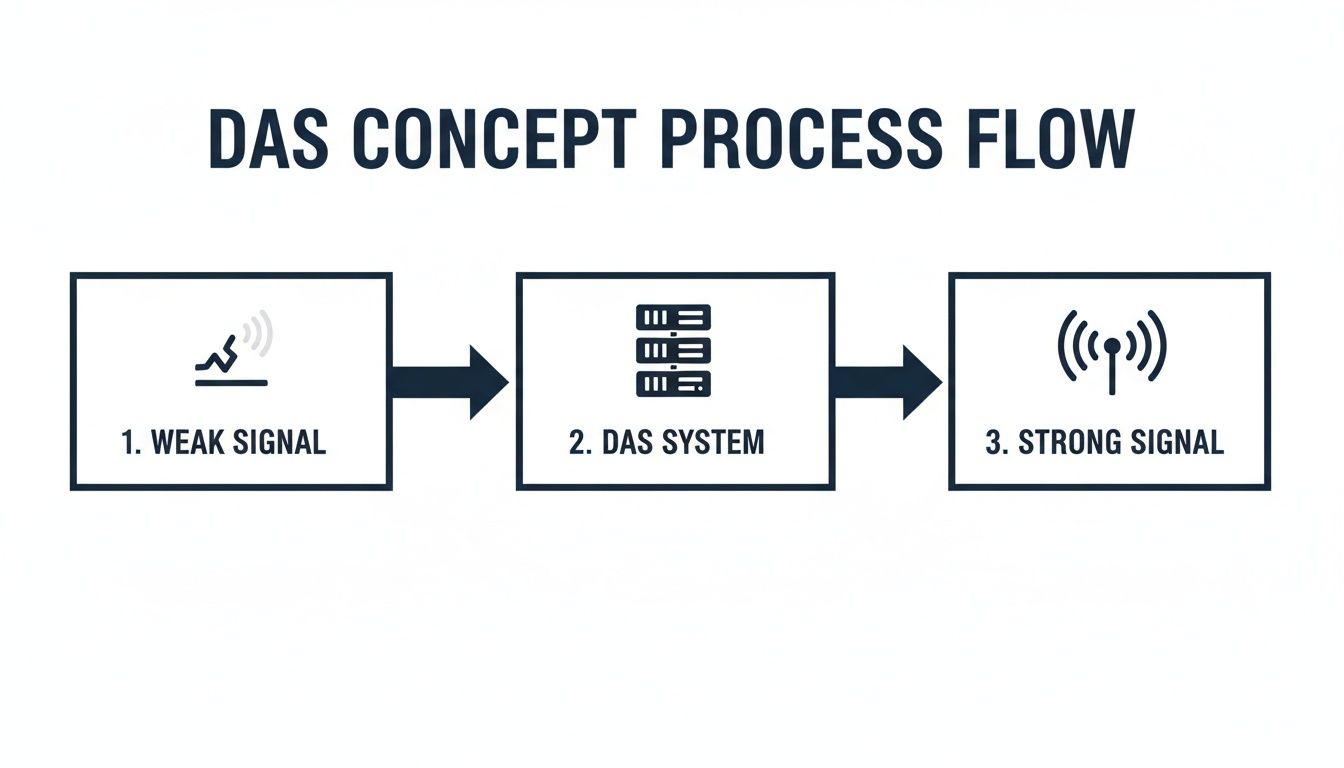
As you can see, a DAS effectively turns a weak, unusable external signal into a strong, consistent indoor one.
The Critical Role of Fibre Cable Installation
To get that amplified signal where it needs to go, a DAS relies on a carefully planned network of high-performance cabling—typically fibre optic cables. This network is meticulously routed from the central amplifier out to different zones on every floor. Choosing the right partner for this job is absolutely essential for long-term reliability.
A certified, tested network delivery is the only way to guarantee performance. Working with an Excel network accredited partner ensures the entire structured cabling system is installed to the highest industry standards. That includes professional cable management that keeps server rooms organised and supports a tidy desk environment for your team.
This level of professional installation comes with some serious assurances. For example, systems installed by accredited partners often come with a 25-year equipment warranty. That kind of long-term protection provides real peace of mind, especially during a big project like an office relocation where equipment testing and certification are vital.
Delivering the Signal to Your Device
The final leg of the journey is getting the signal to your phone or tablet. The fibre optic cables connect to a series of small, discreet antennas installed in ceilings or on walls. These are the "speakers" from our concert hall analogy earlier.
These internal antennas handle the final broadcast, pushing the clean, powerful mobile signal into all those notoriously tricky areas. They’re strategically placed based on a professional site survey to wipe out dead zones in places like:
Underground car parks and basements
Central office areas far from any windows
Large conference rooms and auditoriums
Lifts and internal stairwells
The result is seamless, building-wide coverage. People can walk from floor to floor, from a meeting room back to their desk, without their calls dropping or data speeds grinding to a halt. For a deeper look at sorting out these issues, our guide offers practical tips on boosting your building's mobile signal. Making sure your network is properly tested and certified from the start stops these problems from ever disrupting your business.
Why DAS Is Critical for Hospitals and Commercial Buildings
In theory, a Distributed Antenna System is an elegant solution for poor mobile signal. In practice, it’s an essential utility for modern commercial buildings and hospitals, where the cost of a dropped call or a failed data connection can be immense. For these environments, which do not include houses, reliable in-building mobile coverage isn't just a perk—it’s a fundamental requirement for operations, safety, and productivity.
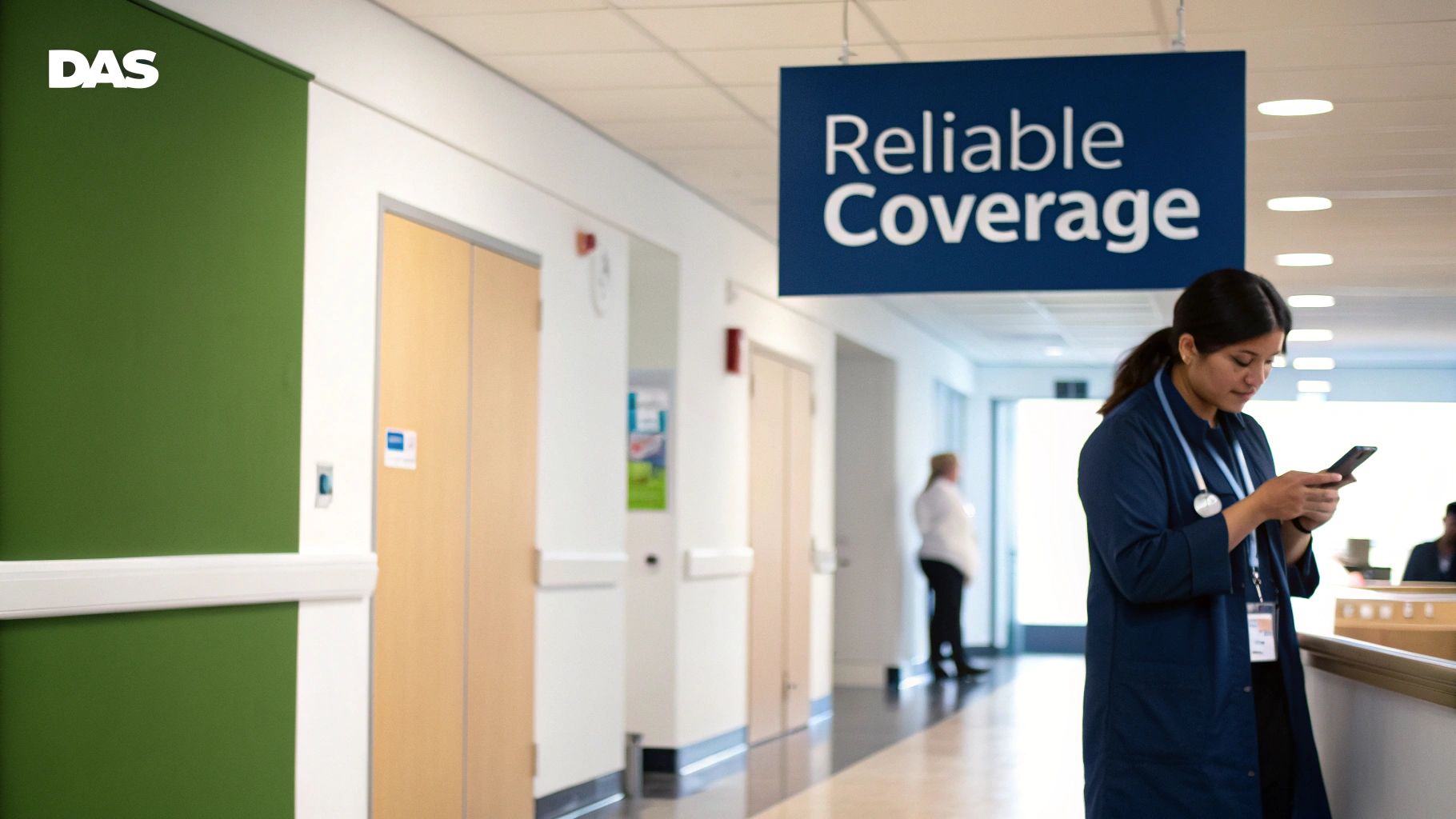
In a typical office, a DAS is a direct investment in business continuity. Dropped client calls, unsent emails, and the inability to access cloud-based apps can bring a fast-paced business to a grinding halt. A well-designed DAS ensures a mobile workforce can function at full capacity without being held back by connectivity blackspots.
The Non-Negotiable Need in Healthcare
In hospitals, the stakes are so much higher. Here, a DAS isn't just about business efficiency; it's a mission-critical system that underpins patient care and safety. Doctors, nurses, and support staff rely on instant, secure communication to coordinate treatments, respond to emergencies, and access patient records on the move.
A professionally installed and certified DAS provides the backbone for these vital services:
Secure Communication Apps: Ensuring encrypted messages between medical staff are delivered instantly without relying on patchy Wi-Fi.
Telehealth Services: Providing a stable connection for remote consultations and diagnostics, which are becoming increasingly common.
Legacy Pager Systems: Many hospitals still use pagers for critical alerts, and these require a strong and consistent signal to function correctly.
Visitor and Patient Connectivity: Allowing patients to stay in touch with loved ones is a crucial part of the healing process.
The complex structure of hospitals—often filled with signal-blocking materials like lead-lined walls in imaging departments—makes them prime candidates for signal dead zones. A DAS simply punches through these physical barriers, making sure connectivity is always there when it matters most. For a deeper look into the unique challenges of healthcare facilities, exploring an ultimate guide to hospital design can provide some valuable context.
Supporting First Responders with Public Safety DAS
Beyond daily operations, there's another critical layer of connectivity that many large buildings must legally provide: Public Safety DAS. This is a specialised system designed to work on the specific radio frequencies used by the police, fire brigade, and ambulance services. During an emergency, first responders must be able to communicate with each other, regardless of where they are inside a building.
Standard mobile networks can become congested or fail during a major incident. A Public Safety DAS provides a dedicated, resilient communication channel, ensuring emergency crews can coordinate their response effectively. In many parts of the UK, having a certified Public Safety DAS is now a regulatory requirement for obtaining an occupancy certificate for new large commercial buildings and hospitals.
A Public Safety DAS isn't an optional extra; it's a legal and moral obligation to ensure the safety of everyone in the building. It’s a crucial investment in emergency preparedness and compliance.
This requirement has become a significant driver in the market, with some reports estimating the global public safety in-building DAS market could reach USD 7.62 billion by 2025. In the UK, regulators and emergency services are increasingly mandating this coverage for large venues. This pressure, combined with NHS modernisation and hospital relocation programmes, has pushed a significant share of DAS spending toward public-safety-compliant installations.
Ultimately, whether for a commercial office move or a new hospital wing, implementing a DAS is about future-proofing the building. It ensures that the vital fibre cable installation supports not just business productivity but also the unwavering communication needs of healthcare professionals and emergency services.
Planning Your DAS Project to Avoid Costly Mistakes
Installing a Distributed Antenna System without a solid plan is like building a house without blueprints. The result is always unpredictable and almost certainly expensive to fix. A successful DAS deployment hinges on meticulous planning to sidestep common but costly data network mistakes that can completely undermine your investment.
This proactive approach is especially vital during an office relocation. Weaving the DAS installation into the main fit-out schedule means your team can walk into a fully connected workspace on day one, avoiding the productivity black hole that post-move connectivity problems create.
Start with a Professional Site Survey
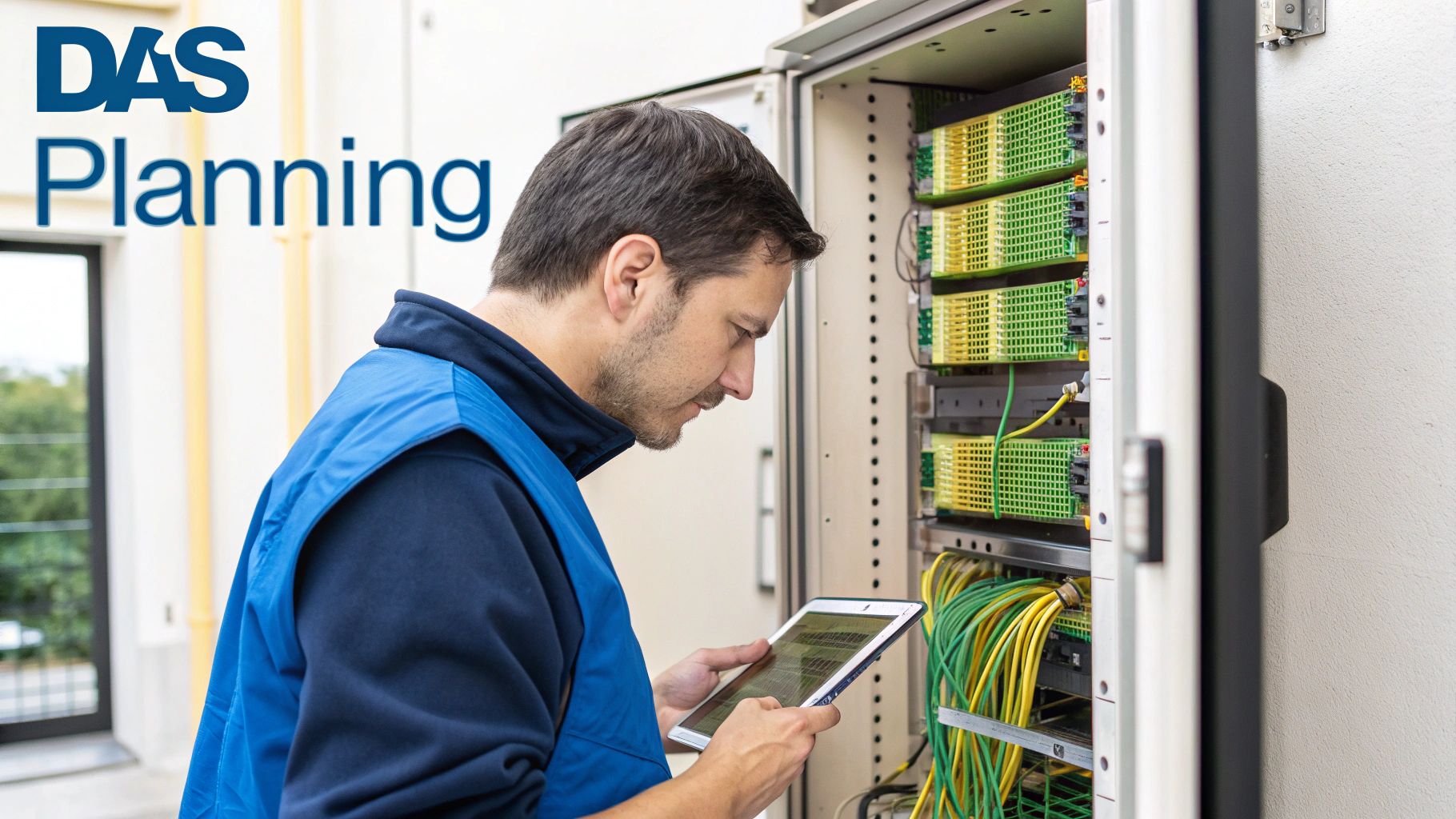
The first, non-negotiable step for any DAS project is a professional site survey. This isn't just a quick walk-through; it's a technical deep-dive. Engineers use specialised equipment to map out the unique radio frequency (RF) environment of your building, identifying exactly where mobile signals are strong, weak, or completely absent.
This data-driven process takes all the guesswork out of the equation and provides the foundation for an effective system design. Skipping this stage is one of the biggest data network mistakes a business can make, often leading to poorly placed antennas and stubborn dead zones, even after the system is live.
A proper survey gives you essential insights into:
Signal Dead Zones: Pinpointing specific problem areas like basements, central offices, or lift shafts that need coverage.
Building Materials: Assessing how materials like low-emissivity glass or reinforced concrete are blocking signal penetration.
External Signal Strength: Measuring the quality of the signal coming from nearby mobile masts, which will feed your system.
Future-Proofing Your Fibre Cable Installation
A DAS is a long-term infrastructure investment, not a quick fix. Because of this, your plan has to account for future needs. Think beyond your current headcount and consider how mobile technology is going to evolve. A system designed only for today’s 4G traffic will buckle under the pressure of 5G and a growing number of connected devices tomorrow.
This is where the fibre cable installation becomes absolutely critical. High-quality fibre optic cabling is the backbone of any modern DAS, providing the sheer bandwidth needed to handle future capacity demands. Working with an Excel network accredited partner ensures this vital infrastructure is installed to the highest possible standards, ready to support new technologies for years to come.
A certified and tested network delivery is your guarantee against performance headaches. An accredited installation doesn't just ensure the system works as designed; it often comes with a 25-year equipment warranty, protecting your investment for the long haul.
Choosing the Right Installation Partner
The physical installation of a DAS is highly specialised work, especially in complex environments like commercial buildings or hospitals. This is not a job for a general electrician or a company that mostly works on houses. The expertise needed for enterprise-level deployments is on a completely different level.
A specialist partner understands the importance of meticulous cable management. A neatly organised installation isn't just for looks; it makes future maintenance and troubleshooting infinitely simpler. Clean cable runs contribute to an organised server room and help maintain a tidy desk environment by keeping all that infrastructure hidden away. For businesses looking to solve these problems, our guide offers more details on fixing bad mobile signal in your UK office.
When you're vetting installers, ask about their experience on projects of a similar scale and complexity, like a multi-floor office move or a new hospital wing. Make sure they provide thorough post-installation equipment testing and official certification documents. This final step is your proof that every component is performing correctly and the system as a whole is delivering the reliable coverage your business depends on.
Sizing Up the ROI of a DAS Investment
It’s easy to look at a Distributed Antenna System and see only the upfront cost, but that’s missing the bigger picture. A professionally installed DAS isn’t just another line item in an expense report; it's a strategic investment in your building's core infrastructure. The return on investment (ROI) is powerful, quantifiable, and something that stakeholders can really get behind. It's not about getting a better signal; it’s about running a better business.
Of course, the initial outlay is shaped by a few key factors. The building's size and complexity, the type of system you need (like active versus hybrid), and how many mobile carriers you want to support will all play a part. But once you start measuring the returns, the value becomes crystal clear.
That value is becoming more obvious every day as the demand for solid indoor coverage skyrockets. Across UK commercial real estate, DAS deployments are expanding fast. In fact, industry analysis predicts the UK DAS market will grow at a compound annual rate of around 16.8% between 2025 and 2030. This boom is largely driven by offices and hospitals, showing a clear shift towards guaranteed indoor mobile performance for staff, visitors, and critical services. You can dig into the data behind this trend in the full market analysis from Grandview Research.
Boosting Productivity and Enhancing Experience
One of the first and most tangible returns you’ll see is a measurable jump in staff productivity. Think about it: dropped calls, emails that won't send, and being unable to access cloud tools are huge productivity killers. A DAS gets rid of these headaches, creating a seamless mobile work environment where your team can operate at full tilt.
But it’s not just about your own team. The impact on your visitors and clients is massive. A client who can't make a crucial call from your conference room, or a patient's family member struggling to send an update from a hospital waiting area, reflects badly on your entire facility. Reliable connectivity screams professionalism and care, giving your organisation's reputation a serious boost.
Increasing Property Value and Ensuring Safety
For building owners and facility managers, a DAS is a direct investment in the property’s value. In a crowded commercial real estate market, guaranteed mobile coverage is a major selling point. Buildings with certified, high-performance connectivity are simply more attractive to prospective tenants, can command higher lease rates, and hold onto tenants for longer.
Investing in a professionally installed DAS is not just an operational expense but a strategic move that enhances your building's infrastructure, operational resilience, and commercial appeal for years to come.
In places like hospitals, the ROI calculation has another critical layer: safety and compliance. Here, a DAS is often a mandatory requirement for public safety radio coverage, making sure first responders can communicate during an emergency. In this case, the ROI isn’t just measured in pounds and pence—it’s measured in lives protected and regulatory boxes ticked. That's a return you can't put a price on.
The Long-Term Value of a Certified Installation
To really maximise the long-term value of a DAS, you need it handled by a certified specialist. An Excel network accredited partner doesn't just pull cables; they deliver a fully tested and certified network. This professional approach, from the initial fibre cable installation to meticulous cable management, sidesteps the common data network mistakes that lead to expensive repairs down the line.
Better still, a certified installation often comes with a 25-year equipment warranty. This long-term guarantee protects your investment and ensures the system will perform reliably for decades. Whether it's part of a major office relocation or a new hospital build, getting your network certified is the smartest way to lock in its long-term ROI.
How to Choose the Right DAS Installation Partner
Let’s be honest, the most advanced Distributed Antenna System in the world is only as good as the team that installs it. Picking the right partner is probably the single most important decision you'll make, and it’s what separates a successful project from a source of endless frustration. The success of a major project like an office relocation or hospital fit-out truly hinges on their expertise.
A top-tier installation partner is more than just a contractor; they are a true infrastructure specialist. Their experience should be rooted in complex commercial buildings and hospitals, not residential houses. These environments throw up unique challenges that demand a deep understanding of radio frequency behaviour, building regulations, and crucially, how to get the job done with minimal disruption.
Look for Certified Expertise and Proven Quality
One of the clearest signs you’re dealing with a professional is official accreditation. For example, being an Excel network accredited partner isn't just a badge; it proves their team is trained to the highest industry standards for structured cabling. This is a critical qualification, as the fibre cable installation is the very backbone of your entire DAS.
This level of certification brings real, tangible benefits:
A 25-Year Equipment Warranty: This is a powerful vote of confidence from the manufacturer, guaranteeing the long-term performance and reliability of every component used.
Certified, Tested Network Delivery: An accredited partner doesn’t just plug things in and hope for the best. They rigorously test every single connection to ensure it meets performance specifications, handing you the official certification documents to prove it.
This process removes all the guesswork and helps you dodge common data network mistakes, ensuring your system works flawlessly from day one.
End-to-End Service from a Single Specialist
The ideal partner offers a complete, end-to-end service. They should be able to manage every phase of the project, from the initial site survey and system design right through to the final equipment testing and handover. A unified approach like this prevents the miscommunication and blame games that can happen when you have different contractors for different jobs, ensuring a seamless, accountable process.
A specialist partner understands that the physical installation is just one piece of the puzzle. They focus on meticulous cable management to ensure server rooms are organised and contribute to a tidy desk environment, keeping the complex infrastructure neatly out of sight.
Ultimately, you’re looking for a partner who gets the bigger picture. They should be able to slot the DAS installation neatly into a larger project schedule, like a building refurbishment or a complete office move. Making sure your network is tested and certified by a qualified, experienced, and accredited partner is simply the best way to protect your investment and guarantee the reliable connectivity your organisation needs to thrive.
Got Questions About DAS? We’ve Got Answers
When you're trying to solve poor mobile signal, a few common questions always pop up. Here are some straight answers to help you figure out if a Distributed Antenna System is the right move for your building.
What’s the Difference Between DAS and Wi-Fi?
Think of them as two completely different road networks for your data. A Distributed Antenna System is all about boosting and spreading the mobile signal (4G/5G) from providers like Vodafone or EE. It’s the reason you can make crystal-clear calls and get a reliable mobile data connection from anywhere in the building.
Wi-Fi, on the other hand, creates your own private, local network for internet access, running off your building’s broadband line. They aren’t competing with each other; they’re partners. Together, they deliver complete connectivity, ensuring every device works perfectly, whether it’s on the mobile network or your internal Wi-Fi.
Do New Buildings Really Need a DAS?
More often than not, yes. Modern building materials like energy-efficient glass, thick concrete, and steel are fantastic for insulation but terrible for mobile signals—they block them dead. This means even a brand-new, high-spec office can be plagued with frustrating signal dead zones, a common and completely avoidable data network mistake.
The smart move is to assess mobile coverage during the initial fit-out. Tackling it then prevents major connectivity headaches after your teams have moved in and you’re trying to run a business. A fully certified network is a productive one, period.
How Long Does a DAS Installation Take?
The timeline really hinges on the size and complexity of the building. But the most efficient way to get it done is to roll the DAS installation into a bigger project, like a major refurbishment or an office relocation.
By running the fibre cable installation at the same time as other electrical and data cabling work, you massively cut down on disruption. It ensures that when the keys are handed over, your building is 100% connected, with all the kit tested, certified, and ready to go. Backing this up with a 25-year equipment warranty on the certified system gives you complete peace of mind for the long haul.
For over 20 years, Constructive-IT has delivered end-to-end network infrastructure solutions for UK businesses. From initial design to certified installation and post-deployment support, we ensure your office relocation or new fit-out is a success. Learn how we can support your next project.
Comments