


Finding Mobile Mast Locations in the UK
- Craig Marston
- Nov 2, 2025
- 12 min read

Knowing where the nearest mobile mast is might sound like a niche technical detail, but for any business, it’s a crucial piece of intelligence. A strong, reliable mobile signal can be the difference between crystal-clear client calls and frustrating dropouts, making it a massive factor in office planning and day-to-day operations.
Getting to grips with the UK's mobile infrastructure is the first step towards building a truly resilient business network.
Why Mobile Mast Locations Matter for Your Business
In today's fast-paced world, a dependable mobile signal isn't a "nice-to-have"—it's foundational. Pinpointing the exact mobile mast locations near your current or potential office is a game-changer for strategic planning. It has a direct impact on everything from staff productivity to your ability to run an effective remote or hybrid work model.
Let's be honest, a weak signal is more than just an annoyance. It frustrates employees, disrupts vital communication with clients, and can genuinely hurt your bottom line.
This is why it pays to be proactive. By identifying the density of masts in an area, the technology they’re using (4G vs. 5G), and how the local geography might interfere with the signal, you can make informed decisions that prevent major connectivity headaches later on.
The Impact on Office Connectivity and Planning
Imagine you’re scouting for a new office. You've narrowed it down to two spots: one in a bustling city centre, the other on a modern but slightly more isolated business park. A quick check of mobile mast locations might reveal the city centre is blanketed with coverage from all major operators, while the business park relies on a single, distant mast.
That one piece of information could save you from signing a lease on a location with a fundamental connectivity flaw baked in.
A business's network is its central nervous system. You wouldn't build an office on unstable ground, so why would you establish it in a location with poor mobile coverage? Mast location data gives you the foresight to build a stable operational base.
The Evolving UK Mobile Network
The UK’s mobile landscape is constantly being upgraded. Initiatives like the Shared Rural Network are actively improving coverage for all major network operators, which is great news for businesses. As of 2025, the government has already upgraded over 130 mobile masts to boost connectivity in rural areas across England, Scotland, and Wales.
For businesses, this means areas that were previously off-limits due to poor signal are now becoming viable options for expansion. Keeping an eye on these developments is just smart business.
Understanding the technology behind the network, like the capabilities and infrastructure needed for 5G, is key to grasping why mast locations are so significant. For a deeper dive, this guide to 5G technology is a great resource. Having a solid grasp of the tech allows you to future-proof your choices, ensuring your business is ready to benefit from the latest advancements in telephony and data connectivity.
How to Use Official Databases for Accurate Mast Data
When you need the most reliable, authoritative data on mobile mast locations, official sources are the best place to start. Government bodies and regulators, chiefly Ofcom in the UK, maintain databases that give you a factual grounding you just can't get from crowd-sourced apps.
These official portals are invaluable for any kind of strategic planning. They let you move beyond guesswork and base decisions on documented infrastructure—a critical step before you even think about a site assessment or network investment.
Navigating Ofcom's Mast Data
Ofcom’s main public tool is its mobile phone base station map. You can search by postcode or location to see all the registered mast sites in an area. It used to be a standalone tool called "Sitefinder," but the data is now integrated into their main consumer advice pages.
When you dive into the map, you can click on each mast to see key details, like which operator is registered to use it—be it EE, Vodafone, Three, or O2. This is incredibly useful if you're trying to figure out which network offers the best potential coverage for a specific building or site. For a deeper look into the legal boundaries and ownership of these sites, checking UK maps of land ownership can be indispensable.
A key thing to remember is data latency. These official databases aren't updated in real time. A brand new mast might not show up for several months, while a decommissioned one could still be listed. Always treat this data as your starting point, not the final word.
This infographic shows just how closely mast density, signal quality, and business operations are linked.As you can see, having more well-placed masts leads directly to better signal quality, which is the foundation for reliable day-to-day business functions.
A Practical Scenario: Business Park Connectivity
Let’s put this into practice. Imagine you’re looking at a potential new office on a business park just outside town. As you walk around, you notice the signal on your phone is patchy.
Your first move should be to check Ofcom's database for that specific postcode. The map might show three masts within a two-mile radius. By clicking on each one, you could discover:
Mast 1: Operated exclusively by EE, located 1.5 miles north.
Mast 2: A shared mast used by Vodafone and O2, located 1 mile south-east.
Mast 3: Run by Three, situated 2 miles west, but its antennas are pointing away from the business park.
This data gives you immediate, actionable intelligence. It tells you that EE, Vodafone, and O2 are likely your strongest bets for coverage, whereas Three might be weaker, even though its mast isn't that far away. This helps you narrow down which mobile contracts to even consider and what kind of backup connectivity you might need.
From there, a professional assessment can validate these findings with on-site signal testing. An Excel network accredited partner, for instance, can deliver a certified network solution backed by a 25 year equipment warranty. This ensures any new fibre cable installation or mobile solution is not only tested but guaranteed for the long haul.
Using Maps and Apps for Real-World Signal Insights
Official databases give you a solid starting point, but they don't tell the whole story. When you need to understand how mobile signal actually behaves on the ground, you have to switch from databases to dynamic mapping apps.
These tools are brilliant because they're community-driven. They pull data from thousands of users' phones to create a live, constantly updating picture of signal strength and mast locations. This is how you find the real-world dead zones, see which way a mast's antennas are pointing, and even spot newly activated 5G sites that haven't hit the official records yet.
Powerful Tools for On-Site Analysis
For this kind of practical survey work, two apps stand head and shoulders above the rest: CellMapper and OpenSignal. Unlike the static government databases, these show you not just where a mast is, but how its signal performs in the real world.
CellMapper is the more technical of the two, and a firm favourite among network engineers. It gives you the nitty-gritty details—mast types, frequency bands, and precise signal strength. Critically, you can filter by network operator to see exactly who owns what.
OpenSignal is much more user-friendly, presenting its data as intuitive signal heatmaps. It's perfect for quickly seeing which provider—be it EE, O2, Vodafone, or Three—gives you the strongest and most reliable coverage at a specific postcode.
Here’s a typical view from CellMapper, which really highlights the density of masts in a built-up area and which networks operate them.

You can see at a glance which providers have invested most heavily in their infrastructure in a location, which makes for a much more informed decision.
Conducting a Practical Site Survey
When you’re physically at a potential new office, these apps turn your smartphone into a professional-grade survey tool. The process is simple: just walk the perimeter of the building and key areas inside while running the app.
The app will usually have an arrow pointing towards the mast your phone is connected to, which is invaluable. This helps you immediately identify physical blockers, like a neighbouring high-rise or even a dense patch of trees, that might be killing an otherwise strong signal.
By testing with SIM cards from two or three different networks during your walk-around, you can build a truly comprehensive connectivity profile for the site. It’s a simple check that might reveal that while Vodafone has a mast just down the road, its signal is blocked by another building, and it’s actually EE that provides a rock-solid connection indoors.
This on-the-ground data is the foundation of a reliable network strategy. As an Excel network accredited partner, we use these insights to design and deliver certified solutions. Whether that involves a new fibre cable installation or technology to boost mobile signal, our work is backed by a 25 year equipment warranty, ensuring robust, long-term performance.
A Quick Comparison of Mobile Mast Finder Tools
Use this table to choose the best tool for finding mobile mast locations and analyzing signal quality based on your specific needs.
Tool Name | Data Source | Key Feature | Best For |
|---|---|---|---|
CellMapper | Community-driven | Detailed technical mast data and operator filtering | Technical users needing in-depth mast specifications and network analysis. |
OpenSignal | Community-driven | Visual signal strength heatmaps and speed tests | Quick, visual comparisons of network coverage and performance in an area. |
Each tool has its strengths, but combining their insights gives you a powerful, real-world understanding of the mobile connectivity landscape for any UK location.
Turning Mast Data into a Smart Network Strategy
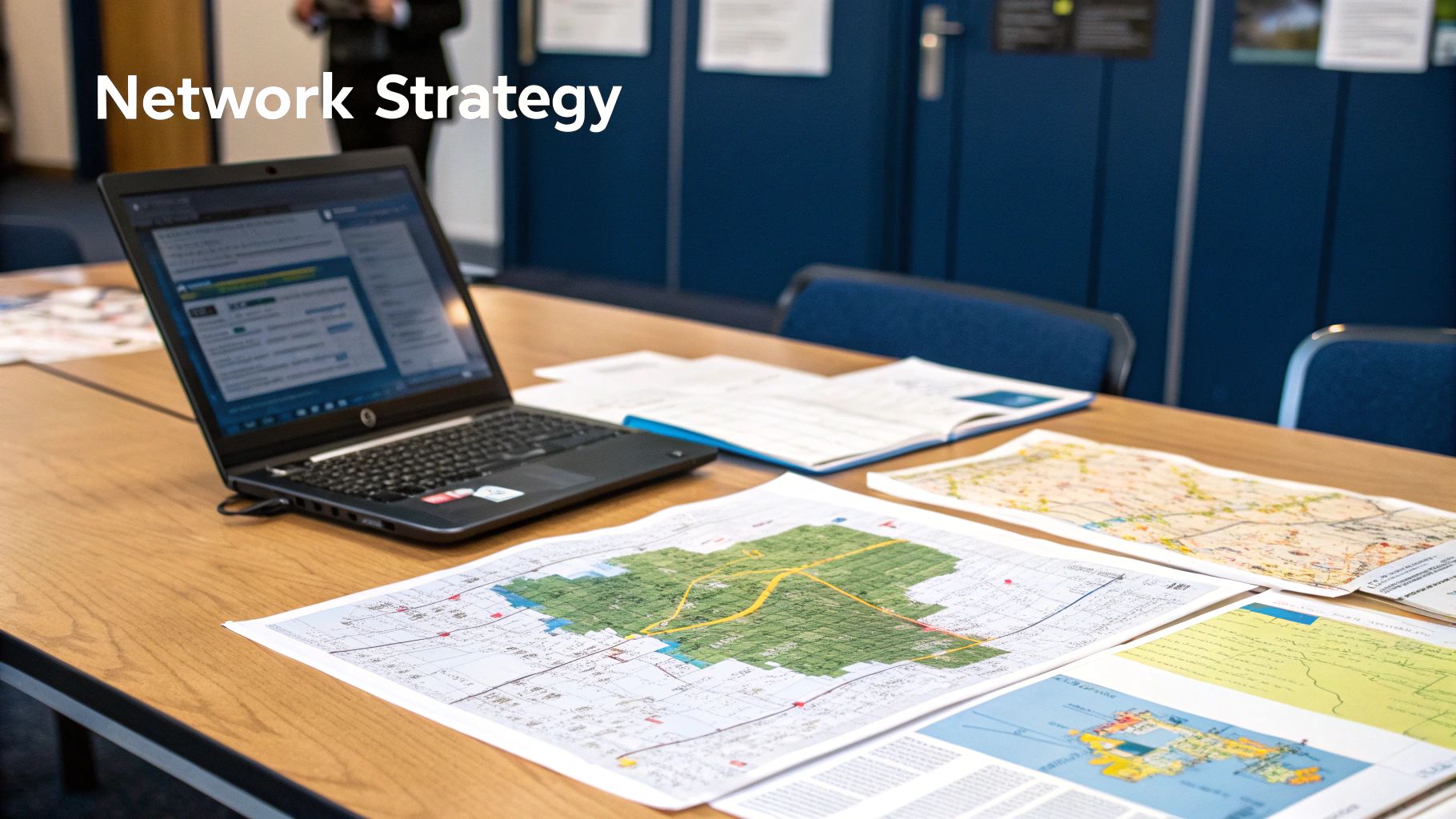
Finding the mobile masts near your office is a great start, but the real win is using that information to build a solid network strategy. It’s all about looking at mast proximity, which operators are present, and what the signal is actually like on the ground. This is how you can accurately predict your in-building coverage and overall reliability.
Let’s be clear: just because a mast is nearby doesn’t mean you’ll get a perfect connection inside. You have to connect the dots between the raw data and what it means for your specific building. This analysis is what ensures your connectivity is dependable from day one.
Building a Connectivity Profile
Your first job is to overlay all the data you’ve gathered. Take the official mast locations from Ofcom and combine them with your on-the-ground signal readings from an app like CellMapper. This paints a complete picture, showing you which operators have the strongest physical presence and the best real-world performance at your chosen site.
It's well-known that mobile signal quality varies massively across the UK. Urban centres are often packed with masts supporting strong 4G and 5G, while rural spots can be left with weak signals from just a handful of locations. This regional difference, often highlighted in network tests by outfits like Which? and Opensignal, is exactly why you can't skip on-site verification. You can read more about these mobile signal findings on ISPreview.co.uk to get a feel for the national picture.
A classic mistake is assuming the network with the most masts is automatically the best. In reality, one well-placed, modern mast can easily outperform three older ones that are congested or pointing the wrong way. Always, always prioritise measured signal quality over a simple mast count.
Case Study: A Relocation Success Story
Think about a logistics firm planning to move its HQ to a big warehouse on the outskirts of Bristol. Their initial checks revealed patchy indoor signal—a huge headache for their handheld scanners and staff comms.
Instead of just hoping for the best, their IT team used mast location data. They identified two masts nearby: one serving Vodafone, and another shared by EE and Three. An on-site signal test quickly confirmed that EE gave them the strongest and most consistent indoor penetration, even though it wasn't the absolute closest mast. Armed with that knowledge, they confidently chose EE for all their company mobile contracts. If you find your own devices are struggling, it might be worth looking into a signal booster for your iPhone.
This proactive approach saved them from what could have been a costly operational nightmare. They turned simple data about mobile mast locations into a smart business decision, securing reliable connectivity before the first box was even moved.
This is where professional expertise really shines. As an Excel network accredited partner, we translate these insights into real-world solutions. We provide certified and tested network delivery—from initial fibre cable installation to mobile backups—all optimised for your unique environment and backed by a 25 year equipment warranty.
Future-Proofing Your Business Connectivity
The mobile network is in a constant state of flux. With the 5G rollout gathering pace and infrastructure being upgraded all the time, what gives you a strong signal today might not be the same story tomorrow. Staying ahead of the curve means anticipating these changes and building a network that can handle them.
One significant risk that often flies under the radar involves the very ground the masts stand on. A recent survey revealed a surprising level of dissatisfaction among landowners who host mobile mast sites. In fact, around 35% are thinking about not renewing their agreements. You can get the full picture on this challenge from this report on InsideTowers.com.
This is a stark reminder that a solid connectivity strategy needs to be resilient.
Your primary mobile connection is only as strong as its weakest link. A single point of failure—whether it’s a decommissioned mast or a new building blocking the signal—can bring operations to a halt. A forward-thinking strategy always includes a backup plan.
Creating a Resilient Network Infrastructure
Building resilience isn’t just about having a plan B for when things go wrong; it’s about engineering your network so that potential issues barely cause a ripple. The gold standard here is a blended solution that doesn’t put all its eggs in one basket.
This usually means pairing a primary, high-speed connection with a reliable secondary one that can take over in an instant. For instance:
Primary Connection: A dedicated fibre cable installation gives you the raw speed and stability needed for day-to-day heavy lifting.
Failover Connection: A dependable 4G or 5G mobile data connection acts as an automatic backup, ready to kick in the moment your primary line goes down.
This dual-pronged approach is the key to business continuity. As an Excel network accredited partner, this is exactly what we specialise in—designing and delivering certified, tested network delivery. We make sure every component is built for the long haul, right from the initial fibre installation to the final configuration.
Everything we deliver also comes with a 25 year equipment warranty, giving you complete peace of mind that your connectivity is sorted for years to come.
Of course, a great network needs to be maintained. For more on that, our guide on improving UK office networks with performance monitoring has some valuable insights into keeping your infrastructure in peak condition. By planning ahead, you can ensure the network you build today remains effective, reliable, and ready for whatever the future throws at it.
Got your head around the tools? Excellent. But even with the best maps and apps, a few questions always pop up when you start digging into mobile mast locations. Let's tackle some of the most common ones I hear.
How Accurate Are Online Mast Maps, Really?
This is a great question, and the honest answer is: it varies.
Official sources like the Ofcom database are highly accurate for registered sites. But there's a catch – they have a time lag. A brand-new mast might not show up for months, and occasionally, a decommissioned one will hang around on the map longer than it should.
On the flip side, community-powered apps like CellMapper are often much faster at spotting new masts, especially in towns and cities where lots of users are constantly feeding it data. Their weakness? They can be patchy in very rural spots with fewer people contributing.
My advice is to always use both. Cross-referencing an official database with a community map gives you the most reliable picture of what’s actually out there.
Does Being Closer to a Mast Guarantee a Better Signal?
You'd think so, but surprisingly, no. Proximity is a huge piece of the puzzle, but it’s not the whole story.
The biggest signal-killers are physical obstructions. We’re talking about things like large buildings, a dense patch of woodland, or even a small hill sitting between you and the mast. These can weaken or completely block a signal, even if you're just a few hundred metres away.
What's more, the direction the mast's antennas are pointing is critical. You could be standing right underneath a mast but be in a "coverage shadow," resulting in a frustratingly poor connection. This is exactly why on-site signal testing is non-negotiable before signing an office lease – it tells you what the signal is really like inside the four walls you care about.
How Do I Know Which Network Operator Uses a Mast?
This is where the official databases really shine. Ofcom’s data clearly lists which operator (or operators) are registered to use a particular site.
You’ll often find that masts are shared to save costs – for example, a single structure might host equipment for both EE and Three. Others are exclusive to a single provider like Vodafone or O2.
For any business, this information is gold. Knowing which networks have a strong physical presence in your area is fundamental to choosing the right mobile contracts and, just as importantly, planning a resilient backup internet connection.
Why Can’t I See Any 5G Masts on the Map in My Area?
It’s easy to assume the maps are wrong, but there are a couple of likely reasons for this. The UK's 5G rollout is still very much a work in progress, so coverage is far from universal, especially once you get outside of major cities.
It’s also entirely possible that the official databases are simply lagging behind recent installations.
If your 5G-capable phone is happily picking up a signal but the mast is nowhere to be found on the map, it's probably a newly activated site that hasn’t been officially logged yet. This is another scenario where community apps often have the edge, showing these newer mobile mast locations long before the official records are updated.
At Constructive-IT, we transform this data into practical, high-performance network infrastructure. As an Excel network accredited partner, we provide certified, tested network delivery, including expert fibre cable installation backed by a 25 year equipment warranty. Plan your next office network with confidence by visiting us at https://www.constructive-it.co.uk.
This was a very well-explained and insightful article that made a strong impression. I really appreciated how the author presented the Saunders Research Onion in such a clear and structured manner. It shows how complex academic concepts can be simplified with the right approach. As a student, I often look for content like this to strengthen my understanding of research methods. Learning about the Saunders Research Onion through posts like this helps improve both academic performance and confidence in writing research assignments.