


Your Essential Guide to Raceway for Cable Systems
- Craig Marston
- Dec 24, 2025
- 16 min read

Think of a raceway for cable as the purpose-built motorway for your building's data and power. It's a protective, enclosed pathway designed to route and organise all the critical copper and fibre optic wiring that keeps a modern office running smoothly. It protects these vital connections from physical harm while keeping the entire installation neat, tidy, and professional.
Why Professional Raceway Systems Are Essential
In any busy commercial space, from a bustling office to a critical hospital ward, a tangled web of cables is more than just an eyesore. It’s a serious operational risk. Unmanaged wiring is a recipe for network downtime, a clear safety hazard, and can turn a simple five-minute fix into a costly, day-long nightmare.
A professionally installed raceway for cable is so much more than a box to hide wires. It’s the foundational structure that supports a reliable, secure, and scalable network. This is especially true for delicate fibre cable installation, where a simple kink or accidental damage can bring your connection speeds crashing down.
The Value of Certified Installation
Bringing in a certified installer, such as an Excel network accredited partner, is about getting an assurance of quality that goes far beyond a tidy-looking job. A professional installation concludes with rigorous testing and certification of every single network link, guaranteeing it performs exactly as it should and heading off connectivity problems before they can start.
For any business, a certified network delivery is a promise of reliability. It’s documented proof that your infrastructure can handle its intended data speeds and is free from the kind of data network mistakes that could cripple your operations.
This certification is also your key to unlocking a 25 year equipment warranty, offering fantastic long-term protection for your investment. What’s more, professional installers have the experience to design a system that not only meets your current needs but has the capacity to accommodate future growth.
Ensuring Continuity and Compliance
A structured raceway system becomes an invaluable asset during major events like an office relocation. It makes decommissioning and recommissioning your IT equipment infinitely simpler. Certified technicians can test and verify the entire network before your team even walks through the door, ensuring a seamless transition with zero disruption.
Ultimately, professional raceway systems are a cornerstone of effective cable management, offering structured pathways that protect and organise cables within any building. They form an essential part of comprehensive cable management solutions.
Investing in a professional raceway installation is a direct investment in your organisation’s long-term efficiency and safety. To dig deeper, you can learn more about the significant benefits of hiding away cables in our detailed guide. It’s how you prevent common network failures, support future growth, and ensure your infrastructure is robust, compliant, and ready for whatever comes next.
Choosing the Right Type of Cable Raceway
Picking the right raceway for cable management is a bit like choosing the right road for your traffic. You wouldn't send motorway traffic down a quiet country lane, and the same logic applies to your network's physical backbone. Your choice of raceway has a direct impact on how efficiently it can be installed, how the finished space looks, and how reliable your network will be for years to come.
Getting it right means matching the raceway system to the specific environment and demands of your building. A hospital has completely different needs to a data centre or a standard commercial building, and the containment solution must reflect that. The end goal is always the same: to create a tidy, accessible, and protected route for all your critical data and power cabling.
The diagram below breaks down the core benefits a well-chosen raceway system delivers, which all centre on reliability, safety, and scalability.
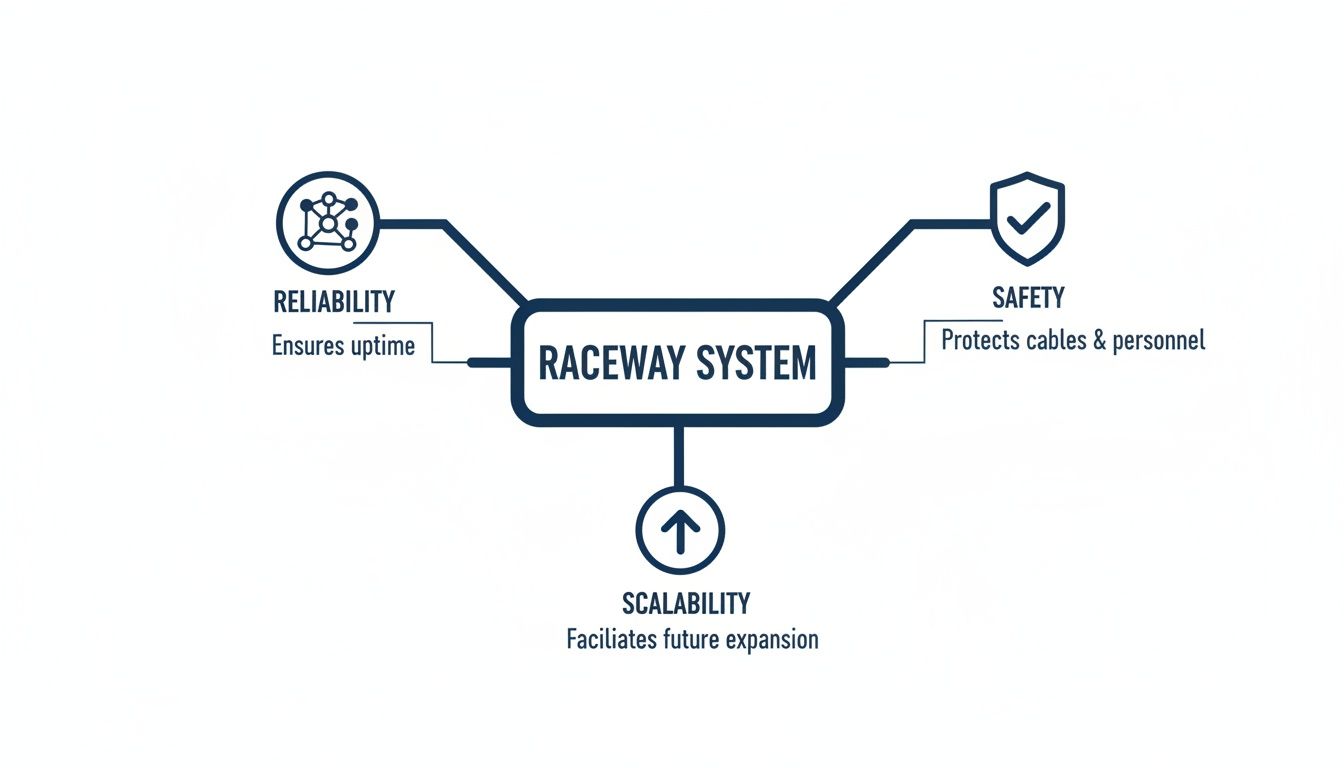
As you can see, these three pillars are completely interconnected. A good system keeps your network safe from physical harm, makes it robust enough to support your daily operations, and ensures it’s flexible enough to handle whatever you throw at it tomorrow.
To make sense of the options, it's best to compare the most common systems side-by-side. Each has a specific job it excels at, and understanding their strengths is key to making the right call.
Comparing Common Cable Raceway Systems
Raceway Type | Primary Application | Common Materials | Key Benefit |
|---|---|---|---|
Surface-Mounted Trunking | Office fit-outs, retrofits, visible wall/ceiling runs | PVC, Steel | Easy access for changes and additions with minimal disruption. |
Under-Floor Systems | New builds, major refurbishments, data centres | Steel, Aluminium | The ultimate clean aesthetic and maximum layout flexibility. |
Cable Trays & Baskets | Data centres, server rooms, industrial areas | Galvanised Steel, Stainless Steel | High capacity and excellent airflow for dense cable bundles. |
This table gives you a quick snapshot, but let's dive into what these differences mean in the real world.
Surface-Mounted Trunking: The Visible Motorway
Think of surface-mounted trunking as the visible motorway running along your office walls and ceilings. It's an incredibly versatile and common type of raceway for cable, particularly in office retrofits where channeling into walls just isn't an option.
These systems are basically rectangular channels, usually made of PVC, that are fixed straight onto surfaces. Their biggest advantage is easy access. Need to add a new network point for a new desk? An engineer can simply pop the trunking lid off, lay the new cable, and snap the cover back on with almost no disruption.
When planned well, it offers a clean finish that hides the cable chaos while keeping everything accessible, solving that "spaghetti junction" problem that plagues so many workspaces. The trick is to plan the routes to be discreet, often running them along skirting boards, ceilings, or at dado height.
Under-Floor Systems: The Hidden Subway Network
For new commercial builds or major refurbishments, under-floor raceway systems are the equivalent of a city's subway network. They are installed within the void of a raised access floor, hiding every last data and power cable completely out of sight.
This approach delivers the ultimate clean aesthetic. All the cabling runs beneath the floor panels and is brought up to desks or equipment through dedicated floor boxes. It’s a highly structured and scalable solution you’ll see in modern commercial buildings and critical environments like hospitals, where trip hazards are a complete non-starter.
An under-floor system is the gold standard for achieving a truly tidy desk policy and maximum layout flexibility. It allows entire office floorplans to be reconfigured without having to re-run a single cable from the ceiling.
It demands a lot of planning during the construction phase, but it pays you back tenfold in long-term flexibility and appearance.
Cable Trays and Baskets: The Industrial Bridges
In places with seriously high cable densities—think server rooms, data centres, or plant rooms—cable trays and baskets act as the heavy-duty bridges of the network. These are open, ladder-like or wire-mesh structures suspended from ceilings or fixed to walls.
Their open design is deliberate. It provides maximum airflow to stop heat from building up in large cable bundles, which is critical for maintaining network performance. They can support a huge amount of weight and offer unparalleled access for adding, moving, or changing large quantities of cabling, from heavy-duty power lines to thick bundles of fibre optics.
While you wouldn't typically use them in general office areas because of their industrial look, they are the absolute backbone of any serious data infrastructure. An accredited partner will use these systems to ensure a network is not just tested and certified for performance, but is also physically supported for decades of reliable service.
Planning Your Raceway Routes for Future Growth
Proper cable management starts long before you cut the first piece of trunking. In fact, one of the most common mistakes we see is a poorly planned raceway system, which quickly leads to cramped, chaotic pathways that make future upgrades a complete nightmare. It’s all about looking beyond today’s needs and designing a network backbone that’s ready for whatever technology throws at it tomorrow.
The aim is to create an infrastructure that’s discreet, accessible, and scalable. This means carefully mapping out routes that work with the building’s aesthetics while still giving technicians easy access for maintenance or adding new lines. This kind of foresight is vital in dynamic places like commercial buildings and hospitals, where things are constantly changing. A tidy desk is one thing, but a future-proofed network is invaluable.

Calculating Fill Ratio for Scalability
One of the most critical concepts to get right is the fill ratio. This is simply the percentage of a raceway's internal space that’s taken up by cables. It might feel tempting to squeeze as much in as possible, but overfilling a raceway is a recipe for disaster.
A packed raceway can cause cables to overheat, which degrades network performance. It also makes pulling new cables nearly impossible without risking damage to existing ones, turning a simple upgrade into a costly and disruptive project.
As a rule of thumb, a professional installer will aim for a fill ratio of no more than 40-50% when the system is first installed. This leaves plenty of room for future growth, allowing you to add new data points, upgrade to better cabling, or integrate new systems with minimal fuss. For a deeper dive into structured cabling specifics, our UK office network wiring installation guide is a great resource.
The growing hunger for high-speed connectivity is driving a boom in cable manufacturing, which has a direct knock-on effect on raceway planning. In the UK alone, the fibre-optic cable manufacturing market is projected to be worth a massive £4.0 billion by 2025. This surge, fuelled by 5G and broadband expansion, means more high-value fibre cables needing robust protection—making spacious raceway planning more important than ever. You can explore more data on UK fibre-optic cable manufacturing on IBISWorld.
Segregating Power and Data Cables
Another absolute golden rule in raceway planning is keeping power and data cables separate. Running electrical wiring alongside sensitive network cables like Cat6 or fibre in the same compartment is a fundamental mistake.
Power cables give off electromagnetic interference (EMI)—think of it as electrical "noise" that can scramble data signals. This interference causes all sorts of frustrating problems:
Slower network speeds: EMI can corrupt data packets, forcing them to be resent and bogging down the whole network.
Intermittent connectivity: Users might get random dropouts or connection failures that are a nightmare to diagnose.
Complete data loss: In the worst cases, the interference can be so strong it makes a network link completely unusable.
To stop this from happening, a professional installer will always use separate raceway systems for power and data. If a single trunking system has to be used, it will be a multi-compartment model with a fixed metal divider that acts as a shield between the two types of cable.
This meticulous approach is the hallmark of a certified, tested network delivery. A partner who understands the physical layout is just as critical as the electronic components. By ensuring proper segregation and planning for future capacity, they lay the groundwork for a reliable network backed by a 25 year equipment warranty, safeguarding your infrastructure for the long haul.
Getting to Grips with UK Fire Safety and Building Regulations
When you're installing cable raceways in a commercial building, getting fire safety right isn't just good practice—it's the law. In the UK, a strict set of regulations dictates exactly how cables must be installed to protect people, especially during a fire. Getting this wrong isn't an option; it can lead to massive legal headaches and, more importantly, put lives at risk.
The bible for this is the IET Wiring Regulations (BS 7671). This document sets the standard for every single electrical installation in the country. A huge focus is preventing the 'premature collapse' of wiring systems when a fire breaks out. This is absolutely critical to keep escape routes clear for people getting out and for the emergency services getting in.
It’s not just about making cables look tidy. It's about ensuring they don't become a deadly hazard when it matters most.
Why Premature Collapse is a Killer
A major update to BS 7671 completely changed how we support cables. In the past, it was common to see plastic clips and non-metallic trunking holding up wiring. The problem? In a fire, plastic melts and fails fast, causing heavy cables to drop down and block fire escape routes.
To stop this, the regulations now insist that wiring systems must be held up by materials that won't give way in a fire. In plain English, this means using metal fixings and supports for all your cable runs, even if the cables themselves are housed inside plastic trunking.
This isn't just for main corridors, either. The rule applies everywhere in an installation. The idea is to keep the entire cable network firmly in place, preventing it from turning into a dangerous trip and entanglement hazard during an evacuation. For any business owner, this is a fundamental part of their duty of care.
Fire Stopping and Compartmentation: Sealing the Gaps
Another pillar of fire safety is compartmentation. Modern commercial buildings and hospitals are cleverly designed with fire-rated walls and floors that split the building into sealed compartments. These barriers are built to hold back a fire for a set amount of time—usually 30, 60, or 90 minutes—giving everyone enough time to escape.
But the moment you drill a hole through one of these fire-rated walls to run a cable raceway, you've created a weak spot. Fire and smoke will exploit that gap in seconds. To maintain the building's integrity, the regulations demand that you use proper fire-stopping measures.
This usually means fitting intumescent fire stops or special collars around the raceway where it passes through the barrier. When these materials get hot, they swell up to completely seal the opening, stopping flames and toxic smoke from spreading into the next compartment.
Failing to fire-stop these penetrations properly makes a building's entire passive fire protection strategy useless. It’s a common but incredibly dangerous shortcut that a certified installer would never take. A big part of this is understanding what a fire risk assessment entails, as this forms the foundation of a safe and compliant building.
This is where a professional installer, like an Excel network accredited partner, is essential. They live and breathe these regulations. They ensure every detail—from the type of screws used to the fire-stopping methods—is fully compliant. This isn't just about ticking boxes for safety; it's a core part of delivering a tested, certified network that qualifies for a 25 year equipment warranty.
The Value of a Certified Installation Process
Choosing the right cable raceway is a great start, but it’s only half the story. The real secret to a network that performs like a finely tuned machine, rather than a constant source of frustration, lies in the quality of the installation.
A certified installation process isn’t just about making things look tidy. It's a systematic approach that guarantees your physical infrastructure is robust, reliable, and ready for whatever you throw at it in the future. This process is what elevates a simple collection of cables and trunking into a high-performance network backbone.
For commercial buildings or critical environments like hospitals where downtime simply isn't an option, the value of getting it right first-time is immense. It’s the difference between a network that just works and one plagued by hidden gremlins.
What Does a Certified Process Involve?
A professional installer, like an Excel network accredited partner, follows a meticulous, multi-stage process that leaves absolutely nothing to chance. It's a structured approach ensuring every single component works in perfect harmony, from the server room right through to the user's desk.
The key stages usually break down like this:
Initial Site Survey: This is where it all begins. We assess the building's layout, scout for potential obstacles, and take stock of any specific environmental needs to plan the most efficient raceway routes.
Meticulous Installation: We stick rigidly to industry standards for handling cables, respecting bend radii, and making sure power and data lines are properly segregated. No shortcuts.
Comprehensive Testing: This is the proof in the pudding. We use advanced network analysers to test every single data point, whether it's a copper or fibre cable installation.
Formal Certification: You get detailed test reports that prove each link meets or exceeds its specified performance standards (like Cat6a, for example).
The Assurance of a 25-Year Warranty
One of the biggest advantages of using an accredited partner is the ability to secure a 25 year equipment warranty. This long-term guarantee is far more than just a piece of paper; it’s the manufacturer's vote of confidence in both their own products and the installer’s workmanship.
This warranty is only activated once a successful certification is complete. It provides total peace of mind, assuring you that the physical layer of your network is built to last and will be supported for decades.
This kind of long-term assurance is particularly vital in environments where a mix of cabling solutions is needed. For example, industry analysis shows that while residential buildings have historically dominated the raceway market, the fastest-growing sector is industrial manufacturing. These industrial projects demand specialist expertise with heavy-duty containment systems, a world away from the lighter PVC trunking often found in offices. You can dig into more insights on the UK cable management market on ResearchAndMarkets.com.
Seamless Office Relocations and Upgrades
A certified process truly proves its worth during complex projects like an office relocation. An accredited team ensures your critical IT equipment is correctly decommissioned, safely moved, and then re-installed and re-certified in your new premises.
This approach takes all the guesswork out of the equation. It guarantees your team can hit the ground running from day one without battling frustrating connectivity issues.
Ultimately, having your network professionally tested and certified provides a documented baseline of performance. It confirms your infrastructure can handle its intended speed and is free from the physical flaws that cause the vast majority of network problems. To get a better feel for the whole journey, from initial planning to final handover, you might find our essential guide to data cabling installation useful.
Maintaining Your Cable Infrastructure for Long-Term Success
Getting a professional raceway for cable installed is a great start, but it’s definitely not the end of the story for a reliable network. Once the system is tested, certified, and handed over, its long-term performance comes down to proactive maintenance. Think of it like a new motorway; it's built to last for decades, but it still needs routine inspections to prevent jams and avoid costly repairs.
Your network infrastructure isn't a static object; it's a dynamic asset that has to adapt as your business changes. Without a clear maintenance strategy, even the tidiest installation can degrade into a mess over time, impacting performance and making troubleshooting a nightmare.
Best Practices for System Longevity
Good maintenance isn't complicated. It really just boils down to solid documentation, disciplined changes, and periodic health checks. This is especially true in critical environments like hospitals, where network integrity is absolutely non-negotiable.
Here are the key activities to focus on:
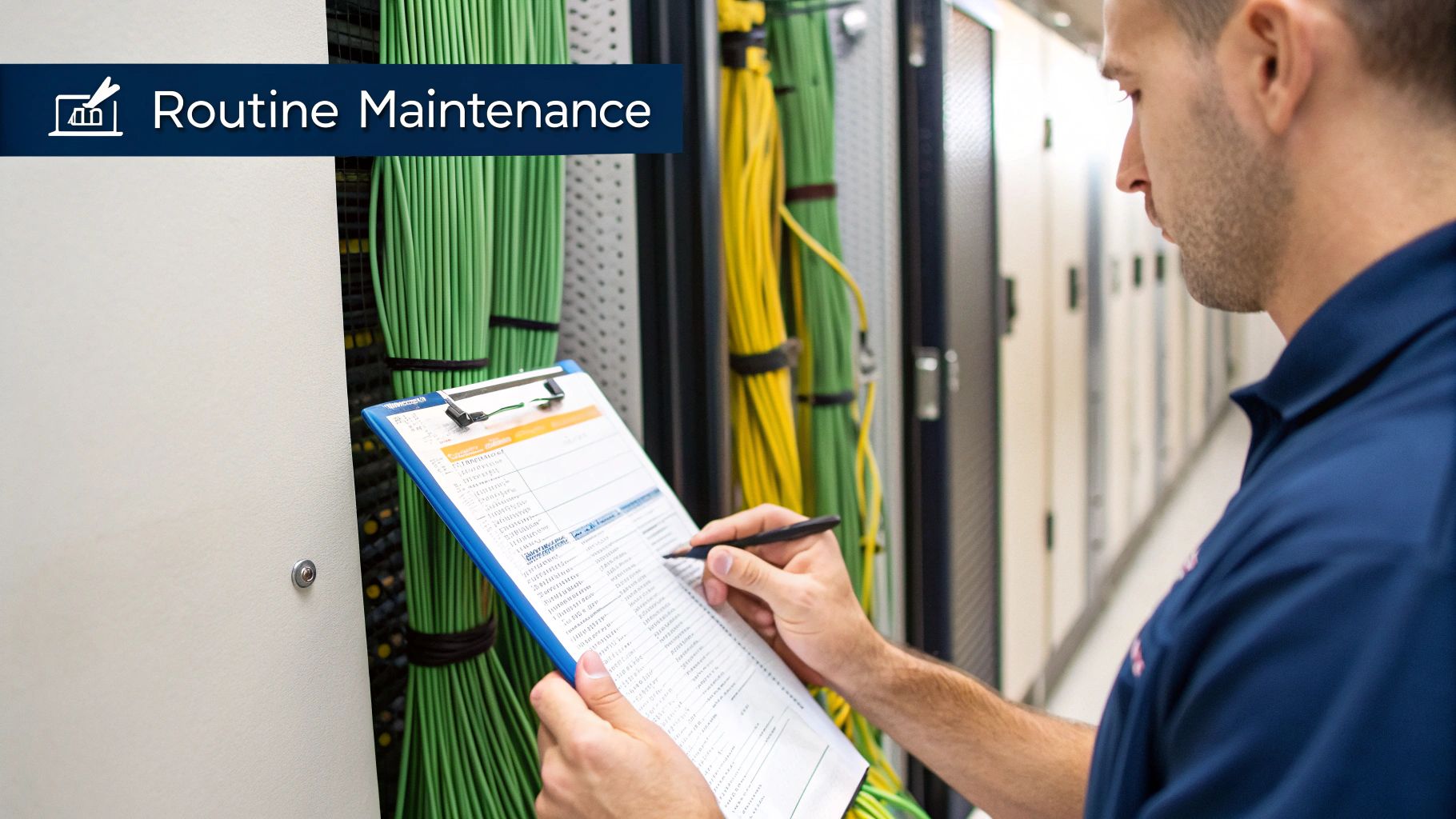
Routine Inspections: Periodically walk the raceway routes and check for any signs of physical damage, loose fittings, or overloaded sections. A quick visual check can stop minor issues from turning into major data network mistakes.
Managing Changes: When you bring on new staff or add equipment, resist the temptation to just run loose patch leads across the floor. To maintain a tidy desk policy and prevent a "spaghetti junction" from forming, every new connection should be professionally installed within the raceway.
Updating Documentation: Every single time a change is made, update your network diagrams and labels. Accurate records are invaluable when you need to troubleshoot an issue quickly and efficiently.
A well-documented network is a manageable network. When an issue arises, technicians can pinpoint the problem source in minutes rather than hours, saving valuable time and minimising disruption.
This disciplined approach is vital. The UK's broader wires and cables market, which underpins the demand for raceways, was valued at around £5.5–£5.7 billion in 2024 and is projected to hit £7.3 billion by 2034. This growth, driven by soaring electricity demand and EV expansion, highlights just how critical robust, long-term cable management has become. You can find out more about the UK's growing wires and cables market on MarketResearch.com.
Re-Testing and the Value of a Warranty
While your initial installation comes with a certified network delivery, the system's performance can shift over time, especially after significant changes. An office relocation or the addition of a new fibre cable installation are perfect examples of when re-certification is crucial.
Professional testing after an office move ensures every single link performs to the required standard in the new environment. It’s an essential step to verify that no damage occurred during the relocation and that all your equipment is functioning correctly.
This is where working with an Excel network accredited partner provides real, lasting value. The 25 year equipment warranty they offer is contingent on the system being installed and maintained to the manufacturer's standards. By sticking to proper maintenance and re-testing protocols, you not only ensure optimal performance but also keep that valuable long-term warranty intact, guaranteeing support for the entire life of the system.
Your Top Cable Raceway Questions Answered
Even with the best-laid plans, a few practical questions always pop up during a commercial raceway project. We get it. Drawing from our experience with IT and facilities managers in commercial buildings and hospitals, we've pulled together answers to the queries that come up time and time again.
These answers all circle back to the core principles we build on: safety, compliance, and making sure your network is ready for whatever comes next.
How Much Extra Capacity Should I Plan for in a Cable Raceway?
This is one of the most common—and most critical—questions. A solid rule of thumb in the industry is to stick to a 40-50% fill ratio. In simple terms, this means the cables themselves should take up no more than half of the space inside the raceway.
It might seem like a waste of space, but it's essential. This breathing room prevents cables from being crushed, which can seriously degrade network performance, and it allows air to circulate, stopping heat from building up. Most importantly, it gives you plenty of room to add more cables later without the headache and cost of installing brand-new raceways. Overfilling a raceway is a classic mistake that makes future network upgrades a nightmare.
Can I Run Power and Data Cables in the Same Raceway Trunking?
While you might see multi-compartment trunking that makes this seem possible, our strong advice is to avoid it unless the raceway has a fixed, solid metal divider designed specifically for segregation.
Think of it this way: power cables generate a constant hum of electromagnetic interference (EMI). When you run sensitive data cables—like Cat6 or delicate fibre optic lines—right next to that hum, the interference can corrupt the data signal. The result? Slow network speeds, lost data packets, and connectivity issues that are incredibly frustrating to track down.
UK regulations and industry standards are clear on this: power and data need to be kept separate to protect network integrity and ensure safety. A professional installer, such as an Excel network accredited partner, will always insist on using separate raceways or properly segregated trunking. It's one of the fundamentals of avoiding common data network mistakes.
What Does a Certified Network Delivery Actually Mean for My Business?
"Certified network delivery" isn't just a fancy phrase; it's your guarantee that the job has been done right, from end to end. It means every single cable and connection point we install is electronically tested with specialised equipment to prove it meets—or exceeds—the performance standards for its category (like Cat6a, for example). You don't just have to take our word for it; you get a detailed report showing that every link can handle the data speeds it's supposed to.
This certification is your insurance policy against the most common data network mistakes and is almost always required to activate the manufacturer's 25 year equipment warranty.
It’s documented proof that your physical infrastructure—from the tidy desk outlet all the way back to the server room—is built to perform and won't be the bottleneck holding your network back. This process is vital for any project, whether it's a standard office fit-out or a complex office relocation where all equipment needs to be tested and re-certified so it's ready to go from day one.
Planning network infrastructure for a commercial building or hospital is no small task. At Constructive-IT, we provide certified network delivery, backed by a 25-year warranty, so you can be confident your system is compliant, scalable, and built for the long haul. Schedule a consultation to discuss how we can help with your project.
Comments