
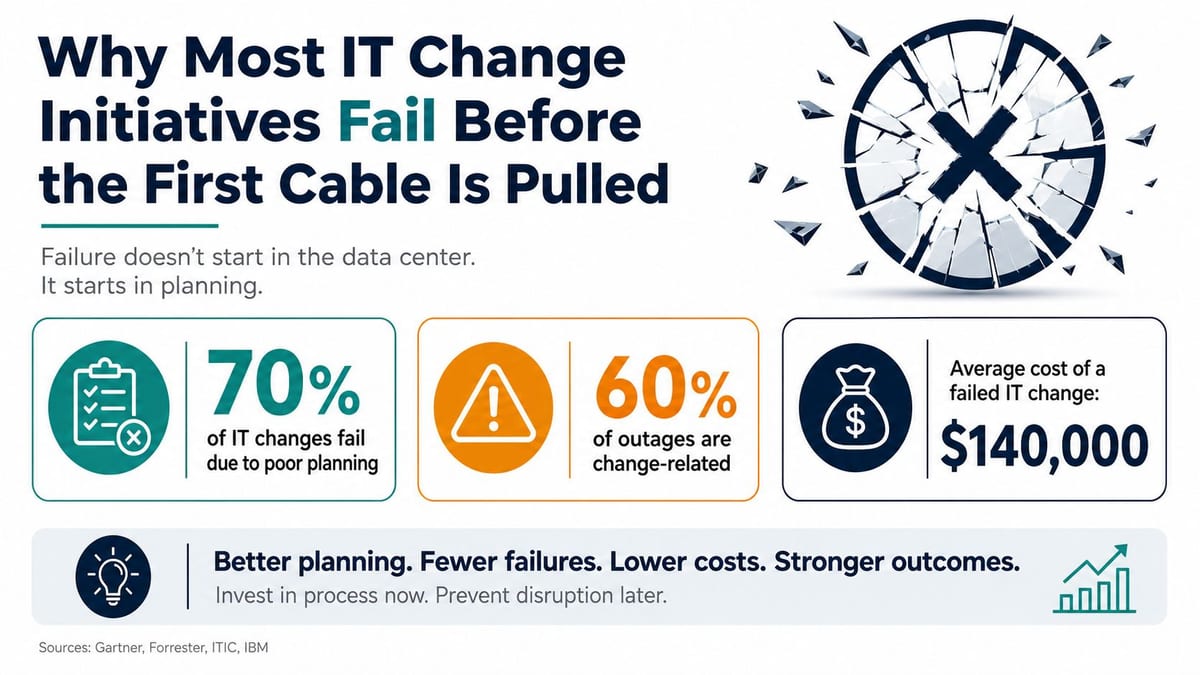
Around 70% of change initiatives fail to deliver their intended outcomes, and only about one-third fully meet their goals, which is why change management for IT is not paperwork, it's the difference between a clean cutover and a messy outage Changing Point. In office relocations, server room moves, Wi-Fi refreshes, and NHS site changes, the failure point is rarely the rack, the switch, or the software patch. It's usually the handoff between people, process, cabling, power, access control, and the teams who think someone else owns the risk.
That's why a serious IT change plan has to deal with the building as much as the network. If you're trying to secure your Perth operations, the same logic applies, because physical infrastructure and security controls only work when they're changed in a controlled sequence, not bolted on at the end secure your Perth operations.
Why Most IT Change Initiatives Fail Before the First Cable Is Pulled
The first failure usually happens on paper, not in the rack room. Most change fails before the first cable is pulled because the organisation has not agreed what success looks like, who owns each dependency, or how the cutover will be reversed if the live environment starts misbehaving. A formal change-management study from IBM found that people who always followed structured procedures reported a 52% project success rate, compared with 36% for those who improvised, and the bottom 20% of performers had only an 8% success rate IBM study. That gap is governance, not luck.
Failure starts with coordination, not code
In a multi-floor office move, the network team can finish the patching and still lose the day if facilities has not cleared floor access, the electrical contractor has not certified the new supplies, or the business has not agreed which services can tolerate interruption. A practical review of implementation work found that project outcomes often turn on coordination failures as much as technical ones, with many initiatives ending in failure and only a smaller share reaching clear success academic review. Those are execution failures, and in physical IT change they usually start before the first item is touched.
Practical rule: if a change touches desks, doors, power, Wi-Fi, telephony, or server-room cooling, treat it as a facilities-led IT change, not an IT ticket with a delivery date.
That is why formal change management exists. It closes the gap between delivery and adoption, which matters most in infrastructure-heavy environments where downtime windows are measured in hours and the order of works is as important as the works themselves. For teams trying to secure your Perth operations, the same discipline applies, because access control, building security, and operational continuity fail when they are changed in the wrong sequence.
The strongest pattern is simple. Define the business case, classify the risk, map dependencies early, and do not assume the technology will rescue a poorly run deployment. The technology is usually fine. The cutover is what breaks.
Building a Governance Structure That Works
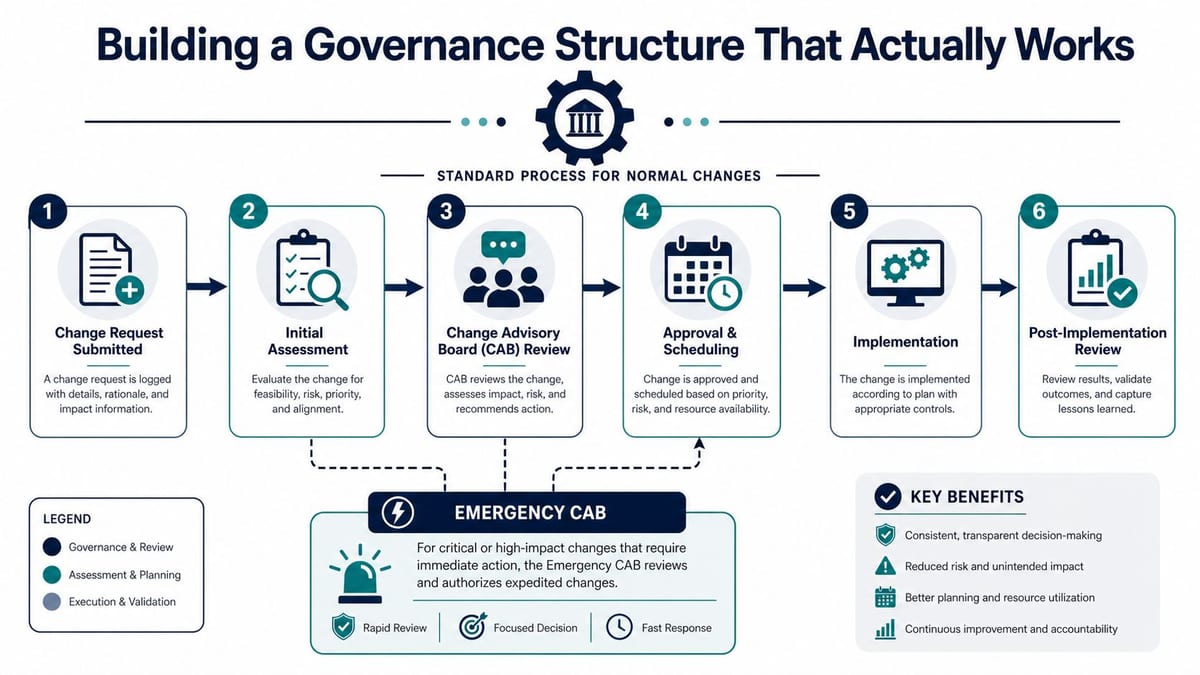
Governance works when it answers three questions before work starts, what is changing, who can approve it, and what gets rolled back if it goes wrong. For change management for IT, that means a real Change Advisory Board, a defined Emergency CAB for critical issues, and a business owner who can state why the change matters in operational terms, not just technical ones. A controlled sequence, define the business case and success criteria, map impacted services and dependencies, classify the change, pilot and back-out test, then schedule implementation with live monitoring and review, is the difference between a managed cutover and a late-night fire drill. Governance frameworks only help if they connect approval discipline to the realities of cabling, power, access control, and site readiness, as outlined in Constructive-IT's IT governance frameworks guide.
What CAB should do
CAB is not there to slow everything down. It's there to stop people approving work before they've identified the knock-on effects on network services, telephony, user access, or building systems. In a fit-out, that can mean checking whether a new comms cabinet has enough power, whether the cabling route conflicts with building works, and whether security teams need temporary controls while doors, cameras, and badge readers are being changed.
A practical CAB flow usually looks like this:
- Change request submitted: capture the reason, the scope, and the service owner.
- Initial assessment: check business impact, affected sites, and likely downtime.
- CAB review: confirm risk, sequencing, and required test evidence.
- Approval and scheduling: align the work with building access, contractor availability, and user impact.
- Implementation: execute against a named runbook with live monitoring.
- Post-implementation review: compare what happened with the original success criteria.
If the change is urgent, ECAB should be narrow, fast, and documented. Emergency authority without documentation becomes a habit, and habit becomes risk.
For teams that need a broader governance lens, the internal framework at Constructive-IT's IT governance frameworks guide is a useful reference point because it ties approval discipline to infrastructure delivery rather than treating governance as a generic policy exercise.
Ownership has to be explicit
The biggest governance mistake I see is shared ownership that isn't owned by anyone. IT thinks facilities is handling access. Facilities thinks the contractor is covering power. The contractor assumes the business has approved downtime. By the time somebody notices, the cutover window is already open.
A simple ownership matrix fixes more problems than another steering meeting ever will. When the network team owns testing, the facilities lead owns building access, and the business owner owns acceptance criteria, decisions happen fast enough to matter. That's how you keep a structured cabling upgrade or server-room expansion from turning into a chain of avoidable delays.
Planning Timelines and Stakeholder Coordination
Move dates always look tidy on paper. The actual work starts much earlier, because cabling, power, rack space, access control, user comms, and cutover support all have to line up before anyone touches a live system. For office relocations and managed IT moves, planning often needs to begin 10 to 12 weeks before the target date, with a structured survey, audit, pre-build, testing, and post-move support sequence. That runway is not padding, it is the minimum time needed to avoid improvising on the day.
Build the schedule around dependencies
A schedule only works when the dependency map is honest. Start with an assessment phase, because there is no safe way to coordinate work that has not been identified. The stakeholder list needs IT, operations, facilities, building management, security, external contractors, and, in healthcare settings, the clinical users whose work depends on uninterrupted access to systems and data. Miss one of those groups and the project team usually discovers the gap during go-live, when the cost of correction is highest.
The safe pattern is phased adoption for critical services, not a big-bang switch for the whole site.
That approach is reinforced by the NHS cloud guidance summary, which uses governance teams, pilots, upskilling, and regular feedback loops between clinicians and IT. The same logic applies to building work. If staff arrive into a new office, a new helpdesk route, a new Wi-Fi profile, and a new access-control process on the same morning, something will be missed. The move has to be sequenced so the people, the kit, and the estate are ready in the same window.
For teams working through controlled environments, the laboratory planning tips resource is useful because lab projects, like complex IT moves, depend on sequencing, compliance, and user safety rather than speed alone.
Stakeholder rhythm matters more than status meetings
The job is to keep every party working to the same clock. IT needs to know when cabling is complete. Facilities needs to know when power is signed off. Security needs confirmation that access control and CCTV are ready before rooms go live. Business leads need honest visibility on what can and cannot be delivered before the move date.
A practical communication structure helps more than another meeting for the sake of attendance. Use a clear communication plan, regular decision points, and named owners for each dependency, which is the same discipline set out in Constructive-IT's stakeholder communication plan. That keeps the conversation tied to timing, ownership, and sign-off, instead of broad updates that sound reassuring but do not move the work forward.
The fewer assumptions you make, the fewer surprises you absorb on cutover day.
Designing Access, Power, and Data as One System
Access control, electrical infrastructure, and network connectivity fail when they are treated as separate workstreams. In practice, building access systems depend on both network connectivity and electrical infrastructure, not just the lock hardware, because the door controller, badge reader, logging, and upstream management platform all need to stay alive and reachable change management and access systems. The design work has to be handled as one system, with facilities, security, and IT agreeing the same dependencies before anything is installed.
Unmanned buildings change the risk profile
In UK practice, unmanned building management means a building runs with minimal on-site staff through integrated access control, CCTV, alarms, remote monitoring, and automated building systems, so incidents can be detected and handled remotely rather than by a constant security desk presence GTAG IT change management. That model only works when the estate is designed for remote operation from the start. A patch, a switch change, or a firmware update that breaks the connection between access control and monitoring can leave a site invisible until a user is locked out or an alarm event is missed.
Battery-less NFC proximity locks make sense in environments where you want lower maintenance, cleaner door hardware, and less dependence on local battery swaps. They fit well in a larger managed estate because they remove one common failure point, battery depletion, while shifting attention to commissioning quality, power continuity, and the integrity of the access network. That trade-off is sensible when you are building a fully autonomous unmanned building unit and want fewer on-site maintenance visits.
Power, CCTV, and certification have to line up
Commercial electrical installation and certification cannot sit in a separate project stream if the building relies on connected systems. CCTV, door readers, alarms, and building-management controls all draw power, exchange data, and depend on clear handover documentation. If electrical sign-off, structured cabling delivery, and access-control configuration happen out of sequence, the result is usually a half-live building, one that looks finished but cannot be operated safely.
Maintenance gets underestimated as well. Battery-less hardware reduces one maintenance burden, but it does not remove the need for firmware checks, reader testing, log review, and periodic validation of the remote monitoring path. The value comes from less day-to-day intervention, not from pretending the system runs itself.
Operational takeaway: if the building cannot be safely run when no one is on site, the design is not autonomous yet.
Common uses include modern office fit-outs, unmanned or lightly staffed utility rooms, receptionless access zones, secure storage areas, and sites where CCTV and access logs have to stay aligned for audit or incident response. In each of those cases, the question is not whether the hardware works in isolation. It is whether the whole estate works as one controlled system, including the network choices that support the doors and cameras, such as Ethernet and wireless design.
Testing, Validation, and Rollback Procedures
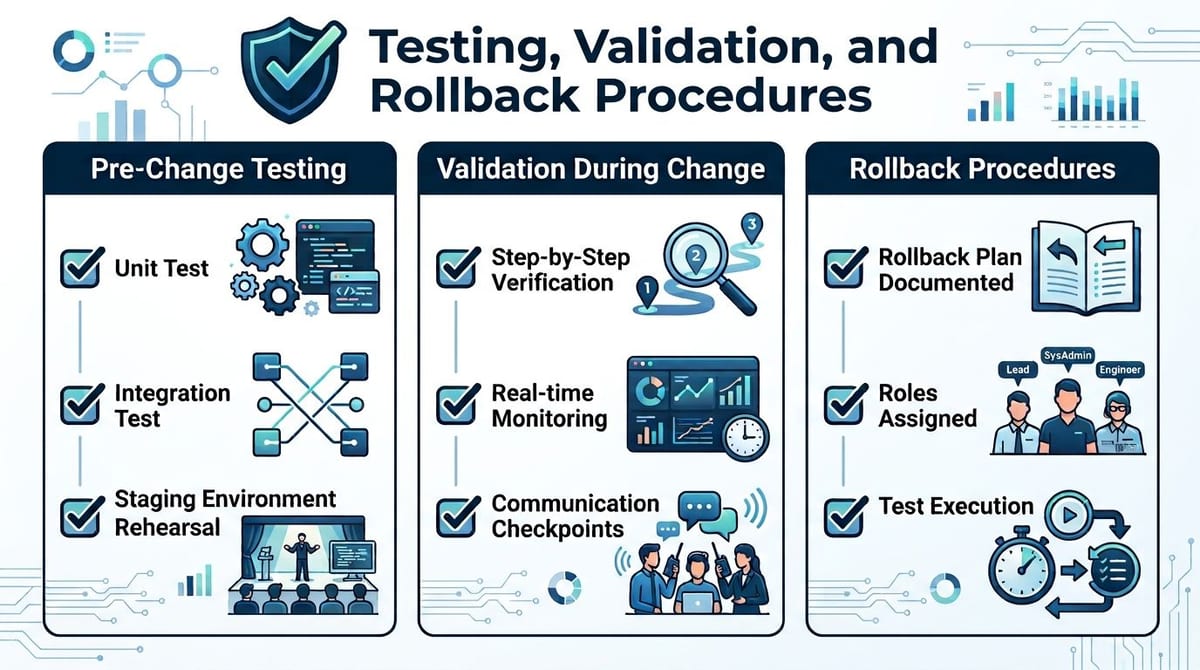
Testing has to begin with the dependency map, not the change date. Application owners need to be named early, network and telephony paths need to be checked before go-live, and acceptance criteria need to be validated in a staged environment before any site-wide switch. If the route has not been rehearsed, the team is not testing, it is guessing.
Test what can fail during cutover
Pilot and back-out testing are not optional polish. They are the only way to know whether the new site can be brought live cleanly and reversed safely if a core service misbehaves. In a cabling refresh, that means checking patching, endpoint connectivity, Wi-Fi access, and voice service before users arrive. In a server-room migration, it means confirming environmental controls, power resilience, and service dependencies before any production traffic moves.
Structured cabling certification should be recorded and matched against the documented baseline. Wi-Fi survey validation needs to show that coverage assumptions still hold once walls, furniture, and occupants are in place. Server-room environmental checks need to be carried out with the same seriousness as logical testing, because power and cooling issues do not care how tidy the runbook looks.
Rollback has to be real, not aspirational
A rollback plan only works if roles are assigned and the team has rehearsed the reversal. Too many change plans say there is a fallback, then fail to state who triggers it, how long the team will wait before deciding to use it, or what the user-facing message will be while the reversal runs. A credible rollback plan documents the trigger, the steps, the owner, and the point at which leadership is informed.
In compliance-heavy environments like NHS facilities, the documentation trail matters as much as the technical result because patient data security and auditability are required. That means maintaining step-by-step verification notes, monitoring logs, and sign-off records that show not only that the change happened, but that it happened in the agreed order.
The best teams do not treat a clean implementation as the finish line until the monitoring window has passed and the service owners have signed off against the original acceptance criteria. That discipline is what keeps a good move from becoming tomorrow's incident.
Measuring Success with KPIs and Post-Change Reviews
A change only matters if you can show what happened, not what the plan said would happen. The KPIs that hold up in practice are the ones that show whether the work stayed inside the approved window, whether the service came back cleanly, whether people could keep working, and whether the team learned enough to avoid repeating the same mistakes. Change management maturity improves when organisations stop treating completion as the finish line and start treating evidence as part of the deliverable.
| Project Phase | KPI | Target Benchmark | Measurement Method |
|---|---|---|---|
| Before change | Readiness of dependencies | All critical owners confirmed | Signed checklist and dependency log |
| During change | Downtime duration against plan | Within approved window | Change record and live monitoring notes |
| During change | First-time fix rate | Issues resolved without repeat intervention | Service desk and engineer logs |
| After change | Stakeholder satisfaction | Positive sign-off from business owners | Post-change review and survey feedback |
| After change | Adoption and usage | Users operating on the new service path | Access logs, usage checks, and support tickets |
What the PIR should capture
The post-implementation review has to be short, factual, and honest. Capture what changed, what went wrong, what went right, what was missed in planning, and what needs to be updated in the baseline for next time. If the team found that a comms room needed more pre-stage validation, that becomes a standard check. If the business owner needed earlier communications, that becomes part of the next stakeholder plan.
That review should also cover the physical controls around the change, because downtime usually starts with something tangible. A loose patch lead, an access issue at the wrong time, a power circuit that was not mapped properly, or an environmental check that was signed off too early can undo a tidy runbook very quickly. Good PIRs keep those failures visible so the next move starts with better facts.
The point is institutional memory. Without it, each relocation or infrastructure upgrade forces the next project manager to relearn the same lessons the hard way.
Good reviews create better governance
A strong review also checks whether the change model itself was fit for purpose. If the project needed more sign-off than expected, or if the live environment was more sensitive than the original risk assessment suggested, that is not a problem to hide. It is evidence that the governance structure needs tightening.
A useful PIR leaves the team with fewer assumptions and more repeatable controls.
That is how you move from reactive delivery to a real change-management capability. Over time, the organisation gets better at estimating downtime, managing dependencies, and deciding when to stage a change rather than compress it into one risky window. That improvement matters more than a neat-looking project plan that nobody can reuse.
Building Towards Autonomous and Future-Ready Facilities
A move toward autonomous and unmanned building operations changes what good change control looks like on the ground. The shift is not just about replacing devices. It means the estate, the governance model, and the compliance budget all have to keep pace with infrastructure that is more connected, more dependent on shared services, and less forgiving when something is missed. If the building is becoming more integrated, the change process has to mature with it.
Future-proofing now means designing for scalability, resilience, patient data security, and total cost of ownership, then accepting that the best answer is usually staged change with a clear risk-based roadmap. A full cutover can sound decisive, but it is a poor fit for buildings where access, CCTV, power, and network services all interact. I have seen office moves fail because the cabling was ready while the access control was not, or because a power change was signed off before the environmental checks were properly tested. The more autonomous the building becomes, the more disciplined the change lifecycle needs to be.
That is the key test. If your current process cannot handle a secure office move, a phased site upgrade, or a building system change without surprises, it is not ready for unmanned operations either. Good change management for IT now has to account for racks, risers, comms rooms, door hardware, and facilities sign-off as one coordinated system, not as separate workstreams handed between teams at the last minute.
A mature facility will still need people, but it should not depend on informal workarounds. The goal is a change process that can absorb repeatable maintenance, support planned growth, and keep critical services available while the estate becomes more automated. That is how you get from reactive delivery to a building environment that is prepared for what comes next.