

You're probably dealing with a familiar mix of pressure and ambiguity. The business wants a migration plan. Operations wants no downtime. Facilities wants clarity on power, cabling and landlord constraints. Security wants assurance that nothing weakens during the move. Everyone asks for one date, one budget and one answer, but a successful data centre migration strategy only works if logical systems and physical infrastructure are designed together.
That matters more in the UK now because the market around you is changing fast. The UK data centre market is projected to expand by USD 37.87 billion between 2023 and 2028, growing at a CAGR of 21.8% according to Technavio's UK data centre market analysis. In practice, that means old server rooms, improvised comms spaces and half-modernised estates are being compared against facilities built for higher density, tighter security and cleaner operational control.
A lot of migration guides stop at workloads, replication and cutover. That's only half the job. In modern UK projects, especially where the target state is a lights-out or unmanned site, the migration plan has to account for rack access, CCTV coverage, commercial electrical installation, structured cabling, remote inspection, testing, certification and operational governance from day one. If those streams run separately, the move gets slower, more expensive and riskier.
It's also worth separating cloud transition from physical relocation. Many estates involve both, and if your application roadmap includes hybrid decisions, it helps to ground the conversation in understanding cloud migration strategies before you lock the physical design.
Your Data Centre Migration Starts Here
A solid data centre migration strategy starts with one uncomfortable truth. The move itself isn't the hardest part. The hard part is establishing what you're really moving, what must stay live, what can tolerate change, and what the target environment must support on day one without workarounds.
In most estates, the risk isn't a single catastrophic event. It's the accumulation of small assumptions. An application dependency that nobody documented. A power feed that looks adequate until the rack plan changes. A temporary access control decision that becomes a long-term security gap. A CCTV blind spot in a room that won't be routinely staffed. Those are the issues that turn a planned migration into an operational problem.
What a modern migration really involves
For a traditional move, teams often think in terms of servers, storage and network cutover. For a modern facility, especially one designed for limited on-site staffing, the scope is broader:
- IT workload planning needs dependency mapping, migration sequencing, rollback logic and post-cutover validation.
- Building systems integration needs access control, CCTV, alarms, power monitoring and environmental alerts tied into the operating model.
- Facilities readiness needs landlord approvals, electrical installation, cabling routes, containment, cabinet layouts and certification.
- Operational design needs to define how engineers will inspect, authorise and maintain the site when routine human presence is deliberately reduced.
A migration plan that ignores the building behaves like an application plan with no network diagram. It may look complete on paper, but it won't survive contact with the real site.
Why the target state has changed
Many organisations aren't just moving to another room. They're moving to a different operating model. A lights-out data centre aims to minimise routine human intervention through automation, remote monitoring, controlled access and tightly integrated building systems. That changes the project from a relocation exercise into an infrastructure redesign.
Unmanned building management in practice means replacing routine physical presence with remote oversight and data collection. In the wider UK built environment, that includes the use of UAVs for real-time site management, progress monitoring and remote health and safety surveillance, as described in research on UAV use in UK housing and construction. In a data centre context, the same principle applies. You design the site so operators can verify conditions, control access and identify faults without sending somebody to stand in front of a cabinet for every minor event.
That only works when the migration is run as a phased programme. Discovery, design, physical preparation, cutover and validation each have their own controls. Skip one, and the next stage inherits hidden risk.
Phase 1 Governance and Discovery
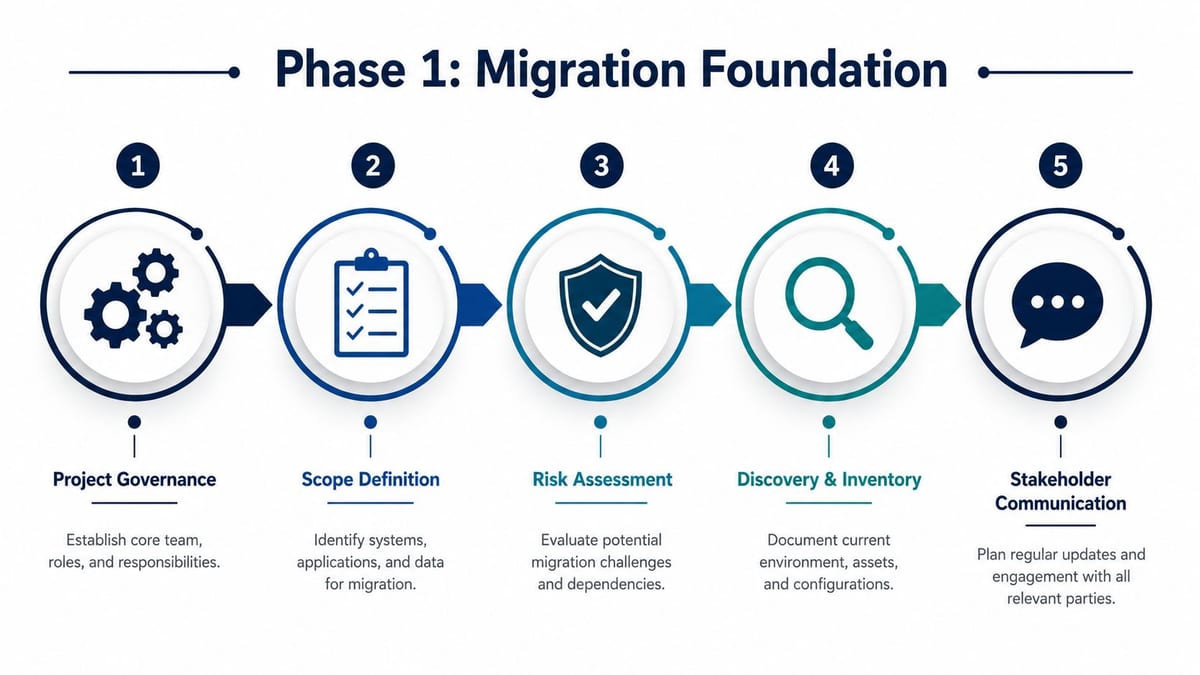
The first phase is where migrations are won or lost. Teams usually want to jump to dates, moves and new layouts. Resist that. Before anyone touches a rack, you need governance, ownership, discovery discipline and a source of truth that everyone accepts.
Build the decision structure first
A proper migration board isn't bureaucracy. It's protection against conflicting assumptions. At minimum, the core team should include infrastructure, networks, security, facilities, commercial electrical specialists, application owners and a person with authority to freeze scope when the project starts drifting.
The board should own four things:
Scope control
Decide what is in the migration, what is being retired, and what is being rebuilt rather than moved.Service priority
Put services into business tiers. If everything is critical, nothing is.Risk ownership
Every major dependency needs an owner, not a shared hope.Change authority
During cutover, someone has to approve go, pause or rollback decisions quickly.
If you need a useful reference point for how those responsibilities usually fit into broader delivery controls, practical IT governance frameworks are worth reviewing before the project gets deep into planning.
Discovery must produce a usable CMDB
A spreadsheet of hostnames isn't discovery. A proper discovery phase produces a live asset register and a Configuration Management Database (CMDB) that captures relationships. That means racks, power feeds, patching, switch ports, uplinks, firewalls, storage, applications, dependencies, management tooling and operational contacts.
Many internal teams under-resource the project. They know the environment well enough to support it day to day, but not well enough to migrate it safely. Hidden dependencies are common in estates that have grown through acquisitions, office moves or piecemeal upgrades.
A UK-specific methodology dictates a phased tiered-priority approach where mission-critical systems are migrated in 72-hour windows, with a documented success rate of 94% for organisations using step-by-step inventory and dependency mapping, while ad-hoc migrations without CMDB assessment fail at a rate of 31%, according to Flexential's migration best practice guidance.
Practical rule: If a service owner says “that server just works” but can't show what it talks to, treat it as high risk until dependency mapping proves otherwise.
What to capture in discovery
The best discovery workshops don't ask abstract questions. They walk the estate service by service and cabinet by cabinet.
Application relationships
Identify upstream and downstream systems, authentication paths, storage dependencies and external connectivity.Physical dependencies
Record cabinet positions, patching paths, power sources, PDUs, cable labels and anything that complicates a move.Operational constraints
Note maintenance windows, user impact, support contracts, remote hands arrangements and approvals required for shutdown.Transport and replacement decisions
Older kit may be better replaced in the target environment than physically relocated.
For teams handling platform data alongside infrastructure discovery, essential ServiceNow data migration tips can help structure the data preparation side of the work without turning the CMDB into a clean-up project halfway through the migration.
Tier the move, don't treat it as one event
A serious migration isn't one weekend. It's a controlled sequence of events. The usual pattern is to validate low-risk services first, then move business systems in agreed windows, then hold, observe and only then proceed to the next wave.
A simple working model looks like this:
| Priority tier | Typical contents | Migration approach |
|---|---|---|
| Low | Utility services, non-production workloads, reporting tools | Pilot early to test process and documentation |
| Medium | Internal business applications and shared platforms | Move in grouped waves with clear support cover |
| High | Customer-facing, operationally sensitive or tightly integrated systems | Use tightly controlled windows, rehearsal and rollback plans |
This phase is laborious. It's supposed to be. Discovery is the point where you pay down uncertainty before uncertainty becomes outage.
Phase 2 Designing the Target Environment
The target environment shouldn't be treated as a blank room waiting for servers. It's an operational system. If the destination is meant to support a lights-out model, the design has to join physical access, power, data, monitoring and security into one coherent fabric.

What unmanned building management means on a data centre floor
In practice, unmanned building management doesn't mean nobody ever attends site. It means the site is designed so normal operation, inspection and first-line decision-making can happen remotely. Engineers attend by exception, not by habit.
That usually includes:
- Remote access control for rooms, cages and cabinets
- CCTV coverage that allows operators to verify entry, movement and interventions
- Environmental and power telemetry feeding into monitoring platforms
- Documented remote procedures for alarms, failed access attempts and maintenance visits
- Inspection methods that reduce avoidable human exposure in risky locations
In wider building operations, UAV-enabled management has already been used for remote inspection and safety surveillance. In a data centre setting, the principle carries over to rooftop plant, external cable routes and infrastructure checks where visual confirmation matters.
Why many unmanned building projects fail
Most failures aren't caused by automation itself. They happen because the operating model is immature. Teams buy the technology but don't resolve the governance, compliance and field procedures around it.
Research into unmanned building projects in the UK found that regulations are the most significant hurdle to drone implementation, especially around video data gathering, confidentiality risks and distinguishing between private and organisational drones, according to Scientific Reports research on barriers to drone adoption. That matters because a lights-out site depends on remote observation and evidence, and every method of collecting that evidence needs clear rules.
Common failure points include:
Security systems deployed in silos
Access control, CCTV and alarms are installed by different parties with no common event logic.No operational playbooks
The site is “unmanned” on paper, but nobody knows who reviews alerts, authorises access or escalates faults.Poor handover from project to operations
The build team leaves, but maintenance teams inherit undocumented integrations.Regulatory blind spots
Remote monitoring creates data handling obligations that were never addressed during design.
A practical design review should test not only whether the system works, but whether it's supportable by the people who will run it at 2am.
Why access, power and data must be designed together
Fragmented execution often causes data centre projects to go wrong. One contractor delivers access control. Another installs electrical infrastructure. Another handles cabling and monitoring. Each stream is competent on its own, but the facility still behaves badly because the interfaces were never designed.
For battery-less, NFC proximity locks in autonomous UK units, access, power and data must be designed together by integrating high-resolution camera sensors for infrastructure inspection that can detect issues on power lines without human risk, ensuring that power monitoring data feeds directly into the access control system for autonomous security, according to this technical reference on integrated autonomous inspection and security design.
That principle has direct value in a data centre:
- A cabinet access event should be verifiable in CCTV.
- A power anomaly should trigger a security and operational review, not sit in a separate dashboard.
- A remote inspection process should support maintenance decisions, not create another detached data stream.
- The lock, the sensor path and the monitoring platform should be designed as one chain.
If you're sizing the site for current load and future density at the same time, data centre capacity planning guidance helps anchor those design choices before cabinet layouts and power distribution are fixed.
A short visual overview helps when aligning technical and facilities teams:
Why battery-less NFC proximity locks make sense
There are practical reasons to choose battery-less NFC proximity locks in autonomous units. They reduce maintenance overhead because there's no battery replacement cycle across racks or cabinets. They support controlled, auditable local access. They also fit well in environments where you want simpler hardware at the edge and stronger control in the management layer.
They're particularly useful in places such as:
- Remote comms rooms where infrequent attendance makes battery maintenance easy to overlook
- Edge data rooms in operational buildings where local access needs strict authorisation
- Cabinet-level security in co-managed facilities where not every engineer should access every enclosure
- Lights-out suites where low-touch maintenance is part of the business case
CCTV, electrical works and certification have to be in the same conversation
CCTV isn't an afterthought in an unmanned facility. It's part of the operating model. Camera placement should support entry points, cabinet rows, loading routes and any area where a remote operator may need to verify activity. Retention, access permissions and incident review procedures need to be decided before handover, not after the first security event.
The same goes for commercial electrical installation and certification. New boards, dedicated circuits, containment, earthing arrangements, PDU feeds and testing records all affect whether the room is safe to energise and support. If those works are detached from the migration programme, the IT timeline becomes fiction very quickly.
Phase 3 Physical Infrastructure and Vendor Coordination
By this stage, the project stops being conceptual. You're dealing with builders, electricians, cabling engineers, carriers, facilities managers, security integrators and equipment schedules. During this phase, good plans are either translated into a functioning site or diluted by sequencing mistakes.

Power dictates the programme
A lot of IT teams still build migration schedules as if the limiting factor is application readiness. In UK data centre work, it often isn't. The primary constraint for UK data centre migration is now securing power and planning consents, not just IT readiness, and teams asking how to migrate are often delayed by how to power the new site, as discussed in Oxford Economics' analysis of the UK data centre boom and power challenge.
That has practical consequences:
- You can't promise a migration date until incoming power, approvals and installation sequencing are real.
- Cabinet density decisions affect electrical design, cooling assumptions and floor layout.
- Temporary energisation plans need the same scrutiny as final-state power paths.
- Utility and landlord dependencies must sit on the critical path, not in a separate workstream.
If the target site has great racks, clean layouts and finished cabling but unresolved power dependencies, it isn't migration-ready. It's just tidy.
Cabling and containment need future discipline
Structured cabling in a migration project isn't just about moving existing links into a newer room. It's your chance to remove years of tactical patching and restore order. That means labelled pathways, tested fibre, clean segregation, sensible slack management and enough spare capacity that the site can absorb change without turning back into an improvised environment.
The practical questions are simple:
| Area | What to verify before install | What usually causes trouble |
|---|---|---|
| Cabinet layout | Front and rear clearance, patching access, PDU position | Overcrowded rows and inaccessible terminations |
| Fibre backbone | Route diversity, test certification, patching discipline | Last-minute route changes and poor labelling |
| Copper services | Patch panel capacity, standards compliance, service separation | Mixed use cabling and undocumented adds |
| Containment | Fill ratios, bend radius, fire stopping | Retrofitted routes that block maintenance |
Vendor coordination is a technical task, not admin
Vendor management is often treated as diary work. It isn't. Someone has to understand how the structured cabling installer's finish date affects switch installation, how the electrical sign-off affects commissioning, and how both affect cutover rehearsal. If those dependencies are managed by people who only see project dates, the technical sequence gets missed.
An end-to-end delivery partner can be useful as one option among others. For example, Constructive-IT works across structured cabling, electrical works, CCTV integration, server room expansion, testing and on-site go-live support. In complex relocations, that kind of combined scope can reduce hand-off risk between trades, provided the internal client still holds clear technical authority.
Building out a fully autonomous unmanned building unit
A fully autonomous unmanned building unit isn't created by installing access control and calling it done. It needs a joined-up stack:
- Access layer with controlled entry to room, cage and cabinet
- Power layer with monitored feeds, alarms and documented fail states
- Data layer with resilient switching, out-of-band access and clean patching
- Security layer with CCTV, event review and clear authorisation paths
- Maintenance layer with inspection routes, spare parts logic and support contracts
- Compliance layer with electrical certification, safety documentation and operating procedures
The handover pack should reflect that reality. If the site can't be maintained, audited and operated by teams who weren't in the build meetings, the design isn't finished.
Phase 4 Testing Cutover and Rollback
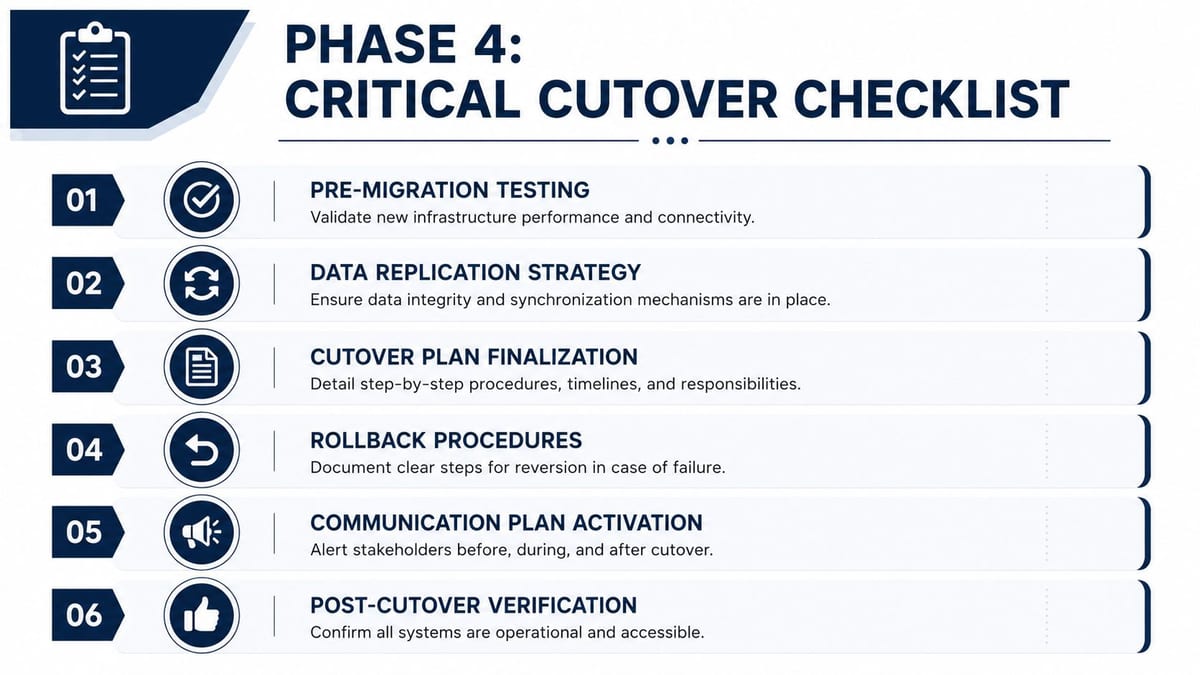
Cutover is where confidence has to be earned. By the time you get here, every unresolved assumption becomes expensive. The teams that handle this well don't rely on optimism. They rely on rehearsed steps, documented ownership and rollback plans that are credible enough to use under pressure.
Test the new environment before migration day
A cutover plan is only as good as the testing behind it. The target environment should already have passed infrastructure validation before you put production service at risk. That means connectivity, cabinet power, remote access, monitoring, access control and support processes have all been exercised as an integrated system.
The first live tests should use non-critical services. You're not trying to prove bravery. You're trying to expose procedural gaps while the blast radius is still small.
Build a runbook that people can actually use
A good runbook isn't a polished summary deck. It's an operational document. It should tell the team what happens, in what order, by whom, with what dependencies, and what evidence confirms each step is complete.
A practical runbook usually includes:
Named roles
Every action should have an owner and a backup owner.Time-sequenced tasks
Include decision points, hold points and communication triggers.Verification steps
Define what counts as success before the next action is authorised.Rollback conditions
State clearly what failure looks like and when the team stops progressing.Escalation paths
If something breaks, people need one route for decisions, not three parallel discussions.
The best rollback plan is the one nobody feels embarrassed to invoke. If the team treats rollback as failure, they'll leave it too late.
Validate latency, cloud paths and service behaviour
For hybrid estates, test the production path from the target location, not just local switching. UK-specific migration guidance requires validating latency and bandwidth to public clouds before physical disconnection, including a 5ms benchmark for real-time Hampshire and London financial trading floors, as noted in the earlier cited Flexential guidance. The lesson is broader than that single use case. Performance assumptions should be proven from the new site before any irreversible move starts.
That means checking:
- Application response behaviour across expected user paths
- Cloud connectivity from the new environment under realistic load
- Authentication and identity flows for local and remote users
- Monitoring and alerting so faults surface in the right tools
- Remote site operations including access authorisation and CCTV verification
Communication is part of resilience
A technically perfect migration can still feel chaotic if communication is weak. Business stakeholders need plain updates. Technical teams need exact timing, exact roles and one decision channel. Service desk teams need scripts that reflect the exact sequence, not a simplified management summary.
Operational resilience is broader than a single migration event, and the GoSafe Dark Web monitoring operational resilience guide is a useful reference if you're aligning your cutover plan with wider continuity and resilience thinking.
Maintenance and operational considerations during cutover
This is also the point where facilities and operations teams should prove that the new site is supportable after go-live, not just switch-on ready.
Check the details that often get left until too late:
Access procedures
Can authorised engineers enter room, cage and cabinet without workarounds?CCTV review
Can operators verify movement and interventions clearly enough to support incidents?Electrical documentation
Are certification records, test results and circuit schedules available to the teams that need them?Spare capacity and support cover
Is there a plan for failed patch leads, optics, lock issues or cabinet access faults during the first days?Remote operating model
Can the site genuinely run with limited attendance, or are hidden manual tasks still embedded in daily support?
A site that goes live but still depends on tribal knowledge isn't stable. It's just running.
Phase 5 Post-Migration Validation and Governance
The migration only becomes complete when the new environment has been validated under normal operating conditions. That means more than checking whether services are reachable. You need to verify performance, confirm user acceptance, close out security actions, update records and formally transfer the environment into steady-state governance.
Validate the site as an operating service
Post-migration validation should cover technical, physical and procedural outcomes together. That includes application behaviour, monitoring accuracy, cabinet access logs, CCTV review, electrical documentation, support handover and updated asset records.
A concise closeout checklist usually includes:
- Service verification that confirms critical workflows run correctly in production
- User acceptance testing for systems where operational teams need to sign off real use
- Security review covering access permissions, surveillance, alarm paths and incident handling
- Documentation updates so the CMDB, rack elevations, cable schedules and support records match reality
For the physical and integrated systems side, data centre commissioning practice is a useful benchmark for deciding whether the room is merely live or ready to operate properly.
Governance doesn't end at cutover
This matters more now because the UK regulatory position has shifted. The Cyber Security and Resilience (Network and Information Systems) Bill classifies data centres as an essential service, bringing them into scope for regulation by Ofcom. This makes migration a compliance-driven activity, requiring strategies that prioritise long-term regulatory adherence, according to the UK government factsheet on data centres and the Cyber Security and Resilience Bill.
That changes the standard of proof after migration. Teams need to show that the environment isn't only functional, but governed. Controls, incident paths, physical security, resilience measures and record keeping all need to stand up after the project team has gone.
A data centre migration strategy succeeds when the new facility is easier to operate, easier to audit and less dependent on heroics. If the move leaves you with cleaner processes, integrated physical systems and a site that can support modern unmanned operations without cutting corners, the project has done its job.
If you're planning a relocation, a server room expansion or a move into a more automated facility, Constructive-IT can support the physical and operational side of the programme alongside your internal IT team, from cabling, CCTV and electrical works through to testing, certification and go-live coordination.