


A Business Guide to Modern Fibre Cabling
- Craig Marston
- Jan 24
- 16 min read

Picture your company's network as the road system of a city. Old copper wiring? That's a congested B-road, grinding to a halt during rush hour. Fibre cabling is the unrestricted, multi-lane motorway—the essential nervous system for any modern, high-performance UK business, engineered to handle enormous amounts of data without a hint of a slowdown.
What Is Fibre Cabling And Why Does It Matter?
At its simplest, fibre optic cabling sends data using pulses of light shot through incredibly thin strands of glass. Unlike old-school copper cables that rely on electrical signals, fibre sends information at almost the speed of light. This single, fundamental difference is what gives it such a massive advantage in speed and reliability.
This isn't just a minor upgrade; it's the very foundation of modern business. Smooth cloud access, flawless video calls, and the ability to process huge data transfers for AI and analytics all depend on a network that can keep up. For any business planning a critical project like an office relocation, a new fit-out, or a data centre build, getting the cabling infrastructure right is a strategic decision that will impact productivity for years.
The UK's Shift to a Fibre-First Future
The move to fibre cabling isn't just a trend anymore; it's a nationwide priority. The UK's connectivity market has been completely transformed, with fibre-to-the-premises (FTTP) technology rapidly becoming the new standard. As of early 2025, an incredible 73% of UK premises can now get full-fibre broadband.
This rapid rollout creates both a huge opportunity and a real sense of urgency for businesses. To take full advantage of the high-speed services now on your doorstep, your internal network has to be up to the job. Otherwise, you risk being left behind.
If you want to go deeper, check out our complete UK business guide to optical fibre cable.
Understanding the Performance Advantage
To really get why fibre is such a big deal, you need to understand how that underlying technology delivers such superior performance. The simple fact that data travels as light gives it natural benefits that copper just can't compete with. For a great breakdown of the mechanics, it's worth reading up on how fibre optic broadband works.
Here’s what that means for your business:
Greater Bandwidth: Think of it as a wider pipe. Fibre cables carry vastly more information than copper cables of the same size, making them perfect for data-heavy work.
Enhanced Speed and Distance: Light signals travel much further with less signal loss. This guarantees consistently high performance, whether it's across a large office or between different buildings on a campus.
Improved Reliability: Fibre is completely immune to the electromagnetic interference (EMI) that can be caused by power lines or heavy machinery. The result is a far more stable and secure connection.
Ultimately, investing in a professionally designed fibre optic network isn't just about getting faster internet. It's about building a tough, high-capacity digital foundation that will support your business's growth and operational needs, both now and well into the future.
Choosing The Right Fibre Cable: Single-Mode Or Multimode
Picking the right type of fibre cabling is one of those crucial decisions that directly shapes your network's performance, reach, and ability to handle whatever you throw at it in the future. At the end of the day, the choice boils down to two main players: single-mode and multimode fibre. Getting your head around the fundamental difference between them is the first step in designing an infrastructure that actually works for you.
Think of it this way: single-mode fibre is like a laser pointer. It fires a single, intensely focused pulse of light down a ridiculously narrow core. That precision lets the signal travel for miles and miles with almost zero distortion, making it the perfect tool for connecting buildings across a campus or linking your main office to a remote data centre.
Multimode fibre, on the other hand, is more like a floodlight. It has a much wider core that lets multiple beams of light (or 'modes') bounce along inside it all at once. This design is fantastic for shifting huge amounts of data over shorter distances—think connecting servers in a single comms room or linking up different floors in the same office block.
This simple analogy gets right to the heart of the trade-off: distance versus bandwidth. Both, however, are a massive leap forward from old-school copper wiring, as the infographic below makes clear.
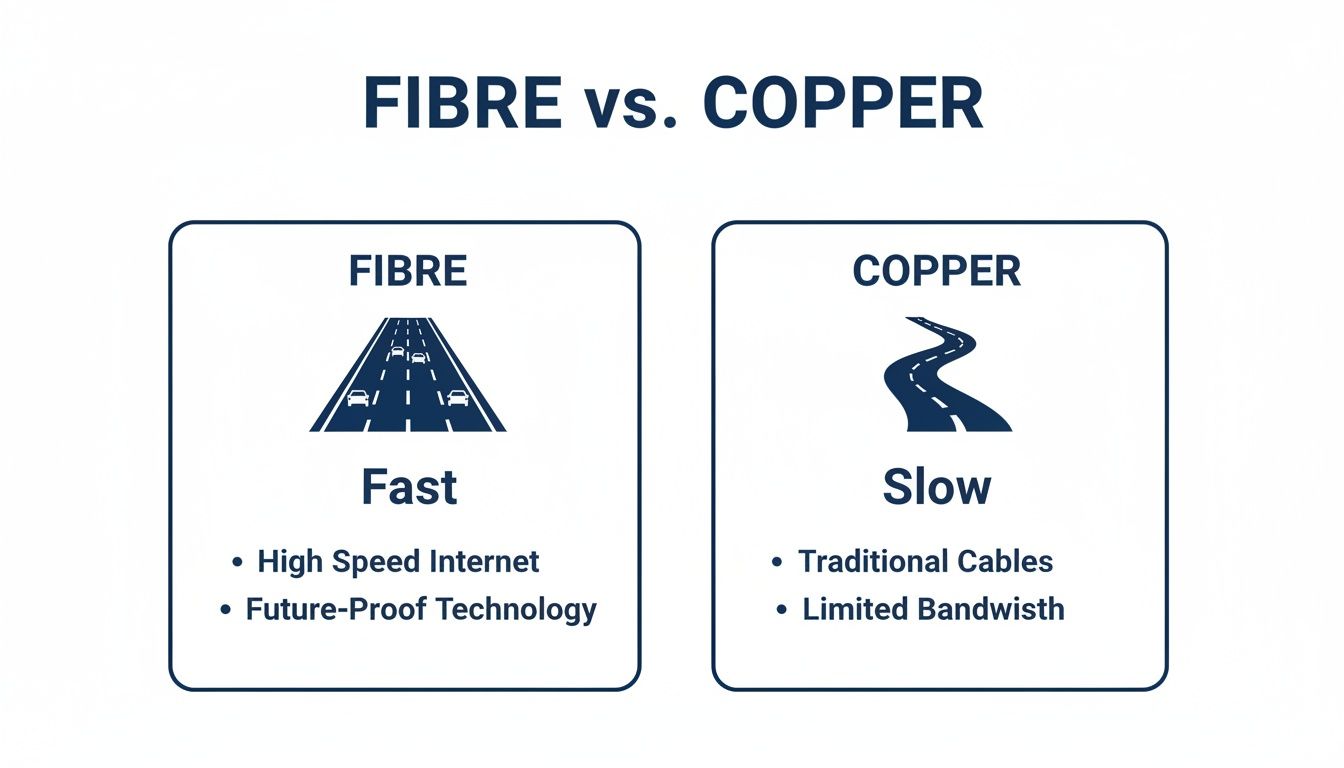
It’s pretty obvious: fibre is the modern motorway built for data, while copper is the congested B-road struggling to keep up.
Decoding Multimode Fibre (OM Ratings)
Once you're looking at multimode, you’ll come across terms like OM3, OM4, and OM5. These aren't just random labels; they specify exactly what the cable is capable of, especially how much data it can handle over a certain distance. You might also hear about OM1, but it's now largely obsolete for any new network build.
Here’s a practical breakdown of what they mean for your network:
OM3: For years, this was the go-to standard for 10 Gigabit Ethernet (GbE), capable of pushing that speed up to 300 metres. It’s still a perfectly viable, cost-effective choice for smaller networks with straightforward needs.
OM4: This is a step up from OM3, offering higher bandwidth that can support 10 GbE up to 550 metres. Crucially, it also handles 40 GbE and 100 GbE over shorter distances (up to 150 metres), making it a solid workhorse for today’s busy data centres.
OM5: Often called wideband multimode fibre, OM5 is designed with the future in mind. Its distance and speed for current applications are similar to OM4, but its real ace is its support for Shortwave Wavelength Division Multiplexing (SWDM). This tech lets multiple signals fly down a single fibre on different light frequencies, dramatically increasing bandwidth without having to pull more cables.
The choice here often comes down to balancing what your budget looks like today against your growth plans for tomorrow. For a more detailed look into the technical side of things, our expert guide to single-mode fiber optic cabling offers some extra context.
The Role of Single-Mode Fibre (OS2)
When distance is the main challenge, single-mode fibre is the only real answer. The standard you'll almost always encounter is OS2, which is purpose-built for long-haul jobs.
The core of an OS2 single-mode cable is incredibly thin—typically just 9 micrometres in diameter. This forces light to travel in a perfectly straight line, which massively reduces signal degradation and allows it to span distances of up to 200 kilometres or more with the right electronics.
This capability is absolutely essential for:
Connecting separate office buildings on a large corporate or university campus.
Establishing a direct, high-speed link to an off-site data centre for disaster recovery.
Connecting to your telecommunication provider's network for your main internet feed.
To bring it all together, here's a simple table to compare the two main fibre types at a glance.
Single-Mode vs Multimode Fibre At a Glance
Characteristic | Single-Mode (OS2) | Multimode (OM3/OM4/OM5) |
|---|---|---|
Core Diameter | Tiny (9 µm) | Larger (50 µm) |
Light Source | Laser | LED / VCSEL |
Max Distance | 100 km+ | Up to 550 metres |
Bandwidth | Practically unlimited | High, but distance-limited |
Best For | Campus backbones, data centre interconnects, long-haul links. | Within data centres, server rooms, and office LANs. |
System Cost | Cable is often cheaper, but electronics (transceivers) can be pricier. | Cable is more expensive, but the transceivers are generally cheaper. |
Ultimately, the choice isn’t about which fibre is "better," but which is the right tool for the job. Most modern enterprise networks actually use a mix of both: OS2 single-mode as the long-distance backbone connecting different sites, with OM4 or OM5 multimode providing the high-density, shorter-range links inside each building's server rooms and comms cabinets.
Planning Your Fibre Cabling Project For Success
A successful fibre cabling installation isn't just about the final product; it's a masterpiece of proactive planning. The real quality of your network is decided long before the first cable is ever pulled. It's forged in the strategic decisions made during the design phase of an office move, fit-out, or data centre expansion. Getting this stage right is the secret to avoiding costly delays and ensuring a flawless network from day one.
The whole process kicks off with a comprehensive site assessment. This is far more than just measuring distances—it's about getting to know the unique character and quirks of your building. A thorough survey identifies potential obstacles like sources of interference, difficult access points, and the physical limits of the structure itself.
This initial groundwork is absolutely vital for mapping out the most efficient and protected pathways for the cables. The goal here is to create a clean, logical route that steers clear of high-traffic areas, power lines, and HVAC systems, safeguarding the integrity of your entire fibre investment.

From Blueprint to Backbone: A Collaborative Approach
You can't plan a network in a vacuum. Effective planning demands close collaboration between your installation partner, your own team, and any other contractors on-site, especially electricians and HVAC engineers. This integrated approach ensures every system—power, data, and climate control—is designed to work in harmony, preventing conflicts that could kneecap performance or create safety hazards.
A critical output of this teamwork is a set of detailed network diagrams. These blueprints are indispensable for a few key reasons:
Clarity for Installers: They provide a clear, unambiguous guide for the installation team, drastically reducing the chance of errors.
Future Maintenance: They become an invaluable map for any future troubleshooting, maintenance, and upgrades down the line.
Stakeholder Alignment: They get everyone involved in the project, from IT managers to the facilities team, on the same page and sharing the same vision.
This collaborative design phase is also the perfect time to build in redundancy. Identifying the most critical network links and designing failover pathways is fundamental to creating a resilient infrastructure that can handle unexpected issues without causing crippling downtime.
Designing for Tomorrow, Not Just Today
One of the biggest mistakes we see in network planning is designing only for today's needs. Your business is going to grow, and its appetite for data will grow with it. A forward-thinking design anticipates this by building in spare capacity right from the very start.
Planning for future growth means installing more fibre strands than you immediately require. The marginal cost of adding extra dark fibre during the initial installation is tiny compared to the expense and disruption of running new cables a few years down the line.
This approach transforms your network from a simple utility into a powerful, strategic asset, ready to support new technologies and increased user loads without needing a complete and painful overhaul. It's about building a platform for your future business goals. When looking at underground installations, using a safe and precise digging method is essential to protect existing utilities. For instance, many projects now rely on techniques like hydro excavation as a non-destructive alternative.
Verifying Availability Before You Begin
While the UK's fibre rollout is moving at a good pace, availability is far from universal. The projected full fibre broadband availability across the UK by May 2026 shows a remarkable transformation, but it also masks some profound regional inequalities. The Isles of Scilly, for example, is expected to have just 1.84% full fibre availability by 2026.
For any organisation planning a major infrastructure project, this uneven landscape means you simply cannot assume high-speed external connectivity will be available. You can discover more insights about UK broadband disparities to see the full picture. Verifying site-specific availability early in the process is a critical planning step, reinforcing just how important that initial, comprehensive site survey really is.
Expert Installation And UK Cabling Standards
The difference between a high-performance network and a source of constant frustration often boils down to one thing: the quality of the installation. A successful fibre cabling project is an exercise in precision, where an installer's meticulous attention to detail ensures every single component works exactly as it should from the moment you go live.
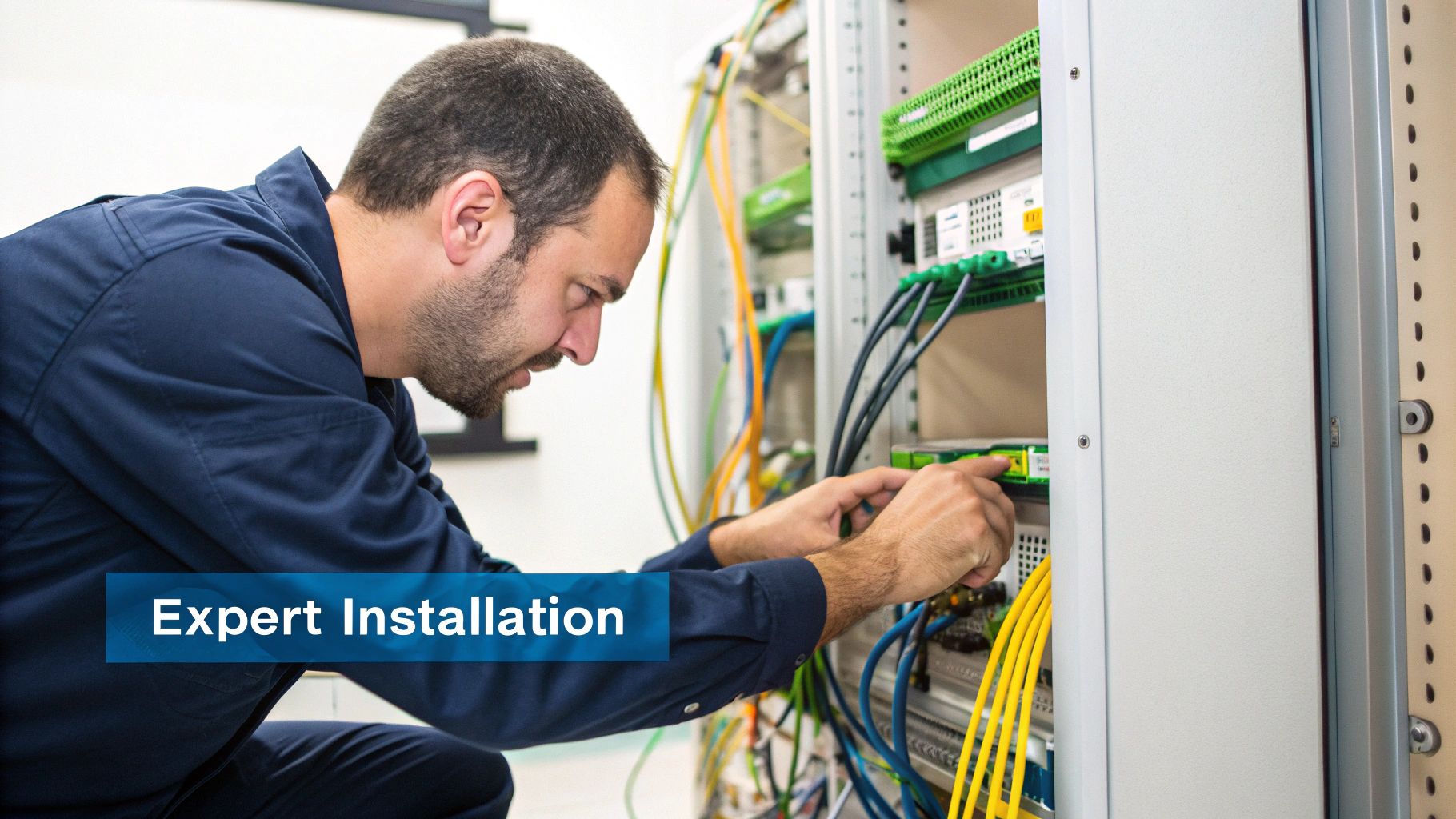
This isn't just about being tidy. Even the most advanced fibre cable in the world is useless if the workmanship is sloppy. Seemingly small details, like respecting the cable's minimum bend radius, have a huge impact. Bend a cable too sharply and you create micro-fractures in the glass core, causing signal loss (attenuation) that can cripple performance or kill a link entirely.
It's the same story with termination—the process of attaching connectors to the ends of the fibre. This demands surgical accuracy. Techniques like fusion splicing, which melts two fibre ends together to create a near-perfect join, are essential for keeping signal loss to an absolute minimum and guaranteeing reliability for years to come. A poorly terminated cable is simply an invitation for future headaches.
Adherence to UK and International Standards
Following industry standards isn’t about ticking boxes; it’s about guaranteeing performance, safety, and making sure all your kit plays nicely together. In the UK, professional installations are built on a framework of standards that ensures your network is built to last and will work with equipment from any compliant manufacturer.
Key standards you'll see governing fibre optic installations include:
TIA-568 Series: This is one of the big ones from the Telecommunications Industry Association. It lays out the rules for structured cabling systems, covering everything from performance specs to installation methods and testing procedures.
BS EN 50173 & 50174: These are the primary British and European standards for IT cabling. They cover the whole lifecycle, from design and planning (50174) to the performance you should expect from different cabling components (50173).
Adhering to these standards is your assurance that the job has been done right. It provides a baseline for quality, ensuring your network isn't just functional today but is a reliable, compliant asset for years to come.
These regulations ensure consistency in everything from how cables are managed and labelled to the protocols used for testing. This standardisation is vital because it simplifies future maintenance, troubleshooting, and upgrades—any qualified engineer can walk in and immediately understand the system's logic.
The Importance of Polarity
One of the most common—and easily avoidable—installation errors is getting the polarity wrong. In simple terms, polarity is what ensures the transmitter (Tx) at one end of a fibre link connects correctly to the receiver (Rx) at the other. If you get this mixed up and connect a transmitter to another transmitter, no data can flow. Simple as that.
While it sounds straightforward, it gets complicated fast in modern data centres using multi-fibre connectors like MPOs. Standards like TIA-568.3-E outline specific wiring patterns (Methods A, B, and C) for managing polarity across trunk cables, cassettes, and patch cords. A professional installer knows these methods inside out and applies them consistently to guarantee every single connection is correct, first time.
For a deeper dive into this critical topic, you can explore our guide to flawless fibre optic cable installation.
Ultimately, expert installation is what turns your investment in high-quality fibre cabling into a tangible performance advantage, protecting it from the hidden risks of poor workmanship and ensuring it delivers every bit of its potential.
Fibre Optic Testing, Certification, and Warranties
So, how can you be sure your new fibre cabling is actually going to deliver the performance you've paid for? After all the careful planning and expert installation, the final, crucial step is getting proof. This is where professional testing and certification come in, turning a collection of cables and connectors into a verified, high-performance network asset.
It’s not just a simple "is it working?" check. This is about using sophisticated equipment to get a detailed report card for every single link in your network. The results give you documented evidence that your infrastructure meets strict industry standards and gives you complete confidence that it will work reliably for years to come.
Demystifying The Certification Process
To get the full picture of your network's health, installers use two main tools. Think of them as an X-ray and an MRI for your cabling—each gives a different but equally vital view.
OLTS (Optical Loss Test Set): This is the fundamental test. It sends a precise amount of light down one end of the fibre and measures exactly how much light makes it out the other side. The difference between the two is called insertion loss or attenuation, and it's the single most important metric for performance. This test confirms the link is within the "loss budget" your network equipment needs to operate correctly.
OTDR (Optical Time Domain Reflectometer): This tool works more like a radar. An OTDR sends pulses of light down the cable and analyses the tiny reflections that bounce back from every event along the way—connectors, splices, sharp bends, or even a break. It creates a graphical map of the entire cable run, pinpointing the exact location and severity of any issues. It's an invaluable tool for both the initial certification and for any future troubleshooting.
Together, these tests don't just measure signal loss. They confirm the cable's length, check the polarity is correct (so transmitters are talking to receivers), and can even inspect the connector end-faces for microscopic specks of dust that could cripple performance. The result is a comprehensive set of documents proving your network is ready for anything you throw at it.
The Value Of A 25-Year Warranty
A warranty is much more than a piece of paper; it’s a long-term guarantee of quality and performance. When you work with a certified installer like Constructive-IT, your fibre cabling installation is backed by a manufacturer's 25-year system warranty.
This type of warranty covers the end-to-end performance of the entire system—cables, connectors, and patch panels—not just the individual parts. It guarantees your network will continue to support the applications it was designed for, giving you two and a half decades of operational peace of mind.
This assurance is built on a solid foundation. The UK's fibre optic cable manufacturing market is projected to hit £4.0 billion by 2026, while the broader market is expected to reach USD 652.9 million by 2030. For IT managers overseeing critical projects in places like NHS hospitals or corporate HQs, this signals a stable supply chain and ongoing innovation, reinforcing the long-term value of a properly warrantied installation. Learn more about the UK fibre optics market growth.
Ultimately, rigorous testing, detailed certification, and a comprehensive warranty are what turn your infrastructure investment from a potential risk into a dependable, future-proofed asset.
Building Autonomous and Unmanned Facilities
The conversation around infrastructure is rapidly expanding beyond traditional offices. A growing number of businesses, from self-storage companies to remote data pods, are building out fully autonomous unmanned building units. In practice, this means creating a facility that can operate securely and efficiently without daily human intervention. Success hinges on designing the core systems—access, power, and data—as a single, integrated ecosystem.
Many of these projects fail because these critical elements are planned in isolation. A high-tech access control system is useless if a power trip takes it offline, and a sophisticated data network can't function without both. True autonomy demands that access, power, and data must be designed together, with robust failovers and maintenance protocols planned from day one.
Key Considerations for Unmanned Buildings
Integrated Infrastructure: A high-bandwidth fibre cabling backbone is essential to connect CCTV cameras, sensors, and access points. This network must be supported by a certified commercial electrical installation with battery backups (UPS) and, potentially, generator failovers to ensure continuous operation.
Smart Access Control: Unmanned sites require reliable access solutions. We often recommend battery-less, NFC proximity locks for their real-world advantages. These locks draw power from the user's smartphone during the interaction, eliminating the maintenance headache of replacing thousands of batteries. This significantly reduces long-term operational costs and is a far more sustainable choice.
Resilient Connectivity & Security: The fibre network must provide a stable connection for remote management and monitoring. Integrating a high-definition CCTV system is non-negotiable for security and operational oversight, allowing teams to respond to alerts without needing to be physically present.
Maintenance and Operations: A successful design considers the entire lifecycle. This includes remote diagnostic capabilities, simplified component replacement procedures, and clear documentation so that when maintenance is required, it can be performed quickly and efficiently.
These systems are commonly used in self-storage facilities, remote equipment shelters, co-location data centres, and automated logistics hubs. The goal is always to maximise operational efficiency while minimising the need for on-site staff.
Why Choose Constructive-IT For Your Network Infrastructure?
Pulling off a flawless fibre cabling installation is about more than just technical skill; it needs someone who sees the bigger picture. From wrestling with complex designs to managing the risk of disruption during an office move or fit-out, the challenges are very real. This is where having a single, expert partner running the show makes all the difference.
At Constructive-IT, we provide a genuine end-to-end service that’s designed to de-risk your project and guarantee a first-class result. We kick things off with a detailed site survey and a collaborative design process, making sure your fibre backbone isn't just powerful but is a perfect fit for your business goals and the physical space you're in. From there, we manage the meticulous installation and comprehensive certification, handing over a network that’s not only high-performance but also fully compliant with UK standards.
Our job isn’t done when the last cable is certified. We provide dedicated on-site support during the critical go-live phase to ensure a smooth transition, troubleshooting any issues that pop up to keep business disruption to an absolute minimum. With over 20 years of experience, we manage every single detail, leaving your in-house IT team free to focus on what they do best.
Choosing Constructive-IT means investing in a partnership that guarantees long-term value. Our 25-year manufacturer-backed warranties provide peace of mind, ensuring your network infrastructure remains a reliable, strategic asset for decades.
Ready to build a network foundation that powers your business's future? Contact our team today for a no-obligation consultation to discuss your upcoming project.
Your Fibre Cabling Questions, Answered
Taking the plunge on a new fibre infrastructure always brings up a few practical questions. It's a significant investment, so getting straight answers is key to making the right call for your business. We've pulled together the most common queries we hear from IT managers and business owners across the UK to help you move forward with confidence.
How Much Does a Fibre Cabling Installation Cost in the UK?
This is the big one, and the honest answer is: it varies massively. The final figure depends entirely on the scale and complexity of your project. Things like the type of fibre you choose (OM4 vs. OS2, for example), the sheer length of the cable runs, how many connection points need terminating, and the unique challenges of your building all play a part.
A simple backbone link between two comms rooms might land in the low thousands of pounds. But a complete, multi-floor installation for a major office fit-out? That could easily run into the tens of thousands. The most important thing is clarity. We always conduct a full site survey before providing a detailed, itemised quote, so you see exactly where every penny for materials, labour, testing, and certification is going. No nasty surprises.
Can New Fibre Cabling Work With Our Existing Copper Network?
Yes, and it’s a brilliant strategy. In fact, this is how most modern networks are designed. You don't have to rip everything out and start from scratch.
Typically, we install fibre as a high-speed backbone—the super-fast motorway connecting your main server room to the comms cabinets on each floor. From those cabinets, your existing Cat6 or Cat6a copper cabling handles the final leg of the journey to individual desks, PCs, and printers. We use network switches with the right ports (called SFP ports) or simple media converters to bridge the two, creating one seamless, powerful system. It’s the perfect way to upgrade your network's core while still getting value from your current setup.
How Long Does a Fibre Installation Project Usually Take?
Again, it all comes down to the scope of the job. A straightforward backbone link for a small office might only take a couple of days from start to finish. On the other hand, a full infrastructure build for a large new office is a much bigger piece of work, often scheduled over several weeks to fit neatly into the main fit-out programme.
At Constructive-IT, meticulous project management is at the core of everything we do. We work hand-in-glove with your team and any other contractors on-site to map out a clear, realistic timeline. Our goal is always the same: minimise disruption to your business and have your network firing on all cylinders, right on schedule.
What Is The Real Difference Between OM4 And OM5 Fibre?
Both OM4 and OM5 are seriously high-performance multimode fibres, more than capable of handling 40Gbps and 100Gbps speeds. Over the distances you'd find in a typical office, their performance is pretty similar for most of today's applications.
The real game-changer with OM5 is its support for a clever bit of tech called Shortwave Wavelength Division Multiplexing (SWDM). Think of it like this: SWDM allows multiple, different-coloured beams of light to travel down a single strand of fibre at the same time. This effectively multiplies the cable’s bandwidth without you having to run any more physical cables. While OM4 is still an excellent choice for many businesses, opting for OM5 is a smart move for future-proofing, especially if you have an eye on next-generation data centre technologies.
Whether you are planning a network upgrade or a fully autonomous facility, let Constructive-IT design and deliver the high-performance fibre cabling solution built for your future. Get in touch with our experts today to start the conversation at https://www.constructive-it.co.uk.
Comments