


Choosing a Fibre and Cabling Ltd: An IT Manager's Guide to Unmanned Buildings
- Craig Marston
- Jan 27
- 16 min read

Picking the right infrastructure partner for a major project like an office fit-out or building out an unmanned facility is a massive decision. You’re not just hiring an installer; you’re bringing in a strategic extension of your IT team. Their work forms the foundation of your network, so it has to be solid, secure, and ready for whatever’s coming next. When you're looking at vendors like Fibre and Cabling Ltd, you need a proper framework to see past the quote and understand what they can really deliver.
Evaluating Your Next Infrastructure Partner
Choosing who manages your physical network layer is one of the most critical calls an IT or Operations Manager will make. It’s that simple. The quality of this work has a direct knock-on effect on everything, from day-to-day user productivity to the long-term health of your entire IT ecosystem. Bad cabling and slapdash planning lead to nagging network problems that are a nightmare—and expensive—to fix later on.
The market is full of all sorts of providers. At one end, you have your basic installers who just focus on running cables from point A to point B. At the other, you have genuine end-to-end partners who handle the whole lifecycle, from design and planning right through to certified installation and support after the job is done. A true partner gets that data, power, and security aren’t separate jobs; they’re interconnected systems that have to be designed to work together. You can learn more about what to look for in our guide on choosing network cabling installers you can trust.

Differentiating Installers From Partners
So what's the real difference? An installer executes a pre-defined task, often with the main goal of being the cheapest. An infrastructure partner, however, consults on the bigger picture. They’ll be the ones asking the tough questions about your future growth, how new tech might impact your needs, and how the physical layer can support your business goals five or ten years down the line.
This distinction becomes absolutely crucial on projects where you’re integrating multiple systems. For instance, building out a fully autonomous unmanned building unit needs more than just a few network drops. It demands a unified plan where access control, power distribution, data connectivity, and CCTV are engineered as a single, resilient system from the very beginning.
The success of modern infrastructure projects hinges on a holistic view. Treating data, power, and security as separate silos is a common point of failure, particularly in complex environments like unmanned facilities or large-scale office relocations.
Key Evaluation Criteria
When you’re assessing a potential partner, you have to look beyond the price-per-point. To really understand if they’re right for your project, focus on these core areas:
Scope of Services: Are they just about structured cabling, or can they handle commercial electrical installation and certification, CCTV, and fibre optics as part of one cohesive project?
Certifications and Warranties: Are their engineers certified by leading manufacturers? Crucially, do they offer comprehensive, long-term warranties (like a 25-year manufacturer-backed warranty) that guarantee performance, not just the parts?
Proven Experience: Can they show you case studies or give you references for projects similar to yours in scale and complexity? Have they actually delivered integrated solutions before?
Thinking about the full lifecycle of your IT environment, which includes eventually retiring old equipment, means you'll need to research various specialised services. For a deeper dive into choosing these types of vendors, guides on evaluating IT asset disposition companies can be a huge help. This wider perspective ensures every part of your infrastructure's journey is managed by the right people.
Core Infrastructure Services Explained
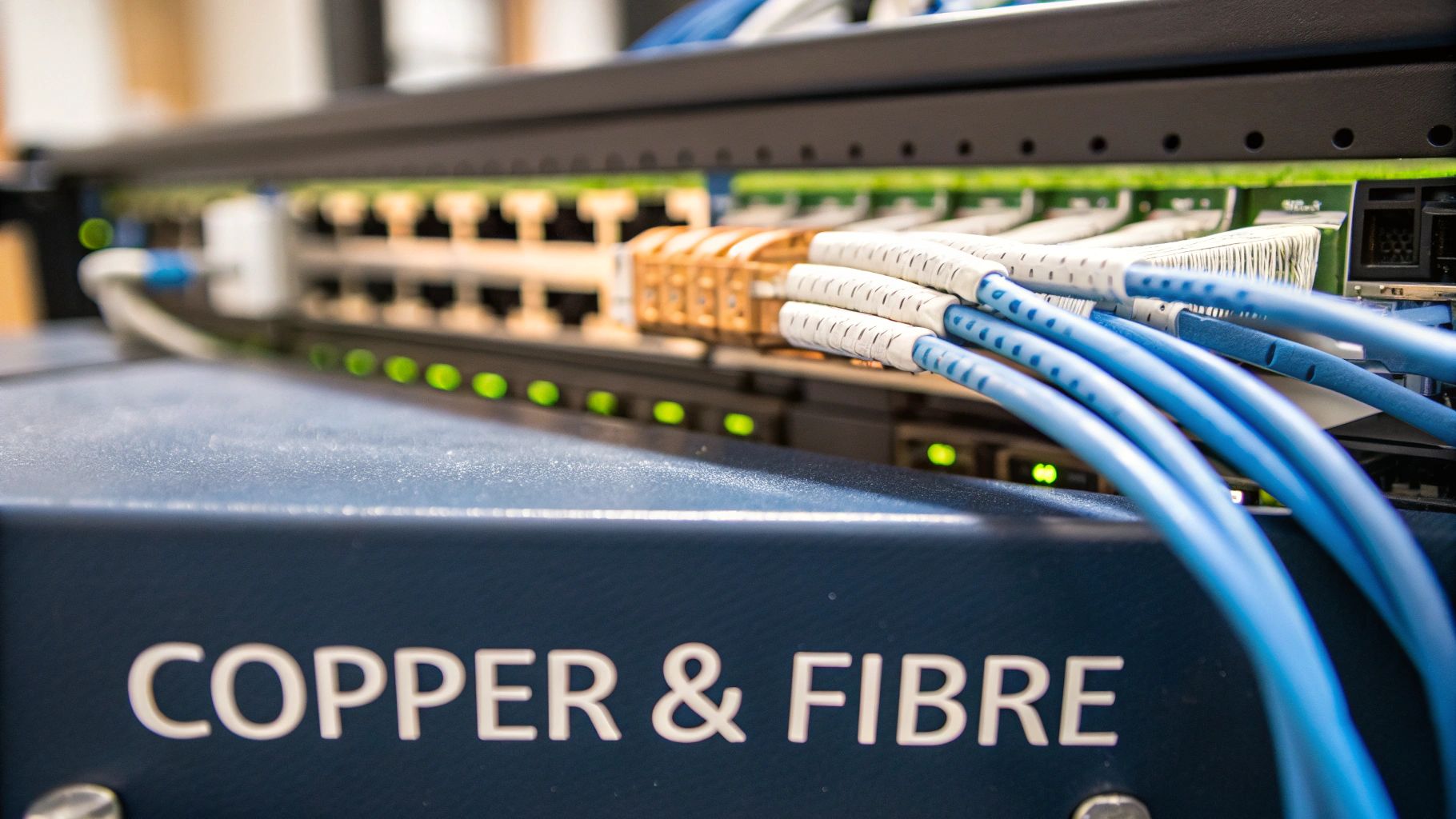
To make the right calls for your network, you first need to get your head around the basic building blocks. Forget the jargon for a moment. At its heart, your office infrastructure is built on two key technologies: structured copper cabling and high-speed fibre optics. A specialist firm like Fibre and Cabling Ltd lives and breathes this stuff, laying the physical groundwork that your entire digital operation depends on.
Think of structured cabling—things like Cat6a—as the intricate nervous system running through your building. It’s the reliable workhorse connecting every single computer, printer, desk phone, and Wi-Fi point back to your central network. It’s all about creating a system built for order and consistent day-to-day performance.
Fibre optics, on the other hand, are the high-capacity arteries of your network. These cables use pulses of light to transmit data, letting them shuttle huge amounts of information over long distances with practically zero signal loss. This makes them indispensable for the big, demanding connections, like linking separate buildings on a campus or connecting your office directly to a data centre.
The Role of Copper Structured Cabling
Structured copper cabling is what delivers the essential connectivity that powers a modern office. When an engineer installs a Cat6a network, what they're really doing is building a methodical, scalable system. Each cable runs neatly from a wall outlet all the way back to a central patch panel in your comms room, creating a network that’s clean, organised, and dead simple to manage.
This systematic approach is absolutely vital. It’s what stops the dreaded "spaghetti junction" of wires that plagues so many server rooms and turns troubleshooting into a complete nightmare. With a properly structured system, adding a new team member or moving a desk around is a simple case of patching a new connection, not trailing another cable across the ceiling. For a deeper dive, you can explore our detailed guide on what network infrastructure truly means for your business backbone.
The real value of a structured cabling system isn't just about plugging things in today. It's about building a stable and adaptable foundation that can easily handle future changes, whether that's taking on more staff, rolling out new tech, or completely reconfiguring your office layout.
Why Fibre Optics Are Indispensable
While copper is perfect for that final hop to a user's desk, fibre optics handle all the heavy lifting. Its massive bandwidth and immunity to electrical interference make it the only sensible choice for the core links in your network. If your business is spread across multiple floors or even separate buildings, fibre is what stitches your local networks together into one seamless whole.
Fibre's muscle is especially critical for data-heavy work. It provides the high-speed links needed for cloud computing, seamless video conferencing, and shifting massive files without a stutter. As businesses create and consume more data than ever, a solid fibre backbone is no longer a luxury—it’s a flat-out necessity for keeping your operations running at speed.
The Importance of Certifications and Warranties
Choosing a provider isn't just about who can pull the cables; it's about guaranteeing performance for the long haul. This is where industry certifications and manufacturer warranties become so important. When a company like Fibre and Cabling Ltd holds certifications from leading brands like Excel, it means their engineers are trained to install systems to precise, exacting standards.
Following these standards is what unlocks a comprehensive 25-year manufacturer warranty. This isn't just a vague promise that the parts won't break. It's a rock-solid guarantee that the entire installed system will meet specific performance benchmarks for a quarter of a century. That kind of assurance is invaluable, protecting your investment and ensuring your network can support whatever technology comes next without needing a costly overhaul. The UK structured cabling market is seeing huge investment, having generated USD 858.6 million and being projected to grow substantially as more businesses upgrade their core systems.
Integrating Power, CCTV and Data Seamlessly
Modern infrastructure projects are about so much more than just data cables. The days of treating data, power, and security as separate, siloed jobs are well and truly over. A genuinely resilient and efficient building relies on these three pillars being designed and installed as a single, cohesive system right from the start.
This integrated approach is a complete game-changer, especially during a complex office fit-out or when setting up a fully autonomous unmanned building unit.

Just picture the typical, fragmented process: you hire one contractor for your network cabling, a separate firm for the commercial electrical installation and certification, and yet another for the CCTV system. What you often end up with is a chaotic mess of coordination, clashing schedules, and finger-pointing when things inevitably go wrong. This disjointed approach creates needless risks and inefficiencies that can stall projects and blow your budget.
The Power of a Unified Approach
A unified strategy, where one expert team manages all three elements, just gets rid of all that friction. When a single partner like Fibre and Cabling Ltd handles the entire scope, they plan the infrastructure holistically from day one.
Cable pathways can be optimised for both data and power. Power outlets can be placed exactly where security cameras and network switches need them. The network backbone gets designed with enough capacity to handle high-definition CCTV streams without ever slowing down your users.
This synergy isn't just about convenience; it’s about creating a fundamentally better and more reliable system. It ensures every component works in perfect harmony from the moment it's switched on.
The core principle of modern infrastructure is interdependence. Your CCTV system is only as reliable as its network connection, and that network is useless without clean, certified power. Designing them together is the only way to guarantee resilience.
Ensuring Safety and Compliance
One of the most critical parts of this integrated model is the professional handling of commercial electrical installation and certification. Let's be clear: this is not a job for a data cabling engineer.
Certified electricians ensure that all power circuits are safe, fully compliant with UK regulations (like BS 7671), and more than capable of handling the load from all your IT and security equipment.
Proper certification gives you complete peace of mind, confirming your installation is legally sound and protecting your business from the huge risks that come with dodgy electrical work. It’s a non-negotiable part of any professional infrastructure project.
Risk Mitigation: Juggling multiple contractors massively increases the chance of miscommunication, leading to errors that can compromise the entire system.
Future-Proofing: A unified design considers what's next, making sure there’s plenty of power and network capacity for future expansion.
Simplified Accountability: With a single point of contact, you know exactly who is responsible for the project's success, from the initial design right through to the final sign-off.
Ultimately, a modern building's nervous system relies on the seamless integration of power, data, and security. Choosing a partner who can expertly deliver all three is the most strategic decision you can make for the long-term health and performance of your facility. Are you planning an office move or a new fit-out? It may be time to consider how a unified infrastructure strategy could benefit your project.
The Rise of the Unmanned Building
The idea of a fully automated, staff-free commercial building is quickly moving from science fiction to practical reality. We're talking about facilities like self-storage depots, remote server closets, and co-working spaces that run themselves without anyone permanently on-site. Unmanned building management means users get in, use the space, and leave—all managed by a smart, interconnected web of systems without permanent staff present.
But here’s the hard truth: the road to a successful unmanned building is paved with failed projects. The number one reason many unmanned building projects fail is a fragmented, piecemeal approach to design. So many organisations make the fatal mistake of treating access control, power, and data connectivity as three separate jobs, often handed to three different contractors. This siloed thinking is a recipe for disaster.
A truly reliable unmanned building has to be built on a unified foundation. Success hinges on designing access, power and data together as a single, interdependent ecosystem from the very first sketch. When one part of the system has a problem, the rest must carry on seamlessly—a goal that’s impossible if you're just bolting systems together as an afterthought.
Why a Holistic Design Is Non-Negotiable
The crippling weakness of a fragmented approach becomes glaringly obvious the moment something goes wrong. If the network drops, how do people get in or out? If there's a power cut, what keeps the doors locked and the cameras recording? These aren't wild "what if" scenarios; they are predictable, everyday challenges that the system must be engineered to handle.
This is where you need a specialist firm that gets the interplay between these systems, like a provider skilled in both data and electricals such as Fibre and cabling Ltd. They understand that the network is the building's nervous system, the electricals are its circulatory system, and the access control is its security perimeter. They have to work in perfect harmony, no exceptions.
The fatal flaw in most failed unmanned building projects is treating critical systems as independent components. True autonomy is achieved only when power, data, and access are engineered as one cohesive, fault-tolerant unit from day one.
Integrating Access, Power, and Data
To get this cohesion right, you need to focus on three core components: the locks, the power, and the data connection.
Access Control: The type of lock you choose is critical. One of the best real-world reasons for choosing battery-less, NFC proximity locks is to eliminate a huge point of failure: dead batteries. These locks cleverly draw power from the user’s smartphone or keycard during that split-second interaction, making them incredibly reliable and almost maintenance-free.
Power Systems: An unmanned site needs two things: rock-solid mains power and a robust backup. This means a certified commercial electrical installation to handle the day-to-day load, backed up by an uninterruptible power supply (UPS) or generator to keep the essential kit—like locks, CCTV, and network switches—online during an outage.
Data Connectivity: A stable network is the absolute lifeline for remote management. The infrastructure has to be tough enough to handle everything from processing access requests to streaming crystal-clear CCTV footage without a single bottleneck or point of failure.
Creating a genuinely autonomous building requires a major shift in mindset. You can't just pop in to fix a small issue when there's no staff on site. These unique maintenance and operational considerations demand a system designed for resilience from the ground up. For a deeper dive into this complex topic, you can learn more about how to approach unmanned building management in our detailed guide.
Ultimately, how reliable your unmanned facility is comes down to how well its core systems were integrated from the start. Choosing a partner who can deliver a unified infrastructure plan isn’t just a nice-to-have; it's the only way to succeed.
Comparing Infrastructure Partners and Services
Choosing the right partner for your infrastructure isn't just about getting quotes; it's about understanding the real value behind them. You need to look past the bottom line and figure out what different providers actually bring to the table. Whether you're running a simple cabling refresh or managing a full-blown office relocation, knowing the difference between a standard installer and a true end-to-end partner is critical.
The UK's connectivity market is growing at a serious pace, expected to hit USD 43.72 billion by 2031, thanks in large part to the massive shift towards high-speed fibre. With more providers popping up, it’s more important than ever to choose wisely. You can get more insights into the UK's evolving connectivity market and its future trends.
This growth makes clarity essential. One company might be great at a single task, while another is geared up to manage your entire project from the first sketch to long-term support. The right fit depends completely on what your project actually needs.
Scope of Services
The biggest difference you'll find is the sheer breadth of services on offer. A standard cabling provider, which is where a company like Fibre and Cabling Ltd fits, is laser-focused on one thing: installing structured cabling and fibre optics. They're specialists who lay down the physical data pathways that form the foundation of your network.
An end-to-end infrastructure partner, on the other hand, thinks much bigger. They don't just see data cables; they see the entire physical layer. This means they handle commercial electrical installation and certification, Wi-Fi surveys and deployment, CCTV systems, and even AV setups. It’s this joined-up approach that’s absolutely vital for projects like autonomous unmanned buildings, where every system has to work together perfectly. Examples of where these systems are commonly used include self-storage facilities, data centres, remote communications hubs, and flexible co-working spaces.
This infographic nails the problem: treating access, power, and data as separate jobs is one of the main reasons unmanned building projects fail.
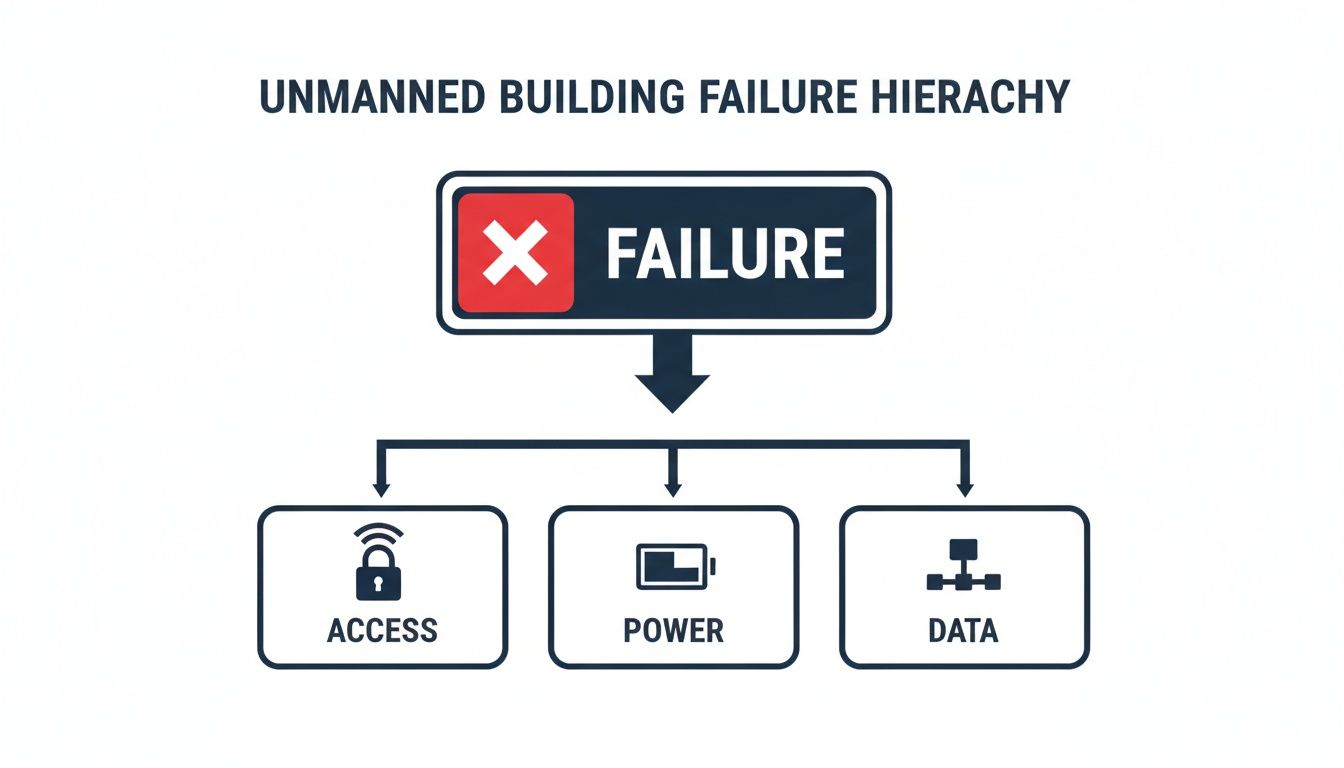
It makes it crystal clear that success comes from engineering these three pillars as one interdependent system, right from the very beginning.
To really spell it out, here’s a side-by-side look at how these two types of providers stack up.
Vendor Service Comparison: End-to-End Partner vs Typical Cabling Provider
Feature / Service | Typical Cabling Provider (e.g., Fibre and Cabling Ltd) | End-to-End Infrastructure Partner |
|---|---|---|
Primary Focus | Installation of data and fibre optic cabling. | Holistic design and delivery of the entire physical layer. |
Electrical Work | Generally not included; requires a separate contractor. | Full commercial electrical installation and NICEIC certification. |
Additional Systems | Limited to core data infrastructure. | Integrated Wi-Fi, CCTV, access control, and AV systems. |
Project Management | Task-focused; executes a defined scope of work. | Full lifecycle management from design to long-term support. |
Warranties | Basic warranty on parts and labour for the installation. | Comprehensive, manufacturer-backed 25-year system warranty. |
Ideal For | Small, straightforward cabling jobs or subcontracted work. | Complex projects, office relocations, and unmanned buildings. |
This table makes the distinction pretty clear. A typical cabler is a specialist for a specific task, while an end-to-end partner is a strategic asset for the entire project.
Warranties and Project Management
The type of warranty you get and how the project is managed are also miles apart. A standard installation will likely come with a basic guarantee on the parts and labour. That’s useful, but it’s limited.
In contrast, a certified end-to-end partner can offer a full 25-year manufacturer-backed warranty. This isn't just a promise that the parts won't break; it's an assurance that the entire system will hit specific performance benchmarks for decades. You only get this level of protection when the installers have been trained and certified to the manufacturer's incredibly strict standards.
An end-to-end partner's value is in their holistic project management. They don't just install cables; they orchestrate the entire process, ensuring that data, power, access, and security are seamlessly integrated for maximum reliability and future scalability.
The project management approach reflects this. A typical provider carries out a specific task. A partner, however, provides full support for the entire lifecycle of the project, from the initial design meetings, through the installation, and right into ongoing support afterwards. This is vital for complex builds like unmanned facilities, where you have to think about long-term operations and maintenance.
Choosing a partner who deeply understands how to design resilient systems—for instance, by using battery-less, NFC proximity locks to get rid of common failure points—can be the difference between a project that works and one that doesn't. Before you sign anything, take a step back and really think about the true scope of your project and which partner model truly aligns with your long-term goals.
Your Vendor Procurement Checklist
Getting the right infrastructure partner on board is the final, critical piece of the puzzle. It’s the move that guarantees your project’s success. But shifting from a longlist of potential vendors to your final choice demands a methodical approach, not just a gut feeling. This checklist is designed to help you cut through the sales noise and run a proper, evidence-based evaluation.
The goal is to find a partner who can deliver a reliable system that won't need ripping out in five years.
A vendor's ability to answer these questions with confidence is what separates the real experts from the rest. For a deeper look into effective procurement strategies, this checklist provides a solid foundation to start from.
Verifying Certifications and Experience
First up, let's talk credentials and track record. Vague assurances that they "know what they're doing" simply won't cut it. You need hard, verifiable proof of their expertise, especially when you're dealing with integrated systems where power, data, and security all need to play nicely together.
Electrical Certifications: Can you provide evidence of your NICEIC (or equivalent) accreditation for all commercial electrical installation and certification work? This is a non-negotiable for safety and compliance. No certificate, no conversation.
Manufacturer Accreditations: Are your engineers actually certified by the manufacturers of the kit you install (like Excel, for instance)? This is the only way to unlock those long-term system warranties everyone talks about.
Integrated Project Experience: Show me the case studies. I want to see projects where you’ve managed data, power, and CCTV installations as a single, unified project from start to finish.
Unmanned Building Expertise: Have you ever designed and built out a fully autonomous unmanned building unit? Get them to walk you through how they made sure the access control, power, and data all integrated seamlessly.
Clarifying Warranties and Project Management
A warranty is only as good as the small print, and a project is only as smooth as the person running it. You have to get absolute clarity on the precise terms of what you’re being offered and how they’ll manage the job on the ground.
A comprehensive, manufacturer-backed 25-year system warranty is the industry gold standard. It guarantees not just the physical parts but the performance of the entire installation. This is what provides genuine, long-term protection for your investment.
Warranty Scope: Let's be specific about this 25-year warranty. Is it a full system performance guarantee, backed directly by the manufacturer, or is it a much more limited installer warranty on just parts and labour?
Project Management Methodology: Who is my single point of contact? I don't want to be chasing three different people. How will you handle scheduling, progress updates, and coordinating with other trades on a busy site?
Testing and Handover: What's your process for testing and certifying the entire installation? And what documentation will I be holding in my hands when you tell me the project is complete?
The UK's fixed broadband market is shifting decisively towards fibre, even as the total number of connections has plateaued. FTTB/H/P lines shot up by 8% to 9.86 million connections, and providers like Openreach are adding a record 529,000 FTTP customers in a single quarter. This surge highlights the massive demand for top-quality installations. A partner like Fibre and Cabling Ltd, who can answer these questions without hesitation, is exactly the kind of company positioned to deliver on that demand.
Your Questions, Answered
When it comes to planning a major infrastructure project, a few key questions always come up. Here are the straight answers we give to IT and Facilities Managers.
How Does An Unmanned Building Actually Work?
Think of an unmanned building—like a self-storage site or a remote comms room—as a facility that runs on autopilot. There’s no permanent staff on-site. Instead, users get in with smart access control, while everything else from lighting and security to climate control is managed from a distance.
For this to work flawlessly, the entire operation hinges on a perfectly unified infrastructure. The CCTV, access systems, and network can't just be separate components; they have to function as a single, cohesive unit.
Why Do So Many of These Projects Go Wrong?
The single biggest point of failure we see is a siloed approach to design. Projects fall apart because the access control, power, and data are treated as totally separate jobs, often handled by different contractors who aren't talking to each other.
The result? When one piece of the puzzle fails—say, the network goes down—it can take the entire system with it. Suddenly, the building is completely inaccessible and insecure, all because the systems weren't engineered to depend on one another from the start.
What’s the Big Deal with Battery-Less NFC Locks?
Battery-less, NFC proximity locks are a complete game-changer for unmanned sites. Why? Because they get rid of one of the most persistent maintenance headaches: dead batteries.
Instead of needing their own power source, these clever locks draw a tiny bit of energy from the user's smartphone or access card at the very moment of use. This makes them incredibly reliable and slashes the operational overhead of having to constantly check and replace batteries across dozens, or even hundreds, of doors.
What Should I Really Look For in a Cabling Partner?
Look beyond just a competitive price tag and dig into their certifications. A partner who can handle commercial electrical installation and certification (like having an NICEIC accreditation) alongside your data cabling is a huge advantage. It means a safer, more integrated project from day one.
But here’s the crucial part: ask them point-blank if they are accredited by the manufacturer to provide a full 25-year system performance warranty. This isn't just a basic guarantee on parts and labour; it's a long-term promise that the entire system will perform as it should. For a specialist installer like Fibre and Cabling Ltd, offering this level of assurance is a key sign you're dealing with a true expert.
Planning an office fit-out or infrastructure upgrade demands a partner who sees the whole picture, not just the individual parts. Constructive-IT specialises in designing and delivering integrated data, power, and security systems that work together seamlessly from the moment they're switched on.
Comments