


A Complete Guide to Cat 6a Cables for Business Networks
- Craig Marston
- Dec 30, 2025
- 16 min read

Think of your network cabling as the central nervous system of your business. It’s mostly invisible, tucked away in walls and ceilings, but it’s the absolute foundation for every single digital communication your organisation relies on. Cat 6a cables are the modern standard for this critical system, delivering the speed and reliability that demanding environments like commercial offices and hospitals need to function. This is the cabling that ensures your infrastructure can handle what you need today, and what you’ll need tomorrow, without hitting a frustrating performance bottleneck.
Why Cat 6a Is the New Standard for Business
In any busy commercial space, whether it’s a fast-paced office or a critical-care hospital ward, the need for fast, stable data is non-negotiable. While older standards like Cat 5e and Cat 6 were fine in their day, they now act as a major brake on modern applications and devices.
Choosing to install Cat 6a cabling is a strategic investment in your organisation’s digital future. This isn't just about getting faster speeds; it’s about laying a rock-solid foundation that can support every part of your operation without compromise.
Future-Proofing Your Commercial Network
The real advantage of Cat 6a is its ability to effortlessly handle the demanding technologies that are now completely standard in the workplace. This includes:
10Gbps Ethernet: This delivers ten times the speed of the old gigabit standard, which is essential for preventing network lag when you’re handling data-heavy tasks.
High-Density Wi-Fi: Modern Wi-Fi systems like Wi-Fi 6 and 6E need a seriously powerful wired backbone to deliver top-tier wireless speeds to hundreds of devices at once.
Power over Ethernet (PoE): This is what powers devices like your VoIP phones, CCTV cameras, and wireless access points directly through the network cable itself, which massively simplifies installation and ongoing management.
A foundational element of any robust business network is its physical infrastructure; understanding modern cable standards like Cat 6a is key to implementing effective network security best practices.
Avoiding Costly Data Network Mistakes
One of the most common—and expensive—data network mistakes we see is when a business under-specifies its cabling during a new build or an office move. Opting for cheaper, older cables might seem like a smart way to save a bit of cash upfront, but it builds a performance ceiling into your building that’s incredibly disruptive and costly to fix down the line. A full re-cabling project means serious downtime, hitting productivity across your entire organisation.
By installing a professionally certified and tested Cat 6a network from the very beginning, you guarantee that the physical layer of your network can handle future upgrades for years to come. That foresight prevents a complete, disruptive overhaul and protects your initial investment. As an Excel network accredited partner, the installations we deliver come with a 25 year equipment warranty, guaranteeing you long-term performance and complete peace of mind.
Understanding Cat 6a Technical Specifications
To really get why Cat 6a is the go-to standard for modern offices, commercial buildings, and hospitals, we need to look under the bonnet. The technical details are what separate this modern cable from older, less capable standards, and they translate directly into real-world performance gains for your network. It's the difference between a country lane and a multi-lane motorway for your data.
The single biggest upgrade is its 500 MHz bandwidth, which is double that of standard Cat 6. This wider frequency range is what allows Cat 6a cables to reliably support 10 Gigabit Ethernet (10GbE) data rates over the full 100-metre channel length. Older cables simply can't maintain that speed over the distances you find in a typical office floor or hospital wing.
Getting this right from the start is essential for preventing the kind of data network mistakes that can cripple a business during an office fit-out or new build. Making sure your network is tested and certified is the only way to be sure it's ready for whatever you throw at it tomorrow.
Shielding Against Interference
In busy commercial environments, cables are often bundled together in trays, running right alongside power lines, LED drivers, and air conditioning units. This creates a noisy electrical environment where signals can interfere with each other—a problem known as crosstalk. Cat 6a is built to tackle this head-on.
A key differentiator is the widespread use of Shielded Twisted Pair (STP) cables. This design wraps a foil or braided shield around the internal wires, acting as a protective barrier against that electrical noise.
This shielding is particularly good at fighting off alien crosstalk, which is the signal noise that "bleeds" between adjacent cables in a large bundle. In places like data centres or comms rooms where hundreds of cables run side-by-side, unshielded cables would suffer serious performance drops, but STP Cat 6a maintains its signal integrity.
The market is clearly shifting towards shielded solutions. In the UK, for example, Excel Networking has become a leader in Category 6a cables, capturing 22% market share in 2022. Over half of these connections were shielded, designed for reliable performance in demanding environments like NHS hospitals.
The Role of Wire Gauge and Cable Design
Another important technical aspect of cat 6a cables is their physical construction. They typically use a thicker copper conductor, often 23 American Wire Gauge (AWG). A thicker wire has less resistance, which means a stronger signal and, crucially, it's far better at dissipating the heat generated by Power over Ethernet (PoE) applications.
This robust design is what ensures devices like high-definition CCTV cameras, advanced Wi-Fi 6 access points, and VoIP phone systems get both stable power and a rock-solid data connection. It's a critical factor in supporting the infrastructure of a modern, tidy desk environment, free from a mess of power adapters through smart cable management.
This chart breaks down the core benefits these technical specs deliver in a real-world setting.

As you can see, Cat 6a's technical superiority translates directly into practical advantages: blazing 10Gbps speed, a powerful backbone for your Wi-Fi, and robust support for high-wattage PoE devices.
To help put Cat 6a's capabilities into context, it's useful to see how it stacks up against the older standards you'll often find in existing buildings.
Cat 6a vs Cat 6 vs Cat 5e Performance Comparison
This table highlights the key performance differences between common Ethernet cable categories to help businesses choose the right standard for their needs.
Specification | Cat 5e | Cat 6 | Cat 6a |
|---|---|---|---|
Max Bandwidth | 100 MHz | 250 MHz | 500 MHz |
Max Data Rate | 1 Gbps | 1 Gbps (10 Gbps up to 55m) | 10 Gbps |
Max Distance for Top Speed | 100 metres | 55 metres (for 10GbE) | 100 metres |
Typical Shielding | Unshielded (UTP) | Unshielded (UTP) | Shielded (STP/FTP) |
The takeaway is clear: while Cat 5e and Cat 6 were fine for their time, only Cat 6a is engineered to deliver the full 10GbE performance required by modern networks over standard commercial distances.
"Choosing Cat 6a isn't just about speed; it's about reliability. In environments where network failure is not an option, the superior shielding and construction provide the performance assurance that modern businesses demand. It’s the baseline for any certified network delivery."
Ultimately, these technical elements work together to create a cabling system that is not only faster but fundamentally more stable and resilient. This performance guarantee is why, as an Excel accredited partner, we can confidently offer a 25 year equipment warranty on our professionally tested and certified installations. For a deeper dive, check out our essential guide to Category 6a cable for UK networks.
Right then, let's move from the technical specs to where the rubber really meets the road. In certain environments, hitting the high-performance benchmark set by Cat 6a cables isn't just a nice-to-have; it's a fundamental requirement for keeping things running smoothly. For the mission-critical infrastructure in commercial buildings, data centres, and hospitals, settling for anything less introduces an unacceptable risk of bottlenecks and future headaches.
These cables are the rock-solid foundation needed to support the web of interconnected systems that defines a modern workspace. From servers crunching vast amounts of data to the smart devices that keep a building secure and efficient, Cat 6a provides the capacity and resilience you need.
Fuelling the Data Centre Core
The data centre or server room is the engine room of any modern organisation. It's where immense volumes of data are processed, stored, and shifted every second. The links between servers, storage area networks (SANs), and other core equipment demand connections that are both lightning-fast and completely stable.
Cat 6a is the go-to copper standard for these environments, guaranteeing sustained 10Gbps speeds for those crucial server-to-switch links. This ensures data flows without restriction, preventing the kind of lag that could bring business operations to a grinding halt. In sectors like healthcare, this speed is absolutely vital for pulling up large medical imaging files and patient records from a central repository without a moment's delay.
The demand for this level of performance is exploding. UK data centre cabling is seeing huge growth, with the Cat 6a segment predicted to grab 38.5% market share by 2025. This isn't just a trend; it reflects its essential role in modern server room builds and upgrades. You can find more insights on these data centre market trends on futuremarketinsights.com.
The Essential Backbone for Modern Wi-Fi
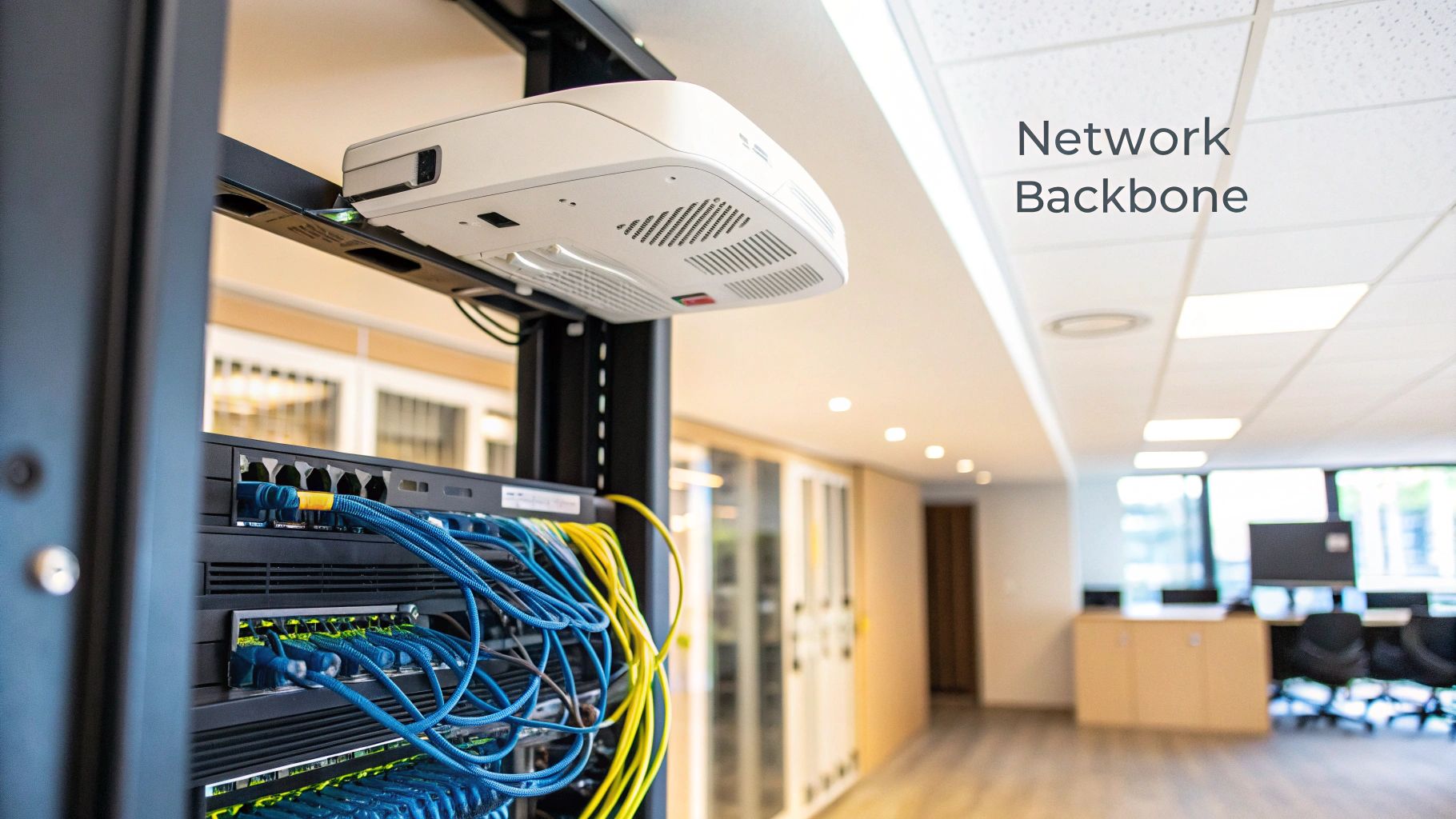
One of the most common networking mistakes we see is businesses investing a fortune in the latest high-speed Wi-Fi access points (APs) while completely neglecting the cables that connect them to the network. A brand new Wi-Fi 6 or 6E access point can deliver multi-gigabit speeds, but it’s utterly pointless if its wired connection back to the switch is capped at 1Gbps.
This is where Cat 6a plays a vital role as a powerful backhaul. By giving each AP a 10Gbps link, it ensures the wireless network has the headroom it needs to support hundreds of users and devices without creating a traffic jam. This is absolutely critical in high-density environments like:
Open-plan commercial offices: Where dozens of staff rely on flawless wireless for video calls and cloud apps.
Hospital wards: Supporting mobile workstations, patient monitors, and staff communication tools all at once.
Conference centres: Handling a huge volume of guest devices all trying to connect simultaneously.
Without a Cat 6a backbone, your advanced Wi-Fi system is like a Ferrari stuck in rush-hour traffic—it has all the potential for incredible performance but is ultimately held back by the crumbling road around it.
Powering Critical Devices with PoE
Modern buildings increasingly run on devices powered directly through their network connection using Power over Ethernet (PoE). This tech massively simplifies installation and cable management, as you no longer need a separate power socket at every device location. The catch? Pushing higher levels of power down a cable generates heat, which can seriously degrade data performance.
Cat 6a’s thicker copper conductors are significantly better at managing this heat than older cables. This makes it the perfect choice for deploying a whole range of essential PoE-powered systems, making sure they get both stable power and reliable data.
Key applications include:
VoIP Phone Systems: Delivering crystal-clear voice quality across the entire office.
High-Definition CCTV Cameras: Ensuring security systems get an uninterrupted data stream for recording and monitoring.
Access Control Systems: Reliably powering door readers and controllers to keep the building secure.
Smart Building Sensors: Supporting the IoT devices that manage everything from lighting to climate control.
By running these systems on a single, certified Cat 6a network, you create a tidy, manageable, and highly efficient infrastructure. This is particularly valuable during complex projects like an office relocation, where a unified cabling system simplifies the entire equipment testing and deployment process.
Common Installation Mistakes That Cripple Network Performance
Investing in high-performance Cat 6a cabling is a brilliant first step, but it’s only half the battle. Even the best cable in the world is useless if the installation itself is flawed. All too often, we see common but critical mistakes that sabotage network performance, turning your high-speed motorway into a frustrating crawl and leading to expensive fixes down the line.
These data network mistakes aren't always obvious. A network might seem to "work," but those intermittent dropouts, sluggish speeds, and unexplained glitches can almost always be traced back to poor installation practices. This is precisely why a professional installation isn't a luxury; it's essential for guaranteeing you get the performance you actually paid for.
Exceeding the Maximum Bend Radius
One of the most frequent yet damaging errors we see is bending a cable too tightly around a corner. Every Cat 6a cable has a minimum bend radius—usually about four times the cable's diameter—that must be respected. Kinking or sharply creasing the cable damages the delicate internal twisted pairs, changing their geometry and creating a weak point where data signals are reflected or lost completely.
This seemingly small mistake can introduce significant performance issues that are notoriously difficult to track down after the walls are closed up. Sticking to this rule is absolutely crucial for maintaining signal integrity along the entire run.
Improper Termination and Cable Management
How a cable is terminated at the patch panel and wall outlet is just as important as the cable run itself. A common shortcut is to untwist the pairs too much before punching them down into the jack. This introduces crosstalk and signal degradation right at the connection point, completely undermining an otherwise perfect installation.
Just as critical is proper cable management. A chaotic "spaghetti junction" of cables doesn't just look unprofessional; it puts physical strain on the connections and turns future maintenance into a nightmare. Neatly organised cable runs are the hallmark of a professional job, essential for a manageable comms room and a tidy desk environment for your team.
A correctly installed network is about more than just getting a connection; it's about delivering certified, guaranteed performance. A single poor termination can compromise an entire link, which is why every connection must be meticulously executed and tested.
Ignoring Electrical Interference
Running Cat 6a cables parallel and too close to power lines, fluorescent lighting, or heavy machinery is a recipe for disaster. This creates electromagnetic interference (EMI), which can easily corrupt the data signals travelling through your network cables.
Professional installers follow strict separation guidelines to avoid this. While shielded Cat 6a helps reduce this risk, physical separation is always the first and best line of defence. For environments with exceptionally high EMI, like certain hospital settings, a robust fibre cable installation might even be a better choice as it’s completely immune. To learn more about the fundamentals, you can explore our essential guide to data cabling installation.
The only way to be certain that none of these mistakes have compromised your network is through rigorous testing. This is why partnering with an Excel accredited partner is so vital. We provide a fully certified and tested network delivery, complete with a 25 year equipment warranty, ensuring your infrastructure is reliable and performs exactly as specified from day one—especially critical for commercial buildings and hospitals where network uptime is non-negotiable.
The Value of Certified Testing and Long-Term Warranties
After all the planning and careful installation work, there’s one final step that’s completely non-negotiable: making sure your network is tested and certified. Professional testing is what transforms a collection of cables and components into a guaranteed, high-performance system. This is where the idea of certified network delivery becomes so important, especially for the high standards of commercial buildings and hospitals.
This isn’t about just plugging in a laptop to see if you get an internet connection. Proper certification is a forensic examination of your new Cat 6a cables infrastructure. It’s the only way to be absolutely certain that none of the common installation mistakes we discussed earlier have silently sabotaged your network’s integrity.
What Does Certified Network Delivery Actually Involve?
To get a network certified, engineers use highly advanced tools like a Fluke CableAnalyzer. This bit of kit goes far beyond a simple continuity check; it performs a whole battery of rigorous tests on every single cable link, from the patch panel in the comms room all the way to the outlet at a user's tidy desk.
The analyser measures complex performance metrics that are invisible to the naked eye but are absolutely critical for hitting those 10Gbps speeds. These tests include:
Near-End Crosstalk (NEXT): Checks for signal "bleed" between the wire pairs right at the connection point.
Return Loss: Measures any signal that gets reflected back towards the source because of a bad connection or damaged cable.
Insertion Loss: Quantifies how much signal strength is lost over the full length of the cable run.
Alien Crosstalk (ANEXT): Specifically tests for interference bleeding between adjacent Cat 6a cables—a massive factor in densely packed installations.
A cable is only officially certified when it passes every single one of these tough tests with flying colours. This process gives you solid, empirical proof that your network is free from physical faults and is ready to deliver its maximum performance.
The Power of a 25-Year Equipment Warranty
Achieving this certification is what unlocks the most powerful form of protection for your investment: a long-term manufacturer warranty. As an Excel accredited partner, our certified installations are backed by a comprehensive 25 year equipment warranty. This is so much more than a piece of paper; it’s a long-term promise of quality and performance.
This warranty guarantees that every single component in your structured cabling system—from the cables and patch panels to the wall outlets—will continue to meet the specified Cat 6a performance standards for a quarter of a century. It provides complete peace of mind, knowing your network’s foundation is secure.
This level of assurance is indispensable during major projects like an office relocation or a new hospital build, where the network simply has to work flawlessly from day one and be ready for future demands. The UK Ethernet cable market is growing fast, with the Cat 6a segment expected to contribute to a 10.2% CAGR from 2023 to 2030, driven by this very need for high-capacity infrastructure. Investing in a future-proof, warrantied solution is the only logical way to respond. You can find out more about the UK's growing demand for high-performance cabling on 6wresearch.com.
Making sure your network is professionally tested and certified isn't just an added expense. It’s the final act that validates your entire investment, protecting your organisation from the data network mistakes that lead to slow speeds, frustrating downtime, and costly repairs down the line.
Choosing the Right Partner for Your Network Project
Picking out the best Cat 6a cables is a great start, but it’s only half the battle. The real secret to a network that performs flawlessly for years to come lies in choosing the right installation partner. An expert team doesn't just pull cables; they translate your business needs into a high-performance reality, especially in tricky environments like busy commercial buildings or hospitals.
A professional installer does more than just connect points A and B. They actively prevent the common data network mistakes that plague so many networks—things like sloppy terminations or failing to account for electrical interference. This expertise is what separates a frustratingly slow network from a fully certified system that just works.
What to Look for in a Network Installer
A top-tier installation partner will have the credentials to back up their claims. One of the clearest signs of quality is accreditation from a major manufacturer, like our status as an Excel network accredited partner. This isn't just a logo for the website; it's your proof of competence and quality.
Crucially, this accreditation is what allows a partner to offer a manufacturer-backed 25 year equipment warranty. This is your ironclad guarantee that every single component, from the cable to the wall socket, will perform as it should for decades. It’s about total peace of mind and protecting your investment.
Beyond the badge, you need a partner with a proven track record. Make sure they can deliver on:
Certified Network Delivery: They must have the advanced tools to test every single link and hand you a detailed report proving the network meets stringent Cat 6a standards.
Fibre Cable Installation Expertise: Your network's backbone often relies on fibre optics. Your partner needs the skill to seamlessly integrate a fibre cable installation for high-speed links or in areas with heavy electrical noise.
Meticulous Cable Management: A neat and tidy comms cabinet isn't just for show. It’s essential for future maintenance, troubleshooting, and helps maintain that clean, professional tidy desk environment for your staff.
Expertise in Complex Commercial Projects
The true value of a seasoned installer shines through on complex projects like a full office relocation or a new building fit-out. These jobs demand military-grade planning and execution to keep downtime to an absolute minimum and ensure every system is live from day one.
An experienced partner will manage the whole process, including crucial equipment testing both before and after a move to guarantee everything works perfectly in the new space. They know the unique challenges of working in live environments like commercial buildings and hospitals, where precision and causing zero disruption are paramount.
A truly professional network installation is a blend of technical skill and project management excellence. The goal is to deliver a network that is not only fast and reliable but also manageable and scalable for the future.
Beyond just the Cat 6a cables, a great partner can provide vital support for the entire lifespan of your IT infrastructure. This includes offering sound advice on IT asset lifecycle management to help you get the most out of your technology. At the end of the day, having your network professionally tested and certified is the only way to be sure you got what you paid for.
Ultimately, choosing the right partner means you're not just buying cables; you're investing in a certified, warrantied, and expertly managed network infrastructure built for the future. For more guidance, you can learn about choosing network cabling installers you can trust in our detailed guide.
Your Cat6a Questions, Answered
We’ve covered the technical side of things, but I know that when it comes to a real-world project, there are always a few practical questions. Here are the straight answers to the common queries we get from IT managers and business owners planning projects in offices, hospitals, and other commercial buildings across the UK.
Is Cat6a Really Worth the Extra Cost Over Cat6 for an Office?
Absolutely. It’s one of those classic "pay a little more now or pay a lot more later" decisions. While Cat6 can technically handle 10Gbps, it’s only reliable over short distances of around 37-55 metres and is far more prone to interference.
Cat6a, on the other hand, guarantees full 10Gbps performance across the entire 100-metre channel, which is the standard for most commercial buildings. The slightly higher initial investment completely prevents the enormous cost and disruption of having to re-cable your entire office when your network demands inevitably grow. It's about building for the future, not just for today.
Do I Need Shielded Cat6a Cables for My Project?
For the vast majority of commercial environments like office fit-outs, hospitals, or data centres, shielded Cat6a is the only way to go. The shielding provides vital protection against the electromagnetic interference (EMI) that’s unavoidable around power lines, fluorescent lighting, and other building systems.
But the biggest reason is to combat 'alien crosstalk'—the signal noise that bleeds between adjacent high-speed cables when they're bundled together. In any dense cabling installation, this is absolutely essential for a stable, certified network that performs at its peak.
What Does a 25-Year Cabling Warranty Actually Cover?
A 25 year equipment warranty from a manufacturer like Excel, provided through an Excel network accredited partner, covers the performance of the entire cabling system from end to end.
This means that if the installation is professionally tested and certified to meet Cat6a standards on day one, the warranty guarantees it will continue to meet those exact same standards for a quarter of a century. This includes the patch panels, the cables themselves, and the outlets, protecting your investment and guaranteeing link performance for the long haul.
Can I Use Cat6a for CCTV and Access Control Systems?
Yes, and it's an excellent choice. Modern IP-based security systems, especially those using Power over Ethernet (PoE), benefit hugely from Cat6a. Its thicker copper conductors are much better at handling power delivery than older cables, running more efficiently with less heat build-up.
This ensures your critical devices like cameras and door controllers get reliable power and data, helping you build a single, robust cabling solution for all your building's systems. It’s a key part of good cable management, whether you're aiming for a tidy desk environment or planning a full office relocation with integrated equipment testing.
Ready to ensure your next project is built on a high-performance, future-ready network foundation? As an Excel accredited partner, Constructive-IT delivers fully certified and tested network installations backed by a 25-year warranty.
Comments