


Advantages of wired networking: advantages of wired networking for faster growth
- Craig Marston
- Dec 22, 2025
- 17 min read

In an age where wireless is everywhere, it’s easy to forget what holds it all together. For any serious business, a physical cable remains the absolute cornerstone of its operations. The real-world advantages of wired networking boil down to three non-negotiable pillars: unmatched speed, ironclad security, and rock-solid reliability.
These aren’t just minor upgrades over Wi-Fi; they represent the essential foundation for any commercial environment where performance and uptime are critical.
Why a Wired Network Is Your Business's Digital Foundation
Think of your company's digital infrastructure like a modern skyscraper. Wi-Fi gives you the flexibility of arranging the furniture and moving around freely inside, but the structured cabling is the deep bedrock and steel framework holding the entire structure up. It’s what guarantees the building is stable, powerful, and secure.
This physical backbone underpins every single digital interaction your business depends on, from crystal-clear video calls with clients to the transfer of critical, time-sensitive data.
For commercial buildings and vital facilities like hospitals, relying only on wireless is a huge gamble. A professionally installed wired network, on the other hand, is a strategic asset. It creates a dedicated, private superhighway for your data, completely free from the signal interference and digital traffic jams that constantly plague wireless airwaves.
Wired vs Wireless: A Quick Comparison for Business Operations
When deciding on your network's architecture, the choice between wired and wireless isn't just a technical detail—it's a strategic business decision. This table breaks down the core differences in a practical way, showing where each technology truly shines in a professional setting.
Feature | Wired Networking (Structured Cabling) | Wireless Networking (Wi-Fi) |
|---|---|---|
Speed & Bandwidth | Consistently high speeds (1 Gbps to 10 Gbps+), dedicated bandwidth per device. | Variable speeds, shared bandwidth, susceptible to slowdowns with more users. |
Reliability & Uptime | Extremely stable connection, immune to radio frequency interference. Rock-solid. | Prone to interference from other devices, walls, and even microwaves. |
Latency (Ping) | Ultra-low latency, crucial for real-time applications like video calls and financial trading. | Higher latency, which can cause noticeable lag and jitter in sensitive applications. |
Security | Highly secure. Physical access is required to intercept data. | Inherently less secure. Data is broadcast over the air, requiring robust encryption. |
Deployment | Requires physical cable runs, patch panels, and outlets. More intensive initial setup. | Simpler setup with access points, but requires careful planning for coverage. |
Mobility | Limited to the physical location of the network port. | The key benefit. Allows users to connect anywhere within the signal range. |
As you can see, while Wi-Fi offers fantastic convenience, a wired network provides the raw power and stability that business-critical operations demand. The two technologies work best when used together, with wired connections forming the reliable core and Wi-Fi providing flexible access where needed.
The Strategic Value of Professional Installation
Avoiding common, and often costly, data network mistakes starts with getting the installation right from day one. An accredited partner doesn’t just pull cables through a ceiling void; they engineer a complete system that supports your business today and is ready for whatever you throw at it tomorrow.
Here’s what that professional approach actually looks like:
Certified and Tested Delivery: Every single connection is meticulously tested with specialist equipment to prove it meets performance standards. Making sure your network is tested and certified guarantees you get every bit of the speed and reliability you paid for.
Meticulous Cable Management: This is about more than just a tidy desk. Proper management prevents signal degradation, makes troubleshooting a breeze, and ensures the long-term health of your entire network.
Long-Term Warranties: A 25-year equipment warranty gives you complete peace of mind, turning your network from a recurring headache into a predictable, long-term investment.
This forward-thinking approach is mirrored in national infrastructure trends. The UK's rapid shift to full-fibre (FTTP) wired networking is unlocking huge economic advantages, with the market projected to grow at an 11.10% compound annual growth rate through 2030. This growth, driven by the demand for efficient, modern infrastructure, just highlights the long-term value of investing in a robust physical network.
Ultimately, a professionally installed and managed wired system is fundamental to your entire network infrastructure. Whether you're in a stable office environment or navigating a complex office relocation, ensuring your physical connections are properly installed and tested is the first and most important step towards building a resilient, high-performance business.
Achieving Unbeatable Speed and Reliability
In any commercial environment, from a bustling corporate office to a critical-care hospital wing, your network's performance isn't a luxury—it's the engine driving the entire operation. The clearest advantages of going with a wired network boil down to two things: raw speed and unwavering reliability. These aren't just technical specs; they directly impact productivity and efficiency every single minute of the day.
A professionally installed wired network gives your data a dedicated, private superhighway, free from the bottlenecks and unexpected dropouts that so often plague wireless connections.
Think of your data travelling on a private, multi-lane motorway with no speed limits or traffic jams. That’s what you get with a structured fibre optic or Cat6a wired connection. Each device gets its own lane, guaranteeing a consistent, high-speed journey. Wi-Fi, on the other hand, is more like a busy city A-road. Every device shares the same congested space, leading to slowdowns and unpredictable delays caused by interference from other wireless signals or even the office microwave.
Translating Speed into Business Outcomes
Raw speed, measured in gigabits per second (Gbps), is much more than a number on a spec sheet. It translates into real, tangible business outcomes. By giving your team a dedicated data pipeline, a wired network eliminates digital friction and unlocks truly seamless workflows.
Here’s what that performance looks like in the real world:
Flawless Video Conferencing: Say goodbye to frozen screens and robotic voices. A wired connection delivers the stable, low-latency link needed for crystal-clear 4K video meetings, making remote collaboration feel as effective as being in the same room.
Instantaneous File Transfers: For teams working with large design files, video projects, or hefty databases, waiting for uploads is a productivity killer. A wired network can slash transfer times from minutes down to mere seconds.
Zero-Lag Cloud Access: With more applications moving to the cloud, a responsive connection is essential. A hardwired link ensures your team can access and use cloud-based software without those frustrating delays that break concentration and slow down operations.
The Critical Role of Reliability in Demanding Environments
While speed is impressive, reliability is completely non-negotiable, especially in places where downtime has serious consequences. Hospitals, for example, depend on a constant, stable network for everything from patient monitoring systems to accessing medical records. A dropped Wi-Fi signal in that setting isn't a minor inconvenience—it's a critical failure.
A wired network physically isolates your connection from the chaotic radio frequency spectrum, cutting out the variables that can wreck performance. This immunity to interference is a core benefit, ensuring you get consistent, predictable peak performance around the clock. The entire system is designed for uptime, providing a stable foundation you can build your business on.
A common and costly mistake is underestimating the impact of latency. Bandwidth determines how much data you can send, but latency determines how fast it starts its journey. The ultra-low latency of a wired connection is what makes applications feel instantly responsive.
The Long-Term Performance Guarantee
This high level of performance isn't just a short-term boost. A professionally designed and implemented system from an Excel accredited partner is built to last for decades. When you invest in a fibre cable installation, you're putting in infrastructure that will meet your needs for years, if not decades, to come. For a deeper look at the specifics, our guide to fibre optic cable provides a detailed breakdown of its capabilities.
Crucially, this long-term reliability is backed by a certified, tested network delivery. Every single cable and connection is verified to meet stringent performance standards, ensuring you get the speed and stability you were promised. It is this rigorous process that unlocks a comprehensive 25-year equipment warranty, offering total peace of mind and guaranteeing a network that performs flawlessly not just on day one, but for a generation. It’s a true investment in predictable, sustained operational excellence.
Fortifying Your Business with a Secure Physical Network
In the modern world of business, we often think of cybersecurity as a software problem—firewalls, antivirus, and encryption. But real network security starts at the most fundamental level: the physical layer. The single biggest security advantage of a wired network is its tangible, physical boundary. By its very nature, a hardwired system is a closed loop, meaning a bad actor needs direct, physical access to a network port to even attempt a breach.
This simple fact creates a powerful first line of defence. It completely neutralises a whole category of remote threats that target wireless signals, like ‘man-in-the-middle’ attacks where data is intercepted as it travels through the air. For any organisation handling sensitive client data, from commercial buildings to hospitals, this physical barrier is an invaluable asset.
While modern Wi-Fi has robust encryption, the very act of broadcasting your network signal introduces a vulnerability that a professionally managed and tested wired network simply doesn't have.
The Physical Moat Around Your Data
Think of your network like a medieval castle. A wireless network is like leaving the drawbridge permanently down—you’re relying entirely on guards (passwords and encryption) to check everyone who tries to get in. A wired network, on the other hand, keeps that drawbridge pulled up by default. The only way in is to physically get over the walls and plug directly into the infrastructure.
This controlled environment is precisely why wired networking remains the gold standard for protecting your most valuable digital assets. It drastically shrinks the attack surface, making it exponentially harder for unauthorised users to even get a foothold. This is especially vital in multi-tenanted commercial buildings or sprawling hospital campuses where you have no control over every device within signal range.
The real security of a wired network comes from its physical limitations. If an intruder can’t physically connect to your cabling, they are locked out before their attack can even begin. It’s a foundational security principle that wireless technology just can't replicate.
Preventing Common Data Network Mistakes
Many of the most common data network mistakes come from overlooking the physical security of the network itself. An unlocked comms room or an active, unsecured network port in a public-facing area can completely undermine the most sophisticated digital defences. A key part of a professional fibre cable installation isn’t just connecting the endpoints, but also securing the physical infrastructure from end to end.
This comprehensive approach involves:
Securing network hardware: Racking all equipment in locked cabinets within controlled-access server rooms.
Deactivating unused ports: Making sure that abandoned or unused network outlets can't be exploited as an easy entry point.
Clear cable management: A tidy desk and an organised server rack aren't just for looks; they make it incredibly easy to spot unauthorised connections or tampering.
Beyond the physical fortifications, it's crucial to systematically identify and address every potential vulnerability. Utilize a cybersecurity risk assessment template to develop a robust security plan.
The Assurance of a Certified and Tested Network
Security isn't just about keeping threats out; it's also about ensuring the integrity and reliability of your internal network. This is where professional certification really proves its worth. When an Excel network accredited partner completes an installation, the job isn’t done until the entire network is fully tested and certified.
This rigorous process verifies that every single cable and connection meets strict performance and security standards, confirming there are no installation flaws that could create vulnerabilities or hurt performance down the line. This certification gives you documented proof that your network is secure, reliable, and performs exactly as designed—a guarantee that’s essential for both compliance and your own peace of mind. During an office relocation, this equipment testing is repeated to ensure security is maintained from day one in the new space.
The Long-Term ROI of Certified Structured Cabling
While the immediate speed of a wired network is a clear win, the real strategic value comes into play over the long haul. It's about the return on your investment (ROI). It's a common mistake to view a professional fibre cable installation or structured cabling project as just another one-off capital expense.
Think of it instead as a foundational business asset, one that delivers predictable costs and rock-solid performance for decades. The financial advantage becomes obvious when you stop looking at the upfront price tag and start thinking about the total cost of ownership over the life of your building. A professionally installed system from an Excel accredited partner isn't just a bunch of cables and ports; it's a fully engineered solution built to last.
Having a certified, tested network delivery completely changes the financial game. It shifts your network infrastructure from a recurring operational headache into a stable, long-term asset. This certification is documented proof that every single component is installed correctly and performs exactly as it should, preventing the costly troubleshooting and performance nightmares that plague poorly implemented networks.
The Power of a 25-Year Equipment Warranty
Perhaps the most significant financial benefit is the comprehensive 25-year equipment warranty that comes with a certified installation. This isn't just a piece of paper; it's a powerful guarantee of two and a half decades of flawless performance.
Imagine completely eliminating unexpected network hardware repair or replacement costs from your budget for the next generation. This warranty turns an unpredictable operational expense into a fixed, reliable asset. For critical environments like hospitals, where equipment failure simply isn't an option, that kind of peace of mind is invaluable.
This long-term assurance is a world away from the typical lifecycle of wireless hardware. Enterprise-grade Wi-Fi access points often need replacing every 3 to 5 years just to keep up with new standards and security protocols. This creates a frequent and costly upgrade cycle that a certified wired network completely sidesteps.
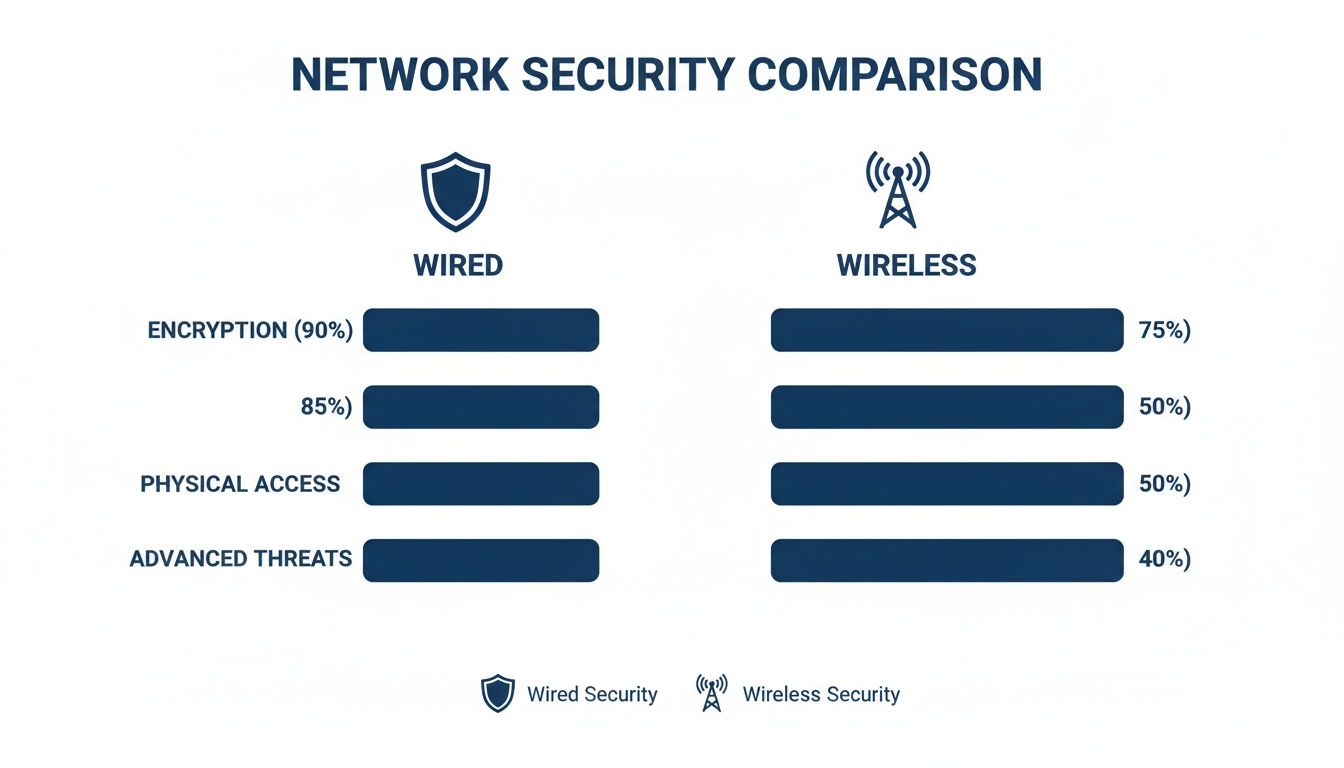
This visual really hammers home the inherent physical security advantage of a wired network. That physical barrier directly contributes to a lower long-term risk profile, which means reduced costs associated with preventing and recovering from data breaches.
Comparing Long-Term Costs of Wired vs Wireless Networks
When you look at the numbers over a typical 10-year business planning cycle, the financial argument for a certified wired network becomes even clearer. The initial outlay for a professional installation is just one part of the story.
Cost Factor | Certified Wired Network | Enterprise Wi-Fi Network |
|---|---|---|
Initial Installation | Higher upfront cost for cabling, termination, and certification. | Lower initial cost for access points and configuration. |
Hardware Lifecycle | 25-year warranty on passive components. No replacement cycle. | 3-5 year replacement cycle for access points to keep up with standards. |
Maintenance | Minimal. Once certified, the physical layer is extremely stable. | Ongoing. Requires regular firmware updates, security patching, and troubleshooting. |
Upgrade Costs (10 Yrs) | None for the physical cabling. Switches may be upgraded. | Requires at least 2-3 full hardware refreshes of all access points. |
Security Costs | Lower. Physical security reduces risk of unauthorised access. | Higher. Constant monitoring and advanced software needed to secure airwaves. |
Energy Consumption | Lower. Power is centralised at network switches. | Higher. Each access point consumes power, scaling with the size of the office. |
Total 10-Year TCO | Predictable and significantly lower over the long term. | Higher due to recurring hardware replacement and maintenance cycles. |
As the table shows, the seemingly cheaper Wi-Fi option quickly becomes more expensive due to the relentless cycle of hardware replacements and the ongoing effort required to maintain and secure it.
Built for Tomorrow's Demands
One of the most overlooked advantages of structured cabling is just how future-ready it is. A well-designed system using modern Cat6a or fibre optic cables is built with enormous capacity headroom. It’s designed to handle not just your data loads today, but the much heavier demands of tomorrow’s applications and devices.
This built-in scalability is a huge financial win. As your business grows, your network can easily handle more users and higher bandwidth without needing a costly and disruptive overhaul. This planned longevity is echoed in major UK infrastructure projects.
Government-backed initiatives like Project Gigabit and the Stratum programme highlight a nationwide commitment to wired infrastructure. In Northern Ireland alone, the Stratum programme has already made over 74,000 homes and businesses full-fibre connectable, proving the sustained economic benefit of investing in a robust physical network. You can dig into more of these regional connectivity statistics on Yellowcom.co.uk.
Investing in a certified wired network is the most effective way to escape the expensive, short-term cycle of technology replacement. It establishes a reliable foundation that supports business growth, rather than hindering it.
Ultimately, for any serious commercial building or hospital, a professionally installed and certified wired network is the most financially prudent decision you can make. It minimises unexpected costs, provides an unbeatable long-term warranty, and ensures your infrastructure is ready for whatever comes next—delivering an ROI that far outstrips any other networking solution.
Why Professional Installation Unlocks True Performance
A high-performance wired network is meticulously built, not just bought off the shelf. We've talked about raw speed and security, but the real, lasting advantages of a wired network are only ever unlocked through professional craftsmanship. It’s a common mistake to think that as long as the cable works, the job is done. The truth is, the quality of the installation directly impacts the performance, reliability, and long-term health of your entire digital infrastructure.
This goes far beyond simply aiming for a tidy desk or an organised server rack. Meticulous cable management is a critical discipline. When cables are properly routed, bundled, and labelled, it does more than just look professional; it improves airflow around sensitive equipment, prevents heat build-up, and makes future troubleshooting or upgrades a thousand times easier. More importantly, it stops signal degradation caused by sharp bends or excessive tension, ensuring every connection performs at its absolute peak for years to come.
What Certified and Tested Network Delivery Guarantees
The term ‘professional installation’ gets thrown around a lot, but what truly sets a high-quality project apart is the final verification stage. A certified and tested network delivery is a rigorous, non-negotiable process where every single connection is individually verified with advanced diagnostic tools. This isn’t a simple "plug it in and see if it lights up" check.
This process involves measuring key performance metrics for each cable run, including:
Bandwidth Capacity: Confirming the cable can handle its rated speed (e.g., 10 Gbps for Cat6a).
Signal Integrity: Checking for signal loss or interference that could cause data corruption and packet loss.
Termination Quality: Ensuring the physical connections at both ends are perfect, as even minor flaws can cripple performance.
You receive a detailed report proving that every single port and cable meets or exceeds industry specifications. This certification is your documented proof that you have received the high-performance network you paid for, free from the common pitfalls that plague amateur installations.
Navigating an Office Relocation Without Compromise
An office relocation is one of the most complex logistical challenges a business can face, and the network is often the first and most critical point of failure. Simply unplugging equipment, moving it, and plugging it back in at a new site is a recipe for disaster. This is where an accredited partner becomes indispensable, especially for large commercial buildings and sensitive environments like hospitals.
During an office relocation with equipment testing, a professional team doesn't just move your hardware. They perform a complete re-certification of the entire network in its new environment. This involves testing every cable run, re-verifying switch configurations, and ensuring all endpoints connect with the same flawless performance they had previously.
An office move is the perfect opportunity to re-evaluate and re-certify your network infrastructure. A professional partner ensures your network performs perfectly from day one in the new space, eliminating the costly downtime and frustrating troubleshooting that can derail a relocation.
This process guarantees that no damage occurred during the move and that the new building’s layout doesn’t introduce unforeseen performance issues. The result is a seamless transition where your team can walk in, plug in, and get straight to work without any network-related disruptions.
The Value of an Accredited Partner
Ultimately, achieving a reliable, high-speed wired network hinges on the expertise of the installer. An Excel network accredited partner brings a level of skill and accountability that is simply unmatched. They have been trained and certified to install systems to the manufacturer's exact standards—a requirement for validating the powerful 25-year equipment warranty. This partnership ensures your fibre cable installation or structured cabling project is executed flawlessly.
When you invest in a certified network, you're not just buying cables and switches; you're investing in the assurance that your business's digital foundation is solid, secure, and built to perform for decades. For businesses looking to understand more about this process, our guide on choosing network cabling installers you can trust offers valuable insights. By prioritising professional, tested installation, you ensure your network remains a strategic asset rather than a recurring problem.
Building a Stable Future for Your Business
Your network isn't just a utility; it's a strategic asset that underpins everything your business does. We've walked through the clear-cut advantages of a wired network, from its blistering speed and reliability to its built-in security. These three pillars—performance, protection, and predictability—are what successful, stable operations are built on.
But just choosing to go wired isn't enough to get you there. The real magic happens when it's done right, with professional and meticulous execution. This is where you see the true value of bringing in an accredited partner.
The Foundation for Growth
An investment in structured cabling is a direct investment in the future stability of your company. Unlike wireless systems that demand frequent, costly upgrades, a professionally installed wired network is built to last for decades.
Certified and Tested Delivery: This guarantees that every single connection meets strict performance standards from day one. It’s about eliminating costly network mistakes before they ever get a chance to impact your operations.
A 25-Year Equipment Warranty: An assurance from an Excel accredited partner that your physical infrastructure is protected for a generation. This turns unpredictable future expenses into a fixed, reliable asset.
Expert Cable Management: This is about more than just a tidy desk. It ensures your network runs at its best and makes future maintenance straightforward, whether you're in a stable office or navigating a complex relocation.
This professional approach is absolutely vital, especially in environments like hospitals where network failure simply isn’t an option.
Your physical network is the foundational investment that ensures stability, protects critical data, and enables future growth. Stop treating it like a recurring cost and start managing it as the long-term strategic asset it is.
Ultimately, the path to a resilient, high-performing business starts at the physical layer. To truly build a stable future and ensure full compliance, businesses also need to implement robust IT asset management best practices that cover the entire lifecycle of their technology. By choosing a certified, tested, and warrantied network installation, you're not just connecting computers—you're building a stable foundation that will support your organisation's ambitions for decades to come.
Your Questions, Answered
Here are some straight answers to the questions we hear most often from business owners and IT managers. It’s all about helping you make the right call for your network.
Is It Cheaper to Just Use a High-End Wi-Fi System?
It's a common thought, especially when you look at the upfront hardware costs. But a professionally installed wired network is a completely different kind of investment. The real value is in its longevity, which is why accredited partners like us can offer a 25-year equipment warranty on Excel hardware. This simple fact gets you off the expensive treadmill of upgrading wireless access points every few years just to keep up.
More importantly, you have to look at the hidden costs of relying only on Wi-Fi. Think about lost productivity from patchy connections in a busy office, or the huge financial hit your business could take from a single data breach. A wired network is a predictable, rock-solid asset, not a recurring problem.
We Are Planning an Office Relocation – Is It Worth Installing a New Network?
An office relocation is, without a doubt, the best possible time to get your network infrastructure right from the ground up. It’s a clean slate, allowing you to avoid all the common data network mistakes that can turn a move into a chaotic mess. An accredited partner can design a system that’s perfectly tailored to your new space and how your team actually works.
Crucially, we manage the whole process, including rigorous equipment testing and re-certification to make sure everything works just as well in the new building. This proactive approach means no last-minute scrambling or costly downtime. Your team can walk in, plug in, and get straight to work from day one.
An office move is the golden opportunity to build your network foundation properly. Professional testing and certification ensure your infrastructure performs flawlessly from the moment you switch the lights on, preventing a stressful and unproductive transition period.
What Does “Certified and Tested Network Delivery” Actually Involve?
This is the quality control step that guarantees you get the performance you paid for. It’s not just about plugging in a cable and seeing if a light turns on. After the fibre cable installation is done, our engineers use specialised test gear to check every single cable against strict industry standards for speed, signal quality, and connection integrity.
You get a detailed report that proves every connection point is performing exactly as it should. This certification is what validates the 25-year equipment warranty, giving you documented proof that your network is free from installation mistakes. Making sure your network is tested and certified is the only way to be certain it will deliver the reliable, high-speed performance your business needs, especially in demanding places like hospitals or data centres.
At Constructive-IT, we specialise in designing and deploying certified, high-performance wired networks that become the reliable backbone of your business. Our end-to-end project management ensures your office relocation or new fit-out is seamless, secure, and supported by a 25-year warranty. Find out more about building a solid digital foundation at https://www.constructive-it.co.uk.
Comments