


Raceways For Cables A Guide to Safe and Scalable Network Wiring
- Craig Marston
- Dec 19, 2025
- 16 min read

Picture this: it's day one after a big office move, and the entire network is down. The culprit? It’s often one of the most overlooked data network mistakes out there—neglecting professional cable management. Proper raceways for cables aren't just plastic or metal channels; they are the absolute foundation for a reliable, safe, and scalable network, especially in demanding commercial environments.
The Unseen Backbone of Your Commercial Network
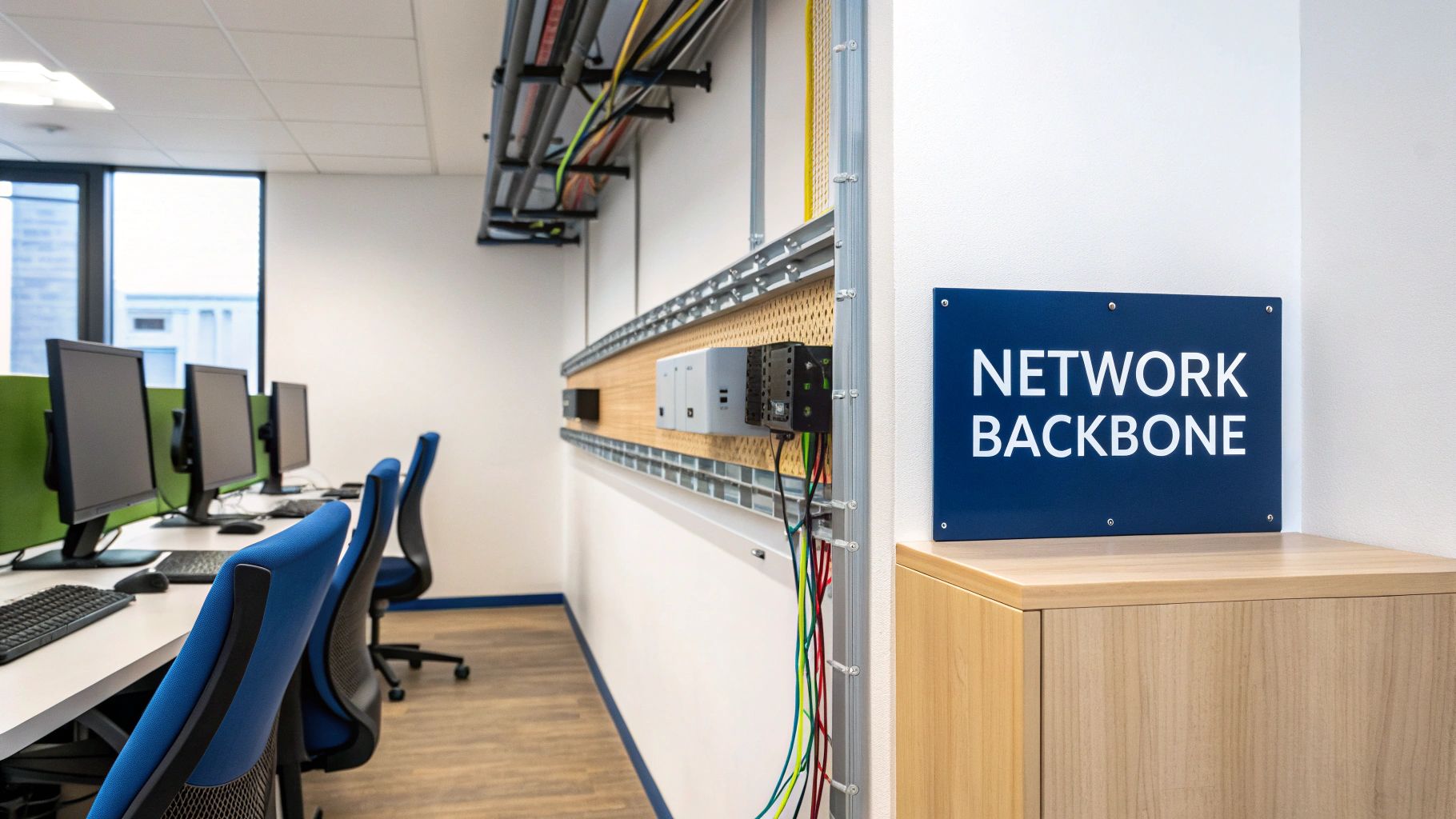
In any commercial building, whether it's a bustling office or a critical hospital wing, the sheer volume of data and power cabling can be staggering. When left unchecked, it quickly descends into a chaotic "rat's nest." This isn't just untidy; it's a direct threat to your business. Without a structured pathway, sensitive wiring like fibre optic cables can get bent, crushed, or damaged, leading to flaky connections and costly downtime.
This is exactly where cable raceways bring essential order and protection. Think of them as a dedicated motorway system for your building's data traffic. They transform a tangled liability into a strategic asset, supporting everything from a tidy desk policy to a professional, high-performing workspace.
Why Professional Systems Are Non-Negotiable
In high-stakes environments like hospitals or large corporate offices, there's no room for shortcuts. A well-planned raceway system is a critical part of a successful network installation, especially during a complex office relocation where all equipment needs to be tested and working perfectly from the get-go.
A professionally installed system delivers tangible benefits:
Enhanced Safety: It neatly contains cables, eliminating trip hazards and protecting them from physical damage that could cause electrical faults.
Simplified Maintenance: A properly organised system makes it easy to trace, test, and replace individual cables without having to dismantle the entire network.
Future-Proofing: Sizing raceways correctly from the start means you have room to grow, allowing for new fibre cables to be added without a complete overhaul.
Guaranteed Performance: When installed by an accredited partner, like an Excel Networking installer, the system often comes with a 25-year equipment warranty, locking in long-term reliability.
A certified and tested network delivery isn't just a nice-to-have; it's the only way to guarantee your infrastructure will support your operations without fail. These systems are the first step in ensuring your network is ready for peak performance. You can discover more about how these components form a resilient digital foundation by exploring our complete guide to your business backbone.
Choosing Your Pathway: Understanding Cable Raceway Types
Picking the right pathway for your network wiring is a bit like choosing the right road for different vehicles. You wouldn't send a convoy of lorries down a narrow country lane, would you? It's the same with your cabling. The raceways for cables you choose must match the volume, type, and sensitivity of the wiring they need to protect, especially in complex places like modern offices or hospitals.
Not all raceway systems are created equal. Each one is engineered for a specific job, whether it's managing high-density cabling in a data centre or just keeping a busy office desk tidy. Getting this choice right is the first step towards a professional and resilient installation—the kind that underpins a fully certified and tested network.
The growing reliance on these systems is clear from the market figures. In the UK, the cable management market, which includes all these raceways, was valued at around £750 million in 2023. Projections show it could nearly double by 2032, driven by data centre expansions and commercial projects that demand compliant, organised installations. You can explore the UK cable management market growth to see the trends for yourself.
Trunking: The Multi-Lane Motorway
Think of cable trunking as the multi-lane motorway for your wiring. It's a rectangular, enclosed channel, usually made from PVC or galvanised steel, designed to handle a high volume of cables running along a single, main route. Its biggest advantage is its sheer capacity and the ability to keep different cable types separate.
In a hospital corridor, for example, trunking is perfect for running power cables in one compartment and sensitive data or fibre optic cables in another. This separation is crucial for preventing the electromagnetic interference (EMI) that can play havoc with network performance.
PVC Trunking: The go-to for standard office environments. It's cost-effective and lightweight, ideal where it won't face any heavy physical knocks.
Metal Trunking: Offers far superior physical protection and fire resistance, making it a mandatory choice for high-risk areas or industrial settings.
Conduit: The Armoured Tunnel
If trunking is the motorway, then conduit is an armoured tunnel, offering maximum protection for a single, critical route. It’s a circular tube, usually made from rigid steel or flexible plastic, designed to enclose just a small number of cables.
Conduit is the solution when you absolutely have to protect wiring from moisture, impact, or chemical exposure. You’ll often see it used to run a vital fibre link between two server rooms or to route power to heavy machinery on a factory floor. Its tough nature ensures that even in the harshest conditions, the cable inside is safe.
A common mistake is thinking all enclosed pathways are the same. While both trunking and conduit offer protection, conduit provides a much higher degree of security for smaller, vital cable runs. It's indispensable for safeguarding your most important network connections.
Cable Trays: The Open-Air Bridge
Cable trays are the open-air bridges of the cable management world. These are ladder-like or solid-bottomed support systems, usually made of steel, used for routing huge bundles of cables through accessible areas like ceiling voids or under the raised floors in data centres.
Their open design is their key strength. It allows for excellent airflow, which is critical for stopping heat from building up around large bundles of power cables. It also makes adding, removing, or tracing cables a straightforward job for maintenance teams—a massive plus during an office relocation with equipment testing.
Perimeter and Dado Trunking: For the Tidy Desk
Finally, we have perimeter or "dado" trunking. This is the system that brings power and data right to the user's fingertips. Mounted at desk height along office walls, it contains pre-fitted outlets for power sockets and network points, providing a neat, organised way to connect every workstation.
This system is fundamental to achieving a tidy desk environment and getting rid of hazardous trailing cables underfoot. It’s a solution that’s both functional and aesthetic, keeping workspaces safe, professional, and up to the high standards expected in modern commercial buildings.
Often, a successful network installation won't just use one of these. It will use a smart combination of all four to create a complete, end-to-end cable management solution that’s built to last.
To help you see how these systems stack up against each other, we've put together a quick comparison table. It breaks down which raceway works best for different commercial needs, so you can make a more informed choice.
At-a-Glance Comparison of Commercial Raceway Systems
Raceway Type | Best For | Material | Key Advantage | Consideration |
|---|---|---|---|---|
Trunking | High-volume cable runs in corridors and main routes; segregating power and data. | PVC, Steel | High capacity and excellent protection with segregation options. | Can be bulky and less flexible for minor route changes. |
Conduit | Protecting critical, individual cable runs from moisture, impact, or chemicals. | Steel, Plastic | Maximum physical protection for small numbers of cables. | Less capacity and more labour-intensive to install. |
Cable Tray | Data centres and ceiling voids with massive cable bundles; areas needing easy access. | Steel, Aluminium | Excellent ventilation and easy access for maintenance and changes. | Offers minimal protection from dust, debris, or impact. |
Dado Trunking | Office environments, bringing power and data directly to workstations at desk level. | PVC, Aluminium | Neat, accessible, and user-friendly solution for a professional finish. | Limited to wall perimeters and has a lower cable capacity. |
Ultimately, choosing the right raceway isn't just a technical detail—it's about laying the physical foundation for a reliable and future-proof network. Each type has its place, and understanding their strengths will ensure your infrastructure is robust, safe, and ready for whatever you throw at it.
A Framework for Picking the Right Raceway System
Choosing the right way to run your cables is more than just a technical tick-box exercise; it's a strategic decision that directly impacts your network's performance, safety, and ability to grow. We've covered what raceways are, but now it's time to get into the how – the essential criteria you need to pick a system that fits your building, whether it’s a slick corporate office or a critical hospital ward. The goal is simple: get it right from the start and avoid those common data network mistakes down the line.
A smart selection process always kicks off with a clear-eyed look at what you need right now and what you’ll likely need in the future. This kind of foresight is what stops you from facing the nightmare scenario of outgrowing your infrastructure in just a few years, or discovering it’s completely unsuitable during a critical office relocation with equipment testing.
Calculating Cable Capacity and Planning for Growth
First things first, you need to work out the total cross-sectional area of all the cables you're planning to run. But here's where people often go wrong: they choose a raceway that just about fits today's cables. A professional will tell you this is a false economy. The industry standard, and a genuinely wise investment, is to plan for at least 25-50% spare capacity.
This "fill ratio" isn't just about leaving room; it's critical for a couple of very practical reasons:
Heat Dissipation: Stuffing a raceway to its absolute limit is a recipe for trapped heat. Over time, that heat can seriously degrade cable performance and even become a fire risk. Proper spacing allows air to circulate, keeping everything cool and running optimally.
Future-Proofing: Let's be honest, the biggest cost in any cabling project is the labour. Trying to squeeze a new fibre cable installation into a raceway that's already full is a painfully difficult and expensive job. That little bit of extra space you planned for makes future upgrades simple, fast, and far more cost-effective.
Planning for future growth is the cornerstone of intelligent network design. By ensuring your raceway has ample spare capacity, you're not just installing cables—you're investing in the long-term agility of your business operations.
This image shows a typical cable tray system, illustrating how its open design supports large volumes of organised wiring.
The neat and tidy layout you see here is exactly what a well-planned system achieves. It prevents a tangled mess, simplifies maintenance, and is a key part of delivering a properly tested and certified network delivery.
Choosing the Right Material for Your Environment
The physical space where your raceway will live dictates the best material for the job. You wouldn't wear sandals in a snowstorm, and the same logic applies here.
PVC (Polyvinyl Chloride): This is the go-to for most modern office spaces. It’s lightweight, it won't corrode, and it's budget-friendly. It’s the perfect choice for things like dado trunking to create a tidy desk environment.
Steel: When you get into industrial areas, plant rooms, or anywhere that fire resistance and sheer physical protection are top priorities, galvanised steel is the only serious contender. It offers unbeatable strength and durability when things get rough.
Aluminium: Often found in cable trays, aluminium is a great middle-ground. It's lighter than steel but still offers excellent corrosion resistance, making it a solid fit for certain data centres or large commercial installations.
Respecting Bend Radius and Keeping Signals Clean
Modern networks are built on delicate fibre optic cables. These cables have a minimum bend radius, and if you bend them too sharply, you'll snap the fragile glass fibres inside and kill the signal stone dead. Your chosen raceway system must be able to guide these cables around corners with gentle curves, never forcing them into tight, damaging angles.
Just as important is keeping your power and data cables separate. Running high-voltage electrical lines right next to data cables creates electromagnetic interference (EMI), which is like static on the line for your network. It can corrupt data and lead to all sorts of mysterious network errors. Professional trunking systems solve this with built-in dividers, creating separate, shielded channels to ensure your data signals stay pure and your certified network performs reliably.
Why Certified Installation and UK Regulations Matter
Choosing the right raceways for cables is only half the battle. Making sure they are installed to meet strict UK regulations is what actually guarantees the safety and performance of your entire network. Compliance isn't just about ticking boxes; it's a non-negotiable framework that protects your building, your staff, and your investment.
In commercial spaces like offices and hospitals, all electrical and data cabling work falls under a heavy blanket of standards. These aren't just suggestions—they are legal requirements designed to prevent catastrophic failures. A professional installation is the only way to ensure every single component, from the trunking on the wall to the fibre cables inside, meets these exacting criteria.
The Bedrock of Compliance: UK Standards
The most critical regulation in this field is BS 7671, better known as the IET Wiring Regulations. This is the rulebook for all electrical installations, and that absolutely includes the containment systems that house your data cables. It dictates everything from the materials you can use to how raceways are secured and earthed.
Fire safety is, of course, a massive concern. When raceways punch through walls or floors, they compromise the building's fire-rated barriers. Regulations demand that these openings are properly sealed with approved fire-stopping materials. This is a critical step that prevents the rapid spread of fire and smoke between different parts of a building—a vital safety measure you simply cannot ignore.
The success of a robust network infrastructure relies heavily on the expertise of certified installers and a clear understanding of the roles of reliable cable contractor companies. These experts ensure every part of the installation adheres to safety codes, from fire-stopping to the correct segregation of power and data cables.
This intense focus on safety has a huge impact on the industry. In fact, regulatory requirements are a principal driver for the widespread adoption of professional cable management systems. These standards are contributing to the strong growth of the UK cable management market, which is projected to expand from roughly USD 921.5 million in 2023 to USD 2.00 billion by 2032.
The decision tree below gives you a simplified process for picking the right raceway based on key factors like how many cables you have, the environment, and the cable type.
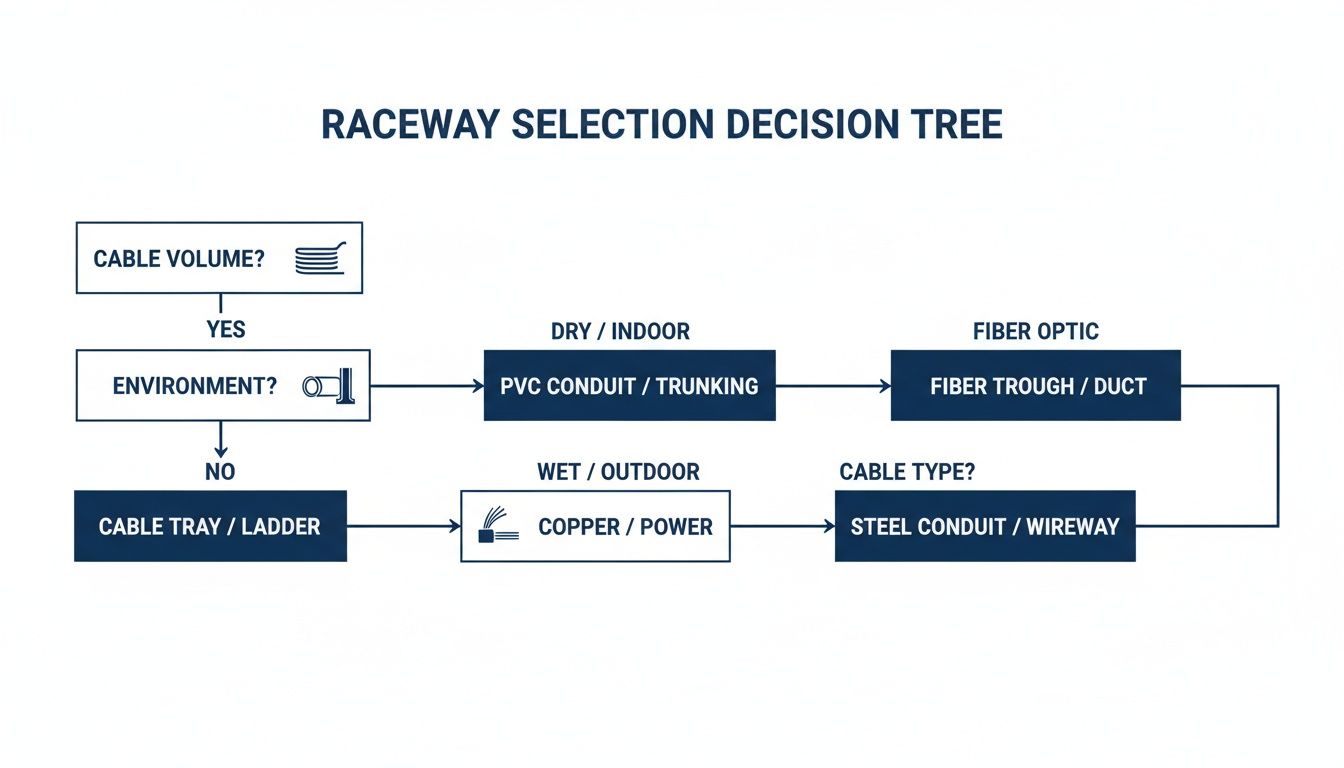
As the flowchart shows, practical considerations—like needing metal raceways in a harsh factory environment or providing special handling for delicate fibre optics—are just as important as ticking the regulatory boxes.
The Value of a Tested and Certified Network
So, what does it really mean to have a network that is "tested and certified"? It means every single cable, from the server room to the desk, has been checked with specialised equipment to prove it can handle the promised data speeds without errors. This isn't a quick visual inspection; it's a deep diagnostic process that confirms the integrity of the whole fibre cable installation.
When a network is certified, you get detailed test reports that prove its performance. This certification is your insurance policy against common data network mistakes and the foundation for long-term, reliable operation.
This is where working with an accredited partner really pays off. An Excel network accredited partner, for instance, has the specific training and calibrated tools to perform this certification correctly. Even better, this accreditation unlocks access to a 25-year equipment warranty. This long-term guarantee gives you complete peace of mind, knowing your network is supported by both the installer and the manufacturer for decades. When you start your project, it's vital to understand the process of choosing network cabling installers you can trust.
Installation Best Practices for Lasting Performance
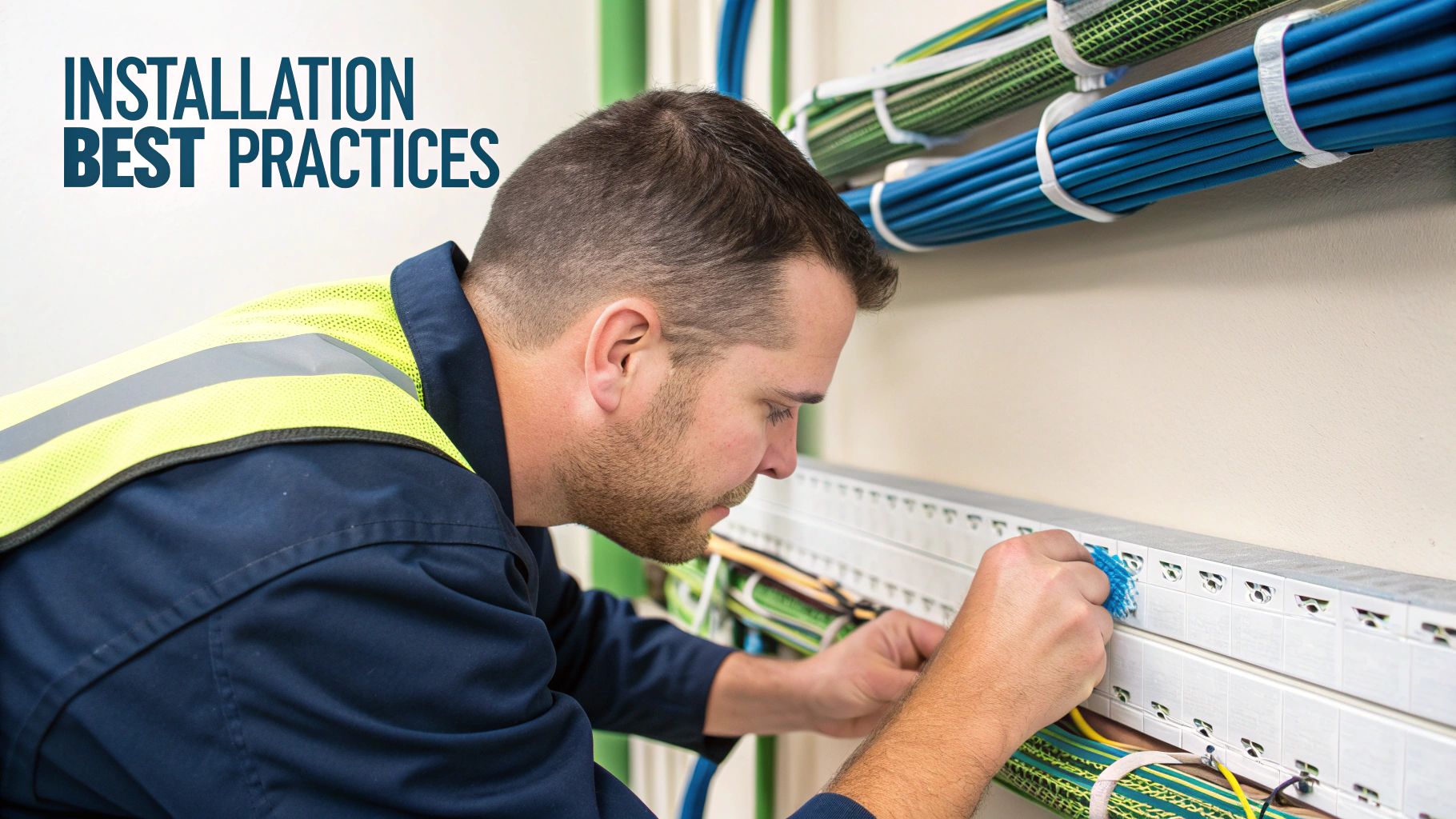
A well-designed raceway plan is a great start, but it's the flawless execution on the ground that guarantees a network will perform reliably for years to come. The installation phase is where common data network mistakes are either made or avoided. Properly installing raceways for cables is about much more than just screwing channels to a wall; it’s a skilled process that ensures safety, performance, and a professional finish.
Getting these details right is essential for any modern network, especially a high-performance fibre cable installation. It’s what separates an Excel network accredited partner from the crowd and makes the difference between a network that’s a constant headache and one that just works, particularly through a stressful event like an office relocation with equipment testing.
Planning the Route and Supporting the System
The first step in any professional installation is meticulous route planning. A certified installer won’t just find the shortest path; they will map out routes that deliberately avoid sources of electromagnetic interference (EMI). Things like large power transformers, fluorescent lighting ballasts, and heavy machinery create electrical "noise" that can corrupt data signals. Keeping data cables a safe distance away is critical for signal integrity.
Once the route is set, the raceway itself has to be securely supported. Every manufacturer specifies the maximum distance allowed between supports to stop the system from sagging under the weight of the cables. Sticking to these intervals is non-negotiable. A sagging raceway doesn't just look sloppy; it puts physical stress on the cables inside, which can lead to performance issues over time.
The Art of Cable Management Inside the Raceway
What happens inside the raceway is just as important as the path it takes. This is where the skill of a seasoned installer truly shows, turning a potential rat's nest of wires into a model of organisation.
Key practices include:
Respecting the Bend Radius: This is especially crucial for fibre optic cables. If you force them into a tight corner, the delicate glass core can fracture, killing the connection instantly. A professional maintains a gentle, sweeping bend radius at every turn.
Using Cable Organisers: Tools like cable combs and Velcro-style straps are used to group cables into neat, manageable bundles. This isn't just for looks; it prevents a chaotic mess and makes tracing an individual line later on much, much simpler.
Clear Labelling: Every single cable should be clearly labelled at both ends. It might seem like a small detail, but it’s an absolute lifesaver during troubleshooting or network changes, saving hours of tedious manual tracing.
A certified and tested network delivery is built on these methodical practices. It’s a commitment to ensuring every connection isn't just working on day one, but is also easy to manage and upgrade for its entire lifecycle.
These principles for achieving clean, organised network wiring are universal, applying to everything from data centres to smaller DIY CCTV installation projects.
Securing the Promise of a 25-Year Warranty
Following these best practices isn't just about creating a tidy desk environment or looking professional. These are the tangible actions that underpin your network's reliability and, critically, qualify it for a manufacturer-backed 25-year equipment warranty. This long-term guarantee is only available when the system is installed by a certified professional who follows these high standards to the letter, ensuring your network is a dependable asset for decades.
Future-Proofing Your Network for Growth and Relocation
Change is the one constant in any growing business. Whether you’re bringing on new team members, rolling out new tech, or planning a full-scale office relocation, your network infrastructure needs to be an asset, not an anchor. A well-planned system, built around properly specified raceways for cables, is what makes these transitions smooth and cost-effective instead of chaotic and disruptive.
Thinking ahead is everything. Treating your cable raceway plan as a core part of any office fit-out or move isn't an expense—it's a strategic investment in business continuity. It ensures that when the time comes to grow or move, your network is ready to go with you, not hold you back. If you're facing a move, our ultimate office relocation checklist breaks down all the critical steps.
Planning for What Comes Next
One of the most common mistakes we see is a network designed only for today's needs. A professional approach always plans for tomorrow. This means installing raceways with 25-50% spare capacity right from the start. Yes, it’s a minor upfront cost for slightly larger trunking or trays, but it saves you from massive labour expenses down the line.
Trying to squeeze a new fibre cable into a raceway that’s already packed to the brim is a slow, painful, and expensive job. That spare capacity is your get-out-of-jail-free card, giving you the flexibility to add new technology, reconfigure desks, or scale up your entire operation without having to rip out your core infrastructure and start over.
The Relocation and Testing Strategy
A seamless office move is about more than just shifting boxes; it’s about guaranteeing operational readiness from the moment you flick the switch in the new space. This is where a structured, methodical testing plan becomes non-negotiable.
Your relocation strategy must include:
Pre-Move Audit: We start by thoroughly assessing and testing all your network equipment in its current home. This gives us a crystal-clear performance baseline to work from.
Certified Installation: We ensure the cabling and raceways at the new site are installed by an Excel network accredited partner. This isn't just a badge; it's your guarantee of compliance and performance.
Post-Move Verification: Once the equipment is in place, we perform a complete re-test of the entire network. This confirms every single connection is live and performing exactly as it should, ensuring zero operational downtime on day one.
This methodical approach of pre- and post-move equipment testing is absolutely essential for critical environments like commercial offices and hospitals. It turns a high-risk transition into a controlled, predictable process, backed by the assurance of a certified and tested network delivery.
This kind of forward-thinking is becoming the standard as the UK’s reliance on robust digital infrastructure continues to grow. The demand from data centres and large commercial projects is a huge driver for the cable management market. In fact, industry forecasts project the market to grow from USD 921.5 million in 2023 to USD 2.00 billion by 2032, all fuelled by the need for scalable, organised cabling solutions. You can find more insights on the growing UK wires and cables market.
Working with an experienced partner ensures your raceway system not only supports your next move but also comes with a 25-year equipment warranty, securing your investment for the long haul.
Frequently Asked Questions About Cable Raceways
Even the most straightforward commercial network installation can throw up a few questions. Here are some clear, direct answers to the queries we hear most often, reinforcing the core principles behind a professional, certified network that uses raceways for cables.
Why Not Just Lay Cables in the Ceiling Void?
It might look like a tempting shortcut to save a bit of time and money, but just laying loose cables in a ceiling void is one of the biggest mistakes you can make. This practice often falls foul of UK fire and electrical safety codes, creating what installers call a 'rat's nest'—a tangled mess of wiring vulnerable to damage from pests, moisture, or being crushed by accident.
Uncontained cables are not just a fire risk; they are also a nightmare to manage, troubleshoot, or upgrade later on. Proper cable management using raceways protects your investment, keeps you compliant, and makes future maintenance straightforward. For any professional environment like a hospital or commercial office, it's non-negotiable.
What Does a Certified and Tested Network Guarantee?
Think of this as your ultimate proof of performance. After a fibre cable installation, a certified network means every single data point has been rigorously checked with specialised equipment to confirm it hits strict industry standards for speed and reliability. This isn't just a quick visual check; it's a deep diagnostic process.
An Excel network accredited partner will hand over detailed test reports for every connection. Crucially, this level of professional work is what unlocks a manufacturer-backed 25-year equipment warranty, giving you total peace of mind that your network will perform flawlessly for decades.
A certified, tested network delivery is the only way to be certain that your infrastructure can support your operations without fail, especially during a critical office relocation with equipment testing. It moves your network from a hopeful assumption to a guaranteed asset.
How Much Spare Capacity Do We Really Need?
Planning for 25% to 50% spare capacity is a simple but vital future-proofing strategy. The single biggest cost in any cabling project is the labour, not the materials. Trying to squeeze new cables into a full raceway later on is incredibly difficult, time-consuming, and ends up being very expensive.
Installing a slightly larger raceway from day one is a minor upfront cost that pays for itself many times over. It gives you immense flexibility for new technologies, future office layouts, or simple business growth. This one small decision will save you significant time, disruption, and money down the line, ensuring your network can scale right alongside your organisation.
At Constructive-IT, we specialise in designing and installing robust, certified network infrastructure that stands the test of time. From initial planning to post-installation support, we ensure your network is a powerful asset for your business. Discover our end-to-end network services.
Comments