


The Ultimate Guide to Network Cables and Cabling for Modern Offices
- Craig Marston
- 2 days ago
- 15 min read

Your office network cabling is the central nervous system of your entire operation. It’s the hidden-in-the-walls infrastructure that connects every device and powers every single digital task, from sending an email to running a video conference. Getting this foundation right is non-negotiable for business performance, dictating everything from internet speeds to the reliability of your internal comms.
A well-planned system is an invisible asset that just works. A poor one creates constant bottlenecks, frustration, and lost productivity.
Your Office's Digital Foundation Explained
Think of your data infrastructure like the plumbing in a house. When it’s designed and installed correctly, water flows exactly where you need it, on demand and without a single leak. But if the pipes are too small, poorly connected, or laid out chaotically, you’ll face low pressure, blockages, and endless problems. The exact same principle applies to your network cables and cabling.
A disorganised network, often resembling a chaotic 'spaghetti junction' in a server room, is a direct path to performance nightmares. Tangled wires make troubleshooting a slow, painful process, massively increase the risk of someone accidentally unplugging the wrong thing, and can even become a fire hazard. This lack of structure leads directly to slower data speeds, intermittent connection drops, and frustrating downtime.
In complete contrast, a structured cabling system is a methodical, standardised approach to your network's physical layer. It’s a comprehensive, organised system of cabling and hardware that provides a rock-solid telecommunications infrastructure. It’s built to support all your services—telephones, computers, security cameras—and isn't dependent on any one piece of equipment.
Key Components of Structured Cabling
A professionally designed system is built from several key components that work together in harmony. Getting your head around these elements is the first step in planning a successful office fit-out or relocation.
Copper and Fibre Optic Cables: These are the motorways for your data. Copper cables, like Cat6a, are the workhorses for connecting desktops, printers, and other local devices. High-speed fibre optics form the backbone, linking different floors, connecting server rooms, or even joining separate buildings.
Patch Panels: Think of these as a central switchboard in your comms room. They neatly terminate all the cables coming in from different areas of the office, allowing for easy changes and maintenance without ever having to disturb the main, permanent cable runs.
Connectors and Outlets: These are the familiar endpoints you see in the wall. They provide the physical connection points for your computers, VoIP phones, and any other network device your team needs to use.
A well-implemented structured cabling system is the bedrock of a modern business. It's an asset that supports current operational needs while providing the flexibility to accommodate future technological growth and organisational change.
Ultimately, investing in a properly designed network is about more than just tidy cables; it’s about building a reliable, high-speed, and future-ready workspace. You can learn more about how these components create a solid business backbone by exploring our complete guide to network infrastructure. Getting this foundation right from the start prevents costly overhauls and ensures your team has the stable, fast connection it needs to thrive.
Choosing the Right Pathway: Copper vs Fibre Optics
When it comes to network cabling, it’s not a simple case of one being universally 'better' than the other. It’s about choosing the right tool for the right job. Think of it like building a road network: you need local streets for homes and businesses, but you also need high-speed motorways to connect entire cities. Copper and fibre optic cables play these distinct yet complementary roles in your office infrastructure.
Copper cabling is the dependable workhorse for the vast majority of connections your team uses every single day. For linking devices over shorter distances within the office, it's the ideal, cost-effective solution.
For most modern offices, Category 6a (Cat6a) copper cable is the go-to standard. It delivers more than enough bandwidth for everyday tasks, reliably connecting desktop computers, VoIP phones, printers, and wireless access points to the network. Its flexibility and lower cost make it the obvious choice for horizontal cabling—the runs that go from a local comms cabinet to the wall outlets at each desk.
The Case for Copper Cabling
Copper’s continued dominance for endpoint connections comes down to sheer practicality and cost-efficiency. It’s also the perfect medium for delivering Power over Ethernet (PoE), which sends both data and electrical power through a single cable to devices like security cameras and telephones, massively simplifying installation.
Endpoint Connections: Perfect for linking individual user devices to the local network.
VoIP and PoE Devices: The standard for powering and connecting IP phones, cameras, and access points.
Cost-Effectiveness: Generally less expensive to purchase and install compared to fibre for standard office connections.
But copper has its limits. Its signal starts to degrade over longer distances (it’s typically capped at 100 metres) and it can be susceptible to electromagnetic interference (EMI) from nearby power cables or heavy machinery. This is where fibre optics step in.
When to Turn to Fibre Optics
Fibre optic cabling is the high-speed motorway of your network. Instead of pushing electrical signals through copper wire, it sends pulses of light down incredibly thin strands of glass. This fundamental difference gives it immense advantages in both speed and distance, making it the undisputed champion for your network's core.
It's the essential choice for creating the backbone of your network—the primary data pathways carrying the heaviest traffic between critical points. You’d use fibre optics to link server rooms together, connect comms cabinets on different floors, or even join separate buildings across a campus. You can learn more about fibre optic cabling services and their role as the backbone of modern buildings.
This decision tree clearly shows how a planned, organised approach is the only way to guarantee performance.
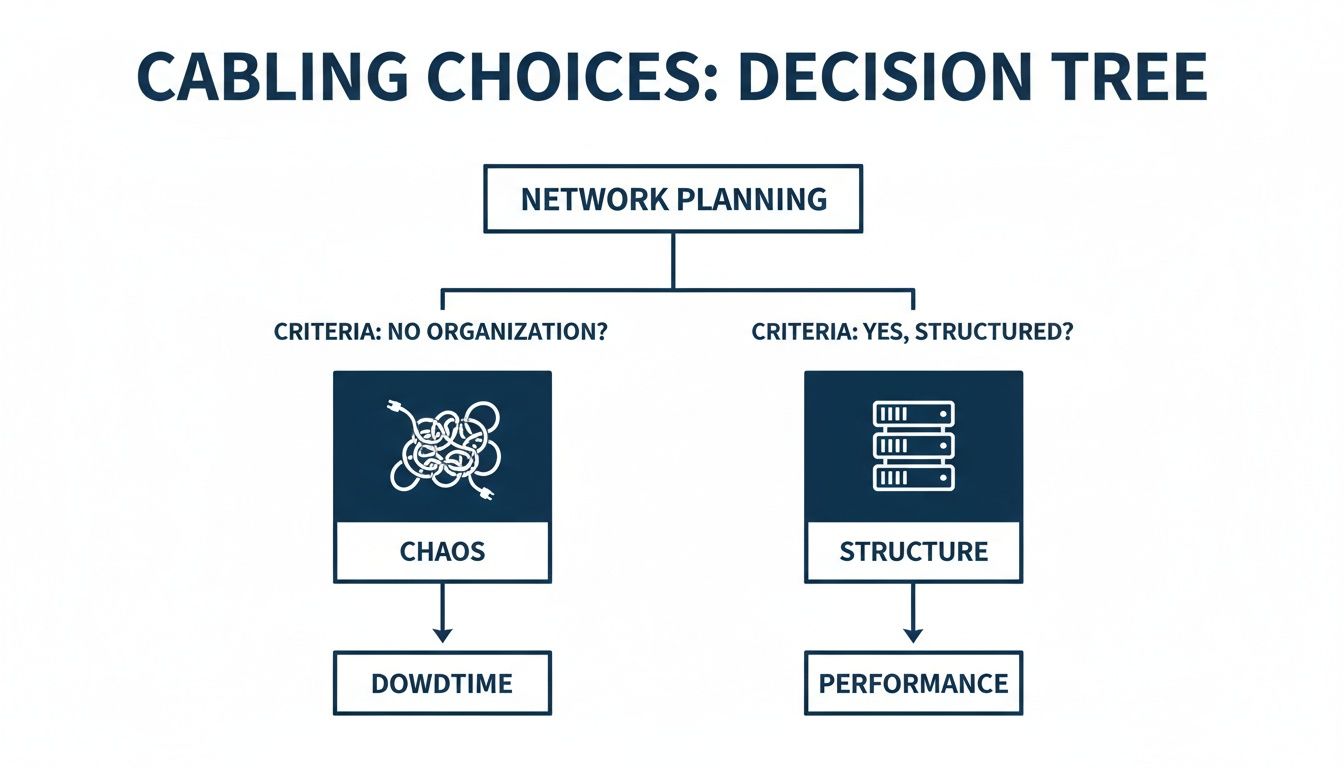
The key takeaway is that a structured, well-planned approach to cabling is the only path to achieving reliable, high-performance network operations.
The UK market reflects this hybrid reality. The structured cabling market was valued at USD 858.6 million in 2024 and is projected to reach USD 1,684.2 million by 2033. While copper cables are currently the largest segment, fibre optic cables are showing the fastest growth, highlighting the increasing need for high-speed backbones.
Copper vs Fibre Optic Cabling At a Glance
To make the choice clearer, it helps to see the key differences side-by-side. This table breaks down the core strengths and typical applications for both copper and fibre, helping you understand where each one fits into a modern network design.
Feature | Copper Cabling (e.g., Cat6a) | Fibre Optic Cabling (e.g., OS2) |
|---|---|---|
Primary Use | Horizontal runs to user devices (desks, printers) | Network backbone, inter-building links, server rooms |
Max Distance | ~100 metres | 10km+ |
Bandwidth | Up to 10 Gbps | Virtually unlimited potential |
Interference | Susceptible to electromagnetic interference (EMI) | Completely immune to EMI |
Power Delivery | Excellent for Power over Ethernet (PoE) | Cannot carry electrical power |
Material Cost | Generally lower per metre for the cable | Higher cable cost, but electronics price gap is shrinking |
Installation | Easier to terminate, more forgiving | Requires specialist tools and skills for termination |
As you can see, they aren't really competing for the same job. They are two different technologies designed to solve two different problems, and a high-performance network needs both.
Designing a Powerful Hybrid Infrastructure
The smartest network design doesn’t force a choice between one or the other; it leverages the strengths of both to create a powerful, efficient, and scalable hybrid system. This approach ensures your network is both cost-effective and ready for whatever the future throws at it.
A hybrid infrastructure uses fibre for the high-capacity backbone and copper for the final connections to user devices. This model delivers maximum performance where it's needed most while managing overall project costs effectively.
By using fibre to handle the heavy lifting between data-intensive hubs and copper for the final, shorter runs to the desk, you build a network that just works. This strategic combination of network cables and cabling is the hallmark of a professional, future-ready installation.
Building a Network That Lasts and Grows With You
Your structured cabling isn't just a day-one expense; it’s a long-term investment that should serve your business for a decade or more. Ripping out and replacing inadequate wiring is one of the most disruptive and costly exercises a business can undertake. That’s why building a network for longevity and future growth is a strategic decision, not just a technical one.
The foundation of any network built to last is a strict adherence to industry standards. These aren’t just arbitrary rules but a collective blueprint for performance, reliability, and safety.
The Power of Following Standards
Organisations like the Telecommunications Industry Association (TIA) and the International Organisation for Standardisation (ISO) set the benchmarks that high-quality network cables and cabling must meet. Following these standards ensures every component—from the cable itself to the patch panels and wall outlets—works together seamlessly, regardless of the manufacturer.
This interoperability is your guarantee against being locked into a single proprietary system. More importantly, it ensures your network can consistently deliver the advertised speeds, preventing the kind of intermittent, hard-to-diagnose issues that plague non-compliant installations.
Practical Future-Proofing for Growth
Future-proofing is about making smart choices today to avoid expensive overhauls tomorrow. It’s about anticipating the ever-increasing demands for data that new technologies will inevitably place on your infrastructure. A perfect example of this is choosing the right category of copper cable.
While Category 6 (Cat6) cabling might handle your current needs just fine, installing Category 6a (Cat6a) provides much greater performance headroom. Cat6a is designed to support 10 Gigabit Ethernet over the full 100-metre distance—a speed that is rapidly becoming the standard for high-performance workstations and next-generation Wi-Fi access points.
The slightly higher initial material cost of installing Cat6a is minimal compared to the labour expense of a complete re-cabling project just a few years down the line. It's an investment in capacity you will almost certainly need.
This forward-thinking approach is reflected across the UK. The broader wires and cables market generated USD 11,503.3 million in 2023 and is expected to reach USD 15,145.4 million by 2030, with low-voltage solutions like structured cabling being the dominant category for commercial applications. You can learn more about these market trends for UK wires and cables.
The Value of a Long-Term Warranty
So, how can you be confident in the quality and longevity of your installation? A manufacturer-backed warranty is one of the clearest indicators. Leading manufacturers like Excel Networking offer a comprehensive 25-year warranty, but there's a crucial condition: the system must be designed, installed, and certified by an accredited partner.
This warranty is far more than a simple product guarantee. It is an assurance that the entire system—every cable, connector, and patch panel—has been installed according to strict best practices and has passed rigorous performance tests.
Here’s what this long-term warranty truly represents:
Performance Guarantee: It certifies that every link in your network meets or exceeds the specified performance standards (e.g., Cat6a).
Quality of Workmanship: It confirms that the installation was completed by trained professionals adhering to the highest industry standards.
Long-Term Peace of Mind: It protects your investment, ensuring that any component failure related to manufacturing or installation is covered for the lifespan of the system.
Ultimately, specifying a standards-compliant, future-proofed installation backed by a robust warranty is the most effective way to build a network that grows with your business. It transforms your cabling from a potential liability into a reliable, high-performance asset built for tomorrow's challenges, not just today's.
Unmanned Buildings: Why Network Cabling is Mission-Critical
You can have the best network cable in the world, but if it's installed badly, it’s going to fail. This is especially true when building out fully autonomous unmanned units. Unmanned building management means facilities operate without on-site staff, relying entirely on integrated technology for access control, security, and environmental management. These systems are commonly used in self-storage facilities, co-working spaces, and remote data centres.
However, many unmanned building projects fail because they treat access, power, and data as separate disciplines. In reality, they are a single, interdependent system. A power outage that takes down your network also takes down your access control. A weak data connection makes your CCTV useless. Flawless operation depends on designing these three pillars together.
Designing for Autonomy: Access, Power, and Data
One of the most critical components in an unmanned building is the lock. This is where many projects go wrong. For real-world reliability, battery-less, NFC proximity locks are the superior choice. Unlike battery-powered locks which create a huge maintenance burden and a single point of failure, NFC locks draw power from the user's device (like a smartphone) upon entry, ensuring they always work. This eliminates the operational headache of checking and replacing hundreds of batteries.
The entire system's reliability hinges on the underlying infrastructure. A holistic plan must include:
Integrated Cabling: The network must reliably connect all systems, from door readers to cameras.
Certified Power: A commercial electrical installation with proper certification and battery backup is non-negotiable to ensure uptime during power cuts.
Robust CCTV: IP-based CCTV cameras rely on Power over Ethernet (PoE) delivered via structured cabling, providing both data and power through one line.
Maintenance Considerations: The design must allow for easy remote diagnostics and troubleshooting, as there is no one on-site to fix minor issues.
The Critical Role of Cable Management
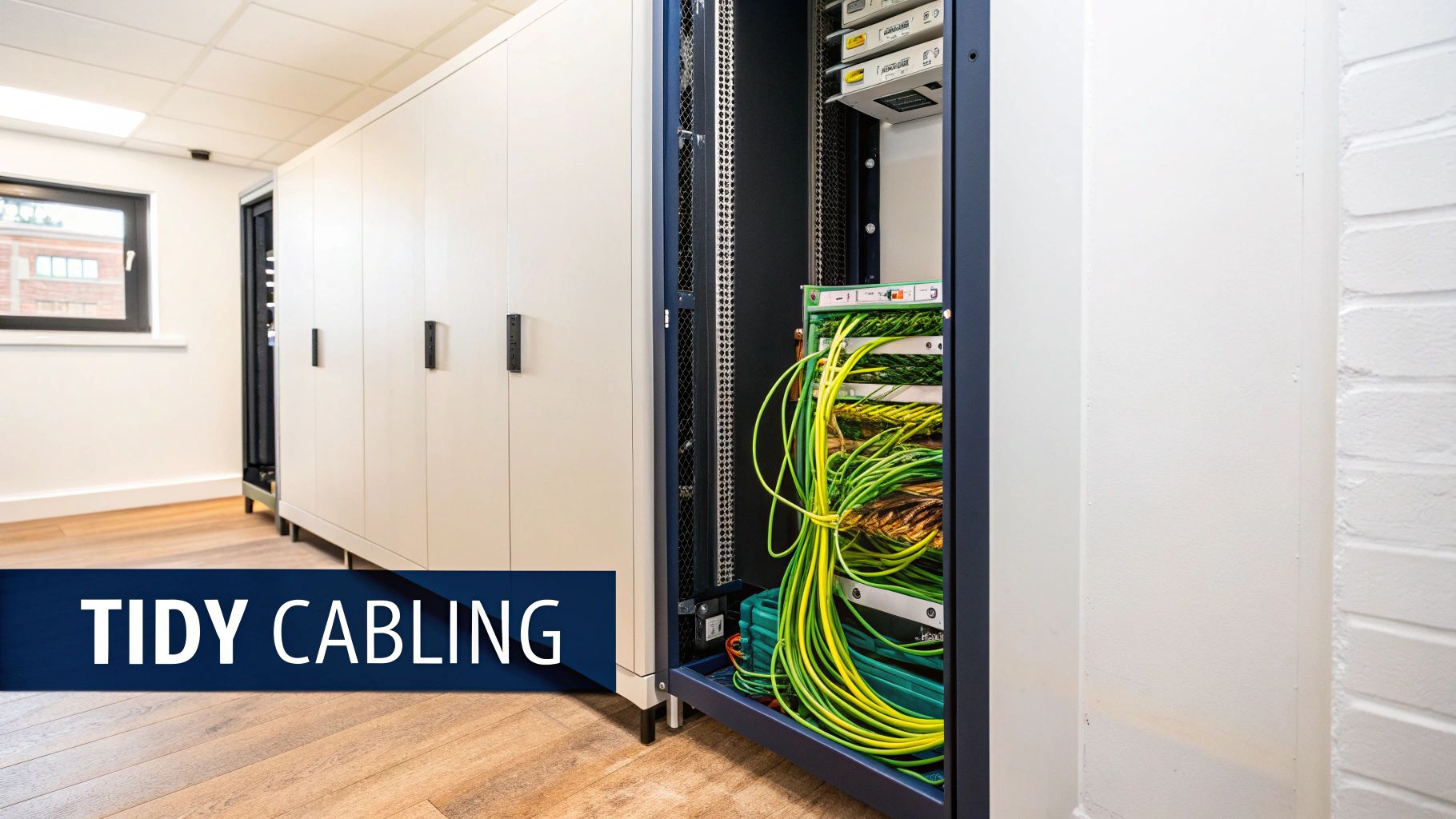
Let's be clear: proper cable management isn't just about making the server room look pretty. In an unmanned facility, it is a core component of reliability. It ensures long-term maintainability and performance. A tangled mess of cables – what we often call a 'spaghetti junction' – makes remote troubleshooting impossible and dramatically increases the risk of a single point of failure taking down the entire building.
A well-managed cabling system transforms a comms room into a reliable asset. It simplifies diagnostics, slashes downtime, and improves airflow, which is critical for keeping your equipment cool and extending its lifespan.
Getting this right involves a few key practices:
Using Containment: Cables should always be neatly routed within dedicated containment like cable trays, trunking, or conduit. This protects them from damage and keeps everything organised.
Respecting Bend Radius: Every cable has a minimum bend radius. If you bend it too sharply, you can damage the delicate internal wiring and permanently ruin its performance.
Clear Labelling: Every single cable, port, and patch panel must be clearly and logically labelled at both ends. This simple step is arguably the most important thing you can do for future maintenance, turning a complex remote diagnosis into a simple instruction for a contractor. You can find more best practices in our essential guide to data cabling installation.
By planning for all these services together, you ensure your core network cables and cabling can support every automated function from day one, creating a truly reliable and autonomous facility.
Why Professional Testing and Certification Matter
So, the last cable is neatly tucked away, and the final faceplate is screwed into the wall. Your new network looks perfect. But how can you be sure it will perform flawlessly when your entire team is hammering it on a Monday morning? This is where professional testing and certification stop being a 'nice-to-have' and become an absolute necessity for any serious business.
This final step isn’t just about ticking a box. It provides documented, undeniable proof that your investment in high-quality network cables and cabling actually delivers the performance you paid for. It’s the only way to guarantee your network isn't just connected, but truly ready for business.
Beyond a Simple “Beep Test”
It’s crucial to understand the massive difference between a basic continuity check and a full performance certification. A simple continuity tester, often called a 'wire mapper' or a 'beep test', just confirms that the pins on one end of the cable are electrically connected to the right pins on the other. It’s a basic test that tells you if a wire is broken, but it tells you absolutely nothing about the cable's performance.
A full certification, on the other hand, is like a comprehensive health check for every single connection in your network. It uses specialised, high-precision equipment to push each cable to its limits, testing it against strict industry standards.
Certification isn’t just about confirming connectivity; it’s about validating performance. It ensures every cable can handle the specified data speeds without errors, providing the rock-solid foundation for a reliable, high-speed network.
This process measures the critical parameters that determine real-world speed and reliability.
What Certification Actually Tests For
Professional certification goes deep into the physics of data transmission. Advanced testers analyse how signals behave as they travel through the cable, providing a detailed report card on the health of your installation.
Key performance metrics include:
Attenuation: This measures how much the signal weakens as it travels down the cable. Too much signal loss, and the message gets lost before it arrives.
Crosstalk (NEXT): Think of this as signal 'bleed' from one pair of wires to another inside the same cable. High crosstalk is a major cause of data corruption and frustrating network errors.
Return Loss: This measures the amount of signal that gets reflected back towards the source because of dodgy connectors or poor terminations. It's a classic sign of a rushed job.
By testing and documenting these factors for every single link, you get a performance baseline for your entire network. You know exactly what you’ve got.
Preventing Future Downtime and Unlocking Warranties
The real value of this rigorous process is preventing future headaches. A certified installation proactively finds and fixes any substandard links or poor terminations that would otherwise become the source of those intermittent, impossible-to-diagnose connectivity problems. These are the gremlins that frustrate users and eat up valuable IT resources.
What’s more, certification is the key that unlocks comprehensive manufacturer warranties, such as the 25-year guarantee offered on professionally installed systems. Without the detailed test reports proving every link meets the required standards, those warranties are simply invalid.
Ultimately, professional testing and certification give you complete peace of mind. It’s your documented assurance that the physical foundation of your IT infrastructure is built to spec, ready to perform, and protected for the long haul.
When to Partner With a Cabling Specialist
Your in-house IT team is fantastic at keeping the day-to-day digital operations running smoothly, but some projects demand a completely different skillset. Knowing when to bring in a specialist for your network cables and cabling isn't just a technical decision; it's a strategic one that can save you from a world of costly mistakes, project delays, and long-term performance headaches.
There are certain moments when a generalist approach just won't cut it. These are usually the big, high-stakes projects where the network foundation is absolutely non-negotiable for business success. If you're looking at a major office relocation, a complete new-build fit-out, or an expansion of your server room or data centre, it's time to call in the experts.
Beyond Just Pulling Cables
A true cabling specialist does far more than just run wires through walls. They provide end-to-end project management, acting as the critical link between your IT department, the facilities team, and all the other trades working on-site. This holistic approach ensures the entire infrastructure is designed to work together perfectly from day one.
The real value a specialist brings to the table includes:
Integrated Design: We plan for all your low-voltage systems right from the start. This means creating pathways for your data cabling that work in harmony with your CCTV, access control, and audio-visual systems.
Commercial Electrical Expertise: Many projects need new power circuits or adjustments to the existing electrical layout. A specialist can handle the certified commercial electrical installation and testing, making sure everything is safe, compliant, and reliable.
Risk Mitigation: With years of experience working in complex environments, specialists know how to spot potential problems before they happen, keeping your project on time and on budget.
Hiring a cabling specialist isn't an operational cost; it's an investment in performance assurance. It's about getting the job done right the first time, minimising disruption to your business, and guaranteeing the long-term reliability of your most critical asset.
Building Your Fully Autonomous Future
As we move towards smarter buildings, this kind of integrated design becomes even more critical. Building out a fully autonomous unmanned building unit requires a flawless synergy between access, power, and data. These systems absolutely must be designed in concert to avoid failure.
A specialist understands these interdependencies, ensuring that maintenance and operational needs are baked into the initial design. This includes deploying robust systems like battery-less NFC proximity locks, resilient power backup, and reliable network-based CCTV. This collaborative, expertly managed process delivers a robust, future-ready network that supports your immediate needs while paving the way for tomorrow's innovations.
When you partner with a specialist like Constructive-IT, you’re not just hiring installers. You’re gaining a dedicated team committed to delivering a warrantied, high-performance network foundation that will serve your business for years to come.
Your Cabling Questions, Answered
Taking on a major infrastructure project always brings up a few practical questions. Getting straight answers is key to making the right call. Here, we tackle the most common queries we hear from IT and facilities managers planning an office upgrade, fit-out, or relocation.
How Long Does a Typical Office Cabling Installation Take?
This is usually the first question on everyone's mind, and the honest answer is: it depends entirely on the project's scale. A small office with a handful of desks might only take a few days. A full, multi-floor fit-out, on the other hand, could take several weeks of careful work.
The timeline is really influenced by the number of data outlets, the complexity of the cable routes, how easily our engineers can access the site, and how we coordinate with other trades on a busy project. A specialist partner will always start with a proper site survey to build a detailed project plan with clear milestones, so you know exactly what to expect.
What Is the Biggest Mistake Companies Make With Cabling?
The most common—and most costly—mistake we see is choosing short-term savings over long-term performance. Opting for a lower grade of cable, cutting corners on installation practices, or skipping professional certification might save a few pounds upfront, but it almost always leads to persistent network problems and expensive troubleshooting down the line.
Investing in a quality, standards-compliant installation always provides a better return. It prevents the huge disruption and cost of having to rip everything out and start again far sooner than you ever planned.
Can I Run Network Cables Next to Electrical Power Lines?
You should never run copper network cables parallel and close to power lines. The electromagnetic interference (EMI) from electrical cables is notorious for corrupting data signals, causing frustrating errors and sluggish performance.
Industry standards dictate minimum separation distances to prevent this from happening. Because fibre optic cabling is made of glass, it’s completely immune to EMI, making it the perfect choice for pathways near significant electrical infrastructure. This is a critical detail that has to be addressed during the design phase to guarantee a stable, reliable network from day one.
Your office's performance relies on the quality of its digital foundation. At Constructive-IT, we specialise in designing and installing certified, warrantied network infrastructure that minimises disruption and maximises reliability. If you're planning a project, let's talk. Schedule your initial consultation with our expert team today.
Comments