


Unmanned Building Management: The Complete Guide
- Craig Marston
- 1 day ago
- 5 min read

Unmanned building management is not just about replacing a security guard with a camera. It’s about creating a fully autonomous, intelligent ecosystem where access, power, and data work in perfect harmony to manage a property without day-to-day human intervention. In practice, this means a tenant can book a space online, receive a digital key to their smartphone, and use the unit—complete with power, lighting, and internet—all without ever speaking to a manager. The system handles everything from billing and access control to monitoring and maintenance alerts.
However, many unmanned building projects fail. The reason is often a fundamental misunderstanding: treating access control, power, and data as separate, disconnected systems. A project is doomed from the start if the access control system is chosen without considering how it will be powered, or if the data network can't reliably support the CCTV and door locks. This siloed approach leads to integration nightmares, unreliable performance, and ultimately, a failed investment.
Designing Access, Power, and Data as a Single System
To build out a fully autonomous unmanned building, you must design access, power, and data as a single, cohesive unit from day one. These three pillars are completely interdependent. One cannot function without the others. Neglecting this principle is the number one reason projects fail.
Consider the critical path: a user needs to open a door. For that to happen, the lock needs power, and the access control system needs a reliable data connection to verify the user's credentials. If the network drops or the power fails, the entire system collapses, and your building is no longer accessible.
Commercial Electrical Installation and Certification
The foundation of any unmanned building is a robust and professionally certified electrical system. This isn't just about running cables; it's about designing a system that can reliably power every critical component, from door controllers and CCTV cameras to network switches and lighting. A certified commercial electrical installation ensures the system is safe, compliant with UK regulations, and capable of handling the specific load demands of your technology. It's a non-negotiable first step that protects your investment and ensures system longevity.
Building the Data Backbone
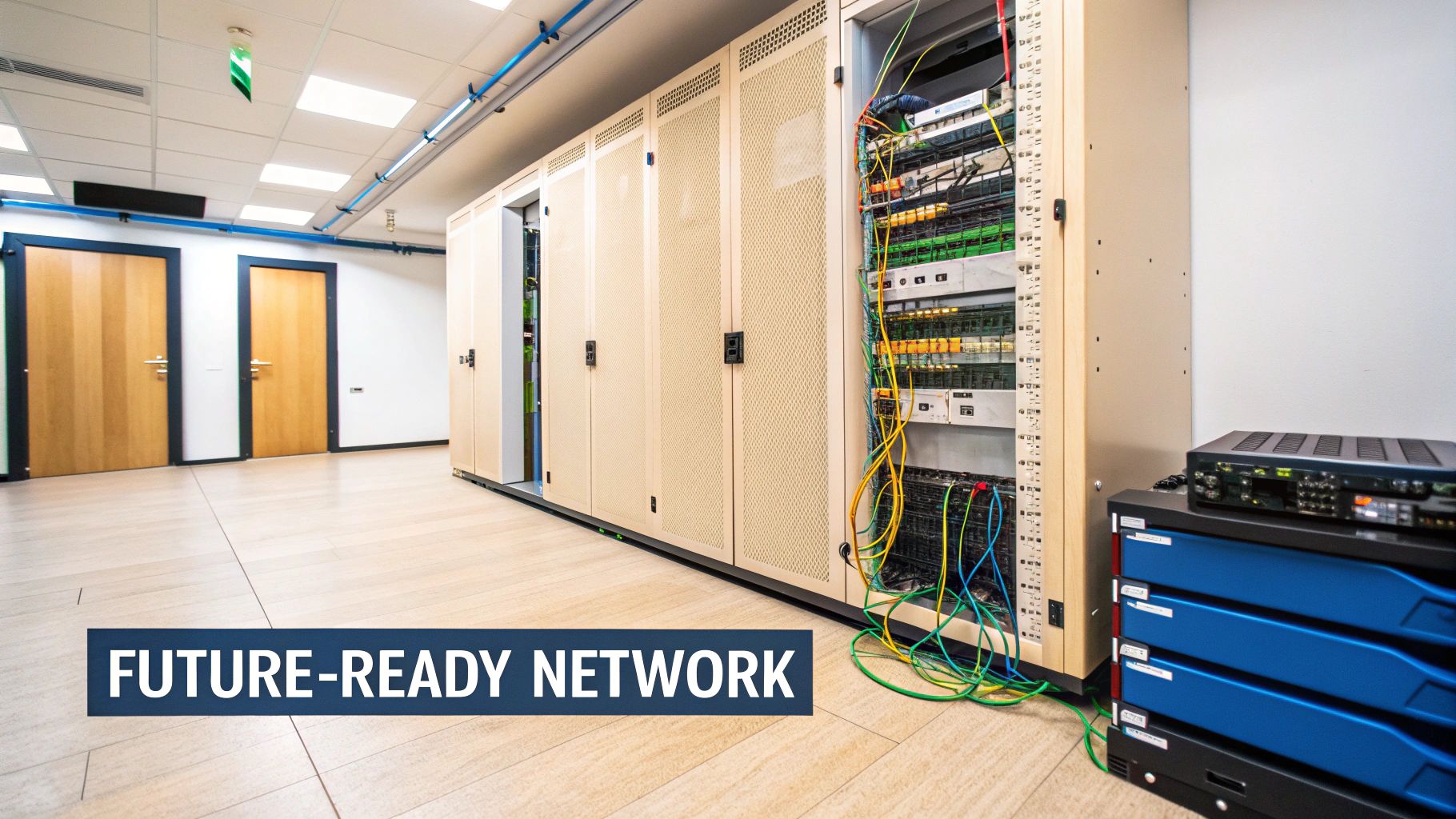
Alongside power, the data network is the central nervous system of the building. It connects every device—locks, cameras, sensors, payment terminals—back to the central management platform. The choice of cabling is critical. For instance, Category 6 (Cat6) structured cabling has become the standard for modern installations, providing a reliable pathway for high-speed data and Power over Ethernet (PoE), which is essential for powering devices like CCTV cameras and VoIP systems. The entire network infrastructure must be professionally installed and certified to guarantee performance.
CCTV: More Than Just Security
In an unmanned environment, CCTV is not just a passive security measure; it's an active operational tool. High-definition IP cameras, powered and connected via the data network, provide remote oversight, verify incidents, and support tenants. When a user reports an issue, you can visually inspect the area in real-time. This integration is vital for remote management, dispute resolution, and maintaining a secure environment without a physical presence.
This diagram neatly summarises the three core pillars that determine the real-world success of an unmanned system.
As you can see, a high-quality component is just one part of the puzzle. A professional installation integrating all three pillars is just as critical for unlocking a reliable, autonomous system.
The Case for Battery-Less, NFC Proximity Locks
When choosing access control, the locks themselves are a major decision point. While battery-powered smart locks are common, they present significant operational challenges in a large-scale unmanned facility.
The real-world reason for choosing battery-less, NFC proximity locks is simple: maintenance. A building with hundreds of units means hundreds of batteries to monitor and replace. A single dead battery results in a locked-out, unhappy customer and an emergency call-out. It creates an enormous and unpredictable maintenance burden that undermines the entire "unmanned" concept.
Battery-less locks, which draw power directly from the user's smartphone via NFC (Near Field Communication), eliminate this problem entirely.
Real-World Advantages of NFC Locks:
Zero Maintenance: No batteries to die, ever. This drastically reduces operational overhead and eliminates the most common point of failure.
Enhanced Reliability: The system is simpler and more robust, with fewer moving parts and no reliance on internal power.
Seamless User Experience: Users simply tap their phone on the lock. The power transfer and data exchange happen simultaneously, providing instant and reliable access.
Security: NFC technology is secure, and credentials can be issued and revoked remotely in real-time, providing tight control over who has access and when.
This choice directly supports the goal of creating a truly autonomous system by removing a major, recurring maintenance headache.
Maintenance and Operational Considerations
A successful unmanned building isn't a "set it and forget it" project. While it eliminates daily staffing, it requires a strategic approach to maintenance and operations. The goal is to move from reactive fixes to proactive management.
Your operational plan must include:
Remote Monitoring: Implementing a system that actively monitors the health of the network, power systems, and access control devices. It should generate automated alerts for issues like a network switch going offline or a door being forced.
Scheduled Maintenance: Regular, planned visits to test systems, inspect hardware, and perform preventative maintenance are far more cost-effective than emergency call-outs.
Reliable Support Partners: You need a trusted technology partner who understands the entire ecosystem—power, data, and access—and can provide expert support when issues arise.
Redundancy: Building in resilience, such as uninterruptible power supplies (UPS) for critical network hardware, ensures the system remains operational even during a local power cut.
Thinking through these operational aspects from the outset is crucial for the long-term viability and profitability of the facility.
Common Applications for Unmanned Systems
The integrated approach to unmanned building management is being successfully deployed across a range of commercial property sectors. The flexibility and efficiency it offers are transformative.
Examples of where these systems are commonly used include:
Self-Storage Facilities: The classic use case. Customers can rent, pay for, and access their units 24/7 without any staff on site.
Co-working Spaces & Serviced Offices: Providing members with seamless, secure access to the main building, private offices, and meeting rooms via their smartphones.
Micro-Fulfilment Centres: Allowing logistics and delivery drivers controlled, audited access to urban warehouses and locker systems at any time of day or night.
Artist Studios & Workshops: Giving creatives flexible, 24/7 access to their rented spaces without the need for a full-time building manager.
Student Accommodation: Streamlining access for thousands of students to their halls and individual rooms, simplifying key management.
In each case, the core benefit is the same: maximising accessibility and convenience for the user while minimising operational overhead for the owner.
Building a Truly Autonomous Future
Building out a fully autonomous unmanned unit is a complex undertaking that demands expertise across multiple disciplines. It requires meticulous planning and a holistic design philosophy that treats power, data, and access as one interconnected system.
The temptation to cut corners by using separate contractors for each element or choosing cheaper, battery-powered components can lead to a system that is unreliable and expensive to maintain. True autonomy is achieved through thoughtful integration, high-quality components, and professional, certified installation. When done right, the result is a secure, efficient, and profitable asset that meets the demands of the modern consumer.
Ensuring your unmanned building delivers the reliability and seamless experience your tenants expect starts with a professional plan and a flawless installation. For expert guidance on integrating access, power, and data for your next project, contact Constructive-IT and build a facility that’s ready for the future. Learn more at https://www.constructive-it.co.uk.
Comments