


What is distributed antenna system: How it works and benefits
- Craig Marston
- Dec 11, 2025
- 15 min read

A Distributed Antenna System, or DAS, is essentially a network of small, strategically placed antennas connected to a single source. Its job is to deliver reliable mobile signal coverage across a specific area, like an entire office building or hospital wing. Think of it as a high-tech indoor signal booster, grabbing a strong signal from outside and spreading it evenly to get rid of frustrating dead zones.
Why Do We Even Need Better Indoor Signal?
Ever walked into a brand-new office block, a sprawling hospital, or a busy shopping centre, only to watch your mobile signal plummet to a single, lonely bar? It’s a familiar story. You’d think that in this day and age, strong mobile coverage would be a given, but ironically, modern building design is often the root of the problem.
The main culprits are the very materials used to build these impressive structures. Energy-efficient Low-E glass, reinforced concrete, steel frames, and thick insulation are fantastic for sustainability and safety, but they are notorious for blocking the radio frequency (RF) signals sent from mobile masts. This is what creates those infuriating "dead zones" where calls drop and your data grinds to a halt. For any modern business, understanding what is a distributed antenna system is the first step to solving this.
The Signal Blocking Problem
Imagine a mobile signal is like music playing outside a soundproofed room. The better the soundproofing, the less music you'll hear inside. In the same way, the materials used in new builds and office fit-outs can dramatically weaken mobile signals before they ever reach your phone.
This issue gets even worse in large venues like stadiums or crowded office floors. Even if a weak signal manages to sneak through, the local network can quickly become overwhelmed when hundreds or even thousands of people try to connect all at once.
A DAS tackles both of these problems head-on. It bypasses the physical signal blockers by piping a strong, dedicated signal directly inside. Then, it distributes that signal evenly, making sure everyone gets reliable access, no matter where they are in the building.
This simple table breaks down the core ideas behind a DAS.
DAS at a Glance: Key Concepts Explained
Concept | Simple Explanation | Why It Matters |
|---|---|---|
Donor Antenna | An antenna, usually on the roof, that captures a strong, clean signal from a nearby mobile mast. | This is the source of the good signal. Without a strong signal to start with, the internal system can't perform well. |
Head-End Equipment | The "brain" of the system. It receives the signal from the donor antenna and processes it for distribution. | This equipment ensures the signal is clean, amplified correctly, and ready to be sent throughout the building. |
Distribution Network | A network of cables (often fibre optic) that carries the signal from the head-end to antennas inside. | This is the backbone of the system, like the arteries carrying blood. It needs to be professionally installed for reliability. |
Remote Antennas | Small, discreet antennas placed throughout the building to broadcast the boosted signal directly to users' devices. | These are the final delivery points, eliminating dead zones and ensuring even coverage in every corner, lift, and basement. |
By breaking the system down, you can see how each part works together to turn poor indoor coverage into a reliable, high-performance asset.
This strategic approach transforms unreliable connectivity from a daily headache into a dependable utility. The foundation for a successful DAS lies in robust, expert planning, which often relies on professional fibre cable installation and certified hardware. When looking at a full-building solution, it makes sense to review your wider network infrastructure at the same time. As an Excel network accredited partner, we guarantee that every component we use is of the highest quality, backed by a 25 year equipment warranty for complete peace of mind.
How a Distributed Antenna System Actually Works
Ever been in a huge concert hall and wondered how the sound reaches the cheap seats at the back just as clearly as the front row? It’s not one massive speaker on stage. Instead, a clean audio feed is sent from the mixing desk to dozens of smaller speakers placed strategically around the venue.
A DAS does exactly the same thing, but for mobile signals. Rather than relying on a distant mobile mast to blast a signal through thick walls, a DAS captures a perfect signal from outside, gives it a boost, and then re-broadcasts it through a dedicated network of small, internal antennas. This clever approach bypasses signal-killing materials like concrete and metal-coated glass, ensuring a strong, reliable connection everywhere it’s needed.
The diagram below shows the core problem a DAS is designed to fix: modern building materials creating frustrating signal dead zones.
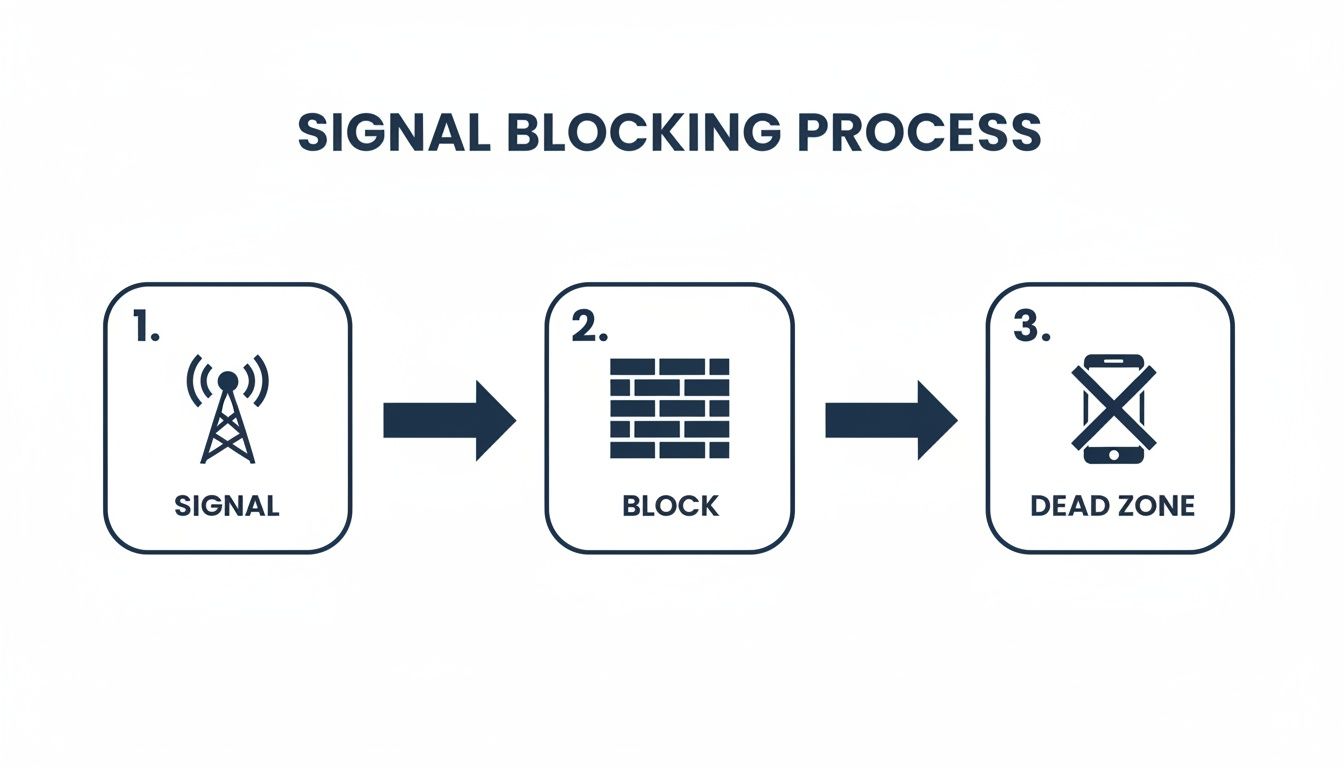
This is precisely why a strong outdoor signal often disappears the moment you step inside a large building. A DAS bridges that gap.
The Signal Journey: From Outside to Inside
Everything starts with capturing the best possible signal from the mobile networks. The quality of this source signal dictates the performance of the entire system – if you start with a weak, noisy signal, that’s all you’ll get inside.
The Donor Antenna: This is the system's lifeline. An external antenna, usually placed on the roof, is carefully aimed at the nearest mobile mast. Its only job is to lock onto the strongest, cleanest 4G and 5G signals it can find for one or more networks.
The Headend Unit: The signal is then fed from the donor antenna to the headend equipment – the brains of the operation. This unit filters, amplifies, and sometimes converts the signal, getting it ready for its journey through the building.
The Distribution Network: Here's where professional expertise is absolutely critical. The processed signal travels from the headend through a meticulously planned network of high-performance cables. For any modern, high-capacity system, this almost always involves fibre cable installation to shuttle the signal over long distances with zero loss in quality.
Delivering Flawless Coverage
Once the pristine signal is flowing through the building’s new nervous system, the final step is getting it to everyone’s devices. This is handled by a series of small, low-profile antennas.
These broadcast antennas are discreetly fitted into ceilings or other strategic spots identified during the design phase. They take the signal from the fibre network and transmit it across their designated area, guaranteeing seamless connectivity in offices, meeting rooms, car parks, and corridors. The whole process works in reverse, too, picking up the signal from your phone and sending it back out via the donor antenna.
This intricate journey from mast to mobile highlights why professional deployment is non-negotiable. A properly engineered DAS isn't a plug-and-play gadget; it’s a piece of critical network infrastructure that demands expert planning, precise fibre cable installation, and rigorous testing to work perfectly from day one.
The need for these robust indoor solutions is exploding. The UK’s Distributed Antenna System (DAS) market was valued at around USD 485.39 million in 2025 and is set to grow at a compound annual growth rate (CAGR) of 18.9% in the coming years. This surge is fuelled by urbanisation and digital initiatives, creating a massive demand for reliable wireless connectivity where standard mobile signals just can’t reach.
Choosing the Right System: Passive, Active, or Hybrid
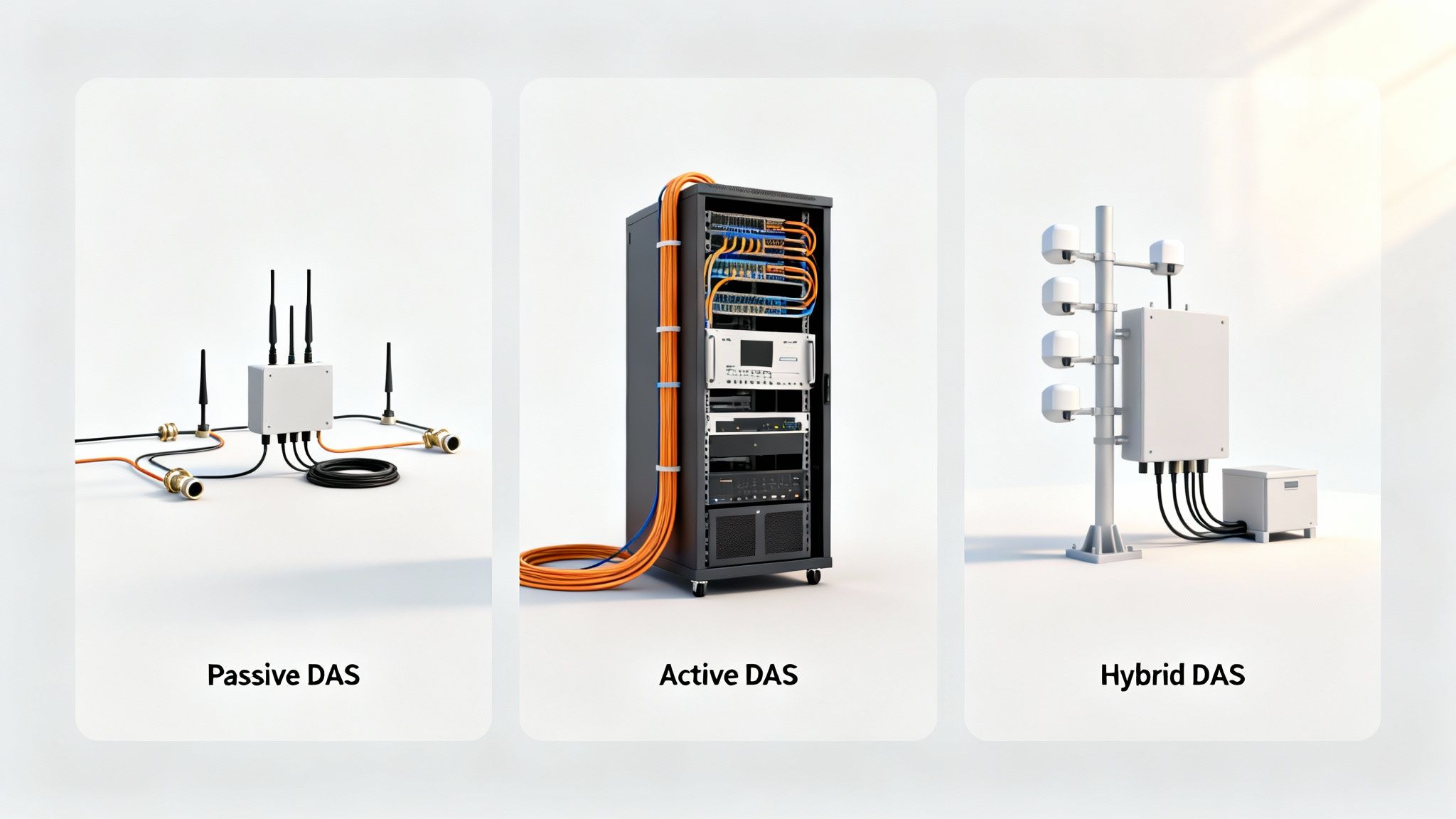
Just like you wouldn't use the same sound system for a small café and a massive concert arena, not all Distributed Antenna Systems are created equal. The right solution for your building hinges on its size, complexity, and, of course, your budget. Getting to grips with the three main types—Passive, Active, and Hybrid—is the first step to making a smart decision.
Each system solves the same fundamental problem of poor indoor mobile signal, but they go about it in completely different ways. The choice often comes down to a trade-off between cost, performance, and the sheer scale of the area you need to cover.
Passive DAS: A Straightforward Solution
A Passive DAS is the simplest and most cost-effective of the bunch. It works by using a donor antenna on the roof to capture the mobile signal. That signal is then sent throughout the building using a network of coaxial cables, splitters, and indoor antennas. Simple.
The term "passive" is key here—it means there are no active electronics boosting the signal along the way. This makes it a reliable, lower-cost option, perfect for smaller buildings or specific zones where coverage is patchy, like a single office floor or a car park. The catch? The signal naturally gets weaker as it travels down the coax cable, so a Passive DAS is generally best for areas under 100,000 square feet.
Active DAS: Power for Complex Venues
At the other end of the scale is the Active DAS. This is the powerhouse solution, built for huge and complex environments like airports, stadiums, university campuses, and sprawling hospitals.
An Active DAS takes the analogue radio frequency (RF) signal and converts it into a digital signal at the headend. This digital signal is then distributed over a fibre cable installation, which is where the magic happens. Using fibre means the signal can travel for miles with virtually zero loss in quality. At the other end, remote units convert the signal back to RF before it’s broadcast by the indoor antennas.
While it’s easily the most expensive option, an Active DAS provides unmatched performance, capacity, and scalability. It's the gold standard for large-scale venues where flawless, high-capacity coverage for thousands of users is simply non-negotiable.
This level of engineering is a serious project. It demands a certified, tested network delivery from an experienced partner to ensure the system performs exactly as it should, especially when it’s part of a major office relocation with equipment testing or a new build.
Hybrid DAS: The Best of Both Worlds
A Hybrid DAS, as the name suggests, cherry-picks elements from both Passive and Active systems to create a flexible, balanced solution. It typically uses a fibre optic backbone to carry the signal from the headend to different zones in a building, just like an Active system.
Once the signal reaches a specific floor or area, however, it’s then distributed to the local antennas using less expensive coaxial cables, just like a Passive system. This approach minimises signal loss over long distances while keeping costs down for the final runs. It's an ideal middle-ground for mid-sized buildings like hotels, corporate offices, and hospitals.
Comparison of DAS Types: Passive vs Active vs Hybrid
Choosing the right system requires a clear-eyed look at what your building really needs. To help you see the differences at a glance, the table below breaks down the key features of each DAS type.
Feature | Passive DAS | Active DAS | Hybrid DAS |
|---|---|---|---|
Ideal Building Size | Small (under 100,000 sq. ft) | Very Large (over 500,000 sq. ft) | Medium to Large (100,000-500,000 sq. ft) |
Cabling Used | Coaxial | Fibre Optic | Mix of Fibre and Coaxial |
Signal Quality | Good (degrades over distance) | Excellent (no signal loss) | Very Good (minimal loss) |
Cost | Lowest | Highest | Moderate |
Scalability | Limited | High | Good |
Best For | Single-floor offices, small retail, car parks | Stadiums, airports, large hospitals, campuses | Corporate offices, hotels, mid-sized hospitals |
Ultimately, the best choice always comes down to a professional assessment of your environment. As an Excel network accredited partner, we ensure every component, from the fibre cable installation to the final antenna, is backed by a 25 year equipment warranty. This guarantees you get a reliable, long-term solution, no matter which system you choose.
The Core Components of a DAS Network
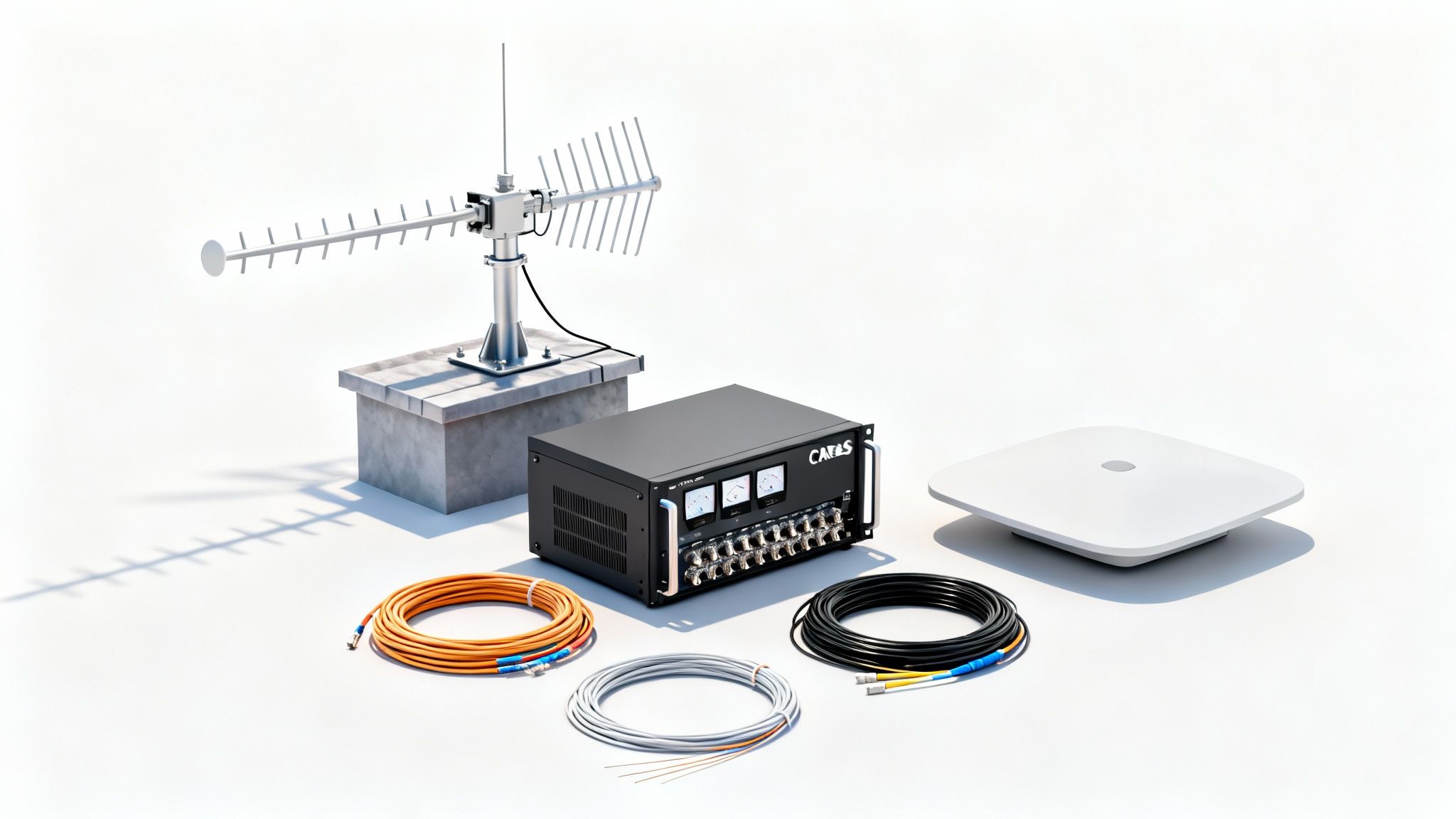
A Distributed Antenna System might look complex from the outside, but it’s really just a few key bits of hardware working together in perfect harmony. Each component has a specific job, and when they’re all doing their part, they form a powerful chain that grabs a weak or non-existent outdoor signal and turns it into strong, reliable indoor coverage.
Once you understand these building blocks, it’s much easier to see how a DAS brings seamless mobile connectivity into your building. At its heart, a DAS is a signal delivery service—it captures, processes, and distributes mobile signals with pinpoint precision. The quality and professional installation of each part are absolutely crucial for the system's performance and longevity.
The Donor Antenna: The Signal Catcher
It all starts outside the building, usually up on the roof. The Donor Antenna is the very first link in the chain, acting as the system’s ears. Its one and only job is to capture the strongest, cleanest signal it can find from a nearby mobile network operator's mast.
Getting the placement and type of this antenna right is critical. It has to be positioned to avoid interference and aimed with absolute precision to lock onto the best available 4G and 5G signals. Think of it like tuning an old radio to get a crystal-clear station; if you start with static, that’s all you’re going to get inside. Locating the ideal signal source is a science in itself—you can learn more about finding mobile mast locations in the UK to see just how important this first step is.
Headend Equipment: The System's Brain
Once the donor antenna has grabbed the signal, it sends it down to the Headend Equipment. This is the central processing hub, the brain of the whole DAS network. This unit takes that raw signal, cleans it up, amplifies it, and gets it ready for distribution throughout the building.
Depending on whether the system is active or passive, the headend might also convert the signal from analogue to digital to be sent over fibre optic cabling. This is a vital step that makes sure the signal's quality is protected before it starts its journey indoors.
The Distribution Network: The Signal's Highway
This is the circulatory system of the DAS, carrying the amplified signal from the headend to every nook and cranny of your facility. The Distribution Network is made up of high-performance cabling, splitters, and connectors that act as the signal’s superhighway.
For modern Active and Hybrid systems, this network relies heavily on fibre optic cables. Fibre can transport signals over huge distances with practically zero loss in quality, making it essential for large or complex buildings. The quality of this infrastructure is paramount; a sloppy installation with poor cabling can kill performance and create maintenance nightmares down the line.
A well-designed distribution network is the hallmark of a professional installation. It ensures that the signal arriving at the final antenna is just as clean and powerful as when it left the headend, guaranteeing consistent performance everywhere.
Broadcast Antennas: The Final Delivery
The final stop on the signal’s journey is the Broadcast Antennas. These are the small, discreet devices you might spot mounted in the ceiling tiles of an office, hospital, or airport. They take the signal from the distribution network and broadcast it into the surrounding area, creating pockets of strong, reliable mobile coverage.
These low-profile antennas are strategically placed to wipe out dead zones, ensuring that every desk, meeting room, and common area gets seamless connectivity. This is how you transform a building from a signal blackspot into a productivity hub.
What Are the Real Business Benefits of a DAS Installation?
Putting in a Distributed Antenna System is much more than just a technical fix for bad mobile signal. Think of it as a strategic investment that pays off in very real ways, transforming unreliable indoor coverage into a genuine business asset. It stops the conversation being about dropped calls and starts it being about operational excellence.
When your staff can walk freely through the entire building without their connection dropping, efficiency just naturally improves. A certified, tested network delivery means every single team member, from the basement stores to the top-floor offices, has what they need to collaborate without a hitch. This seamless connectivity creates a more agile, productive workforce, turning a daily frustration into a competitive edge.
Boosting Productivity and Improving On-Site Experiences
In any modern business, consistent mobile access is completely non-negotiable. A DAS gets rid of the dead zones that force employees to wander around hunting for a signal, which saves valuable time and prevents annoying disruptions to important calls with clients or colleagues. This reliability also extends to your visitors, improving the customer and guest experience by giving them the dependable connectivity they've come to expect.
But this level of performance isn't just about convenience; it’s about making your building ready for the future. A professionally installed DAS, built with quality components like those from an Excel network accredited partner, provides the solid foundation needed for next-generation technologies.
A huge advantage of a distributed system like DAS is how it overcomes the usual signal limitations, achieving optimized coverage and reduced interference. This means your building's infrastructure is ready for the demands of 5G and the Internet of Things (IoT), protecting your investment for years to come.
Ensuring Public Safety and Increasing Property Value
Beyond the day-to-day operations, a DAS installation plays a vital role in public safety. Many systems can be set up to support the Airwave network used by the emergency services, guaranteeing that police, fire, and ambulance crews can communicate without fail during a critical incident. For any large public or commercial building, this is an essential, non-negotiable feature.
The ever-growing demand for solid indoor coverage is also making waves in the property market. Projections show a massive upward trend for Distributed Antenna Systems in the United Kingdom, with analysts forecasting the market to grow from around USD 485 million in 2025 to an estimated USD 1.5 trillion by 2032. This incredible growth shows just how much a DAS is becoming seen as a fundamental utility for modern buildings. You can find out more about the UK's rapid adoption of DAS technology here.
This demand directly boosts your property's value. A building with guaranteed, high-performance mobile coverage is far more attractive to potential tenants, which often leads to higher occupancy rates and happier tenants. A professional installation, complete with a 25 year equipment warranty, meticulous cable management, and seamless integration into an office relocation with equipment testing, marks your property as a premium, future-ready workspace. It effectively turns your building’s connectivity into one of its most valuable selling points.
Planning Your DAS Deployment from Design to Installation
A successful Distributed Antenna System project doesn't just happen by chance. It’s the result of a meticulous planning process that takes you from the initial design right through to the final installation, ensuring your system delivers flawless mobile coverage from day one. Trying to cut corners or underestimating the complexity here often leads to poor performance and budgets spiralling out of control.
This is why partnering with an experienced integrator is so crucial. They can navigate this multi-stage journey with you, because it’s far more involved than just plugging in some equipment. Think of it as a piece of critical infrastructure engineering that demands precision every step of the way.
The Initial Site Survey and System Design
Every great DAS project kicks off with a thorough site survey. This is the bedrock of the entire plan, where professionals come in to analyse your building’s layout, look at the construction materials, and measure existing signal strengths to pinpoint exactly where the dead zones are. A critical first step in any deployment is thorough planning, and this detailed guide on conducting a comprehensive site survey for wireless networks provides essential insights into mapping out your needs.
Armed with this data, engineers can then design a truly custom solution. They’ll select the right type of DAS—be it Passive, Active, or Hybrid—and map out the perfect placement for every single antenna and cable. This design phase is all about guaranteeing optimal coverage and capacity, tailored specifically to your facility’s unique challenges.
Professional Installation and Commissioning
Once the design gets the green light, the physical installation begins. This is where real-world expertise in fibre cable installation and structured cabling becomes absolutely non-negotiable. As an Excel network accredited partner, we ensure every component is installed to the highest possible standard, delivering a certified, tested network delivery.
The attention to detail here is paramount, right down to meticulous cable management that results in a system that’s not just reliable but also looks clean and professional. A tidy installation simplifies future maintenance and troubleshooting, ensuring your system performs reliably for years to come and is backed by a 25 year equipment warranty.
A DAS project can be seamlessly integrated into a larger project like an office relocation with equipment testing. This approach ensures that all your connectivity is fully commissioned and working perfectly before your team even sets foot in the new space, guaranteeing a smooth transition without any frustrating signal issues on day one.
Your Next Steps for Flawless Connectivity
Getting started on your DAS planning journey is surprisingly straightforward. The first steps usually involve gathering up your floor plans and identifying the key areas where poor mobile signal is hurting your operations. Bringing an expert in early will help you define a clear budget and timeline right from the start. For more immediate tips, you can explore our guide on boosting cell signal in a simple office environment.
By following a structured deployment plan, you can turn your building’s connectivity from a frustrating liability into a powerful asset that improves productivity and future-proofs your entire infrastructure.
Your DAS Questions Answered
To wrap up our guide on distributed antenna systems, let's tackle some of the most common questions that pop up when businesses start exploring this technology. Here are a few straightforward answers to help you get to grips with the practical side of planning, installing, and living with a DAS.
How Much Does a Distributed Antenna System Cost?
There's no single price tag for a DAS. The final investment really depends on your building's size, its complexity, and the type of system you need. A small, passive setup for a single floor might run into the tens of thousands of pounds, whereas a large-scale active DAS for a hospital campus could easily reach hundreds of thousands.
The biggest cost drivers are the total area needing coverage, the number of mobile networks you want to support, and the complexity of the fibre cable installation. The only way to get a true figure is with a detailed site survey and a custom quote from a certified integrator.
Will a DAS Interfere with Our Wi-Fi Network?
In short, no. A professionally designed and installed DAS won't cause any problems for your existing Wi-Fi network. DAS operates on licensed cellular frequencies (like 4G and 5G), while Wi-Fi uses separate, unlicensed frequencies. The two are built to coexist without getting in each other's way.
An experienced installer, like an Excel network accredited partner, will ensure proper cable management and antenna placement for both systems. This stops any signal conflict dead in its tracks, letting both your cellular and Wi-Fi networks perform at their best. A tidy installation avoids a lot of future headaches, contributing to a clean and efficient workspace, far from the chaos of a messy desk.
A certified, tested network delivery is absolutely crucial. This is your guarantee that all systems, including DAS and Wi-Fi, are commissioned properly to work alongside each other without any drop in performance, giving you a reliable wireless environment for all your devices.
How Long Does a DAS Installation Take?
The project timeline is all about the scale of the job. A simple system in a small office might only take a few weeks from the initial design chat to the final switch-on.
On the other hand, a more complex, multi-carrier active DAS project for a large building can take several months. That longer timeframe covers everything from detailed site surveys and system design to getting approvals from the network operators, ordering equipment, and the physical installation itself. If you can, tying the project into an office relocation with equipment testing can really streamline things, making sure everything is fully operational from day one. A 25 year equipment warranty also gives you long-term confidence in your investment.
Ready to eliminate dropped calls and dead zones for good? Constructive-IT designs and delivers high-performance Distributed Antenna Systems tailored to your building's unique needs. Get in touch with our experts today to start planning your seamless connectivity solution.
Comments