


What is rg cable? A Quick Guide to RG6, RG59, and Their Uses
- Craig Marston
- Feb 13
- 12 min read
When you’re dealing with signals for things like broadband, TV, or CCTV, you need a cable that can carry that signal cleanly from A to B. That’s where RG cable comes in. The "RG" simply stands for Radio Guide, a name that stuck from an old military specification for different types of coaxial cable.
What Exactly is RG Cable?
Think of RG cable as a purpose-built, shielded tunnel for information. Its whole design is focused on one job: protecting a signal as it travels, keeping outside electrical noise out. This clever, layered construction is why it's been a trusted workhorse for decades in telecoms, broadcasting, and any network where signal quality is paramount.
For years, it was the go-to for everything from connecting your telly to getting you online. While newer tech like fibre has come along, understanding RG cable is still crucial because it’s a key player in many modern buildings, especially for broadband and security systems.
Its Role in Modern Buildings
Even with the rise of fibre optics, RG cable is far from obsolete. It still holds a strong position where its unique strengths—namely, excellent interference blocking and cost-effectiveness for certain jobs—make it the perfect fit. Today, you’ll most often find it:
Delivering high-speed internet from the street cabinet to a business or home.
Distributing TV signals, whether from a satellite dish or a cable provider.
Connecting analogue high-definition CCTV cameras back to the recorder.
In the UK, RG cable is a staple for reliable signal transmission in IT infrastructure, broadcasting, and telecoms. The market for insulated coaxial cable, where types like RG-6 for broadband and TV are dominant, was valued at a hefty $392 million. This shows just how critical this cabling is, especially as businesses fitting out new offices need dependable network foundations. You can get more details on this from the IndexBox market analysis of the UK's coaxial cable market.
At its heart, an RG cable has one simple mission: get a signal from one point to another with as little interference and signal loss as possible. The secret to its success is all in its physical construction.
Breaking Down the Layers of Coaxial Cable
So, what makes an RG cable so good at its job? The secret is in its precise, multi-layered construction. Every single layer has a specific role, and they all work together to move a signal cleanly while shielding it from all the electrical chaos in a busy office.
Think of it as a high-security transport system for your data. Right at the very centre is the central conductor, which is usually a solid copper or copper-clad steel wire. This is the main motorway the signal travels down. The quality and thickness of this conductor have a direct impact on how far that signal can go before it starts to weaken.
Wrapped around this core is a vital layer called the dielectric insulator. This is typically a foam or solid plastic material that acts as a buffer. Its main job is to keep the central conductor perfectly spaced from the next layer, preventing signal bleed (attenuation) and maintaining the cable's characteristic impedance—a critical factor for keeping the signal clean and stable.
The Protective Shielding
Next up is the metallic shield, which is the cable's primary defence against interference. This shield is like armour, blocking unwanted electromagnetic interference (EMI) and radio frequency interference (RFI) from corrupting the signal. For dependable CCTV or audio-visual systems, this is non-negotiable.
This shielding can be built in a few different ways:
Braided Shield: A woven mesh of tiny copper or aluminium wires. It provides fantastic flexibility and is very durable.
Foil Shield: A thin layer of aluminium foil that offers 100% coverage against high-frequency interference.
Combination Shield: Most modern RG cables, like RG6, use both a foil and a braided shield. This gives you the best of both worlds, providing maximum protection across a huge range of frequencies.
Finally, the entire bundle is wrapped in the outer jacket. This is the tough, usually black or white plastic coating you see on the outside. Made from materials like PVC, its job is purely physical: to protect all the delicate inner layers from moisture, scrapes, and general damage during installation.
Think of it like this: the central conductor carries the message, the dielectric insulator keeps it on the right path, the metallic shield protects it from eavesdroppers (interference), and the outer jacket is the armoured vehicle keeping everything safe from the outside world.
Each layer is engineered to support the others, creating a cable that's far more than the sum of its parts. This layered design is precisely why RG cable remains a trusted solution where a clean, stable signal is paramount. Without this careful construction, the signal would quickly fall apart, leading to grainy video or an unreliable internet connection.
Choosing the Right Cable: RG6 vs RG59 vs RG11
Picking the correct RG cable isn't just a technical footnote; it's a critical decision that directly affects how well your entire system performs. Get it wrong, and you could be stuck with fuzzy images, signal dropouts, or a painfully slow internet connection. The three most common types you’ll come across are RG6, RG59, and RG11, and each one is engineered for a specific job.
Think of them as different types of pipes. A thin pipe (RG59) is fine for a trickle of water over a short distance, but you’d need a much wider, stronger pipe (RG11) to move a huge volume of water over a long way without losing pressure.
RG6: The Modern Standard
RG6 is the go-to choice for virtually all modern, high-frequency setups. It has a thicker central conductor and much better shielding (often a double layer of foil and braid) than its predecessors. This design is built to carry high-bandwidth digital signals with minimal loss.
That makes it the undisputed champion for digital satellite TV, HD cable television, and pretty much any residential or commercial broadband internet installation. If you're setting up a system that needs a strong, clean signal for high-frequency data, RG6 is almost always the right answer. Its superior construction ensures that digital information arrives intact, preventing the pixelation or connection drops that plague lesser cables.
This diagram breaks down the essential layers that give these cables their protective qualities.
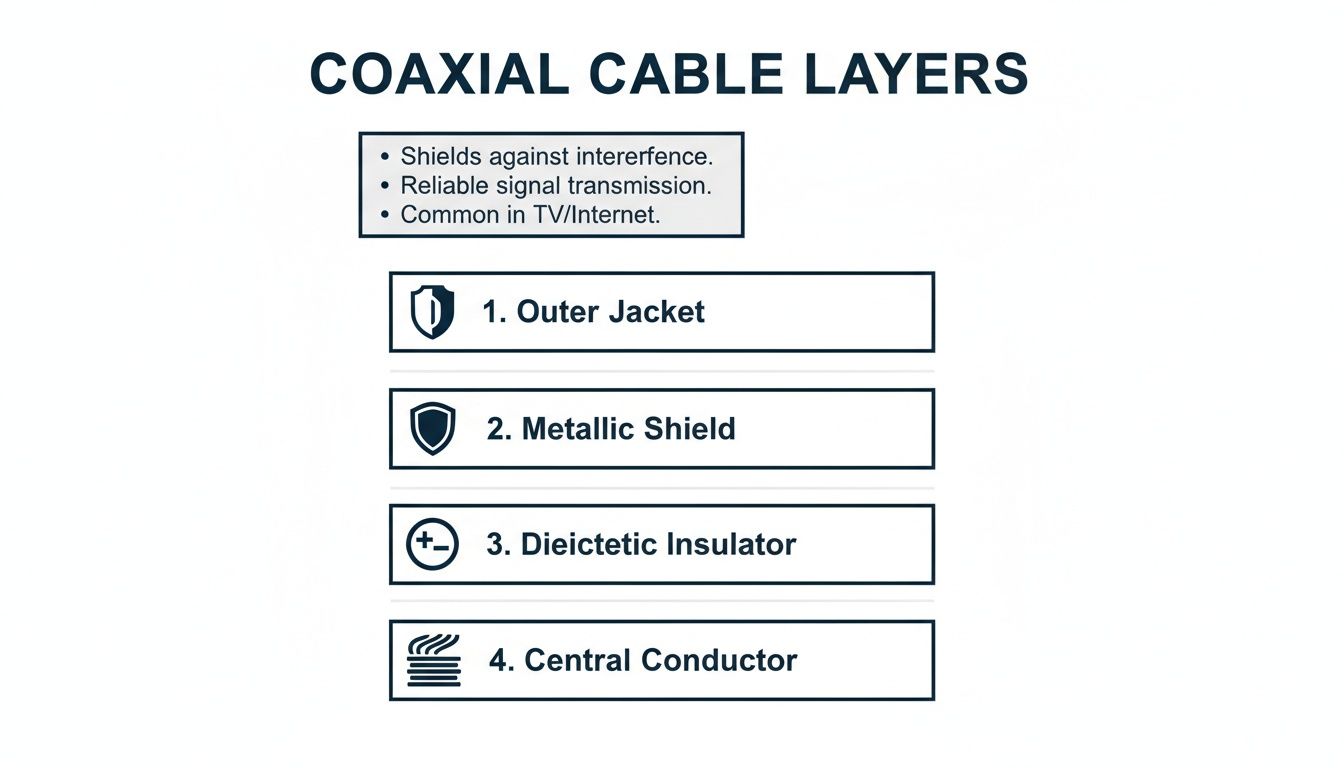
Each layer, from the copper core to the outer jacket, works together to shield the precious signal from outside interference.
RG59: The Analogue Specialist
Before digital signals took over, RG59 was king. It has a thinner central conductor and lighter shielding compared to RG6, making it better suited for lower-frequency signals over shorter distances.
Today, you’ll mostly find it in older analogue CCTV systems and some component video setups. While it’s completely unsuitable for your broadband or satellite dish, it remains a perfectly good and cost-effective option for legacy security camera installations where high frequencies aren't a factor. Trying to force it to carry a modern HD signal, however, will lead to serious signal degradation.
RG11: The Long-Distance Runner
When you absolutely have to send a strong signal over a very long distance, RG11 is the heavy-hitter you call in. It has the thickest conductor of the three, which dramatically reduces signal loss (known as attenuation) over extended runs.
This makes it the perfect choice for backbone installations—for example, connecting a satellite dish on a large commercial building to a distribution point hundreds of feet away. The trade-off is that its thickness makes it far less flexible and more expensive, so it’s usually reserved for those specific long-haul jobs where RG6 would run out of steam.
To help you decide at a glance, here’s a quick comparison of the three main contenders.
Comparison of Common RG Cable Types
Feature | RG6 | RG59 | RG11 |
|---|---|---|---|
Primary Use | Digital TV, Satellite, Broadband Internet | Analogue CCTV, Low-Frequency Video | Long-Distance Runs, Backbone Cabling |
Frequency Range | High Frequency (up to 3 GHz) | Low Frequency (up to 1 GHz) | Very High Frequency (up to 3 GHz) |
Signal Loss | Low | High | Very Low |
Conductor Size | Medium (18 AWG) | Small (20 AWG) | Large (14 AWG) |
Flexibility | Good | Excellent | Poor |
Cost | Moderate | Low | High |
Ultimately, choosing the right cable comes down to matching its strengths to your specific application. For most modern network and media installations, RG6 strikes the perfect balance of performance and practicality.
RG coaxial cables have been at the heart of the UK's telecommunications story since the early BBC transmissions in the 1950s. Today, the UK's RF interconnect market, which relies heavily on these assemblies, generates £1.8 billion in revenue, with RG cable assemblies accounting for 33.85% of that. A great example is Virgin Media O2's recent network upgrade, which saw over 10 million metres of RG6 installed to boost speeds for millions of homes. You can read more about these UK market findings from Grand View Research.
Where RG Cable Still Wins in Modern Buildings
Even with Ethernet and fibre optics running the show for data networks, RG cable remains the undisputed champion in a few key areas. Its unique design, which is brilliant at keeping a signal strong over distance and fighting off interference, makes it the most reliable and sensible choice for specific, critical jobs in even the most advanced buildings.
This is especially true for analogue high-definition CCTV systems. While IP cameras are hugely popular, many systems (like HD-TVI or HD-CVI) send high-resolution video over good old RG59 or RG6 cable. That robust shielding is absolutely essential in electrically noisy environments, ensuring you get a clean, stable video feed without the flickering interference that could plague a less protected cable.
Another stronghold for RG cable is distributing TV and satellite signals. Think about offices, reception areas, or break rooms where a single satellite dish or aerial feed needs to be split and sent to multiple screens. RG6 is perfectly engineered for this job, handling the high frequencies of digital signals with minimal loss so every screen gets a crisp, clear picture.
Backbone for Broadband Internet
Crucially, RG cable is still the backbone of many major broadband internet services across the UK. Internet Service Providers (ISPs) often run a robust fibre network to a street cabinet, but that final connection from the cabinet into the office—often called the 'last mile'—is frequently made with high-quality RG6 coaxial cable.
This hybrid approach plays to the strengths of both technologies. It uses fibre for the heavy lifting over long distances and leverages RG cable's reliability and existing infrastructure for that final, critical delivery into the building.
The UK coaxial cable market, where RG types are dominant, reflects this enduring importance, reaching a market size of around $1.2 billion. Operations managers planning office fit-outs still specify RG-6/U for its flawless handling of 75-ohm signals for HDTV over 100-metre runs. The UK's broadcasting sector alone got through over 4,000 tonnes of coaxial cable, with RG types making up a massive 65% thanks to their superior shielding against EMI. You can discover more insights about the European coaxial cable market and its growth.
RG cable's resilience and specialised performance ensure it remains a vital part of any modern building's cabling plan. While Cat6 and fibre handle the data, RG cable reliably manages the video and broadband signals that keep a business connected and secure. Understanding how all these pieces fit together is key to designing a successful network infrastructure.
Knowing When to Use Modern Alternatives
While RG cable is a master of its specific craft, modern data networks need a completely different set of tools. To build an infrastructure that's both effective and ready for the future, you have to recognise where coaxial cable hits its limits and know exactly when to bring in heavy hitters like structured cabling and fibre optics.
The undisputed champion for any modern office data network is structured cabling, almost always Cat6 or Cat6a. Think of an RG cable as a single, dedicated lane for one specific type of traffic, like a video signal. Cat6, on the other hand, is an eight-lane motorway built to handle massive volumes of different data all at once—from huge file transfers and voice calls to high-definition video conferencing.
This multi-lane capability is the lifeblood of any business's daily operations. What’s more, Cat6 brings a game-changing feature to the table that RG cable simply can't offer: Power over Ethernet (PoE). This clever technology lets a single Ethernet cable carry both data and electrical power, which massively simplifies installing devices like VoIP phones, Wi-Fi access points, and IP cameras by getting rid of the need for a separate power brick.
When Fibre Optic Cable Is Essential
When your needs escalate to maximum speed over serious distances, fibre optic cable becomes non-negotiable. Fibre works by sending data as pulses of light through impossibly thin glass strands, which makes it completely immune to the electromagnetic interference that can disrupt copper cables like RG and Cat6.
Fibre optic cabling is the ultimate solution for high-demand connections, such as linking buildings across a campus or connecting server rooms that require blistering data transfer speeds. It offers vastly superior bandwidth and can carry signals for kilometres with virtually zero signal degradation.
Its capacity for speed and distance is simply in a different league to any copper-based alternative. For any business with an eye on future growth and the ever-increasing demand for data, building a fibre backbone into the network design isn't just a good idea—it's a strategic necessity.
Upgrading CCTV from Coaxial to IP Systems
One of the most common crossroads we see involves security systems. Traditional analogue CCTV systems run on RG59 or RG6 cable, and for what they do, they work perfectly fine. However, modern IP (Internet Protocol) camera systems that run over Cat6 Ethernet cabling offer some serious advantages.
IP cameras give you:
Higher Resolution: Delivering images that are far sharper and clearer than their analogue counterparts.
Network Integration: They just become another device on your data network, making remote access, management, and storage much easier.
Advanced Features: IP systems often pack in intelligent analytics, better scalability, and PoE for a much simpler installation.
Understanding these distinctions is key to designing a truly robust system. By integrating the right mix of RG, structured copper, and fibre, you can build a powerful, layered infrastructure that supports all your business needs. For a deeper dive into designing these integrated systems, learn more about our approach to telephony and data connectivity.
Installation Mistakes That Can Ruin Your Network
Even the best RG cable in the world won’t save you from a bad installation. A few common, costly mistakes during setup can completely undermine its performance, leading to signal degradation, dodgy connections, and endless troubleshooting headaches down the line. Knowing what not to do is just as important as getting the right steps down.
One of the most frequent errors we see is ignoring the cable's minimum bend radius. Every cable has a hard limit on how sharply it can be bent before its internal structure gets damaged. Kinking a coaxial cable is a sure-fire way to deform the dielectric insulator, which throws its impedance out of whack and causes signal reflections that can cripple performance.
Another critical failure point is improper termination. Attaching the connectors is a precise job. Using the wrong tool, the wrong connector for that specific cable, or just failing to create a clean, solid connection introduces signal loss and opens the door for interference. A poorly terminated cable is, simply put, an unreliable one.
Common On-Site Pitfalls
When you're running cable through a building, a few simple oversights can turn into major problems. Paying attention to these details is what separates a reliable network from a constant source of frustration.
Cable Crushing: Using staples or cable ties that are cinched down too tight will compress the cable, damaging the shielding and the layers inside. This creates weak points that are magnets for signal loss and interference.
Proximity to Power Lines: Running RG cable parallel to electrical wiring is a recipe for disaster. The electromagnetic field from power lines can induce a ton of noise (EMI) into your coax, corrupting the signal and resulting in grainy video or poor data transfer.
Incorrect Cable Support: Long runs of cable need to be properly supported. If they're left to sag under their own weight, the stress will damage the cable over time and degrade its performance.
A well-installed cable network is invisible—it just works. A poorly installed one becomes a constant source of problems. The difference often comes down to respecting the physical limitations of the cable and avoiding these common installation shortcuts.
By steering clear of these pitfalls, you ensure your cabling infrastructure is robust, compliant, and built to last. For complex projects where you need guaranteed performance, working with specialists in structured cabling, like those providing Excel networking solutions, can ensure a flawless installation from day one.
Common Questions About RG Cable Answered
Getting into the weeds of cabling always throws up a few questions. To help clear things up, here are some straightforward answers to the queries we hear most often about RG cable.
Can I Use RG59 for HD Satellite TV?
In a word, no. It’s a really bad idea. While you might get a flicker of a picture over a ridiculously short distance, RG59 was built for old-school, low-frequency analogue signals.
The high frequencies needed for a crisp HD satellite picture will just die a death travelling down an RG59 cable. This signal loss, or attenuation, will leave you with a pixelated mess or, more likely, no picture at all. For this job, RG6 is the correct choice, hands down. It’s designed to handle those higher frequencies with minimal fuss.
What Is the Main Difference Between 50 Ohm and 75 Ohm RG Cable?
The crucial difference here is what they’re designed to do. 75 Ohm cables, like the familiar RG6 and RG59, are the undisputed standard for video. Think of anything that carries a picture – from CCTV and satellite TV right through to the broadband internet piped into your home.
On the other hand, 50 Ohm cables, such as RG58, are all about data and radio frequency transmission. You’ll find them hooked up to two-way radio systems, Wi-Fi antennas, and other RF gear. Mixing them up is a recipe for disaster. Using the wrong impedance creates a mismatch that causes signal to literally reflect back down the cable, leading to a serious drop in performance.
Is RG cable obsolete because of fibre optics? Not at all. While fibre is unmatched for long-distance, high-speed data, RG cable remains a cost-effective and highly reliable solution for its specific jobs, like 'last mile' broadband delivery and many AV and CCTV systems.
For any large-scale network infrastructure project, from cabling to complete office fit-outs, getting the design and installation right from the start is critical. Constructive-IT specialises in planning and delivering robust, warrantied network solutions across the UK. Learn more about our services.