

Nearly 40% of IT projects were reported as being on track to fail, while another UK source states that at least 65% of projects terminate before cutover, exceed budget, or fail to deliver their expected benefits. Those figures, reported in UK project-failure analysis, change how cutover planning should be approached. The weekend switchover is visible, but the decisions that determine its outcome are usually made months earlier.
A reliable cutover is therefore less about producing a long move-day checklist and more about governing dependencies, freezing scope at the right time, testing the actual operating environment, and giving every team a controlled decision path. That applies to a UK office relocation, a data-centre migration, an NHS clinical system transition, or the build-out of fully autonomous unmanned building units.
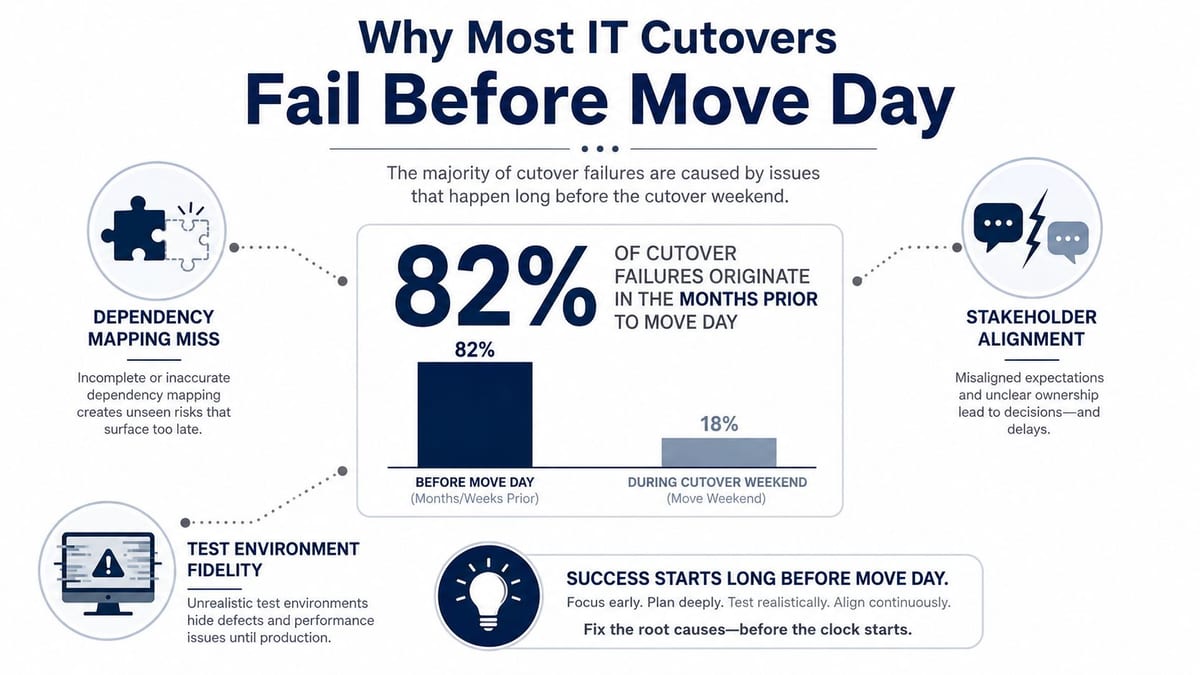
Why Most IT Cutovers Fail Before Move Day
The common failure pattern is straightforward. Teams focus on the final shutdown, equipment move, network activation and go-live approval, while unresolved dependencies remain scattered across suppliers, facilities, applications, telecoms, security and business operations. By the time those gaps appear, the cutover window has become the worst possible place to discover them.
The same UK project-failure reporting supports this concern. One source cited survey data indicating that nearly 40% of IT projects were on track to fail, while another stated that at least 65% either ended before cutover, exceeded budget or failed to produce expected benefits. These are not reasons to abandon complex migrations. They're reasons to treat cutover as a governance challenge rather than a final technical event. Read the practical implications alongside a structured change management approach for IT.
The dependency problem
A dependency register should identify more than servers and circuits. It should connect each service to its location, power feed, network path, access requirement, supplier, owner, test evidence and rollback option. A door controller may depend on a switch port, a power supply, an access database, a time source and a facilities approval. CCTV may depend on storage, network bandwidth, display infrastructure and a correctly commissioned electrical installation.
Fragmentation makes this harder. UK digital delivery has been described as being slowed by bespoke point-to-point integrations, separately managed estates and organisational fragmentation, all of which increase coordination difficulty and the attack surface. In an NHS or multi-site office project, no single team may own the complete service chain, so the cutover manager must create that operational view.
Practical rule: if two teams can independently declare their work complete while the service still can't operate, the plan has a governance gap.
Readiness gates beat optimism
A readiness gate is a formal decision point with evidence behind it. It should answer whether the scope is frozen, whether dependencies are mapped, whether the target environment matches production, whether users and suppliers are available, and whether rollback is still possible.
A last-minute checklist records tasks. A governed cutover controls progression. The difference matters because a task can be marked complete while its result remains unverified. “Circuit ordered” isn't the same as “circuit installed, tested and accepted”. “Access system configured” isn't the same as “credential, door, alarm and CCTV event validated together”.
End-of-life infrastructure adds another layer of risk. NHS trust reporting has identified ageing network infrastructure as a risk to clinical systems, while broader NHS digital reviews have warned that fragmented estates and weak cyber resilience undermine delivery. A sound plan must therefore include fallbacks for fragile legacy equipment, lost subject-matter expertise, staff shortages, change freezes and delayed approvals. Technical rollback alone won't rescue a cutover if nobody can operate the old environment safely.
Building a Phased Cutover Timeline
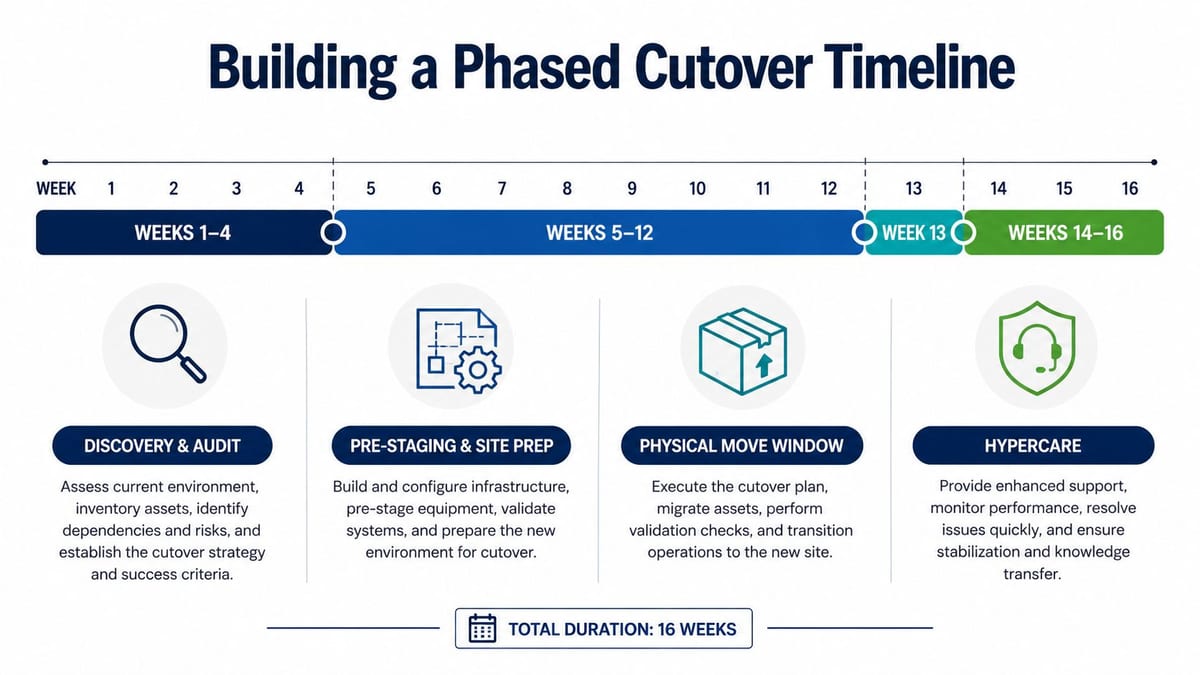
For a mid-market UK office relocation, practical cutover planning should start 12–16 weeks before go-live. The sequence described in UK office relocation timeline guidance allocates 4–6 weeks to discovery and audit, 4–6 weeks to pre-staging and site preparation, a weekend for the physical move, and 2–4 weeks of hypercare. Those phases aren't administrative decoration. Each one removes a different category of uncertainty.
Discovery and audit
Start by establishing the current state. Record assets, racks, circuits, carrier contracts, wireless coverage, structured cabling, power availability, server-room conditions, access systems, CCTV, telephony, meeting-room technology and business-critical applications. Interview the people who support the old environment, especially where documentation is incomplete.
This is also the point to identify constraints. Confirm landlord access, building rules, lift availability, loading arrangements, permit requirements, electrical isolation procedures and working-hour restrictions. A survey that ignores facilities and commercial electrical installation and certification will produce a technically neat but operationally unusable plan.
Pre-staging and site preparation
Pre-stage anything that can be configured and tested away from the live environment. That may include switches, wireless access points, firewalls, racks, patching, endpoint images, monitoring, CCTV devices and access-control components. Label equipment against the design, not against memory.
Connectivity deserves immediate attention. UK telecoms lead times commonly run 45–90 working days, so late ordering is a major failure mode in infrastructure cutovers. The UK-focused relocation evidence reports that 92% of successful relocations had connectivity and circuits completed early, compared with 74% for network pre-build and cabling, making circuit readiness the highest-impact dependency in that dataset. See the UK data-centre move project-management guidance for the wider dependency picture.
The physical move window
The move weekend should contain only activities that require the physical window. Equipment shutdown, transport, installation, power-on, patching and validation need named owners, start criteria and completion evidence. Keep facilities, electrical, network, application, security and business representatives available through the same command structure.
A useful cutover plan also defines what won't happen. Don't introduce unrelated configuration changes, cosmetic improvements or undocumented fixes during the move. A controlled scope is easier to validate and easier to roll back.
Hypercare
Hypercare begins when the business starts using the new environment, not when the project team leaves site. Build a support rota, escalation tree, issue log, monitoring dashboard and decision authority before go-live. The UK office-move evidence reports a 94% zero-downtime success rate for professional IT relocation teams, while unmanaged moves experience 8–14 hours of downtime on average and can reach 48 hours or more. Preparation and managed execution are material risk controls, not optional extras.
Creating Runbooks and Test Plans That Catch Real Failures
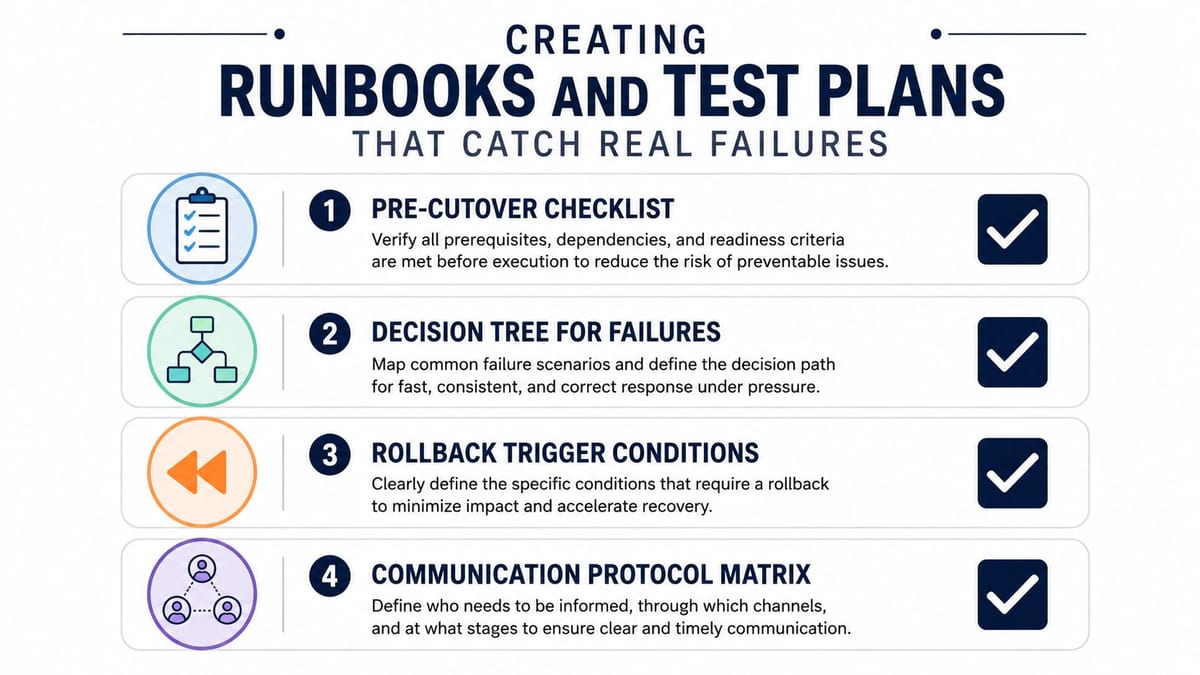
A runbook should let a tired engineer make the correct decision at the correct time. It needs more than a sequence of tasks. Each line should identify the owner, prerequisite, expected result, evidence, next decision and rollback consequence.
UK relocation guidance states that 70% of move-day IT incidents trace back to decisions made in the first fortnight, which is why the runbook must be built early rather than written during the final week. The data-centre commissioning guidance is useful context because commissioning turns installed infrastructure into verified, operational infrastructure.
Build the runbook around decisions
Organise the document by time and decision state. A typical structure includes:
- Pre-cutover validation: Confirm backups, data integrity, change freeze, access permissions, monitoring, supplier attendance and communication channels.
- Cutover initiation: Record the formal go or no-go decision, stop the legacy service where required, begin final synchronisation and raise monitoring sensitivity.
- Execution and validation: Complete each migration step, then verify the result before allowing the next dependent activity.
- Failure decision tree: Define who can pause, who can approve a workaround and who can authorise rollback.
- Go-live confirmation: Capture business acceptance, technical sign-off and the exact point at which operational ownership changes.
Make rollback executable. State the trigger, the person who declares it, the last safe point, the data-handling consequence, the communications message and the validation required after restoration. “Rollback if required” isn't a plan.
Test the conditions that break in production
Test the complete service path, not just individual components. Validate connectivity from real user locations, authentication, printing, telephony, wireless roaming, line-of-business applications, backup access, monitoring alerts, CCTV recording, access events, alarms and power recovery. For data-centre work, include failover and failback tests, endpoint dependencies, storage listeners, batch processing and external integrations.
A dress rehearsal is valuable only if it resembles the cutover. Use the same owners, sequence, communications channels and acceptance criteria. If an application team tests in isolation while facilities, carriers and security teams work from separate assumptions, the rehearsal may confirm nothing useful.
Field teams often introduce another dependency through endpoint operating-system changes. A practical OS upgrade guide for field teams can help standardise preparation, user communication and recovery steps where mobile or distributed devices form part of the cutover scope.
Set gates that can stop the project
A readiness gate should be allowed to fail. Require evidence for circuit acceptance, site readiness, cabling certification, electrical sign-off, application validation, backup integrity, user acceptance and rollback viability. The project manager's job isn't to force every gate open. It's to make the consequence of opening an unsafe gate visible to the sponsor.
A green status without test evidence is a forecast, not a readiness decision.
Integrating Access Power and Data Into One Cutover Scope
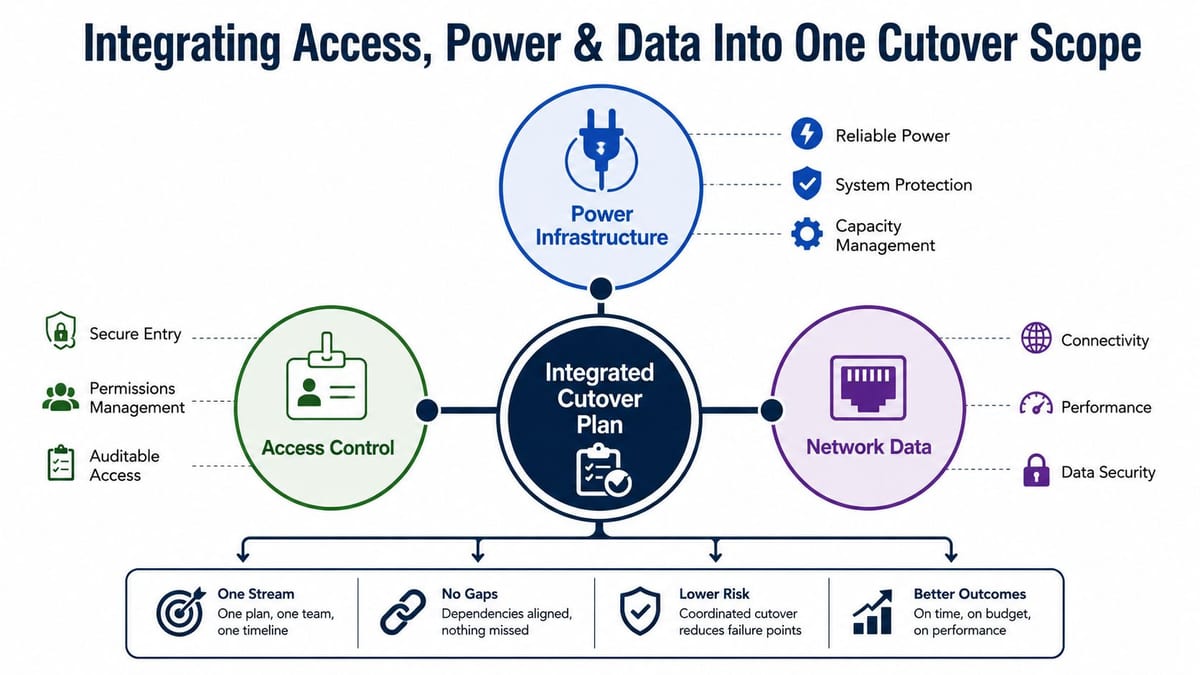
Unmanned building management means operating a site with minimal routine human intervention, while still controlling entry, monitoring conditions, managing alarms, recording events and responding to faults. In practice, that means access control, power infrastructure, network data, CCTV and building-management systems must work as one operating environment.
The design principle is a three-legged stool of access, power and data. UK smart-building guidance uses this model and stresses that CCTV events, access logs, alarms and BMS records must be time-synchronised so operators can correlate what happened. If a door opens, a camera records movement and an alarm changes state, those records should tell one coherent story.
Treat the physical layer as part of the system
A network can be correctly configured while the building remains unusable. A door controller may have power but no reliable network path. A CCTV camera may be online but unable to retain footage. A BMS gateway may report a state using a different time reference from the access platform. These aren't separate defects when they affect the same operating process.
The cutover scope should therefore include:
- Commercial electrical installation and certification: Confirm distribution, circuits, protective devices, earthing, isolation procedures and certification before energising equipment.
- Network and data validation: Test switching, wireless coverage, segmentation, monitoring, time synchronisation and resilient paths.
- Security integration: Validate access permissions, door states, alarms, CCTV events and operator notifications as a single scenario.
- Building controls: Check sensors, HVAC interfaces, environmental alarms and BMS records under normal and failure conditions.
- Operational response: Define who receives alerts, who attends site and how remote access is revoked or escalated.
Why integrated commissioning matters
Many building automation failures begin during commissioning because the full system isn't validated as an integrated whole. Industry analysis also notes that electrical design, grounding and communication-path problems are often mistaken for software faults. That misdiagnosis wastes time and sends the wrong team to investigate.
Commission in layers, then test across layers. First prove the electrical supply and protective arrangements. Next prove network connectivity and device communication. Then validate application logic, event correlation, alarm handling and operator response. A fully autonomous unmanned building unit isn't complete when the devices are installed. It's complete when the building can detect, report and safely respond to expected and abnormal states.
Choosing battery-less NFC proximity locks
Battery-less, NFC proximity locks can be selected where maintenance access is difficult or cabling is undesirable. UK access-control material describes systems that don't require local batteries or cabling, while iLOQ explains that NFC induction from a smartphone or key fob supplies the power needed to read credentials and open the lock. That removes a local battery replacement dependency without removing the need for sound doors, hinges, access policies, credential governance and emergency procedures.
These locks suit plant rooms, remote service areas, internal technical spaces and locations where opening walls for cabling would be disruptive. They still need operational ownership. Plan credential issuance, lost-device handling, access reviews, firmware or platform support, mechanical inspection and a safe manual-entry method. A battery-less lock reduces one maintenance burden. It doesn't make access control maintenance-free.
Rethinking Zero Downtime as a Success Metric
Zero downtime is a useful ambition, but it can become a misleading project objective. In a simple, well-bounded system, a clean switchover may be achievable. In a multi-site NHS transition or a large office relocation, different systems can reach their new state at different times, and temporary inconsistency may be safer than forcing every dependency to change simultaneously.
The NHS clinical migration guidance provides a helpful operational structure. It defines cutover as the period between the final data production from the old system and go-live on the new system. It also says practices should meet at least 4 weeks before the final data production date to agree processes, and sets a 90-day support window for the legacy system after go-live. Those milestones show why cutover success extends beyond the switchover itself. The NHS clinical migration guidance frames the transition as coordinated preparation, a controlled cutover period and post-launch support.
Measure continuity, not appearances
A better success model asks whether critical services remain safe and usable, even if some records, integrations or reporting views are temporarily inconsistent. For clinical environments, preserve patient-care workflows, access to essential information, prescribing processes, communications and escalation routes. For offices, prioritise user access, core applications, telephony, connectivity, security and facilities response.
Define inconsistency windows explicitly. State which data may lag, which functions are read-only, how teams record work manually, when reconciliation occurs and who confirms completion. Users cope better with a known limitation than with an unexplained outage.
Account for constraints the weekend can't solve
Funding changes, organisational restructuring, delayed approvals, staff reductions and ageing infrastructure can all affect readiness. NHS coverage has described fragmentation, funding pressure and organisational change as factors slowing digital delivery, while recent NHS reporting continues to highlight inadequate cyber resilience. No runbook can manufacture missing skills or make end-of-life hardware dependable.
That means the cutover board must be willing to defer, narrow scope or introduce a controlled fallback. It should also identify operational workarounds that don't depend on the people who are most likely to leave or become unavailable. Zero downtime deployment methods, as discussed in this practical deployment overview, can inform application strategies, but infrastructure and building cutovers still require physical readiness, human coordination and service-specific acceptance criteria.
Continuity is the outcome. Zero downtime is only one possible technique.
Post Cutover Hypercare and Long Term Stabilisation
Go-live changes the risk profile, but it doesn't end the project. For office relocations, the practical hypercare period is 2–4 weeks, covering early user issues, monitoring, configuration tuning, supplier follow-up and defects that only appear under normal workload. The NHS guidance provides a longer model, with a 90-day legacy-system support window after go-live. Together, these periods support a useful distinction between immediate stabilisation and controlled retirement.
Structure the first hours and days
Use one operational command channel and one issue record. Every incident should have an owner, severity, affected service, workaround, next update time and closure evidence. Escalate by impact rather than by which supplier first receives the call.
During the first hours, validate critical workflows from real locations. Check power alarms, core network health, wireless performance, authentication, printing, telephony, CCTV recording, access events, BMS status and application transactions. The technical team should compare expected behaviour with observed behaviour, not just confirm that devices respond to a ping or dashboard check.
Move ownership deliberately
By the end of hypercare, the operational team should have:
- Approved as-built records: Include rack layouts, patching, circuits, device locations, access-control relationships, CCTV coverage and certificates.
- Support agreements: Record service hours, response routes, supplier responsibilities and escalation authority.
- Known-error guidance: Document workarounds for issues that are understood but not yet permanently resolved.
- Monitoring ownership: State who reviews alerts, which alerts matter and how operators respond.
- Change control: Prevent emergency fixes from creating undocumented configuration drift.
- Legacy exit criteria: Define when old systems can be retired, archived or disconnected safely.
Skills shortages require an explicit fallback. Pair operational staff with project engineers during handover, capture short troubleshooting procedures and keep access to legacy expertise available for the stabilisation period. If an approval is delayed, record the risk, owner and interim control rather than allowing the decision to disappear in meeting notes.
The best cutover plans finish with a stable operating model, not a successful screenshot of the new system. Review incidents, update the runbook and close dependencies only when the receiving team can support the environment without project intervention.
Constructive-IT can support UK office relocations, new fit-outs and data-centre cutovers with migration runbooks, structured cabling, LAN and Wi-Fi delivery, electrical works, certification, AV and CCTV integration, and on-site go-live support. If your project needs dependency mapping and readiness gates rather than a last-minute checklist, visit Constructive-IT to discuss the scope, timeline and operational handover.