
You're probably dealing with the same pattern most UK infrastructure teams hit before a move or fit-out goes live. The cloud estate is documented, scripted and reviewed. The physical estate isn't. Switch configs sit in a laptop folder, the cabling schedule lives in a spreadsheet no one trusts, facilities are chasing electrical sign-off, and somebody still has to walk the floor to check whether CCTV, access control and Wi-Fi are aligned with the latest plan.
That gap is where most project pain sits.
Infrastructure as code is usually discussed as a cloud discipline. In practice, the same mindset is just as useful for office relocations, data centre upgrades, commercial electrical installation, CCTV rollouts and building out fully autonomous unmanned building units. If the design matters, if the configuration must be repeatable, and if changes need an audit trail, it belongs in code or in a version-controlled definition that behaves like code.
Beyond the Cloud The New Reality of UK Infrastructure
The final week before go-live exposes every weak process. A floor plan changes late, so the structured cabling routes need updating. New desks mean more ports. The Wi-Fi design no longer matches the partitioning. A comms room gets built on time, but no one can clearly confirm whether the power installation has been fully tested and certified against the current rack layout.
That isn't a tooling problem first. It's a control problem.
Infrastructure as code gives teams a disciplined way to define infrastructure before they touch production. In cloud work, that usually means servers, storage and networking declared in files and applied through automation. On physical projects, the same principle works if you treat switch configurations, rack elevations, cabling manifests, power schedules, access rules and commissioning records as controlled artefacts rather than disconnected documents.
Why this matters now
The UK market is moving quickly. The United Kingdom Infrastructure as Code tool market was valued at $1.2 billion USD in 2024 and is forecast to reach $5.5 billion USD by 2033, expanding at a CAGR of 18.5%, reflecting a shift towards automated provisioning to reduce manual errors and deployment times, according to UK Infrastructure as Code market analysis.
That matters for office projects because manual methods don't scale well once the job includes multiple floors, mixed tenancy, resilient WAN links, CCTV, telecoms, server room upgrades and electrical dependencies. The more trades involved, the more expensive uncontrolled change becomes.
Where cloud-first guidance falls short
Most IaC writing stops at virtual machines and cloud resources. Real projects in the UK rarely do. A relocation involves:
- Physical network design: patch panels, fibre, cabinet space, containment and labelling
- Commercial electrical installation: clean power, circuits, testing, certification and handover packs
- Operational systems: access control, CCTV, environmental monitoring and remote support paths
- Live cutover planning: sequencing old and new sites without losing service
Practical rule: If your team can rebuild the cloud environment from source control but can't prove which cabinet, cable run, breaker or door schedule is current, your infrastructure is only half managed.
That's the new reality. Cloud and physical delivery now meet in the same project window, under the same security expectations, with the same pressure to avoid disruption.
What Is Infrastructure as Code in Practice
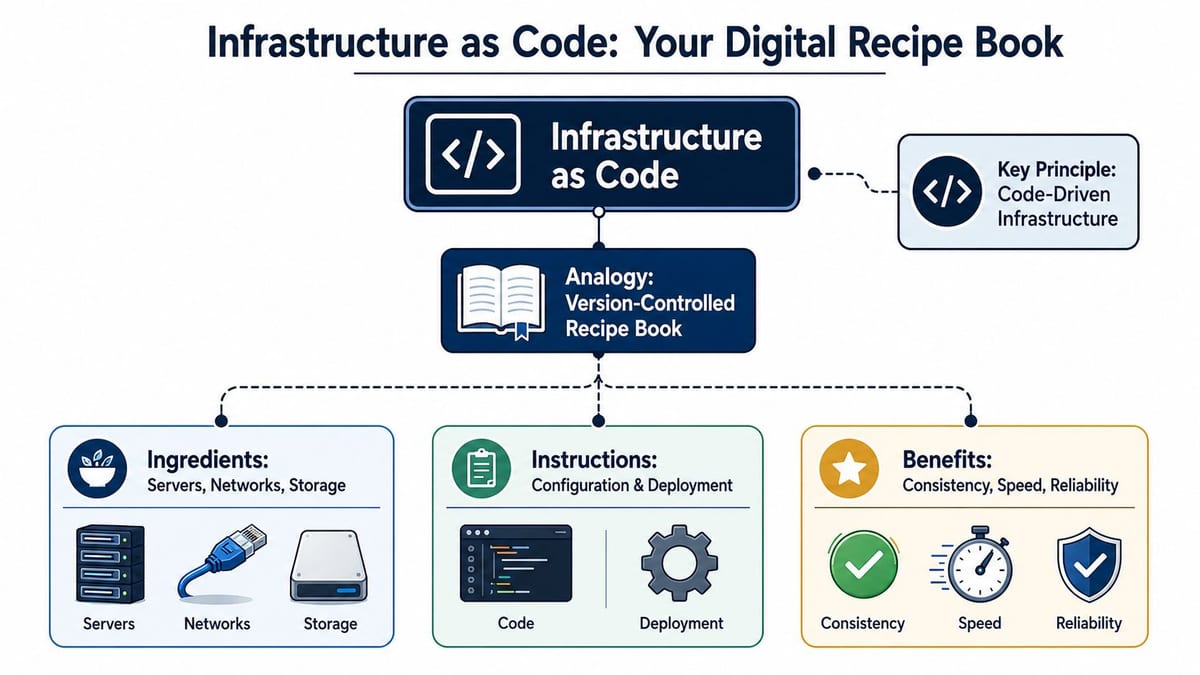
The simplest way to explain infrastructure as code is this. It's a version-controlled recipe book for infrastructure.
Instead of relying on memory, screenshots or one engineer's personal notes, you define the ingredients and the method in a form that can be reviewed, tested and repeated. For cloud systems, the ingredients are compute, network and storage. For a physical project, the ingredients also include switch templates, VLAN plans, rack layouts, Wi-Fi survey outputs, door hardware schedules and device naming conventions.
What the recipe book changes
When teams work this way, a change is no longer “please remember to update that switch” or “I think the contractor moved that AP”. The change becomes a reviewed update to the source of truth, followed by controlled deployment and validation.
That gives you three practical gains.
- Consistency: Every switch in a role can inherit the same baseline configuration.
- Speed: Rollouts stop depending on repeated manual build steps.
- Auditability: You can see who changed what, when, and why.
A lot of teams get the cloud side of that. Fewer apply it to the physical estate with the same discipline.
The physical-digital gap
Projects begin to slip when existing IaC content focuses exclusively on cloud resources, neglecting how code-based automation can manage physical infrastructure. In the UK, 68% of infrastructure projects face delays due to disconnected physical/digital planning, as noted in HMRC-linked discussion of the physical-digital planning gap.
That figure feels believable to anyone who's run a relocation. The cabling contractor works from one revision. The network engineer uses another. Facilities signs off power for a layout that changed after the last drawing issue. Then everyone discovers the mismatch at the worst possible point.
A strong primer on implementing infrastructure automation is useful for the cloud side of the discipline. The missing step is extending that thinking into site surveys, rack build standards, patching schedules and commissioning evidence.
What good looks like
A practical physical IaC approach usually includes a controlled set of artefacts:
| Artefact | Why it matters |
|---|---|
| Switch templates | Keeps port roles, naming and security settings consistent |
| Cabling manifest | Ties outlet IDs, patch panel positions and test results together |
| Rack elevation | Prevents power, cooling and space conflicts during build |
| Access schedule | Defines who gets in, where, and under what conditions |
| Handover records | Preserves certification, labels, test outcomes and change history |
Treat drawings and schedules as living infrastructure definitions, not static project paperwork.
That's the shift. Infrastructure as code isn't just “writing Terraform”. It's deciding that infrastructure should be reproducible, reviewable and testable, whether it lives in Azure, a server rack or an unmanned unit.
Applying IaC to Physical Network and Data Centre Projects
A typical office fit-out exposes the value of this approach very quickly. Start with the network edge. If you're deploying dozens or hundreds of switch ports across floors, manual switch-by-switch configuration is slow and it creates subtle inconsistency. One uplink gets the wrong profile. One voice VLAN is omitted. One shutdown policy is different from the standard. None of those faults look dramatic in isolation, but they show up later as support noise.
With an IaC mindset, the switch build starts from a template and a dataset. Role-based configs define what a floor switch, access switch or comms room distribution switch should look like. Site-specific variables define hostnames, port descriptions, VLAN assignments and uplink relationships. Tools such as Ansible are well suited to this kind of repeatable configuration work, especially when network hardware needs consistent policy enforcement across many devices.
Treat the cabling plan as code-adjacent
The more interesting move is to apply the same discipline to structured cabling.
A cabling schedule is often treated as a static project document. It shouldn't be. In practice, it behaves more like configuration data. It changes when desks move, room functions change, or additional CCTV and access points are added. If that schedule sits in version control with clear naming, change history and approvals, the team can validate whether the physical install still matches the intended design.
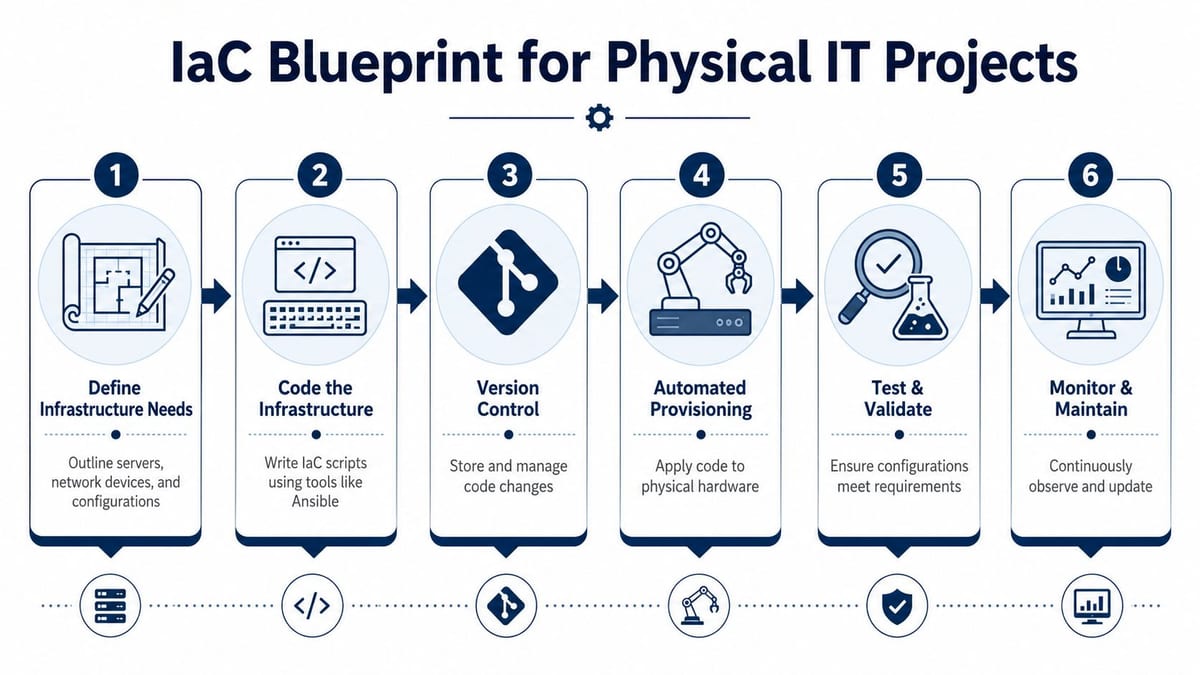
A practical workflow looks like this:
Capture the survey properly
Site survey outputs, cabinet locations, outlet counts, Wi-Fi positions and containment assumptions go into a controlled repository.Define the intended state
The team records switch roles, patch panel mapping, fibre links, cabinet standards and logical segmentation.Build from templates
Switches and edge devices are configured from repeatable templates rather than one-off console work.Validate against evidence
Certification results, labels and commissioning outcomes are checked against the manifest before handover.
Data centre work benefits in the same way
The same logic applies in server room expansions and migration programmes. Rack space, power paths, patching, cross-connects and remote access need the same control as cloud resources. If a migration sequence says a cabinet is ready but the power install isn't certified, the migration plan is wrong. If the patching map in the repository doesn't match what was installed, the repository is wrong. Both need reconciling before service transition.
For teams planning larger transitions, a well-sequenced data centre migration strategy matters because migration errors are often rooted in documentation drift rather than in the move weekend itself.
What works and what doesn't
A quick comparison helps.
| Works | Usually fails |
|---|---|
| Standard port profiles and naming conventions | Hand-built switch configs with local exceptions |
| Version-controlled rack and cabling manifests | Multiple spreadsheet versions emailed around |
| Certification results linked to outlet IDs | Test files saved separately with unclear ownership |
| One source of truth for floor and comms changes | Drawings, config files and move plans updated independently |
The physical job becomes much easier when the install team, network team and project manager are all reading from the same current definition.
This doesn't remove site reality. Engineers still deal with blocked risers, late furniture changes and inherited building constraints. It does make those changes visible early, reviewable by the right people, and far less likely to appear as a surprise during go-live.
The Ultimate Test Case Building an Unmanned Unit with IaC
An unmanned unit is where weak infrastructure design gets exposed immediately. If there's no routine on-site presence, every dependency has to be deliberate. Access has to be controlled remotely. CCTV has to tell you what's happening without someone walking the site. Power and connectivity have to be observable. Fault response has to start with remote diagnosis, not guesswork.
That's why unmanned buildings are a strong test case for physical infrastructure as code.
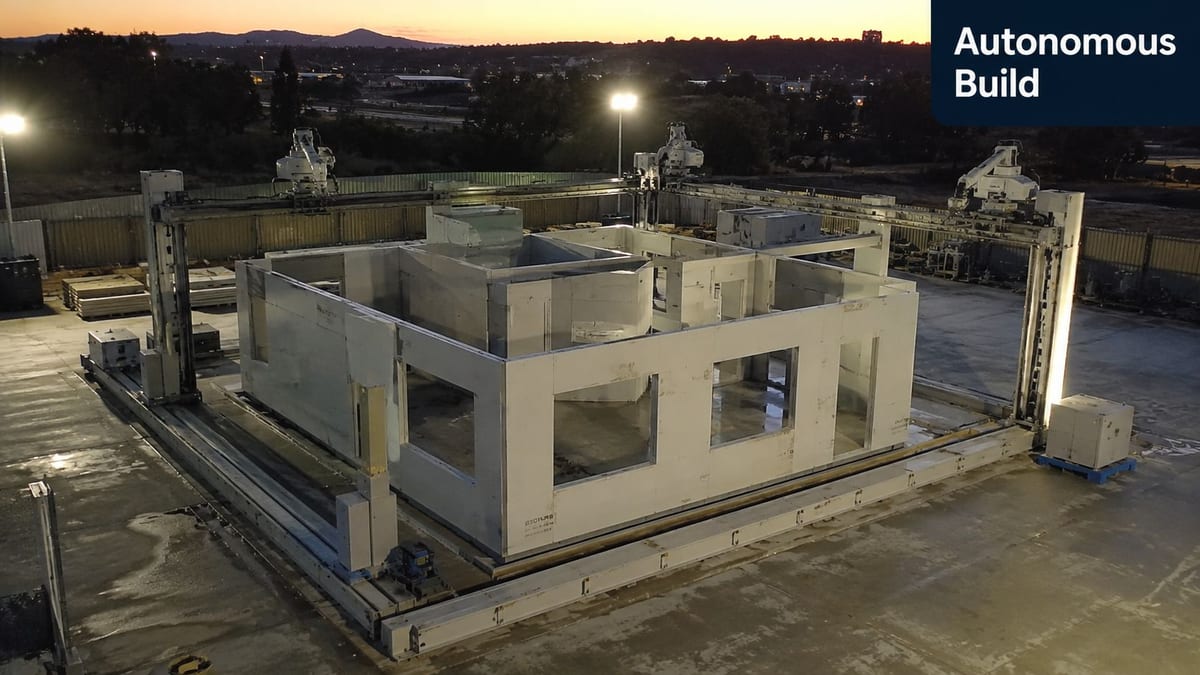
What unmanned building management means in practice
The definition is straightforward. Unmanned building management means automating core functions to answer four questions without human presence: who can get in, what is happening inside, are critical systems powered and connected, and can someone diagnose and act remotely. If a routine issue requires a site visit due to a lack of remote visibility, the building is not properly unmanned, as set out in this guide to unmanned building management.
That's a useful standard because it cuts through marketing language. A unit isn't autonomous because it has a smart lock on the door. It's autonomous when daily operation doesn't depend on local workarounds.
Why battery-less NFC proximity locks often make sense
For this kind of environment, I'd usually favour battery-less, NFC proximity locks when the use case supports them. Not because they sound modern, but because they remove a maintenance burden.
Real-world reasons include:
- Fewer routine maintenance tasks: Battery replacement becomes one less recurring job to track across dispersed sites.
- Cleaner operating model: Access can be managed around issued credentials rather than physical keys and local lock servicing.
- Better fit for low-touch sites: If the goal is to minimise engineer visits, reducing battery-dependent hardware helps.
- Useful for controlled occupancy patterns: Small unmanned units, comms rooms, managed offices and secure plant areas often have predictable access needs.
That doesn't mean they fit every door or every risk profile. Some sites need different hardware because of fire requirements, usage volume, physical abuse risk or integration demands. The point is to choose access technology that supports the operational model, not just the procurement list.
Access, CCTV, power and data are one system
An unmanned unit only works when these layers are designed together.
Take a contractor visit. You grant temporary access. CCTV confirms entry and time on site. Network connectivity keeps controllers and monitoring online. Power resilience maintains the lock, comms and visibility chain. If one of those elements is weak, the whole operating model degrades.
A solid design usually covers:
- Access control: digital credentials, permission revocation, event logs
- CCTV: visibility at entry points, internal risk areas and critical assets
- Power: certified supply, resilience where required, clean distribution to key systems
- Data: secure connectivity for controllers, cameras, alerts and remote support
If you're balancing site networking choices, this overview of Ethernet and wireless is useful because unmanned environments usually need both, used for the right jobs.
Common use cases
These systems are commonly used in managed office suites, storage and industrial units, remote comms locations, shared occupancy buildings, and facilities where access is intermittent but security and visibility still matter.
An unmanned building is an operating model, not a gadget stack.
That's the lens infrastructure as code brings. It forces every device and rule to support the intended mode of operation.
Why Integrated Infrastructure Design Is Non-Negotiable
Most failed unmanned projects don't fail because the lock was wrong or the camera was poor. They fail because the project was split into silos. Access was designed by one supplier. CCTV by another. Data by internal IT. Power by an electrical contractor working to a different revision. Then everyone assumes integration will happen during commissioning.
It won't.
Many unmanned building projects fail because they treat layers like access control, CCTV, power, and data connectivity as optional silos. Success requires an integrated approach where physical and digital layers are planned as one cohesive unit from day one, including maintenance, labelling, and test records, according to guidance on integrated wireless and building infrastructure planning.
How projects go wrong
A few patterns come up repeatedly:
Access without network resilience
The credential system is in place, but there's no dependable path for remote management or alerts.CCTV without operational design
Cameras exist, but retention, field of view, remote access and event correlation weren't defined properly.Power without service context
Commercial electrical installation gets delivered to code, but not to the actual needs of comms, controllers, remote diagnostics or resilience expectations.Documentation without control
Labels, as-built drawings and test records are handed over, but they aren't maintained as living artefacts.
Why IaC thinking helps
Infrastructure as code pushes teams towards one joined-up definition of the environment. You can't sensibly describe the intended state of an unmanned site if the electrical schedule, the door hardware plan and the network topology all disagree.
That matters for commercial electrical installation and certification in particular. Electrical work isn't separate from the digital outcome. It determines whether cabinets, network devices, access hardware, CCTV and remote support equipment will operate reliably. If certification and test evidence are detached from the main infrastructure record, operations inherit uncertainty from day one.
The practical design test
Ask a few blunt questions before installation starts:
| Question | What a good answer sounds like |
|---|---|
| What happens if connectivity drops? | Remote visibility degrades in a known way, with defined fallback and alerts |
| Can access be revoked immediately? | Yes, through managed credentials and central control |
| Is the power installation documented against the live design? | Yes, with certification tied to current layouts and dependencies |
| Can someone trace a fault remotely? | Yes, through logs, monitoring and labelled infrastructure |
That's the standard for building out fully autonomous unmanned building units. Access, power and data aren't separate packages. They're one operational system.
Ensuring Security Compliance and Operational Readiness
Security gets harder when the physical and digital estates drift apart. A repository says one thing. The cabinet contains another. The access list includes someone who should have been removed. A switch was changed locally to solve a short-term issue and nobody updated the controlled definition.
That's exactly why source control matters. UK government engineering standards require infrastructure definitions to be stored in source code repositories and treated identically to application code, enforcing version control and automated testing to eliminate configuration drift and ensure auditability, according to the UK Home Office Infrastructure as Code standard.
What that means on a real project
For physical infrastructure, this translates into disciplined handling of:
- Configuration baselines: switch templates, SSID definitions, controller settings, CCTV naming and access roles
- Change approvals: no ad hoc local edits without review and record
- Testing: validation of intended changes before cutover or production rollout
- Rollback thinking: clear path back if a change breaks service or security policy
A commissioning process should reflect that. The technical handover isn't just “it powers on”. It's proof that the installed estate matches the approved definition and that the support team can operate it safely. That's why a structured data centre commissioning process is so valuable on hybrid environments where physical install quality and digital readiness have to line up.
Drift in hybrid environments
Drift isn't only a cloud problem. In office and building work it often shows up as:
- a patched port that no longer matches the schedule
- an access permission that outlived the contractor visit
- a camera moved during fit-out but never updated in records
- a replacement device installed with a local-only config
Those faults are manageable if the team expects drift and checks for it. They become dangerous when the project assumes that as-built documentation stays true without process.
Good operations don't depend on memory. They depend on current records, controlled change and fast validation.
Security posture includes the physical estate
A lot of organisations spend heavily on cyber controls while leaving gaps in physical governance. Access logs, CCTV coverage, permission handling, asset traceability and cabinet control all affect exposure. Anyone reviewing understanding UK company data leaks will recognise the wider lesson. Security failures rarely stay neatly inside one domain.
Operational readiness comes from joining those domains up. If a contractor needs temporary access, the team should issue time-bound credentials, track the visit, review associated CCTV if needed, and remove access cleanly afterwards. That's far stronger than handing over a key and hoping someone remembers to collect it.
Your Roadmap to Adopting Physical Infrastructure as Code
Trying to transform everything at once is generally ill-advised. The better approach is to start where repeatability matters most, prove the method, and expand from there.
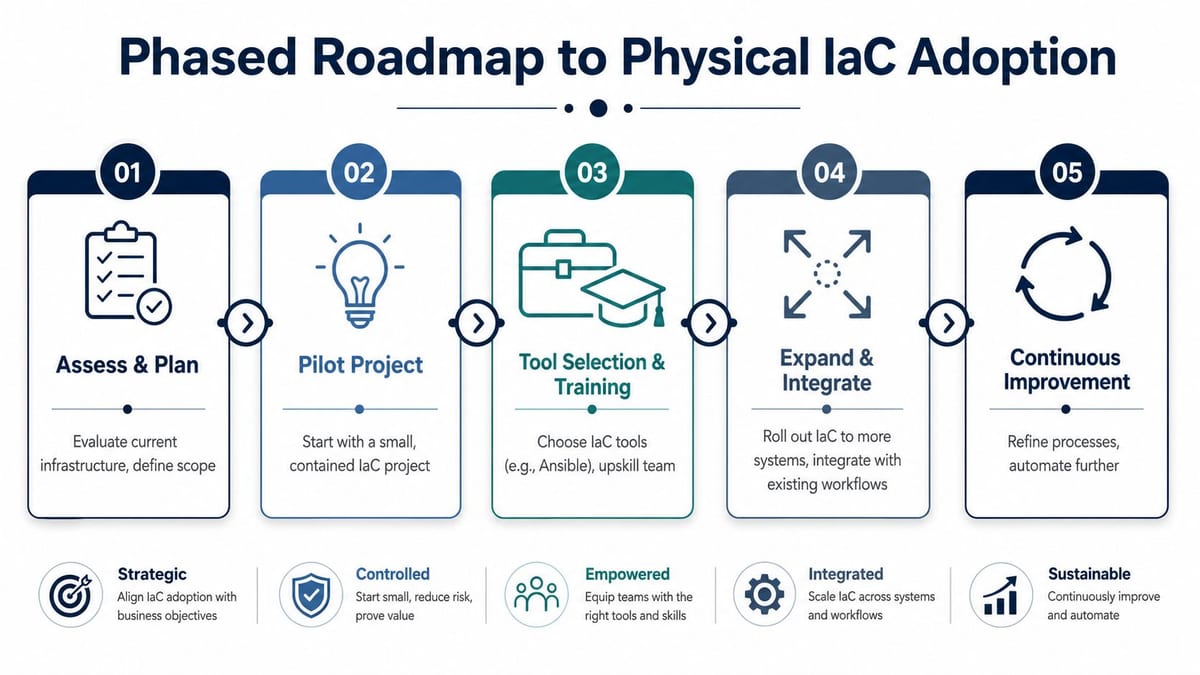
Start with one repeatable build
Pick a task that already causes friction. Network switch configuration is a strong candidate because the value is obvious and the manual risk is high. Standardise naming, port roles, VLAN patterns and security settings, then hold those definitions in version control.
If switch automation isn't the immediate pain point, use a cabling manifest instead. The important thing is to choose a real operational artefact, not a theoretical pilot no one depends on.
Create one source of truth
The next step is simple but often neglected. Put the project's critical technical artefacts in one controlled home.
That usually means:
- Network definitions: topologies, switch templates, naming standards
- Physical records: rack layouts, cabinet schedules, outlet lists, patching maps
- Installation evidence: test records, certification files, labels, as-built updates
- Operational controls: access roles, CCTV schedules, maintenance logs
This doesn't require perfection on day one. It requires discipline.
Build review and validation into delivery
Once the core artefacts are controlled, make review part of the normal workflow. Changes to the floor layout should trigger review of Wi-Fi, cabling and access implications. Changes to cabinet design should trigger review of power and patching implications. Engineers should validate installations against the live definitions, not against whatever was printed first.
A workable phased model looks like this:
Pilot one domain
Automate or control one high-value area, such as switch configs or structured cabling records.Train the operational team
The people supporting the estate need to understand how changes are proposed, reviewed and applied.Integrate adjacent systems
Bring access control, CCTV, server room records and electrical dependencies into the same governance model.Treat handover as the start
Maintenance, change control and future fit-out changes must feed back into the same source of truth.
Know when to bring in specialists
The hardest part isn't learning a tool. It's coordinating cloud logic, physical installation, commercial electrical work, certification and go-live support under one delivery model. That's where experienced project support helps, especially for relocations, data centre upgrades and autonomous building environments where downtime and compliance risks are high.
Infrastructure as code works best when the code reflects reality on site. If those two drift apart, the method collapses. If they stay aligned, projects become calmer, handovers become cleaner, and future changes stop feeling like archaeology.
If you're planning an office relocation, fit-out, data centre upgrade or an unmanned building project, Constructive-IT can help bridge the gap between coded design and physical delivery. Their team works across cabling, Wi-Fi, CCTV, telecoms, electrical works, server rooms and go-live support, which makes them a sensible partner when your project needs both engineering control and practical site delivery.