


Mesh WiFi vs Range Extender for Your UK Office Network
- Craig Marston
- Dec 7, 2025
- 15 min read

When you're weighing up mesh WiFi vs a range extender for a UK office, the choice is pretty clear for most businesses. A professionally installed mesh WiFi system delivers the seamless, high-performance connectivity that modern operations depend on. A range extender, on the other hand, is really just a temporary fix with some serious performance drawbacks.
If your office relies on VoIP calls, video conferencing, and cloud applications, a unified mesh network is without a doubt the way to go.
Your Strategic Network Choice
Choosing the right WiFi solution is a critical decision that directly impacts daily productivity and how efficiently your team can work. While a WiFi range extender might seem like a tempting low-cost option to patch a single dead spot, it introduces performance bottlenecks and management headaches that just aren't suitable for a professional setting.
These devices work by creating a separate, weaker network. This can literally halve your available bandwidth and cause frustrating connection drops for people moving around the office, like walking from their desk to a meeting room.
A mesh WiFi system, in contrast, creates one intelligent, cohesive network. Each node, or access point, works together to provide strong, consistent coverage across your entire premises. This unified approach gets rid of dead zones without sacrificing speed or reliability, making sure your essential business tools just work.
When we plan a professional installation, we often include structured fibre cable installation for a wired backhaul. This hardwires the nodes together, creating a rock-solid foundation for a certified, tested network delivery you can truly depend on.
For any business planning an office relocation with equipment testing or even just aiming for a tidy desk environment with flawless connectivity, a robust network is non-negotiable. It’s about so much more than signal strength; it’s about stability and future-proofing your IT infrastructure.
Mesh WiFi vs Range Extender At a Glance for Business
For a quick comparison, it’s helpful to see how these two technologies stack up side-by-side in a business context. The differences in performance and user experience are quite stark.
Factor | Mesh WiFi System | WiFi Range Extender |
|---|---|---|
Network Performance | Creates a single, seamless, and high-speed network for the entire office. | Creates a separate, slower network that can halve available bandwidth. |
User Experience | Allows seamless roaming without connection drops, ideal for mobile devices. | Forces manual network switching and causes interruptions for moving users. |
Installation & Management | Requires professional planning and cable management but offers simple, centralised control. | Simple to plug in but becomes complex to manage with multiple units. |
Reliability & Warranty | High reliability, especially with a wired backhaul; often backed by a 25 year equipment warranty. | Lower reliability, prone to interference and performance degradation. |
Ultimately, while an extender might solve a problem in the short term, a mesh system is a strategic investment in your office's productivity and reliability.
How Mesh and Extenders Fundamentally Work
To get to the bottom of the mesh Wi-Fi vs range extender debate, you need to look at how each one actually handles your data. While both aim to spread your office Wi-Fi further, their methods are worlds apart, and that leads to a completely different experience for your team.
One creates a single, intelligent network. The other just shouts a weaker, repeated signal into the void.
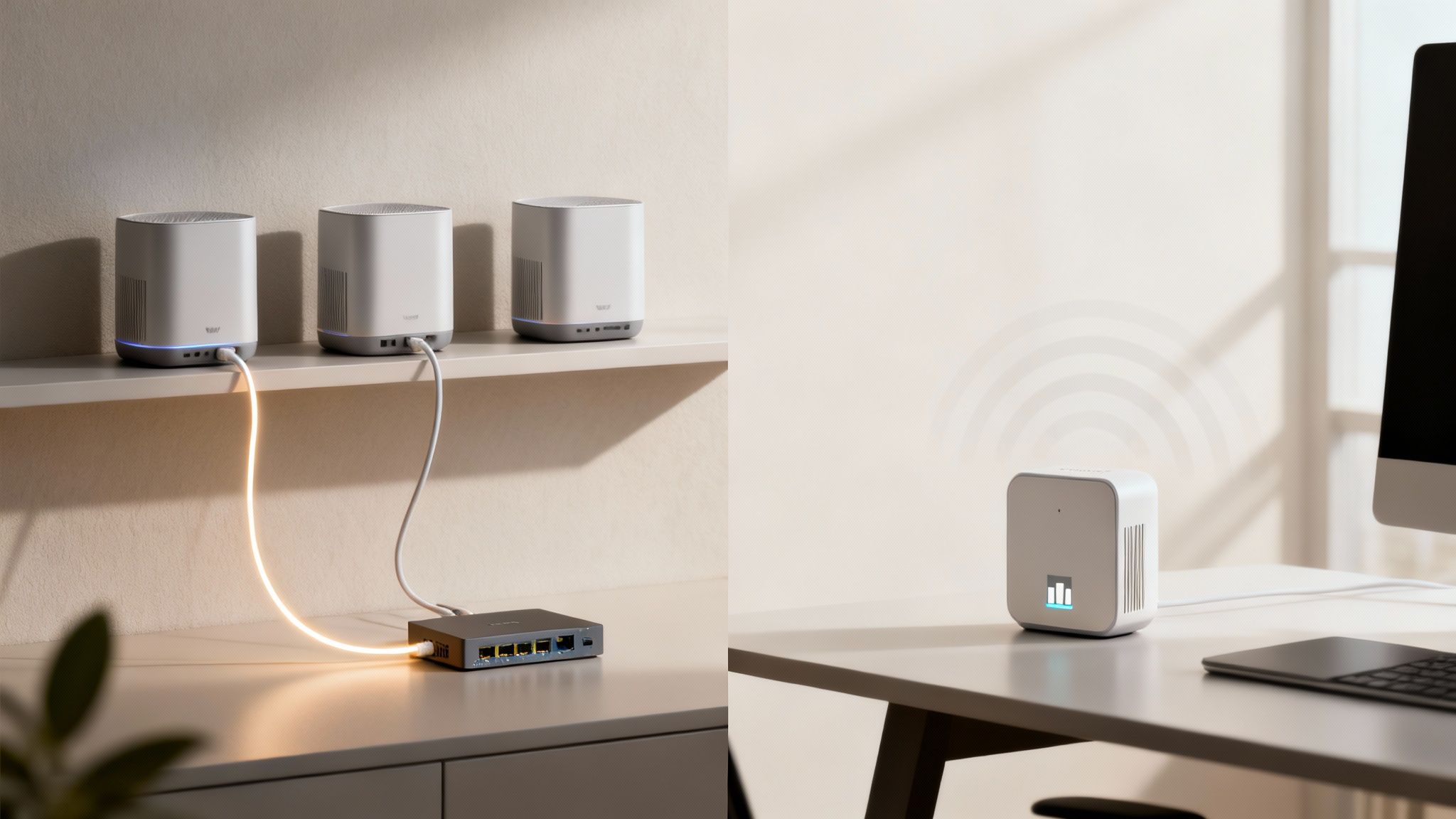
A Wi-Fi range extender works on a very basic principle: it listens to your main router's signal and then rebroadcasts it. This process is called half-duplex communication, and it’s the root of the problem.
The extender simply can't listen and rebroadcast on the same radio band at the same time. This single limitation immediately cuts the available bandwidth by up to 50% for any device connected to it. For a busy office, that performance hit is often crippling.
The Problem with Extenders in a Professional Setting
The issues don't stop at speed. An extender usually creates its own, separate network (SSID). This means if an employee walks from their desk (connected to the main router) to a meeting room (covered by the extender), their device has to manually switch Wi-Fi networks.
This creates a few obvious problems:
Dropped Connections: A VoIP call or video conference will almost certainly drop during that clumsy switchover.
User Frustration: Nobody wants to manually juggle Wi-Fi connections just to move around the office. It's inefficient and annoying.
Inconsistent Performance: Connection quality becomes a lottery, depending entirely on which network a device happens to be on.
A Wi-Fi extender acts as a simple repeater, rebroadcasting a signal at the cost of significant bandwidth. This design is fundamentally unsuited for the seamless, reliable connectivity required in a modern business environment.
Extenders create isolated pools of slower Wi-Fi, not a unified coverage area. If you want to dive deeper into how they work, you can explore what a Wi-Fi range extender is and see how it tries to boost coverage.
How Mesh Systems Create an Intelligent Network
A mesh Wi-Fi system is a far more sophisticated beast. Instead of one box repeating another, a mesh system is made up of multiple intelligent nodes that all talk to each other. Together, they create a single, unified network that covers your entire office under one name (SSID).
This constant communication allows devices to roam seamlessly. As someone moves through the building, their laptop or phone is automatically handed off to the node with the strongest signal—instantly and without any interruption. This is absolutely critical for maintaining stable connections.
This seamless experience is fast becoming the standard in UK offices. In fact, dual-band Wi-Fi systems, which include most mesh networks, now hold over 50% of the market share as businesses finally prioritise performance. The demand for whole-office coverage without the classic bandwidth loss of extenders is what's driving this change.
The Critical Role of the Backhaul Channel
The secret weapon behind a mesh network’s superior performance is its dedicated backhaul channel. Think of this as a private motorway the nodes use to talk to each other, completely separate from the Wi-Fi traffic your devices are using. This is what prevents the dramatic speed loss that plagues every extender.
There are two main types of backhaul:
Wireless Backhaul: The nodes use a dedicated wireless radio band just for communicating with each other. This is already a huge improvement over an extender.
Wired Backhaul: This is the gold standard for any business. By connecting the nodes with structured fibre cable installation, you create an incredibly fast and stable data superhighway. This completely eliminates any wireless interference between nodes, guaranteeing maximum speed and reliability across the whole network.
A professionally planned wired backhaul, delivered by an Excel network accredited partner, ensures your network is not only fast but also fully certified and backed by a 25 year equipment warranty. That's a level of tested, reliable delivery an off-the-shelf extender could never hope to match.
Comparing Performance Under Real Office Demands
When we move from technical specs on a datasheet to the reality of a busy workday, the performance gap between a mesh system and a simple range extender becomes impossible to ignore. The real measure of any office network isn’t just signal bars; it’s how it holds up under pressure from simultaneous, high-demand tasks. This is where the mesh WiFi vs range extender debate is settled.
Picture your office at 11 AM on a Tuesday. Sales are hammering VoIP calls, marketing is deep in a video conference sharing hefty files, and the finance team is crunching numbers in data-heavy spreadsheets linked to a cloud server. This is exactly the kind of scenario where a range extender’s core weaknesses create serious operational headaches.
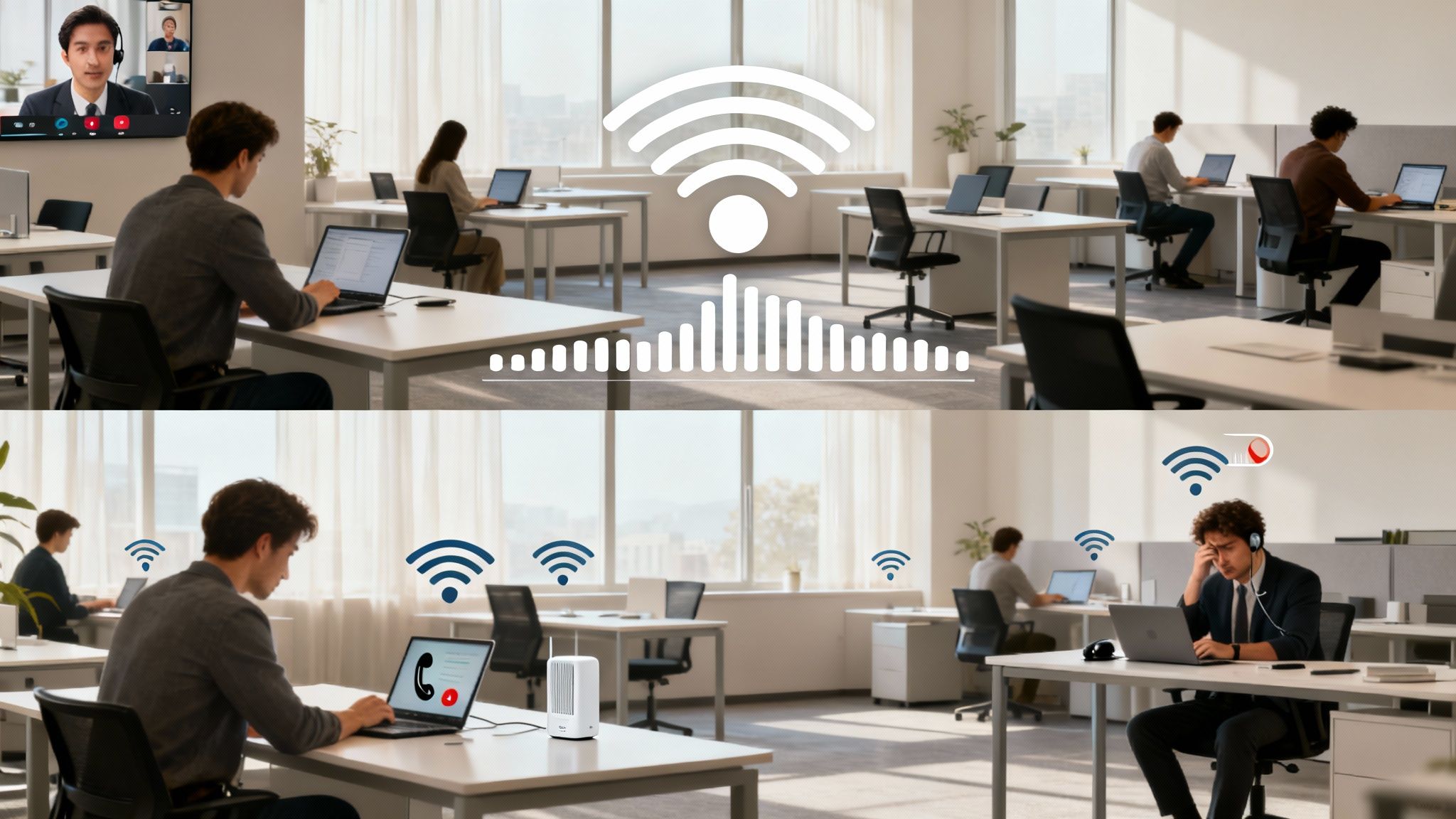
Because an extender has to receive and then rebroadcast a signal, it inherently slashes the available speed by at least half. For any device connected to it, this means latency skyrockets and throughput plummets. That video conference starts to stutter, the VoIP call quality drops off a cliff, and file transfers crawl along. Productivity takes a direct hit, and your staff's frustration goes through the roof.
Throughput and Stability Under Load
A professionally installed mesh network is a different beast entirely. Every node acts like an intelligent access point, cleverly managing traffic to keep performance consistent for everyone, no matter where they are in the building. This is especially true when the system uses a wired backhaul.
By linking the nodes with a structured fibre cable installation, we create a dedicated, congestion-free superhighway for your data. This setup ensures that someone working in the furthest corner of the office gets the same fast, low-latency connection as the person sitting right beside the main router. Large file transfers and HD video calls just work, because the network is built to handle the load.
A mesh network creates a reliable blanket of performance for every user. In stark contrast, an extender creates frustrating bottlenecks and dead zones where productivity grinds to a halt.
This reliability is the foundation of a modern, productive office. For a deeper dive into the operational benefits, have a look at the key advantages of mesh networking for UK offices in our detailed guide. A well-designed system, backed by a certified, tested network delivery, is an invisible asset that lets your team get on with their work.
Real-World Latency and User Experience
Latency—that tiny delay before data starts moving—is a killer for real-time applications. High latency makes video calls laggy and cloud software feel sluggish and unresponsive. A range extender, by its very nature, adds a huge layer of latency because it has to process and re-transmit every single packet of data.
That extra delay is a deal-breaker for any modern business. A mesh network, on the other hand, is engineered from the ground up for low-latency communication. Its smart routing algorithms push data along the most efficient path available, keeping delays to an absolute minimum.
Think about what this means in practice:
VoIP Calls: With an extender, users might get choppy audio or even dropped calls, especially if they move around. A mesh network gives you a stable connection that keeps call quality crystal-clear throughout the office.
Video Conferencing: High latency from an extender leads to frozen screens and out-of-sync audio. A mesh system, particularly with a wired backhaul, ensures collaboration is smooth and in high definition.
Cloud Applications: When staff are collaborating on shared documents or using cloud-based software, the low latency of a mesh network makes the experience feel instant and responsive, not slow and painful.
For any business planning an office relocation with equipment testing or just trying to improve its current IT, choosing a network that guarantees low latency and high throughput is non-negotiable. Backing that choice with a 25 year equipment warranty from an Excel network accredited partner solidifies it as a long-term investment in your operational backbone, not just a temporary sticking plaster.
Deployment, Installation, and Ongoing Management
While performance metrics are a huge part of the mesh Wi-Fi vs range extender debate, the real-world practicalities of installation and long-term management are where the true costs for a business lie. A range extender might tempt you with its "plug-and-play" simplicity, but this approach almost always unravels in a professional setting, creating more headaches than it solves. In contrast, a business-grade mesh system requires a more thought-out deployment that pays for itself in reliability and straightforward management.
An extender's setup seems easy enough: plug it into a wall socket and follow a quick app wizard. That’s fine for one device, but the complexity skyrockets when you need to cover multiple dead zones. Each extender acts as an isolated island, often needing its own configuration, separate firmware updates, and a unique troubleshooting process. This fragmented setup quickly becomes a management nightmare for any IT team.
Professional Installation for Peak Performance
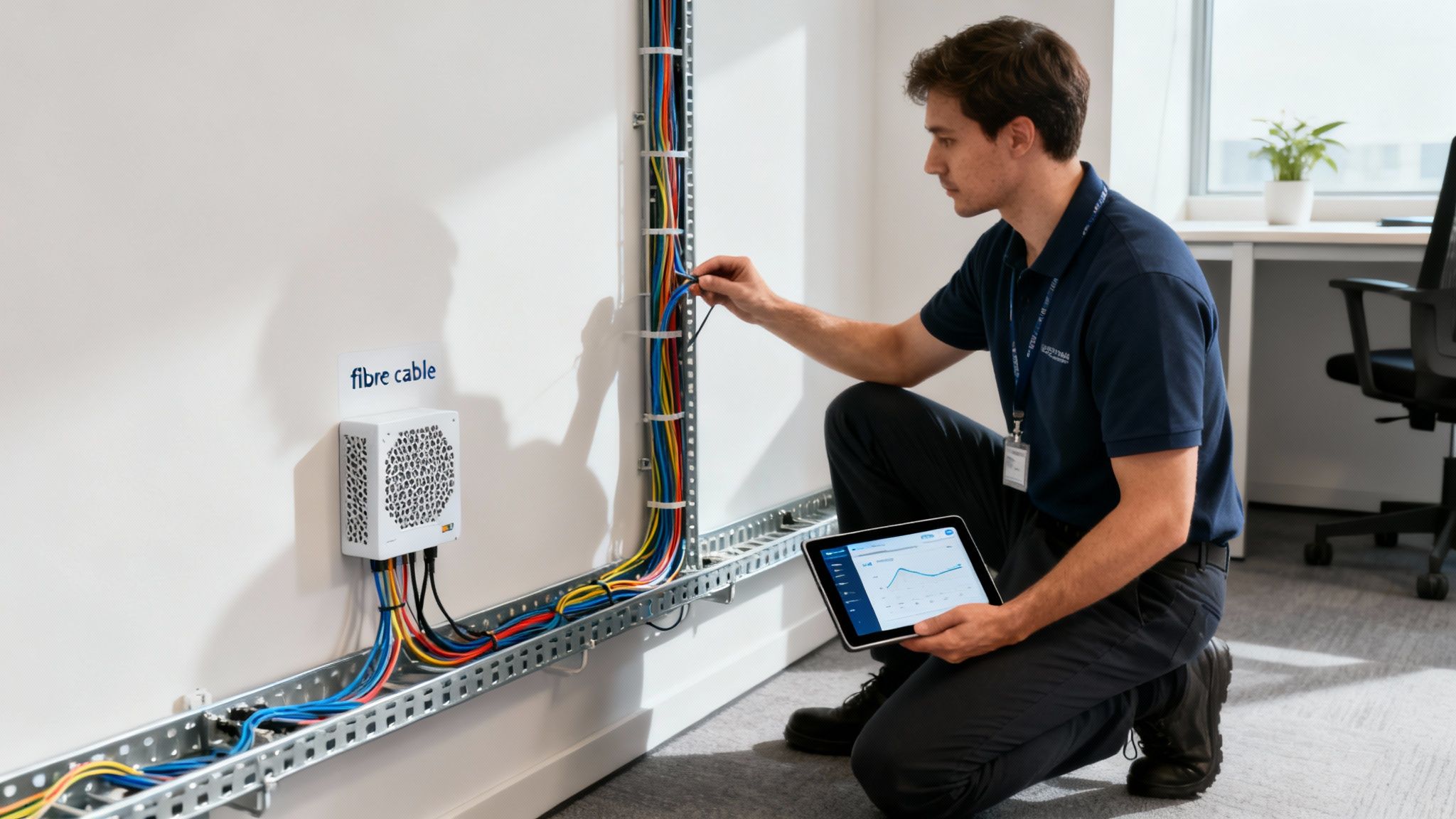
Rolling out a business-grade mesh network is a planned, strategic project. It starts with identifying the best locations for each node to guarantee seamless coverage, which often means getting a professional Wi-Fi survey done first. However, the real key to unlocking its full potential is creating a wired backhaul.
This means running structured cabling—usually high-performance fibre or copper—directly to each mesh node. This fibre cable installation builds a dedicated, rock-solid communication path between the nodes, which completely sidesteps wireless interference and ensures you get maximum throughput across the entire network. It's the foundational step that takes the system from being a good solution to an exceptional one.
Partnering with an Excel network accredited partner for your installation ensures a certified, tested network delivery. This isn't just about plugging in cables; it's about a meticulously planned infrastructure that guarantees performance and is backed by a robust 25 year equipment warranty.
This level of professional installation is critical for businesses navigating an office relocation with equipment testing or those simply wanting a clean, functional workspace with immaculate cable management and a tidy desk policy. It establishes a network backbone built for today's demands and tomorrow's growth.
Centralised Control Versus Fragmented Management
The difference in day-to-day management is night and day. With multiple extenders, your IT team is left juggling several different devices through separate, clunky interfaces. There’s no single view of network health, security status, or user activity. When a problem crops up, troubleshooting becomes a frustrating game of trial and error, checking each extender one by one.
A mesh system is the complete opposite. It’s managed from a single, unified dashboard. This centralised control panel gives your team the power to:
Monitor Network Health: Get a real-time overview of the entire network's performance, seeing how all nodes and connected devices are behaving.
Simplify Security Updates: Push firmware and security patches to every single node at once, making sure your network is always protected against the latest threats.
Manage User Access: Easily set up guest networks, control bandwidth for different users, and manage access policies, all from one place.
This streamlined management saves a huge amount of time and resources, freeing up your IT staff to focus on more important projects instead of constantly chasing down connectivity gremlins. It turns network administration from a reactive headache into a proactive, efficient process. For more practical advice on improving your office's connectivity, check out our guide on boosting your WiFi signal in UK offices.
Ultimately, the initial convenience of a range extender is a false economy. The long-term demands of individual configuration, manual updates, and painful troubleshooting make it an impractical choice for any serious business. A professionally deployed mesh system, with its structured installation and centralised management, delivers the stability and control that modern operations demand.
The True Cost of Your Office WiFi Network
When you're weighing up mesh WiFi vs range extenders, it’s all too easy to fixate on the upfront hardware cost. That little white box with ‘range extender’ on the front looks like a bargain, but it’s a false economy that almost always costs businesses more in the long run.
The real cost of your office network isn’t what you pay at the till; it’s the Total Cost of Ownership (TCO). This has to include all the hidden expenses that come with an unreliable network—the lost productivity from another dropped video call, the flood of IT support tickets from frustrated staff, and the operational drag of slow file transfers. The cheap initial price of an extender is quickly wiped out by these constant, invisible drains on your resources.
An investment in a professionally installed mesh system, on the other hand, isn’t just an expense—it’s a strategic asset. The price reflects far more than the hardware; it’s for a complete, certified, tested network delivery.
Beyond Hardware: The Value of a Professional Installation
The genuine value in a business-grade mesh system comes from its professional implementation. This isn’t about just plugging things in and hoping for the best; it's a planned, methodical process engineered for long-term stability. The cost covers critical services an off-the-shelf extender simply can’t offer.
This structured process involves:
Expert Planning: A proper site survey to map out the optimal placement for each node, guaranteeing total coverage without any performance dead spots.
Structured Cabling: A professional fibre cable installation creates a rock-solid wired backhaul—the essential foundation for maximum speed and reliability.
Guaranteed Performance: A certified, tested network delivery from an Excel network accredited partner, which confirms your infrastructure meets strict, verifiable performance standards.
Long-Term Assurance: The peace of mind that comes with a 25 year equipment warranty, protecting your investment for decades to come.
This approach transforms your network from a potential liability into a dependable tool for growth. It becomes particularly crucial during a complex project like an office relocation with equipment testing, where the network simply has to work perfectly from day one.
Investing in a certified mesh network isn't just buying hardware; it's buying operational stability. The goal is to minimise downtime, reduce IT overhead, and support your business without future networking headaches.
Calculating the Return on Investment
A stable, high-performance network delivers a tangible return on investment. It's simple, really. When your team can rely on fast, consistent connectivity, productivity goes up. Time that was previously wasted troubleshooting dodgy connections or waiting for files to load is now spent on valuable work. The reduction in IT support tickets alone can represent a significant operational saving.
And there’s more to it than that. A professionally installed mesh system with meticulous cable management contributes to a more organised and efficient workspace. A tidy desk environment, free from a tangled mess of wires and temperamental extenders, reflects a more professional and productive operation.
When you compare the two properly, the financial argument becomes clear. A range extender offers a low entry cost but saddles you with high ongoing operational expenses due to poor performance and constant firefighting. In stark contrast, a certified mesh system requires a larger initial investment but delivers a much higher ROI through drastically reduced downtime, minimal IT intervention, and boosted employee productivity. It’s a network built to support your business, not hold it back.
Making the Right Choice for Your Business Scenario
Choosing between mesh Wi‑Fi and a range extender for your office isn't just about tech specs. It's a business decision that directly affects your team's productivity. The right solution has to align with your daily operations, the physical layout of your building, and where you see the business going in the future.
For almost every professional scenario, the answer points decisively towards a professionally installed mesh system. Still, to give you a completely balanced picture, let's break down the specific situations where each technology makes sense. This will help you find the clear path forward for your network, making sure it’s a genuine asset and not a constant headache.
When a Mesh System Is Non-Negotiable
A business-grade mesh network should be the default, strategic choice for any company that can't afford to compromise on connectivity. If your operations fall into any of these categories, a mesh system isn't just a recommendation; it's essential for keeping things running smoothly and supporting growth.
Businesses Reliant on Real-Time Communication: If your team depends on uninterrupted VoIP calls, video conferences, or collaborative cloud software, the seamless roaming and rock-solid performance of mesh are critical.
Offices with Complex Layouts: Buildings with thick walls, multiple floors, or signal-blocking materials like concrete and steel will easily defeat a simple extender. A professionally planned mesh network, ideally with a wired backhaul, is designed to overcome these physical barriers.
Companies Planning for Growth or Relocation: A mesh system is built to scale. As your team expands or you plan an office relocation with equipment testing, the network can be easily grown without creating performance bottlenecks. A certified installation ensures it's ready for you from day one.
The market trend in the UK reflects this reality. Mesh networks are quickly making traditional extenders obsolete, now accounting for over 40% of the total Wi-Fi market share. This shift is driven by advancements like AI-powered optimisation and the need to support high-density office environments where extenders simply can't cope, leading to fragmented networks and frustrated users. If you're interested, you can find more insights on the Wi-Fi range extender market.
The Very Limited Case for a Range Extender
So, is there ever a good reason to use a range extender in a professional setting? The use case is exceptionally narrow. Think of it as a temporary, tactical fix, not a permanent solution.
A range extender is a sticking plaster, not a long-term cure. It can provide a quick, cheap signal boost to a non-critical area, but it should never be relied upon for business-essential operations.
You should only consider an extender in a scenario like this:
A Temporary Boost for a Non-Critical Area: You might use one to get basic Wi-Fi into a small, isolated breakroom where connectivity is a "nice-to-have," not a "must-have." The inevitable performance drop won't impact core business functions.
This decision tree gives you a visual on the cost implications when choosing between a scalable mesh system and a budget extender.
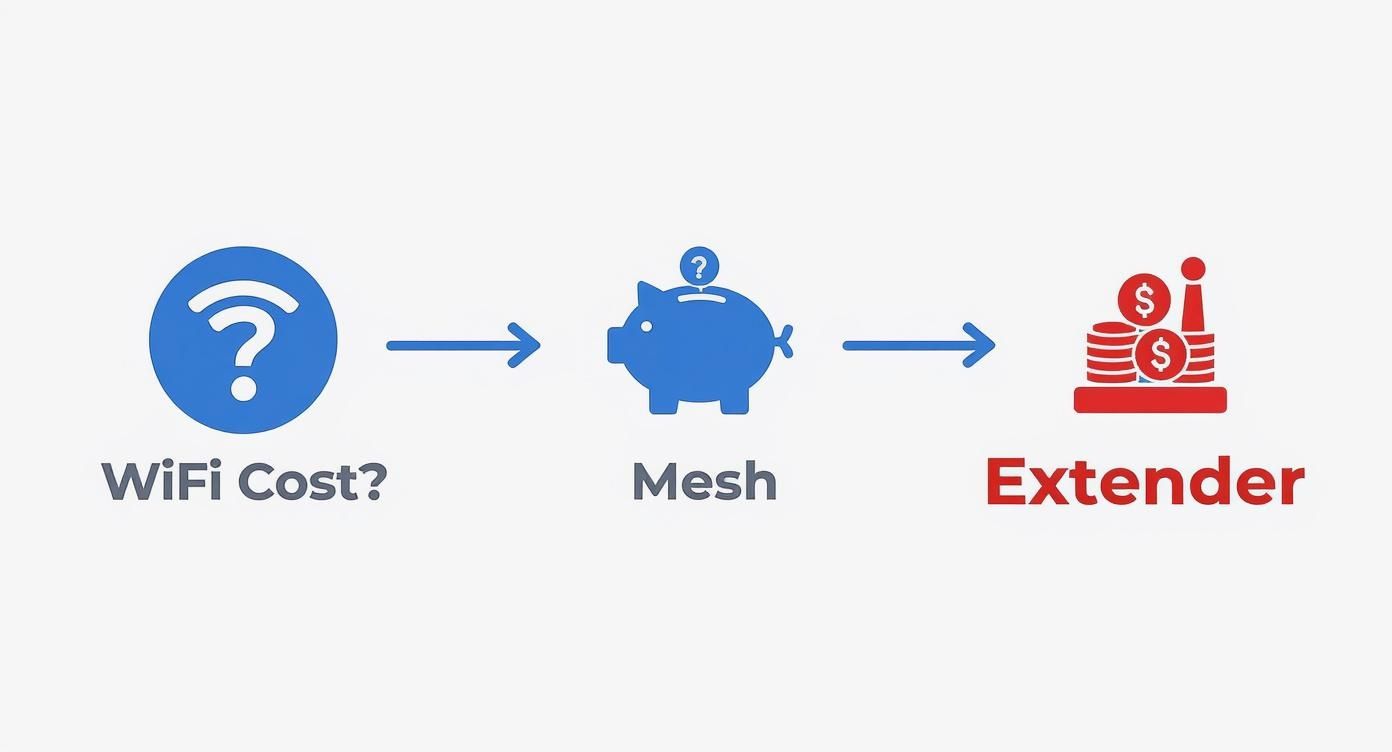
As the infographic shows, while an extender has a lower initial cost, a mesh system represents a much more stable, long-term investment for a business.
Frequently Asked Questions
When weighing up mesh Wi-Fi versus a range extender, many UK businesses run into the same practical questions. We’ve answered the most common ones here, cutting through the technical jargon to get to what really matters for installation, long-term performance, and reliability.
Can I Use Multiple Range Extenders in an Office?
You can, but we’d strongly advise against it. Stacking multiple extenders is like putting a plaster on a plaster—it never addresses the root cause of poor coverage. Each extender broadcasts its own separate network, which quickly leads to signal interference, frustrating performance bottlenecks, and a real management headache for your IT team.
How Does a Wired Backhaul Improve a Mesh Network?
A wired backhaul is the gold standard for any serious business Wi-Fi network. It involves running a professional fibre cable installation to physically connect each mesh node back to your main network switch. This creates a dedicated data superhighway between the nodes, completely sidestepping wireless interference to guarantee maximum speed and stability across your entire office.
This forms a core part of our certified, tested network delivery process.
By linking mesh nodes with structured cabling, you achieve a level of consistent, peak performance that wireless-only systems simply can't promise. It’s a foundational step for any business relying on rock-solid connectivity for its day-to-day operations.
What Warranty Comes with a Professional Installation?
This is a key advantage of working with an Excel network accredited partner. Our structured cabling solutions, which are the backbone of a high-performance mesh network, are backed by a comprehensive 25 year equipment warranty. It’s a long-term guarantee that protects your investment and proves the quality of the underlying infrastructure.
This kind of assurance is vital for businesses planning an office relocation with equipment testing, as it ensures the network performs exactly as it should from day one.
Is a Mesh System Difficult to Manage?
Not at all. Despite the sophisticated technology working behind the scenes, business-grade mesh systems are built for simple, centralised management. Instead of juggling multiple extenders with different settings, the entire mesh network is controlled from a single, intuitive dashboard. This allows your IT team to monitor network health, roll out security updates to all nodes at once, and manage user access effortlessly.
When paired with professional cable management, this streamlined approach helps maintain a tidy desk environment and ultimately reduces your ongoing IT support costs.
Ready to build a network that supports your business instead of holding it back? Constructive-IT provides certified, warrantied network solutions designed for performance and reliability. Contact us today to discuss your project.
Comments