


Cat 6a Cable The Definitive Guide for Modern Networks
- Craig Marston
- Jan 11
- 16 min read

When you’re planning your network infrastructure, you're making a critical long-term investment. For modern UK businesses, Cat 6a cable has shifted from a premium upgrade to the essential baseline. It’s the only way to build a robust foundation that can handle high-speed data demands and power-hungry devices, effectively future-proofing your commercial space.
Why Cat 6a Is the New Standard for UK Businesses
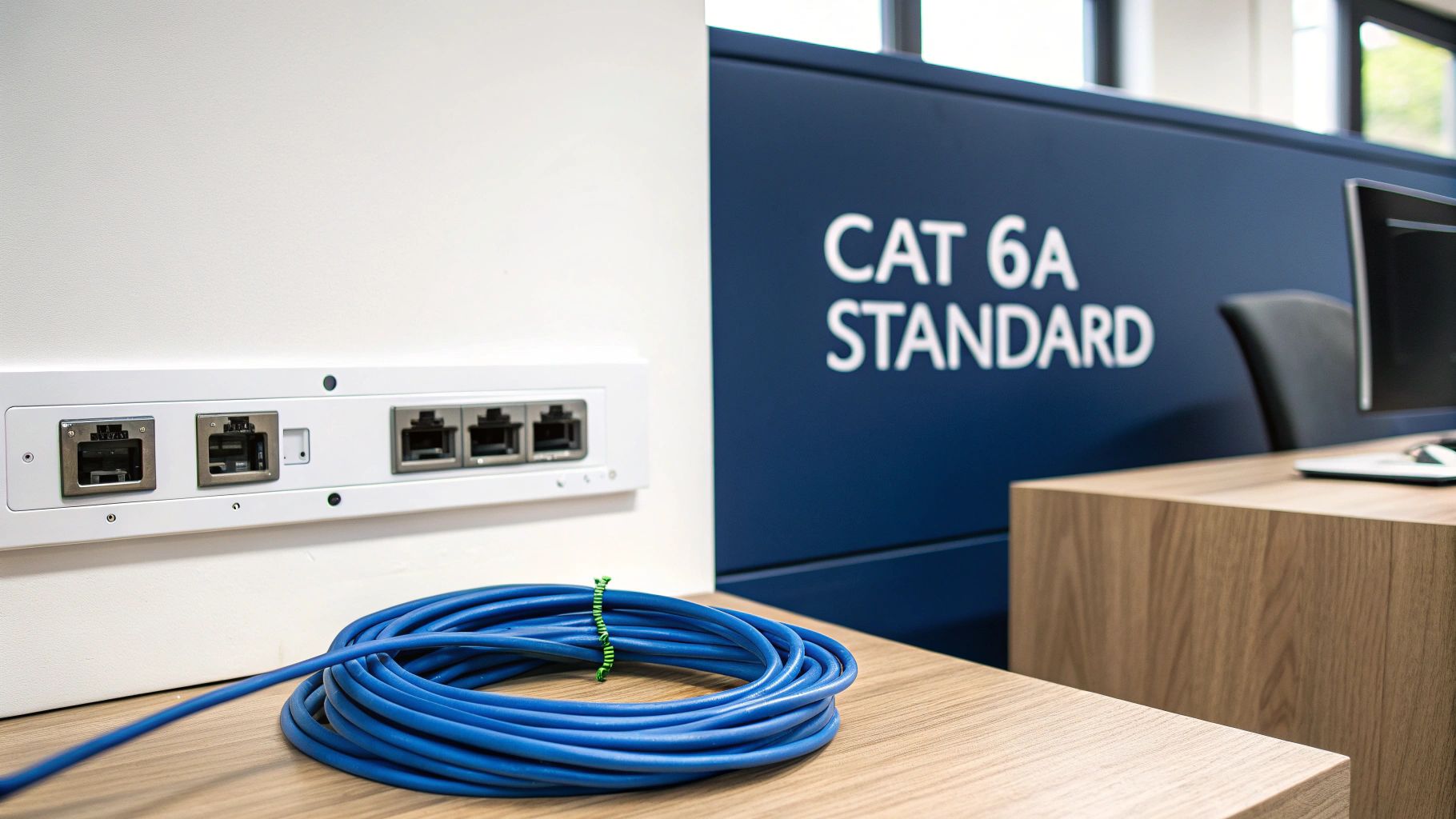
If you're an IT or facilities manager overseeing an office fit-out, a relocation, or a new build in a demanding sector like healthcare, your choice of data cabling will echo for years. It’s tempting to try and save a few quid by opting for older, lower-spec cabling, but that’s a classic false economy. It creates immediate performance bottlenecks and almost always leads to expensive, disruptive upgrades just a few years down the line.
Imagine fitting out a new commercial building with cabling that can’t even support the speed of modern Wi-Fi or power your new CCTV system. It’s a common data network mistake that cripples productivity from day one. This is exactly why Cat 6a is no longer just an option—it’s the required standard.
Future-Proofing Your Digital Infrastructure
Choosing Cat 6a is about preparing your building’s network for what’s coming next. It's engineered to handle the demands of today and tomorrow, ensuring your infrastructure doesn't become obsolete the moment a new technology arrives.
Here's why making Cat 6a your standard is a smart move:
10Gbps Speed: It reliably delivers 10 Gigabit per second speeds over the full 100-metre channel. This is absolutely essential for data-intensive tasks, large file transfers, and a smooth user experience.
High-Power PoE Support: Cat 6a is built to better manage the heat generated by Power over Ethernet (PoE) devices. This makes it the only sensible choice for powering modern Wi-Fi 6E access points, IP phones, and advanced security cameras.
Investment Protection: Installing Cat 6a during a fit-out or office relocation prevents the need for a costly re-cabling project in just a few years. Do it once, do it right.
This shift is happening right across the industry. In the UK, Cat 6a has quietly become the default copper standard for any office or healthcare project that needs to be future-proof. Market analysis now specifically tracks Category 6A revenues, which just shows how widely it's being specified in commercial schemes and public-sector builds. You can learn more about these market trends in UK structured cabling to see how Cat 6a is now embedded in long-term forecasts.
A certified installation is the only way to guarantee that every connection point meets its performance potential. Making sure your network is tested and certified avoids frustrating troubleshooting later and ensures it performs as expected from the moment you move in.
Ultimately, specifying Cat 6a is about building a dependable and scalable network foundation. For any business that relies on fast, stable connectivity, understanding the benefits of a wired network is the first step. A properly planned and certified Cat 6a installation ensures your network is an asset, not a liability.
How Cat6a Tackles Real-World Network Problems
To really get why a Cat6a cable installation is such a smart move, you have to look past the headline speed figures. The real value is in how its physical design stamps out the common, everyday problems that can bring a network to its knees. The clever engineering packed into every Cat6a cable delivers a far more stable, reliable, and error-free connection, which is exactly what you need in a busy office or hospital. It’s not just about going faster; it’s about building a network that’s fundamentally better at protecting your data.
One of the most disruptive gremlins in a densely cabled environment is crosstalk. This is where the signal from one cable bleeds over and interferes with an adjacent one, corrupting data and forcing it to be re-sent. It’s a major cause of network slowdowns. The worst offender is Alien Crosstalk (ANEXT), which is interference coming from other cables packed tightly into the same bundle.
Think of it like trying to hold a confidential meeting in an office with paper-thin walls. You can hear the muffled chatter from next door, making it hard to concentrate and leading to mix-ups. Alien Crosstalk is the network equivalent of that background noise, where one cable's "conversation" garbles another's.
Soundproofing Your Data with Smarter Design
A Cat6a cable is basically engineered to act like acoustic soundproofing for your data, silencing the noise from neighbouring cables. This isn't magic; it's achieved through a few key physical upgrades that older standards just don't have.
These design improvements work in concert to build a robust shield against interference:
Tighter Wire Twists: The copper pairs inside a Cat6a cable are twisted together much more tightly than in Cat6. It’s a simple change, but it makes a huge difference in cancelling out electromagnetic noise.
Thicker Outer Jacket: You'll notice Cat6a cables are physically thicker. This extra bulk creates more space between the pairs inside the cable and separates it from its neighbours, dampening any potential interference.
Optional Shielding: Many Cat6a cables come with a layer of foil or braided shielding (known as F/UTP or S/FTP). This acts like a complete barrier, making it the perfect choice for electrically noisy places like hospitals or factory floors.
By killing off Alien Crosstalk, Cat6a ensures your data gets from A to B intact. That means fewer transmission errors, less packet loss, and rock-solid network performance—vital for the applications your business relies on.
Powering Modern Devices Without Breaking a Sweat
Beyond keeping data clean, the beefier construction of Cat6a makes it vastly superior for Power over Ethernet (PoE). Today’s offices and hospitals use PoE to power a huge range of devices, from high-performance Wi-Fi access points and VoIP phones to IP security cameras and access control panels.
Pushing power down a network cable generates heat. When you have large bundles of cables all doing this at once, that heat can build up to a point where it starts to degrade network performance and can even become a safety issue. Thanks to its thicker copper conductors and overall sturdier build, Cat6a cable is much better at dissipating this heat than older cables.
This isn't just a minor perk; it's a critical design advantage. Better thermal performance ensures your PoE devices get stable, reliable power without the cable overheating. It protects your expensive network gear and your building's infrastructure.
For any organisation looking to deploy modern, power-hungry devices, this makes Cat6a the only sensible choice. A properly installed and certified network guarantees that every single endpoint, from a phone on the reception desk to a critical patient monitoring device, gets the clean data and stable power it needs to work properly, 24/7.
Choosing the Right Cable for Your Office Fit-Out
When you’re managing an office fit-out or relocation, every decision feels like a balancing act between today's budget and tomorrow's needs. Network cabling is a perfect example. This isn’t just a technical tick-box; it’s a strategic investment in your business’s future productivity.
Getting it right means weighing up cost, performance, and the kinds of applications you'll be running, not just on day one, but in five or ten years. The main players you'll be looking at are Cat 6, the far superior Cat 6a cable, and of course, fibre optic. Each has a specific job to do in a well-planned network. Knowing where each one fits is the key to building a robust system that won't need a costly, disruptive upgrade any time soon.
This decision tree helps cut through the noise, showing the key questions to ask when picking the right cable for your environment.
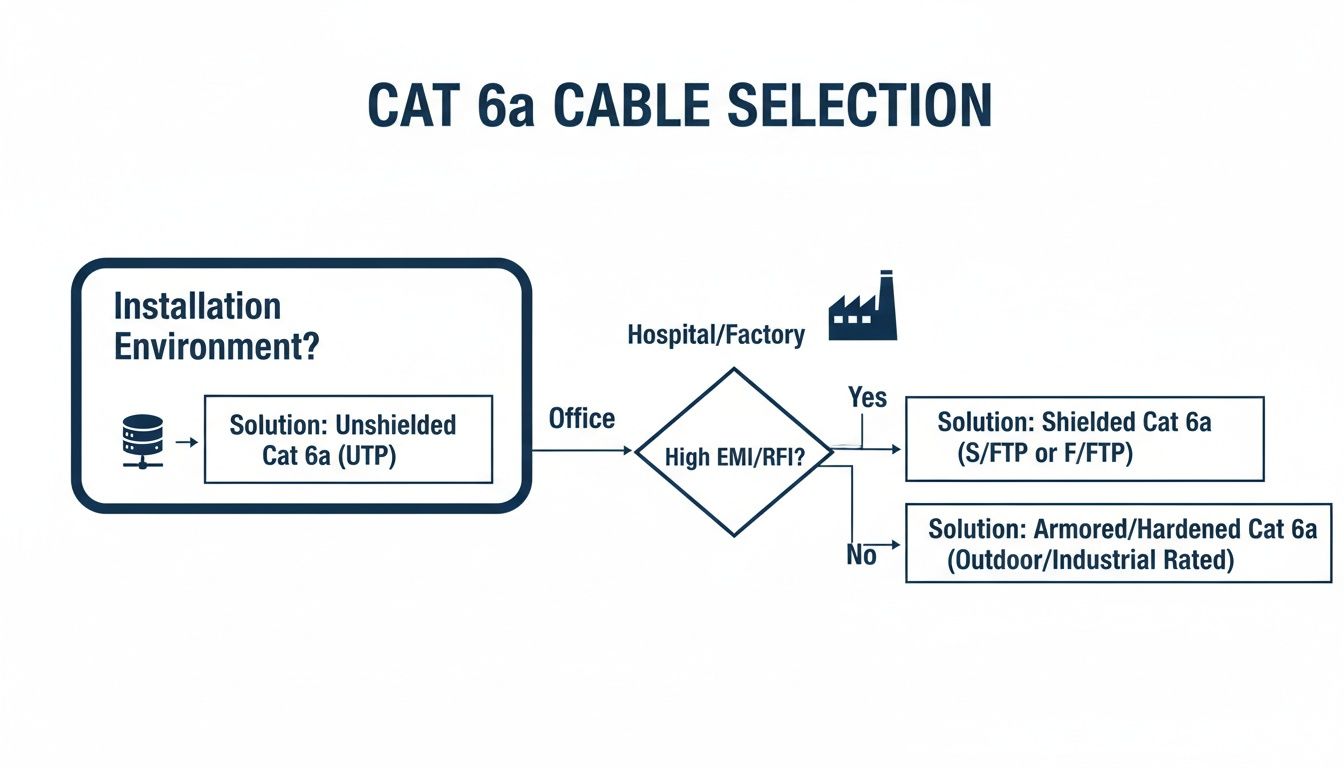
As you can see, factors like electromagnetic interference quickly come into play, making it obvious why a hospital or factory floor has very different needs to a standard office.
Finding the Sweet Spot with Cat 6a
For the vast majority of day-to-day connections—the horizontal runs from the comms cabinet out to desks, Wi-Fi points, and printers—Cat 6a is the undisputed sweet spot. It reliably delivers 10Gbps performance over the full 100-metre distance, which is its single biggest advantage over the older Cat 6 standard.
Sure, standard Cat 6 can technically handle 10Gbps, but only over very short runs of around 33-55 metres. That makes it a bit of a gamble for future-proofing an entire office floor. You can read more on that in your essential guide to Cat 6 cable. By opting for Cat 6a, you get that 10Gbps capability right across your workspace without the extra cost and complexity of running fibre to every single desk.
For project managers, this makes Cat 6a the most pragmatic and cost-effective choice for future-proofing the user-facing parts of the network. It guarantees that your infrastructure can support high-bandwidth applications and next-generation devices for years to come.
When Fibre Optic Is Still Essential
Even with Cat 6a’s impressive performance, fibre optic cabling is still the heavyweight champion for certain high-demand jobs. Its role isn’t at the desk, but as the high-speed motorway forming the backbone of your entire network.
Fibre is the non-negotiable choice for:
Backbone Connections: Linking server rooms and comms cabinets between different floors or buildings.
High-Interference Zones: Providing total immunity to electrical noise in places like hospitals, factories, or workshops.
Extreme Distances: When you need to go well beyond the 100-metre limit of any copper cable.
A professionally planned network almost always uses a hybrid approach. Fibre acts as the super-fast data highway between your core network hubs, while Cat 6a provides the highly capable final link out to your users and their devices. This strategy gets you maximum performance exactly where it’s needed while keeping overall project costs firmly in check.
Of course, networking is just one piece of the puzzle. A great office fit-out also considers the bigger picture, and looking into essential office renovation tips can help shape a more functional and productive workspace. A certified network, delivered by an accredited partner, ensures this critical part of your office is tested, guaranteed, and comes with a 25 year equipment warranty for complete, long-term peace of mind.
Cabling Decision Matrix: Cat 6 vs Cat 6a vs Fibre
Choosing the right cable can feel complex, but breaking it down by your specific needs makes the decision much clearer. This table lays out the key differences to help you see where each cabling type shines within a typical commercial building.
Criteria | Category 6 | Category 6a | Fibre Optic |
|---|---|---|---|
Max Speed | 10Gbps (at <55m), 1Gbps (at 100m) | 10Gbps (at 100m) | 100Gbps+ |
Best For | Standard office desks, VoIP phones | High-performance workstations, Wi-Fi 6/7 Access Points, PoE devices | Building backbones, server links, long distances |
Distance Limit | 100m (for 1Gbps) | 100m | Kilometres |
Future-Proofing | Limited; may struggle with future bandwidth demands | Excellent for the next 10-15 years of user-end applications | The ultimate long-term solution for core infrastructure |
Cost (Installation) | Lowest | Moderate | Highest (due to specialist termination) |
EMI Resistance | Good (with shielding) | Very Good (thicker, better shielding) | Immune |
Ultimately, a smart cabling strategy isn't about picking just one type; it's about using the right tool for the job. Cat 6a provides the perfect blend of performance and value for the vast majority of user connections, while fibre remains essential for the heavy lifting in the background. This balanced approach ensures you get a network that's both cost-effective today and ready for whatever tomorrow throws at it.
The Critical Role of Certified Network Installation
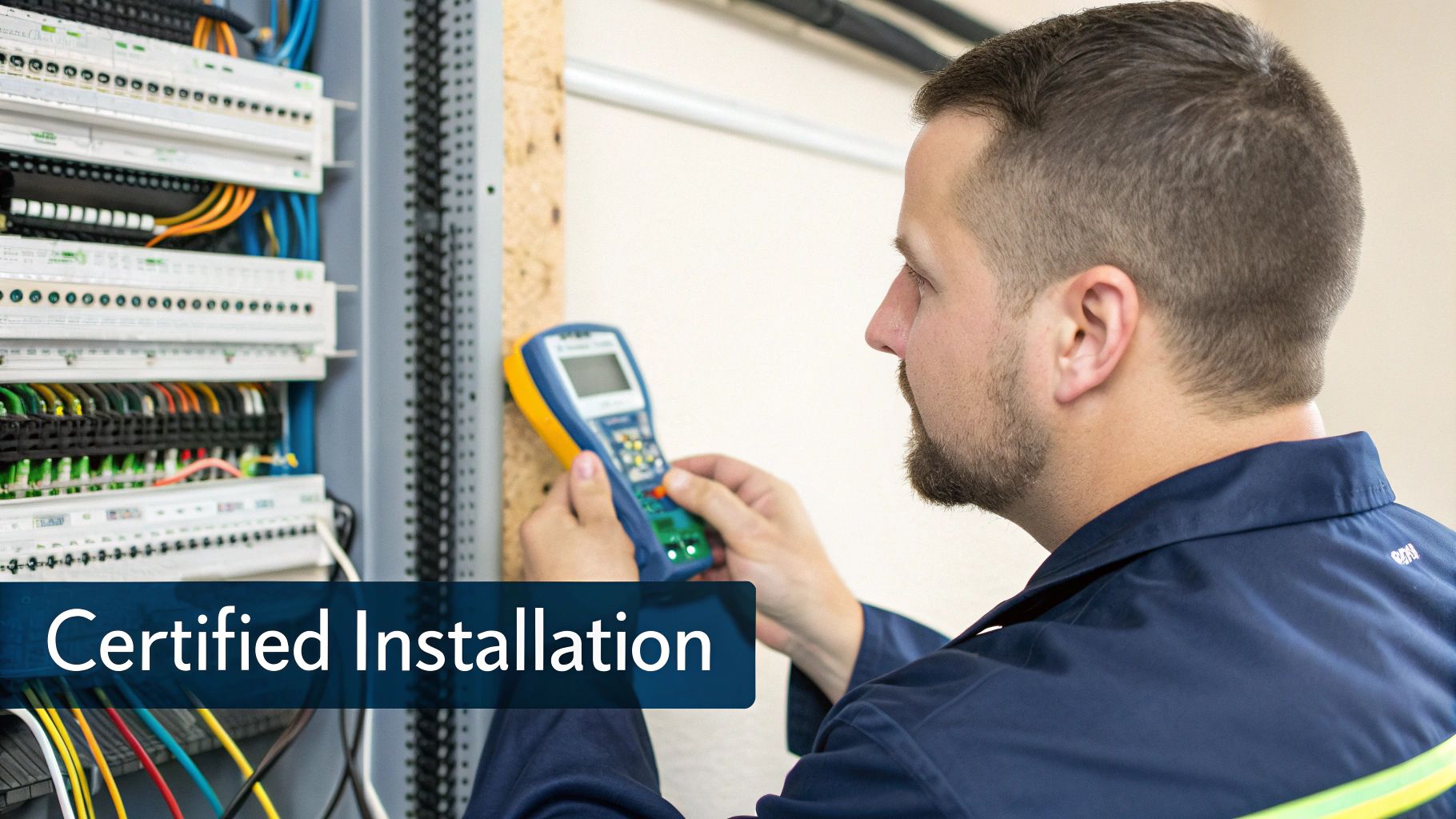
Investing in high-quality Cat 6a cable is a great first step, but it’s only half the battle. The truth is, the full performance of your network hinges entirely on the quality of the installation. Even the best cable in the world will let you down if it's terminated poorly, bent too sharply, or installed incorrectly. You'll have wasted your investment on a network riddled with hidden problems just waiting to surface.
This is exactly why a certified network delivery is non-negotiable for commercial buildings, hospitals, and any environment where rock-solid reliability is paramount. A certified installation isn’t just about plugging things in; it’s a meticulous engineering process that guarantees every single connection meets the strict performance standards needed for 10Gbps speeds.
Without that guarantee, you’re basically flying blind. Your network might seem to work at first, but it could be plagued by intermittent faults, slow speeds, and data errors that are an absolute nightmare to diagnose after the fact.
What Certified Network Delivery Really Means
When we talk about a "certified" network, we mean that every link in the chain—from the patch panel in the comms room to the outlet at a user's desk—has been scientifically verified. This involves using specialised testing equipment, like the industry-standard Fluke network analysers, to run a whole battery of tests on every single cable run.
This rigorous testing validates several critical performance metrics:
Wire Map: Confirms all eight wires are connected to the correct pins at both ends. Simple, but you'd be surprised how often this goes wrong.
Insertion Loss: Measures the signal loss along the cable's length.
Crosstalk (NEXT & FEXT): Checks for that pesky interference between wire pairs inside the cable.
Return Loss: Makes sure the signal isn't being reflected back towards the source, which can cause chaos.
Only when a cable passes every single one of these tests against stringent TIA/ISO standards can it be considered certified. It’s the only way to be certain your Cat 6a infrastructure is performing to its full potential and will deliver the speed and reliability you paid for.
Avoiding Common and Costly Data Network Mistakes
An uncertified or amateur installation is often a minefield of common mistakes that silently kill performance. These seemingly small errors can have a massive impact, turning your high-speed network into a source of constant frustration.
A professional installer knows that the difference between a 10Gbps link and a 1Gbps link can be just a few millimetres of untwisted wire at the termination point. This attention to detail is what defines a certified network delivery.
Common installation pitfalls that professionals are trained to avoid include:
Exceeding the Bend Radius: Kinking or sharply bending a Cat 6a cable permanently damages its internal structure and ruins its performance.
Untwisting Wires Too Far: The tight twists in the copper pairs are essential for preventing crosstalk. Untwisting them more than the allowed 13 mm during termination creates a weak point for interference to creep in.
Cable Compression: Using overly tight zip ties or cable staples can crush the cable, altering its geometry and degrading the signal.
Proximity to Power Cables: Running data cables parallel to high-voltage electrical lines induces electromagnetic interference, which corrupts your data.
These mistakes are precisely why choosing the right partner is so important. By engaging a team with proven expertise, you can trust that your network is being built correctly from the ground up. For more guidance, our article on choosing network cabling installers you can trust provides some valuable insights.
This professional approach isn't just about performance; it's about securing your investment for the long haul. Leading manufacturers like Excel Networking only offer their comprehensive 25 year equipment warranty on systems installed by an accredited partner. This warranty covers not just the components but the installation itself, giving you complete peace of mind that your network will perform flawlessly for decades.
The demand for such robust infrastructure is growing fast, with the UK Ethernet cable market projected to expand at around 10.2% CAGR through to 2030. As Cat 6a cements its place as the workhorse for 10Gbit/s links in offices and hospitals, certified installation becomes more critical than ever.
Professional Cable Management for Long-Term Success
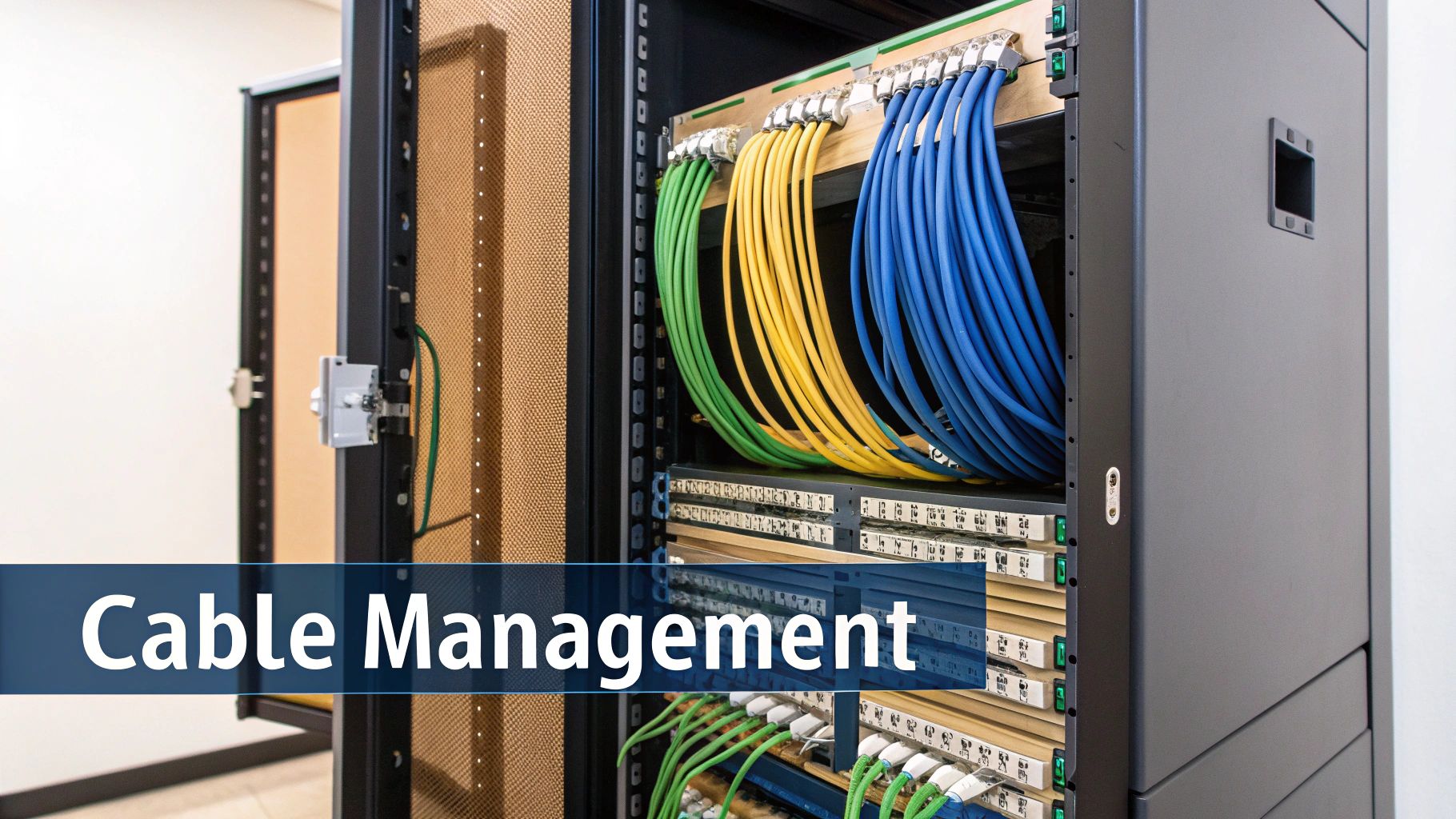
After investing in a meticulously installed Cat 6a cable network, the last thing you want is for it to descend into chaos. This is where professional cable management comes in, and it’s about so much more than just making things look tidy. Think of it as the bedrock of a high-performing, reliable, and easily maintainable network.
For places like commercial buildings and hospitals where network uptime is absolutely non-negotiable, it’s not just a nice-to-have; it's a critical investment. A chaotic, undocumented server cabinet is simply a disaster waiting to happen. On the flip side, a professionally organised system provides a tidy desk environment and delivers real, tangible benefits day in and day out.
The Anatomy of Expert Cable Management
Getting to a perfectly managed network isn’t about bundling a few cables with zip ties. True professional management is a systematic approach, built on industry best practices that guarantee both day-one performance and long-term serviceability. It’s a core part of any certified, tested network delivery.
Here's what it really involves:
Strategic Use of Patch Panels: These are the central switchboard for your network. They allow for easy moves, adds, and changes without ever having to touch the permanent, structured cabling hidden in the walls and ceilings.
Clear and Consistent Labelling: Every single cable, port, and patch panel gets a unique identifier that matches up with the network diagrams. This simple step can turn hours of frustrating troubleshooting into a quick five-minute job.
Proper Bundling and Routing: Cables are carefully grouped and guided through horizontal and vertical managers, trays, and conduits. This stops them from getting tangled, protects them from physical damage, and makes sure crucial bend radius standards are met.
This structured approach becomes invaluable during complex projects like an office relocation. When all your equipment is on the move, a perfectly managed and documented cabling system means reconnecting and re-patching is swift and straightforward. Combine this with thorough equipment testing, and you get the entire network back online with minimal disruption.
Tangible Business Benefits of a Tidy Comms Room
That attention to detail in professional cable management pays off directly in operational efficiency and cost savings. An organised cabinet is about building a resilient and adaptable network that actually supports your business goals.
A well-managed communications room is the physical embodiment of a reliable network. It demonstrates a commitment to quality that extends from the user’s desk all the way to the core infrastructure, safeguarding your investment for the long term.
The immediate advantages are crystal clear:
Faster Troubleshooting: When a network problem hits, a labelled and organised system lets engineers trace connections and pinpoint faults in a fraction of the time. No more guesswork.
Improved Airflow and Equipment Longevity: Neatly routed cables prevent airflow from being blocked inside server racks. This helps keep critical switches and servers cool, reducing the risk of them overheating and failing prematurely.
Simplified Upgrades and Maintenance: Adding new connections or upgrading equipment becomes a simple, methodical task, not a risky expedition into a "spaghetti junction" of tangled wires.
This meticulous approach is the hallmark of an accredited Excel network accredited partner. It ensures your Cat 6a cable and fibre cable installation not only smashes performance standards on day one but is also manageable and scalable for its entire lifecycle, all backed by a 25 year equipment warranty.
Your Partner for Guaranteed Network Performance
Choosing the right Cat6a cable is a great first step, but turning that box of cables into a reliable, high-performance network? That comes down to expertise. In fact, the installation partner you select is the single most important factor in guaranteeing your infrastructure performs flawlessly from day one and for decades to come.
This is where a certified, accredited partner isn't just a nice-to-have—it's essential, especially for mission-critical environments like commercial buildings and hospitals.
Working with an Excel network accredited partner provides a level of assurance that you simply can’t get anywhere else. This accreditation is more than just a badge; it's your key to unlocking a comprehensive 25 year equipment warranty. This powerful guarantee covers both the high-quality Excel components and the installation itself, giving you complete, long-term protection for your investment.
From Blueprint to Certified Delivery
A successful network deployment follows a meticulous, end-to-end process that leaves absolutely nothing to chance. It’s an engineering exercise that moves from a high-level plan to a fully tested and certified reality, ensuring minimal disruption during projects like an office relocation or a new fit-out.
Our proven workflow looks like this:
Initial Consultation and Design: We sit down with you to understand your specific needs for today and, just as importantly, for tomorrow.
Meticulous Installation: Our engineers execute the fibre cable installation and Cat6a runs to strict industry standards, ensuring every connection is perfect.
Certified Testing: We verify every single link with advanced equipment to prove it meets or exceeds the required performance specifications.
Professional Cable Management: All infrastructure is organised for a tidy, maintainable, and efficient comms room that makes future work a breeze.
This systematic approach is designed to avoid the common data network mistakes that can cripple performance down the line. By making sure your network is fully tested and certified, we deliver a solution you can depend on without question.
A network is more than just a collection of cables; it’s the central nervous system of your organisation. A certified, warrantied installation ensures it remains a powerful asset, not a source of constant problems.
Our focus on established, high-quality product lines like Excel Networking also provides consistency and reliability, which is vital for large-scale projects. In fact, analysis shows that Excel grew its Category 6A market share to 22% in the UK, making it a leading choice for commercial rollouts. This allows organisations to standardise on a proven solution backed by a robust manufacturer and installer warranty. You can explore more data on UK Cat 6a market trends to see just how widespread its adoption has become.
Ultimately, our role is to engineer a dependable network solution. Whether it's for a multi-floor office building or a complex hospital wing, we provide the certified network delivery and ongoing support needed to ensure your infrastructure is ready for the future.
Your Cat 6a Questions, Answered
When you're planning a new network, a few practical questions always come up. Getting straight answers on performance, cost, and long-term value is key to making the right call. Here, we tackle the most common queries we hear from IT and facilities managers about Cat 6a cable.
Is Cat 6a Really Necessary for a Standard Office?
Yes, without a doubt. It’s now the baseline for any modern commercial installation. While older Cat 6 technically can hit 10Gbps, it can only hold that speed over very short distances, which makes it a gamble for a full office fit-out.
A proper Cat 6a cable installation guarantees you get that full 10Gbps performance across the entire 100-metre channel. That headroom isn't just for show; it's essential for powering the latest Wi-Fi 6/7 access points, handling data-hungry applications, and supporting power-demanding PoE devices. Think of it as building a network with room to grow, not one that’s already at its limit.
Can I Mix Cat 6 and Cat 6a Components?
You technically can, but it’s one of the biggest mistakes you can make. A network link is only as strong as its weakest point. If you plug a high-spec Cat 6a cable into an older Cat 6 outlet or use a Cat 6 patch lead, the whole channel immediately drops to Cat 6 performance.
To get the certified, guaranteed speed you’re paying for, every single component—from the patch panel to the wall outlet—must be Cat 6a rated.
A certified installation ensures every link, from patch panel to outlet, performs to the highest standard. Mixing components undermines the entire investment and introduces a weak link that compromises speed and reliability across your network.
What Does a 25-Year Warranty Actually Cover?
When your network is installed by an accredited installer, like an Excel network accredited partner, that 25 year equipment warranty is your safety net. It’s a comprehensive guarantee that the entire cabling system, including the products and the professional installation, will be free from any material defects.
Crucially, it certifies that your network will continue to meet the specified Cat 6a performance standards for the full warranty period. For critical environments like commercial buildings and hospitals, this provides complete, long-term peace of mind.
Should I Choose Shielded or Unshielded Cat 6a Cable?
This really comes down to the environment where the cables are being installed.
Shielded (FTP/STP) Cable: This is your best defence against electromagnetic interference (EMI). It’s the go-to choice for environments with a lot of electrical "noise," like hospitals with sensitive medical equipment, manufacturing floors, or anywhere data cables have to run close to heavy-duty power lines.
Unshielded (UTP) Cable: For most standard office buildings where EMI isn't a major worry, UTP is perfectly fine. It’s also a bit more flexible and generally more cost-effective than its shielded cousin.
The only way to know for sure is with a professional site survey to assess your specific environment.
At Constructive-IT, we specialise in designing and delivering certified, warrantied network solutions that meet the demands of modern UK businesses. From initial planning and fibre cable installation to meticulous testing and ongoing support, we ensure your network is a reliable asset.
Comments